
Since its inception in 1946, spheroidal graphite cast iron has experienced rapid development due to its excellent castability and relatively low production costs. This material finds widespread applications in automotive components, mining machinery, wind power generation equipment, and various other fields. However, when compared to carbon steels, spheroidal graphite cast iron often exhibits higher brittleness, lower strength, inferior corrosion resistance, and reduced wear resistance, which limits its broader application. To expand the utilization of spheroidal graphite cast iron, it is essential to enhance its performance. Generally, two primary approaches are employed to improve the properties of cast iron: alloying, where alloying elements are added to enhance performance, and heat treatment, which modifies the matrix microstructure to achieve better comprehensive properties. Common heat treatment processes for spheroidal graphite cast iron include quenching and tempering, annealing, thermomechanical processing, and austempering. Beyond these traditional methods, the Quenching and Partitioning (Q&P) process, initially proposed for steels in 2003, offers a novel heat treatment route that can significantly improve the combined strength and ductility of materials. Inspired by this, applying the Q&P process to spheroidal graphite cast iron is potentially beneficial for property enhancement.
In the Q&P process, the material is first austenitized, then quenched to a temperature between the martensite start (Ms) and martensite finish (Mf) temperatures to form a controlled amount of initial martensite. Subsequently, it is held at a partitioning temperature to allow carbon diffusion from the supersaturated martensite into the retained austenite, thereby stabilizing the austenite against transformation to martensite upon final cooling. The quenching temperature is a critical parameter as it determines the initial volume fraction of martensite, which in turn influences the carbon partitioning efficiency and the final microstructure. For spheroidal graphite cast iron, understanding the effect of quenching temperature is vital for optimizing the Q&P process to achieve a desirable balance of hardness, strength, and toughness. This study systematically investigates the influence of quenching temperature on the microstructure, particularly the retained austenite content and its carbon concentration, as well as the mechanical properties, specifically hardness, of spheroidal graphite cast iron subjected to the Q&P heat treatment.
The fundamental motivation behind this research stems from the need to overcome the inherent limitations of spheroidal graphite cast iron. While alloying can improve certain properties, it often increases cost and complexity. Heat treatment, particularly innovative processes like Q&P, provides a cost-effective means to tailor the microstructure. The Q&P process leverages carbon partitioning to enhance austenite stability, potentially leading to a multiphase microstructure comprising martensite, retained austenite, and possibly bainite, which can offer an improved combination of strength and ductility. However, the application of Q&P to spheroidal graphite cast iron is not yet fully explored, and the role of quenching temperature remains unclear. Previous studies have indicated that the quenching temperature affects the initial martensite fraction, which dictates the carbon source for partitioning. If the quenching temperature is too low, a high fraction of initial martensite is formed, but the retained austenite after partitioning may be limited due to the small amount of austenite available for carbon enrichment. Conversely, if the quenching temperature is too high, the initial martensite fraction is low, providing insufficient carbon to stabilize the larger amount of austenite, leading to its transformation during final cooling. Therefore, an optimal quenching temperature likely exists that maximizes the retained austenite content, thereby improving the mechanical properties of spheroidal graphite cast iron.
In this work, I prepared spheroidal graphite cast iron using a medium-frequency induction melting furnace and applied the Q&P heat treatment with varying quenching temperatures. The microstructural evolution was characterized using X-ray diffraction (XRD), optical microscopy (OM), and field emission scanning electron microscopy (FESEM). The mechanical property assessment was conducted via hardness measurements. The results provide insights into the microstructure-property relationships and elucidate the effects of quenching temperature on the Q&P process for spheroidal graphite cast iron. The findings contribute to the broader understanding of heat treatment strategies for enhancing the performance of this important engineering material.
Experimental Procedures
The spheroidal graphite cast iron was fabricated using Q10 pig iron as the base material, with additions of high-purity copper (99.99%), ferromanganese, and 75% ferrosilicon as alloying elements. Melting was carried out in an LHM-35 medium-frequency induction melting furnace with a power of 30 kW and a capacity of 30 kg, under an air atmosphere. The pig iron was first charged into the furnace and melted. Once molten, the other alloys were added sequentially based on their absorption rates. The melt temperature was monitored using a portable thermometer, and the melting temperature was approximately 1450°C. After complete melting, the melt was held for 3–5 minutes for homogenization. Subsequently, a rare-earth magnesium alloy was added for spheroidization treatment, which lasted about 2 minutes, followed by slag removal. After slag removal, ferrosilicon inoculant was added for inoculation. A sample of the molten iron was then taken using a ladle and poured into a copper mold for rapid water quenching to produce a test piece for composition analysis. When the temperature reached 1380°C, the molten iron was poured to prepare standard Y-block castings. The dimensions of the Y-block are illustrated below. After pouring, the mold was opened when the Y-block temperature dropped below 200°C, and the casting was removed.
The chemical composition of the spheroidal graphite cast iron was determined using both direct reading spectroscopy and JQ-9 elemental analysis. The composition, measured from the sample taken during pouring, is considered representative of the Y-block castings and is presented in Table 1.
| C | Si | Mn | P | S | Cu | Mg | RE | Fe |
|---|---|---|---|---|---|---|---|---|
| 3.6–3.8 | 2.40 | 0.259 | 0.015 | 0.015 | 0.762 | 0.044 | 0.027 | Bal. |
For heat treatment, specimens were sectioned from the narrower part of the Y-block castings using wire electrical discharge machining. The Q&P heat treatment was performed as follows: specimens were first austenitized at 900°C for 2 hours, then rapidly quenched into a bath of engine oil maintained at various quenching temperatures (ranging from 100°C to 260°C) and held for 2 minutes. Subsequently, the specimens were transferred to a salt bath furnace at 300°C for partitioning treatment, with partitioning times of 0 minutes (i.e., no partitioning) and 30 minutes. After partitioning, all specimens were air-cooled to room temperature. The detailed Q&P process parameters are summarized in Table 2.
| Specimen No. | Austenitizing Temperature (°C) | Austenitizing Time (min) | Quenching Temperature (°C) | Quenching Time (min) | Partitioning Temperature (°C) | Partitioning Time (min) |
|---|---|---|---|---|---|---|
| 1–9 | 900 | 120 | 100, 120, 140, 160, 180, 200, 220, 240, 260 | 2 | – | 0 |
| 10–18 | 900 | 120 | 100, 120, 140, 160, 180, 200, 220, 240, 260 | 2 | 300 | 30 |
Microstructural characterization was conducted using a Zeiss AxioScope.A1 optical microscope and a German Merlin field emission scanning electron microscope (FESEM). Specimens for metallographic observation were prepared by standard grinding, polishing, and etching with 4% nital. Phase analysis was performed using a German Bruker AXS D8 X-ray diffractometer (XRD) with Cu Kα radiation, operated at 40 kV and 40 mA. XRD scans were taken in the 2θ range of 30° to 90° with a step size of 0.02°. The volume fraction of retained austenite was calculated using the direct comparison method based on the integrated intensities of the diffraction peaks. The carbon content in the retained austenite was estimated from the lattice parameter derived from the XRD patterns. Mechanical property evaluation was carried out using a TH-300 Rockwell hardness tester (scale C). Hardness measurements were taken on the as-cast and heat-treated specimens, with at least five indentations per specimen to ensure reproducibility.
Microstructure of As-Cast Spheroidal Graphite Cast Iron
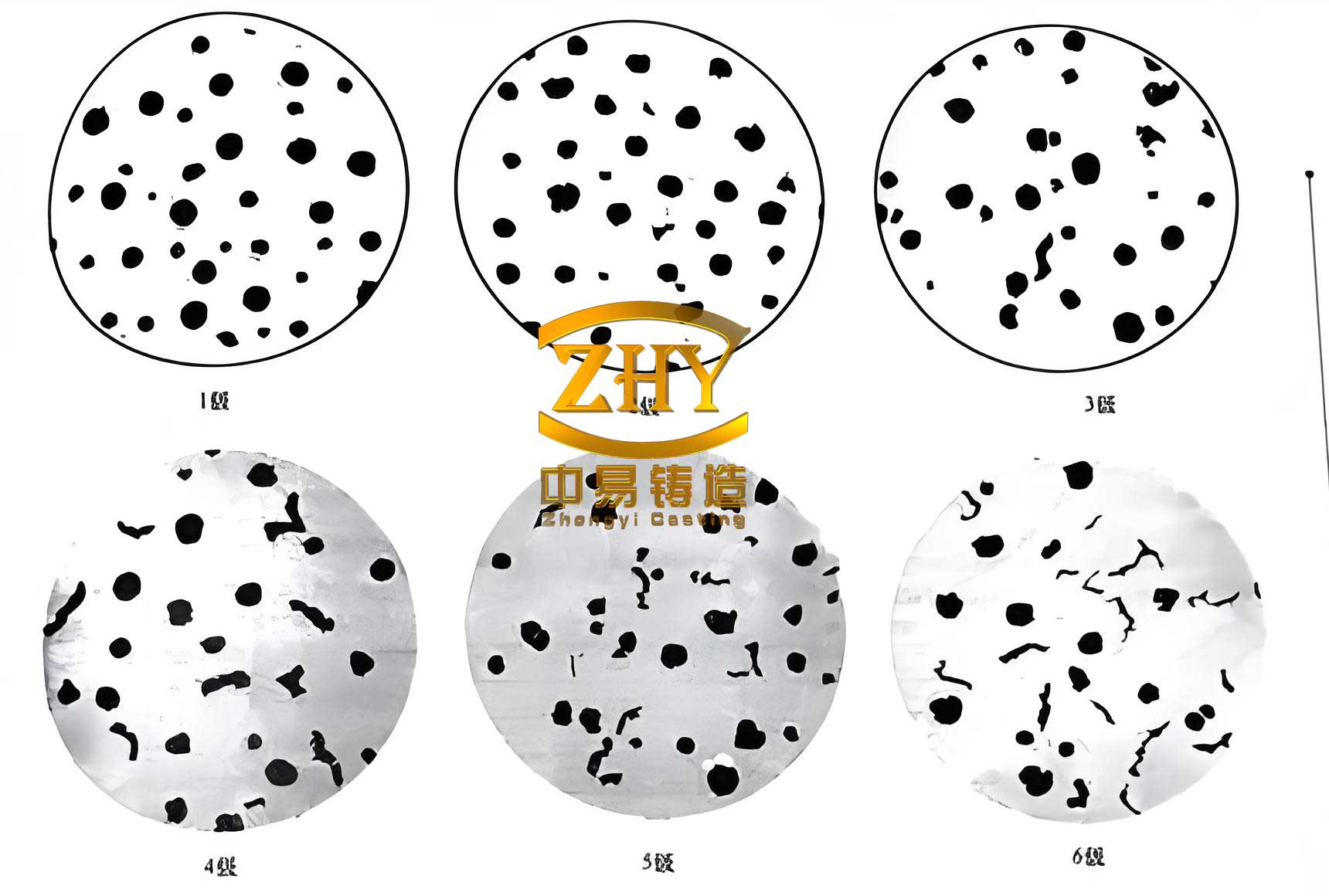
Before heat treatment, the microstructure of the as-cast spheroidal graphite cast iron was examined. Figure 1 shows the optical micrograph of an unetched specimen, revealing numerous spherical graphite nodules uniformly distributed in the matrix. The graphite nodule size is generally below 30 μm, and the distribution is relatively homogeneous. According to the ASTM A247 standard, the graphite nodularity is rated above grade 2, and the nodule size distribution is above grade 6, indicating good spheroidization. Quantitative image analysis using Zeiss microscope software indicates that the graphite volume fraction is approximately 10%.
Upon etching, the matrix microstructure becomes visible. Figure 2 presents the optical and scanning electron micrographs of the etched as-cast specimen. The matrix consists of pearlite, ferrite, and graphite nodules. The ferrite appears as white regions surrounding the graphite nodules, often referred to as “bull’s-eye” ferrite, while the gray areas are pearlite. The pearlite exhibits a lamellar structure of alternating ferrite and cementite phases with varying interlamellar spacing. Quantitative analysis suggests that the matrix comprises about 26% ferrite and 74% pearlite. This microstructure is typical of as-cast spheroidal graphite cast iron with the given composition and cooling conditions.
Assuming all alloying elements are dissolved in the matrix, the chemical composition of the matrix can be estimated by accounting for the carbon tied up in graphite. Based on the graphite content of 10%, the matrix composition is calculated and presented in Table 3. This matrix composition is relevant for understanding the phase transformations during heat treatment, as it determines the austenite stability and transformation kinetics.
| C | Si | Mn | P | S | Cu | Mg | RE | Fe |
|---|---|---|---|---|---|---|---|---|
| 0.55 | 2.72 | 0.32 | 0.018 | 0.018 | 0.78 | 0.046 | 0.029 | Bal. |
Effect of Quenching Temperature on Microstructure After Q&P Treatment
The microstructure of spheroidal graphite cast iron after Q&P treatment was investigated using XRD and microscopy. Figure 3 shows the XRD patterns of specimens quenched at different temperatures (from 100°C to 260°C) and partitioned at 300°C for 30 minutes. All patterns exhibit diffraction peaks corresponding to body-centered cubic (bcc) martensite (α’) and face-centered cubic (fcc) retained austenite (γ). The martensite peaks are identified as (110), (200), and (211), while the austenite peaks are (111), (200), and (220). The intensity of the austenite peaks varies with quenching temperature, indicating changes in the retained austenite volume fraction.
The volume fraction of retained austenite, Vγ, was calculated using the direct comparison method with the following formula:
$$V_{\gamma} = \frac{1}{1 + \frac{I_{\alpha} \cdot K_{\gamma}}{I_{\gamma} \cdot K_{\alpha}}} \times 100\%$$
where Iα and Iγ are the integrated intensities of the martensite and austenite diffraction peaks, respectively, and Kα and Kγ are the reflection coefficients for martensite and austenite, which depend on the specific crystal planes used. For this analysis, the (110) peak of martensite and the (111) peak of austenite were employed. The calculated retained austenite volume fractions as a function of quenching temperature are plotted in Figure 4.
The results demonstrate that the retained austenite content does not vary monotonically with quenching temperature. Instead, it initially increases, reaches a maximum at a quenching temperature of 200°C, and then decreases. At 200°C, the retained austenite volume fraction is approximately 27.1%. This trend can be explained by the interplay between the initial martensite fraction and the carbon partitioning efficiency. At lower quenching temperatures, a higher fraction of initial martensite is formed during the quenching step. During partitioning, carbon diffuses from this martensite into the untransformed austenite, enriching it with carbon and stabilizing it against transformation upon final cooling. However, because the amount of untransformed austenite is relatively small at low quenching temperatures, the total volume of stabilized retained austenite remains limited. Conversely, at higher quenching temperatures, the initial martensite fraction is lower, while the untransformed austenite fraction is higher. During partitioning, the limited amount of carbon from the small martensite fraction is insufficient to fully stabilize the larger austenite volume, leading to partial transformation of austenite to martensite during final cooling, thereby reducing the final retained austenite content. Thus, an optimal quenching temperature exists that balances the initial martensite and austenite fractions to maximize carbon partitioning efficiency and retained austenite stability.
Furthermore, the XRD patterns reveal shifts in the austenite peak positions, indicating changes in the lattice parameter and, consequently, the carbon content in the retained austenite. The carbon content in retained austenite, Cγ, can be estimated from the lattice parameter, aγ, using empirical relationships. Two common formulas are:
$$C_{\gamma} = \frac{a_{\gamma} – 3.547}{0.0467}$$
and
$$C_{\gamma} = \frac{a_{\gamma} – 3.578 – 0.00095Mn_{\gamma} – 0.002Ni_{\gamma} – 0.0006Cr_{\gamma} – 0.0031Mo_{\gamma} – 0.0018V_{\gamma}}{0.033}$$
where aγ is in angstroms, and the alloying element contents are in weight percent. Given the alloy composition of the spheroidal graphite cast iron, the second formula, which accounts for alloying effects, was used. The calculated carbon content in retained austenite as a function of quenching temperature is shown in Figure 5. Interestingly, the carbon content exhibits an opposite trend to the retained austenite volume fraction. It decreases initially, reaches a minimum in the quenching temperature range of 180–220°C, and then increases at both lower and higher quenching temperatures. This behavior can be attributed to the partitioning kinetics and the possible formation of bainite during the partitioning stage. At lower quenching temperatures, the high initial martensite fraction provides a abundant carbon source, leading to significant carbon enrichment in the small amount of austenite, resulting in high carbon content. At higher quenching temperatures, the initial martensite fraction is low, but the partitioning process may involve bainite transformation. During isothermal holding at 300°C, some austenite may decompose into bainite, which has lower carbon content than martensite, and carbon from bainite may diffuse into the surrounding austenite. However, the overall carbon influx into austenite might be limited due to the lower carbon content of bainite, leading to a moderate carbon content. The minimum in carbon content around 200°C coincides with the maximum retained austenite volume, suggesting that efficient carbon partitioning occurs without excessive enrichment, possibly due to a balance between carbon supply from martensite and bainite and the austenite volume.
Optical micrographs of Q&P treated spheroidal graphite cast iron at different quenching temperatures are presented in Figure 6. The microstructure consists of martensite (dark needles) and retained austenite (light regions). As the quenching temperature increases, the martensite lath size appears to increase, and the grain boundaries become more distinct. This is because at higher quenching temperatures, the initial austenite grain size may be larger due to reduced undercooling, and the lower martensite fraction allows for less constrained growth of martensite laths. Additionally, the amount of retained austenite visibly changes, corroborating the XRD results. At 200°C, more retained austenite is observed, while at extreme temperatures, the retained austenite content is lower. It is noted that bainite may also be present, but it is difficult to distinguish from martensite in optical micrographs due to their similar acicular morphologies.
Effect of Quenching Temperature on Hardness
The mechanical property evaluated in this study is hardness, which is indicative of strength and wear resistance. Figure 7 plots the Rockwell hardness (HRC) of spheroidal graphite cast iron as a function of quenching temperature for two partitioning conditions: 0 minutes (i.e., quenched only) and 30 minutes partitioning at 300°C.
For specimens with no partitioning (0 minutes), the hardness generally decreases with increasing quenching temperature, though the decrease is gradual. This trend can be explained by the changing martensite fraction. At lower quenching temperatures, a higher fraction of martensite is formed, which is hard and contributes to high hardness. As the quenching temperature increases, the martensite fraction decreases, leading to a reduction in hardness. However, even at higher quenching temperatures, the formation of some martensite and possibly auto-tempering effects maintain a relatively high hardness level.
For specimens with 30 minutes partitioning, the hardness is consistently lower than that of the non-partitioned specimens at corresponding quenching temperatures. This is because the partitioning process allows carbon diffusion from martensite, resulting in tempered martensite with lower hardness, and the presence of retained austenite, which is softer than martensite. The hardness versus quenching temperature curve for partitioned specimens shows an initial decrease, then plateaus with slight fluctuations. At low quenching temperatures (e.g., 100°C), the hardness is relatively high due to the high initial martensite fraction. After partitioning, although some carbon diffuses out, the martensite remains relatively carbon-rich and hard, and the retained austenite fraction is low, so the overall hardness remains elevated. As the quenching temperature increases, the martensite fraction decreases, and carbon partitioning leads to greater softening of martensite and a higher retained austenite fraction, both contributing to reduced hardness. The plateau region corresponds to quenching temperatures where the retained austenite content is maximized and the microstructure stabilizes, resulting in a more consistent hardness value.
The relationship between hardness and microstructure can be further quantified. The hardness of a multiphase material like Q&P treated spheroidal graphite cast iron can be approximated using a rule of mixtures:
$$H = f_{\alpha’} H_{\alpha’} + f_{\gamma} H_{\gamma} + f_{b} H_{b}$$
where H is the overall hardness, fα’, fγ, and fb are the volume fractions of martensite, retained austenite, and bainite, respectively, and Hα’, Hγ, and Hb are their respective hardness values. Although bainite is not explicitly quantified in this study, its potential presence is considered. The decrease in hardness with increasing quenching temperature for partitioned specimens is primarily due to the increase in fγ and decrease in fα’, as Hγ is typically lower than Hα’. The non-monotonic variation in retained austenite content and carbon content also influences the hardness through changes in the hardness of individual phases. For instance, higher carbon content in retained austenite can slightly increase its hardness, but the effect is secondary compared to the phase fraction changes.
Discussion
The results highlight the significant influence of quenching temperature on the microstructure and hardness of spheroidal graphite cast iron processed by the Q&P route. The non-monotonic variation in retained austenite content with quenching temperature aligns with theoretical expectations based on carbon partitioning kinetics. The optimal quenching temperature of 200°C for maximizing retained austenite is consistent with the concept of balancing initial martensite and austenite fractions to achieve efficient carbon enrichment without destabilizing the austenite.
The inverse relationship between retained austenite volume fraction and its carbon content is intriguing. This phenomenon can be understood by considering the carbon mass balance during partitioning. The total carbon available for partitioning comes from the initial martensite. If Vα’,0 is the initial martensite volume fraction and Cα’,0 is its average carbon content, the total carbon mass from martensite is proportional to Vα’,0 × Cα’,0. This carbon diffuses into the untransformed austenite of volume fraction Vγ,0 (initial austenite fraction). Assuming complete partitioning and no other carbon sinks, the carbon content in retained austenite after partitioning, Cγ, can be estimated as:
$$C_{\gamma} \approx \frac{V_{\alpha’,0} \cdot C_{\alpha’,0}}{V_{\gamma,0}} + C_{\gamma,0}$$
where Cγ,0 is the initial carbon content in austenite before partitioning. Since Vα’,0 + Vγ,0 = 1 (ignoring other phases), and Vα’,0 decreases with increasing quenching temperature, the ratio Vα’,0/Vγ,0 decreases. Therefore, if Cα’,0 is constant, Cγ would decrease with increasing quenching temperature. However, in reality, Cα’,0 may vary because the martensite formed at different quenching temperatures has different carbon concentrations due to variations in austenite carbon content before quenching. Moreover, bainite formation during partitioning complicates the carbon redistribution. The observed minimum in Cγ around 180–220°C suggests that in this range, the carbon partitioning is most effective in terms of distributing carbon without causing extreme enrichment, possibly due to concurrent bainite transformation that acts as an additional carbon source or sink.
The hardness behavior further underscores the trade-offs in the Q&P process. While partitioning reduces hardness compared to direct quenching, it potentially improves toughness and ductility due to the presence of retained austenite. The decrease in hardness with increasing quenching temperature for partitioned specimens is desirable if the goal is to achieve a better combination of strength and ductility. However, for applications requiring high wear resistance, a higher hardness might be preferred, which could be achieved by lower quenching temperatures or shorter partitioning times. Thus, the Q&P process offers flexibility in tailoring the properties of spheroidal graphite cast iron by adjusting parameters such as quenching temperature and partitioning time.
Comparing with previous studies on Q&P of steels, the behavior of spheroidal graphite cast iron shows similarities but also distinct differences due to its higher carbon content and graphite nodules. The graphite nodules themselves do not transform during heat treatment but can influence stress distribution and crack propagation. The matrix transformations, however, follow similar principles. The presence of silicon in spheroidal graphite cast iron is beneficial for suppressing cementite formation during partitioning, promoting carbon partitioning into austenite. This study confirms that the Q&P process can be successfully applied to spheroidal graphite cast iron, yielding a multiphase microstructure with adjustable phase fractions.
Conclusions
In this investigation, I examined the effects of quenching temperature on the microstructure and hardness of spheroidal graphite cast iron subjected to the quenching and partitioning (Q&P) heat treatment. The following conclusions can be drawn:
-
All Q&P treated specimens, regardless of quenching temperature, contained martensite and retained austenite. The volume fraction of retained austenite varied non-monotonically with quenching temperature, initially increasing, reaching a maximum at 200°C, and then decreasing. At the optimal quenching temperature of 200°C, the retained austenite content was approximately 27.1%.
-
The carbon content in retained austenite exhibited an opposite trend to the retained austenite volume fraction. It decreased with increasing quenching temperature, attaining a minimum in the range of 180–220°C, and increased at both lower and higher quenching temperatures. This behavior is attributed to the carbon partitioning kinetics and possible bainite formation during the partitioning stage.
-
Microstructural observations revealed that the matrix consisted of martensite and retained austenite, with the martensite lath size increasing and grain boundaries becoming more distinct as the quenching temperature increased. The amount of retained austenite visually correlated with the XRD measurements.
-
Hardness tests demonstrated that specimens without partitioning (0 minutes) had higher hardness than those with 30 minutes partitioning at all quenching temperatures. For non-partitioned specimens, hardness gradually decreased with increasing quenching temperature due to the reduction in martensite fraction. For partitioned specimens, hardness initially decreased with increasing quenching temperature and then plateaued, reflecting the combined effects of martensite softening, retained austenite increase, and microstructural stabilization.
These findings underscore the importance of quenching temperature in the Q&P processing of spheroidal graphite cast iron. By selecting an appropriate quenching temperature, it is possible to manipulate the microstructure to achieve a desired balance of hardness and potentially improved toughness. Future work could explore the impact of partitioning time and temperature more extensively, as well as evaluate other mechanical properties such as tensile strength, impact toughness, and wear resistance to fully harness the potential of the Q&P process for enhancing the performance of spheroidal graphite cast iron in engineering applications.