
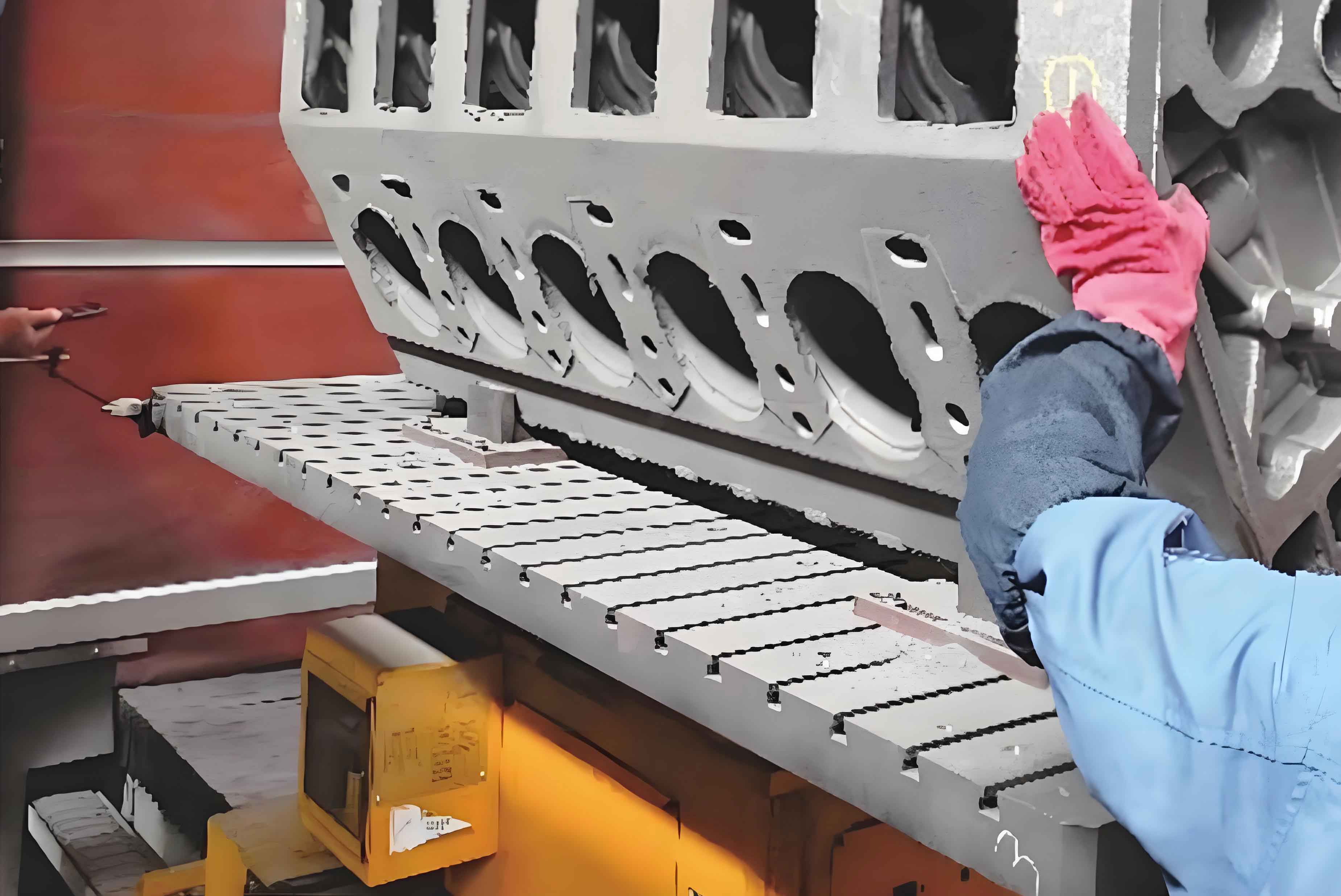
In the development of modern automotive engines, the engine cylinder block serves as the structural backbone, supporting critical components and ensuring operational integrity. During a recent project, our team encountered recurring failures in the mounting bosses of the engine cylinder block, specifically崩裂失效 (catastrophic fracture) under extreme driving conditions. This article details our systematic approach to diagnosing the root cause, validating hypotheses through finite element analysis (FEA), and implementing structural optimizations to enhance robustness.
1. Failure Mechanism Investigation
The engine cylinder block mounting boss exhibited fractures under dynamic loads, particularly during rapid acceleration/deceleration and collision scenarios. Initial observations revealed:
- Fracture Origin: Cracks initiated at the upper thread region of the mounting boss (Figure 1, original document).
- Propagation Pattern: Fracture propagated upward, characterized by rough, rapid-failure morphology.
- Bolt Failure: The suspension bolt fractured at a 45° angle, with shear dimples observed via SEM (Figure 4).
Material Analysis:
- Metallurgical Testing: The cylinder block material (HT250 gray cast iron) showed 98% pearlite, <1% carbides, and graphite morphology (Type A/B, Level 4). Hardness and microstructure complied with HT250 specifications.
- Stress Localization: Despite nominal material compliance, stress concentrations at the boss-root fillet exceeded safe thresholds under transient loads.
2. Finite Element Analysis (FEA) for Stress Evaluation
Using ABAQUS, we modeled the engine cylinder block assembly, including the block, oil pan, suspension mount, and bolts. The model employed second-order tetrahedral elements for accuracy. Boundary conditions replicated real-world constraints:
- Fixed Surfaces: Upper block face immobilized.
- Load Application: Forces applied at the suspension center point (Table 1).
Table 1: Material Properties for FEA
| Component | Material | Density (kg/m³) | Elastic Modulus (MPa) | Poisson’s Ratio |
|---|---|---|---|---|
| Suspension Mount | Steel | 7,800 | 208,000 | 0.30 |
| Cylinder Block | HT250 | 7,280 | 138,000 | 0.27 |
| Oil Pan | ADC12 | 2,700 | 70,000 | 0.33 |
| Bolt | Steel | 7,800 | 208,000 | 0.30 |
Critical Load Cases:
Six extreme工况 (load cases) were evaluated (Table 2). The worst-case scenario occurred during frontal collision (11g acceleration), generating peak stresses of 230 MPa at the boss-root fillet—near HT250’s ultimate tensile strength (UTS: 250 MPa).
Table 2: Load Cases and Force Components
| Load Case | Fx (N) | Fy (N) | Fz (N) |
|---|---|---|---|
| Frontal Collision | -5,384.36 | 42.87 | -904.84 |
| Rear Collision | 4,795.64 | -54.91 | -632.60 |
| Vertical Upward (Pothole) | -41.02 | -22.70 | 2,881.49 |
| Vertical Downward | -0.68 | 15.25 | -4,336.98 |
| Vertical Upward + Lateral Left | -62.64 | -1,176.14 | 2,694.43 |
| Vertical Downward + Lateral Right | 14.80 | 1,183.15 | -4,146.54 |
Stress Distribution:
The von Mises stress field highlighted critical zones (Figure 7, original document). The boss-root fillet experienced maximum stress due to geometric discontinuities and bending moments from the suspension bolt.
3. Structural Optimization Strategy
To mitigate stress concentrations, we redesigned the engine cylinder block mounting boss with two key modifications:
- Reinforcement Ribs: Added at the boss periphery to redistribute loads.
- Fillet Radius Optimization: Increased fillet radius from 2 mm to 4 mm to reduce stress gradients.
Validation via FEA:
Post-optimization FEA demonstrated a 50% reduction in peak stress (230 MPa → 115 MPa). The reinforcement ribs effectively diverted stresses away from the fillet, while the enlarged radius minimized notch effects.
Table 3: Optimization Results
| Parameter | Original Design | Optimized Design | Improvement |
|---|---|---|---|
| Peak Stress (MPa) | 230 | 115 | 50% |
| Safety Factor | 1.09 | 2.17 | 99% |
Safety Factor Calculation:
Safety Factor (SF)=Peak StressUTS
For the optimized design:
SF=115 MPa250 MPa=2.17
4. Discussion and Implications
- Failure Root Cause: The engine cylinder block mounting boss failed due to inadequate geometric design, not material defects. Transient lateral forces induced bending stresses exceeding local strength.
- Optimization Efficacy: Reinforcement ribs and fillet adjustments reduced stress concentrations, aligning with HT250’s mechanical limits.
- Generalizability: This methodology applies to other engine cylinder block components prone to stress-related failures, such as crankshaft bearings or coolant passages.
5. Conclusion
By integrating fracture morphology analysis, material characterization, and FEA-driven design iterations, we successfully enhanced the engine cylinder block mounting boss’s durability. The optimized structure withstands extreme working condition with a safety factor >2, ensuring reliability across the product lifecycle. Future work will explore topology optimization and additive manufacturing to further reduce weight while maintaining strength.