
The lost foam casting process represents a significant advancement in foundry technology, particularly for the production of complex, large-scale components. Its principle of replacing a sacrificial foam pattern with molten metal offers unparalleled freedom in design, eliminating the need for traditional cores and complex mold assemblies. For large, hollow box-type castings, such as machine tool beds, gearboxes, or structural frames, this process promises substantial simplification of production steps, drastic reduction in pattern-making costs (especially for one-off or low-volume production), and a shortened overall manufacturing cycle. The economic and technical allure is undeniable. However, the practical application of the lost foam casting process for such demanding geometries is fraught with specific challenges that can compromise yield and quality. Defects like mold collapse (collapse or ‘塌箱’), mold wall movement/swelling (‘胀箱’), and misruns (‘浇不足’) are prevalent. Successfully harnessing the lost foam casting process for these large hollow structures requires not just a standard procedure, but a deeply engineered approach that addresses the unique physics of the situation.
The core challenge stems from the very nature of a large hollow cavity. During the lost foam casting process, the foam pattern vaporizes upon contact with the molten metal. The gases generated must be evacuated rapidly through the coating and the surrounding dry sand, which is compacted and held in place by a applied vacuum. In a solid casting, this vacuum acts uniformly. In a large hollow casting, the internal cavity creates a zone where vacuum application is indirect and often insufficient. This leads to a critical pressure differential: the external sand is under full vacuum, tightly compacted, while the sand within the internal cavity (‘sand core’ or sand胎) experiences lower effective vacuum, resulting in lower strength and permeability issues. This differential, coupled with the dynamic pressures of metal filling and foam degradation, sets the stage for failure.
The fundamental mechanics can be described by analyzing the forces at play. Let us consider a simplified model of the internal sand mass. For it to remain stable, the net force acting on it must be zero or downwards. The primary upward force is the buoyancy force ($F_b$) due to the molten metal, analogous to core lift in conventional casting. The resisting force is the shear strength of the sand ($\tau$) over its contact area with the external sand mold and the gravitational force of the sand mass itself.
$$ F_{net} = F_b – (F_{shear} + F_{weight}) $$
Where:
$$ F_b = V_{displaced} \cdot \rho_{metal} \cdot g $$
$$ F_{shear} = A_{contact} \cdot \tau $$
$$ F_{weight} = V_{sand} \cdot \rho_{sand} \cdot g $$
In the lost foam casting process, the shear strength $\tau$ is highly dependent on the effective vacuum pressure ($P_{vac}$) within the cavity and the compaction of the sand. If the internal vacuum is inadequate, $\tau$ drops precipitously. Simultaneously, the pressure from foam pyrolysis ($P_{gas}$) and the metallostatic pressure ($P_{metal} = \rho_{metal} \cdot g \cdot h$) add to the destabilizing forces. The condition for stability becomes:
$$ A_{contact} \cdot \tau(P_{vac, internal}) + V_{sand} \cdot \rho_{sand} \cdot g \geq V_{displaced} \cdot \rho_{metal} \cdot g + P_{gas} \cdot A_{projected} $$
This inequality clearly shows that to prevent collapse or floating of the internal sand, we must maximize the left side (sand strength) and minimize the right side (disruptive forces). The entire engineering effort in the lost foam casting process for hollow parts revolves around manipulating these variables.
Critical Defects and Their Root Causes in the Lost Foam Casting Process
A systematic understanding of the defects is the first step towards mitigation. The table below summarizes the primary defects, their manifestations, and the underlying physical causes specific to large hollow castings in the lost foam casting process.
| Defect | Manifestation | Primary Root Cause in Hollow Castings | Governing Factor |
|---|---|---|---|
| Mold Collapse (塌箱) | Partial or complete disintegration of the mold cavity, leading to a malformed or incomplete casting. | Severe pressure differential causing the weaker internal sand to be pushed outward. Insufficient gas evacuation leading to back-pressure that fluidizes the sand. | $P_{vac,external} – P_{vac,internal}$ is too high. $P_{gas} > \tau_{sand}$. |
| Mold Wall Movement / Swelling (胀箱) | Dimensional inaccuracy, thickening of sections, or general distortion of the casting geometry. | Excessive buoyancy and gas pressure force causing the internal sand mass to float upwards or the mold walls to deflect outwards. Inadequate weighting or restraint. | $F_b + P_{gas} \cdot A > F_{shear} + F_{weight} + F_{restraint}$. |
| Misrun / Cold Shut (浇不足) | Incomplete filling of the mold, leaving unfused sections, particularly in thin areas or far from the gates. | Premature loss of heat due to the massive foam pattern’s endothermic decomposition. Inadequate pouring temperature or rate. Gas back-pressure slowing metal front advancement. | $\frac{dQ_{metal}}{dt} < \frac{dQ_{foam \, vaporization}}{dt} + \frac{dQ_{heat \, loss}}{dt}$. |
| Carbon Defects | Shiny, lustrous carbon films or pockets on the casting surface. | Incomplete evacuation of pyrolysis gases (especially for polystyrene), which crack into carbon and deposit on the advancing metal front. Aggravated by low permeability in hollow sections. | Low $P_{vac}$, high $P_{gas}$, low sand permeability $\kappa$. |
Engineered Solutions for Robust Lost Foam Casting of Hollow Structures
Addressing the challenges of the lost foam casting process for large hollow components requires a multi-faceted strategy targeting pattern integrity, gating, vacuum management, and mechanical stabilization.
1. Pattern Construction and Reinforcement
For one-off or large castings, patterns are typically hand-assembled from cut foam boards. A large, thin-walled hollow pattern has very low structural rigidity. It can easily deform under its own weight, during coating application, or during sand filling and vibration. The solution is an integrated support structure or internal skeleton. This skeleton, often made from lightweight metal or reinforced plastic, must be designed to:
- Provide dimensional stability from pattern assembly through to the moment of metal pour.
- Withstand the forces of sand compaction.
- Minimize its own volume to avoid creating internal solid masses in the final casting.
- Potentially serve as an additional conduit for vacuum or gas evacuation if designed as a permeable structure.
The presence of this skeleton is a critical, non-negotiable aspect of the lost foam casting process for such components.
2. Strategic Gating System Design
The gating system must fulfill three conflicting goals: rapid fill to prevent misruns, minimal thermal shock to the mold, and control of turbulence. For tall, hollow castings, a vertical or near-vertical orientation is often preferred to maximize metallostatic pressure and feeding. A stepped or staggered gating system attached to the external side walls is superior to internal gating for several reasons:
- External Vacuum Integrity: Placing gates inside the hollow cavity severely compromises the ability to draw a uniform vacuum within that cavity. External gating preserves the sealed envelope of the hollow section.
- Progressive Solidification: A multi-level side gate system allows the metal to fill from the bottom upwards in stages. This provides a continuous hot metal feed towards the top of the casting, aiding directional solidification and reducing shrinkage porosity.
- Reduced Internal Turbulence: Metal entering from the side creates a more controlled rising front compared to turbulent dumping from top gates inside the cavity.
The gating ratio (sprue:runner:gate) should be designed as a “choked” system at the gates to ensure rapid fill and minimize air entrapment. The filling velocity $v$ can be approximated by Bernoulli’s equation, adjusted for the resistance of the foam:
$$ v \approx \sqrt{2gH – \frac{2 \Delta P_{foam}}{\rho_{metal}}} $$
where $H$ is the effective sprue height and $\Delta P_{foam}$ is the pressure drop due to foam decomposition.
3. Advanced Vacuum Management and Pressure Control
This is the most critical technological intervention for hollow castings in the lost foam casting process. Standard vacuum applied only through the flask walls is insufficient for a large internal volume. The solution is the integration of active, internal vacuum ducts.
- Internal Vacuum Ducts: Perforated pipes or hoses (e.g., wire-reinforced rubber hose with small drilled holes, wrapped in a mesh screen) are strategically placed within the hollow cavity of the foam pattern before sand filling. These ducts are connected directly to the vacuum system, creating a dedicated evacuation path for pyrolysis gases from the core of the casting. This action directly increases $P_{vac,internal}$, reducing the destructive pressure differential and strengthening the internal sand. The required vacuum level ($P_{vac}$) is alloy-dependent. For cast iron, a typical operational range is -0.04 to -0.06 MPa. The holding time after pouring must be sufficient for the casting to solidify and gain enough strength, often 15-25 minutes for multi-ton components.
- Top Weighting (压铁): To counteract the immense buoyancy force ($F_b$) and gas pressure ($P_{gas}$) that cause swelling, significant weight must be applied to the top of the sand flask. This weight, often in the form of heavy plates or blocks, provides the necessary restraining force ($F_{restraint}$) in our stability equation. The required weight can be estimated as:
$$ W_{min} \approx (A_{top} \cdot \rho_{metal} \cdot g \cdot h_{metal}) \cdot SF $$
where $A_{top}$ is the projected area of the casting top, $h_{metal}$ is the metal height, and $SF$ is a safety factor (often 1.5-2.0) to account for dynamic pressures.
4. Optimized Process Parameters
Fine-tuning the thermal and temporal parameters is essential. The table below provides a guideline for key parameters in the lost foam casting process for large iron hollow castings.
| Parameter | Typical Range for Large Hollow Iron Castings | Rationale |
|---|---|---|
| Pouring Temperature | 1420°C – 1480°C | Must compensate for the significant endothermic heat of foam decomposition (~1000 J/g for EPS). Higher than in empty mold casting. |
| Pouring Rate | Fast, controlled (e.g., 2-3 min for 3-4 tons) | To maintain a steady, rising metal front that continuously vaporizes foam without allowing it to collapse prematurely. |
| Vacuum Level ($P_{vac}$) | -0.05 MPa ± 0.01 MPa | Sufficient to compact sand, evacuate gases, and improve metal fluidity without causing excessive penetration. |
| Vacuum Hold Time | Solidification time + 5-10 min | Must maintain mold integrity until the casting skin is thick enough to resist distortion. |
| Sand Grain Size & Type | AFS 40-55, rounded silica or zircon | Good flowability for compaction around complex patterns and high permeability for gas evacuation. |
Synthesis and Process Flow for Success
Implementing a successful lost foam casting process for a large hollow box casting is a sequence of deliberate, interconnected steps:
- Pattern Engineering: Fabricate the foam pattern with integrated internal reinforcement/skeleton. Apply a highly permeable refractory coating of controlled thickness.
- Mold Assembly: Position the pattern in the flask. Install the internal vacuum ducts within the hollow sections, ensuring they are connected to the external vacuum manifold. Set up the external stepped gating system.
- Sand Filling & Compaction: Fill the flask with dry, unbonded sand while applying vibration for uniform compaction, especially around the internal cavities. Ensure vacuum ducts are not clogged.
- Pre-Pour Setup: Seal the flask with plastic film. Apply heavy weights to the top surface. Connect all vacuum lines (flask walls and internal ducts) to the vacuum pump system.
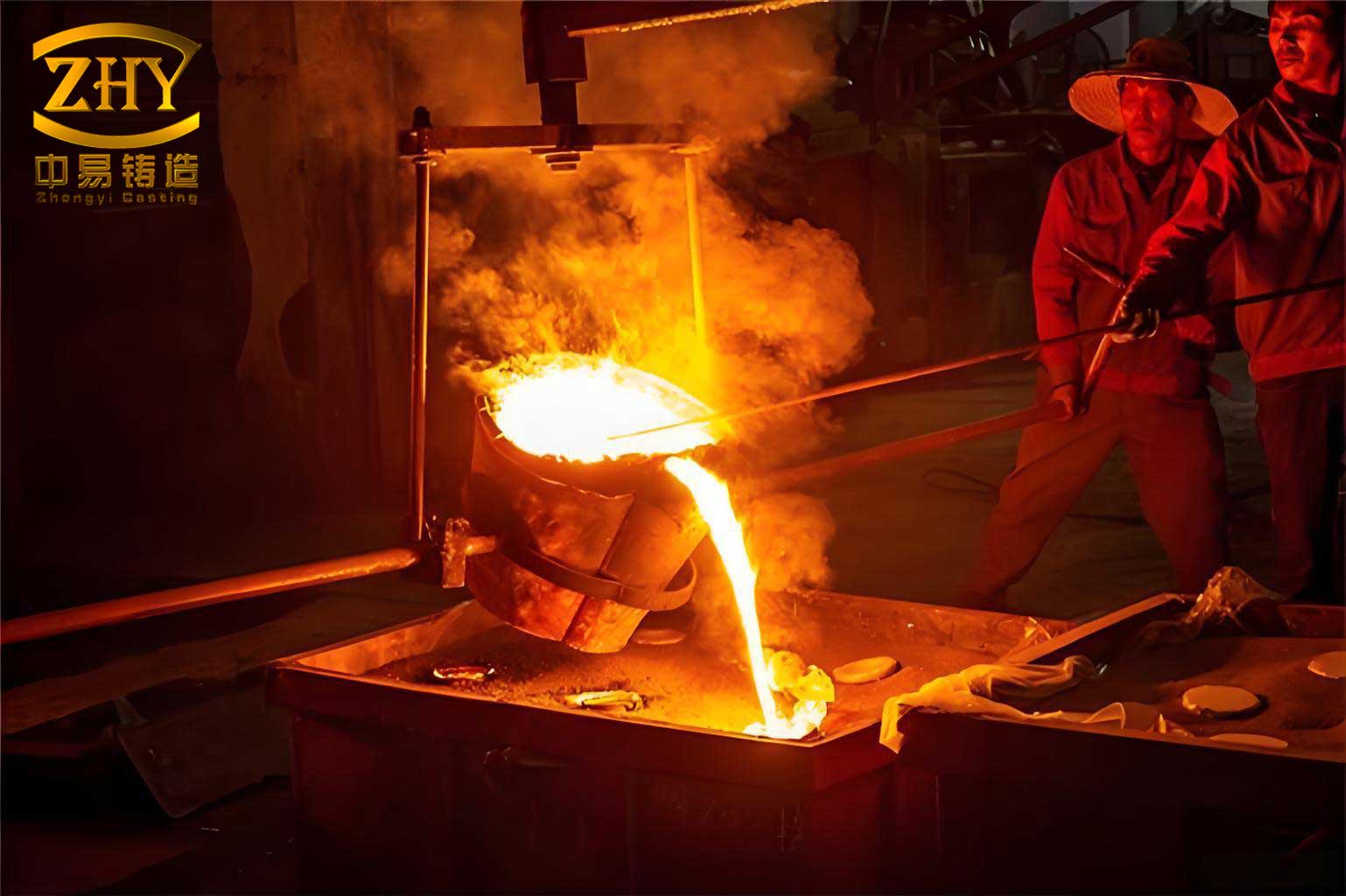
- Pouring: Start the vacuum pump to achieve the target negative pressure. Pour the metal at the prescribed high temperature and fast, steady rate. Maintain the vacuum throughout the pour.
- Solidification & Cooling: Hold the vacuum for the predetermined time to allow complete solidification. Release the vacuum and allow the casting to cool in the sand.
Conclusion and Future Perspectives
The production of large, hollow box-type castings via the lost foam casting process is a demanding yet highly rewarding endeavor. It transforms what would be a core-making and molding puzzle in conventional methods into a manageable, integrated process. The key to success lies in recognizing and actively managing the unique set of challenges—primarily the control of pressure differentials and sand stability within internal cavities. By employing a systematic approach that combines robust pattern support, strategically external gating, active internal vacuum assistance, and sufficient mechanical weighting, the prevalent defects of collapse, swelling, and misruns can be effectively mitigated.
Future advancements in the lost foam casting process for such applications will likely focus on smarter pattern materials with lower gas generation, advanced coating formulations with even higher gas permeability, and real-time process control. This could involve sensors embedded within the mold to monitor internal vacuum and gas pressure, allowing for dynamic adjustment of vacuum levels during pouring. Furthermore, computational modeling of the coupled phenomena—fluid flow, foam decomposition, heat transfer, and stress in the sand matrix—is becoming increasingly sophisticated, allowing for virtual prototyping and optimization of the entire lost foam casting process before any physical pattern is made. This digital twin approach will further enhance the reliability and expand the application envelope of this versatile casting technology for large, complex, and hollow geometries.