
In my extensive experience in automotive component manufacturing, I have observed that exhaust manifolds are critical components in internal combustion engines, subjected to extreme thermal and corrosive environments. For commercial vehicle engines, the material of choice is often spheroidal graphite cast iron, specifically silicon-molybdenum variants like QTRSi4Mo1. This spheroidal graphite cast iron offers a balance of high-temperature strength and castability, but it remains susceptible to oxidation under operating conditions. During engine hot-run tests, where exhaust gases reach temperatures around 700°C, the inner surfaces of these manifolds frequently develop red rust, primarily iron oxide (Fe₂O₃). This rust can detach and potentially damage turbocharger blades, leading to customer complaints and reliability issues. Therefore, addressing this oxidation problem is paramount for ensuring product quality and longevity.
The core issue stems from the inherent reactivity of iron in spheroidal graphite cast iron when exposed to high temperatures and oxidizing atmospheres. Traditional anti-corrosion methods, such as applying rust-preventive oils or paints, are inadequate in this context. These coatings degrade or are stripped away by the high-velocity, high-temperature exhaust flow during engine operation, leaving the bare spheroidal graphite cast iron surface vulnerable to rapid oxidation. The red rust formed is not adherent and flakes off easily, posing a contamination risk. My analysis confirmed that the rust was not present on as-cast parts stored with protective oil but appeared exclusively after engine testing, indicating that the thermal cycling and gas冲刷 during testing accelerated the oxidation process beyond the capabilities of standard protection.
To tackle this, I focused on developing a surface modification technique that could withstand the service environment. The proposed solution involves subjecting the spheroidal graphite cast iron exhaust manifold to a controlled high-temperature steam oxidation process. The objective is to grow a dense, adherent layer of magnetite (Fe₃O₄) on both the external and internal surfaces. Unlike the porous and non-protective red rust (Fe₂O₃), magnetite forms a continuous, chemically stable oxide film that significantly retards further oxidation. This “black oxide” or “steam blueing” process is known to enhance the corrosion resistance of ferrous alloys. The key is to precisely control the process parameters to achieve a uniform Fe₃O₄ layer of optimal thickness on the complex geometry of a spheroidal graphite cast iron manifold.
The chemical composition of the base spheroidal graphite cast iron material, QTRSi4Mo1, is crucial as it influences the oxidation kinetics and the nature of the oxide scale. The typical composition range is summarized below.
| Element | Content (wt.%) |
|---|---|
| C | 2.7 – 3.5 |
| Si | 4.0 – 4.5 |
| Mn | ≤ 0.3 |
| Mo | 1.0 – 1.5 |
| P | ≤ 0.05 |
| S | ≤ 0.015 |
| Mg | 0.01 – 0.05 |
The high silicon content in this spheroidal graphite cast iron promotes the formation of a silica-rich layer beneath the primary oxide, which can further improve oxidation resistance. The molybdenum addition enhances high-temperature strength. The oxidation process I developed involves several stages. First, the cast spheroidal graphite cast iron manifolds are thoroughly cleaned to remove any sand, oil, or contaminants. They are then loaded onto fixtures and placed into a dedicated steam oxidation furnace at room temperature. The thermal profile and atmosphere are carefully programmed.
The fundamental reaction for the desired magnetite formation from iron in a steam environment can be represented as:
$$ 3Fe + 4H_2O \ (g) \rightarrow Fe_3O_4 + 4H_2 \ (g) $$
This reaction is favored within a specific temperature and oxygen partial pressure window. To achieve a controlled growth, the process follows a multi-step curve. Initially, the furnace is heated to a temperature range of 300–420°C under a nitrogen atmosphere (flow rate 16–20 m³/h) to purge the system and pre-heat the spheroidal graphite cast iron components uniformly. After holding for 1.5 hours, the temperature is raised to the main oxidation range of 630–690°C. At this point, the nitrogen flow is stopped, and steam is introduced at a controlled rate of (5 ± 1) m³/h. The furnace pressure is maintained between 14.57 and 21.46 kPa. The components are held under these conditions for 2.5 hours to allow the growth of the Fe₃O₄ layer. Finally, the temperature is lowered to 530–610°C, the steam is shut off, and the furnace is opened to retrieve the treated spheroidal graphite cast iron parts.
The growth kinetics of the oxide layer can be described by models such as the parabolic rate law, which is common for diffusion-controlled high-temperature oxidation:
$$ x^2 = k_p \cdot t $$
where \( x \) is the oxide layer thickness, \( k_p \) is the parabolic rate constant (dependent on material and environment), and \( t \) is time. For spheroidal graphite cast iron under steam, the rate constant is influenced by the silicon and molybdenum content. Through iterative process optimization, I targeted an oxide layer thickness between 15 and 25 micrometers. This range provides an optimal balance between protection and the risk of spallation due to thermal stress. The treated surface exhibits a characteristic dark blue-black appearance, which is a visual indicator of the magnetite layer.
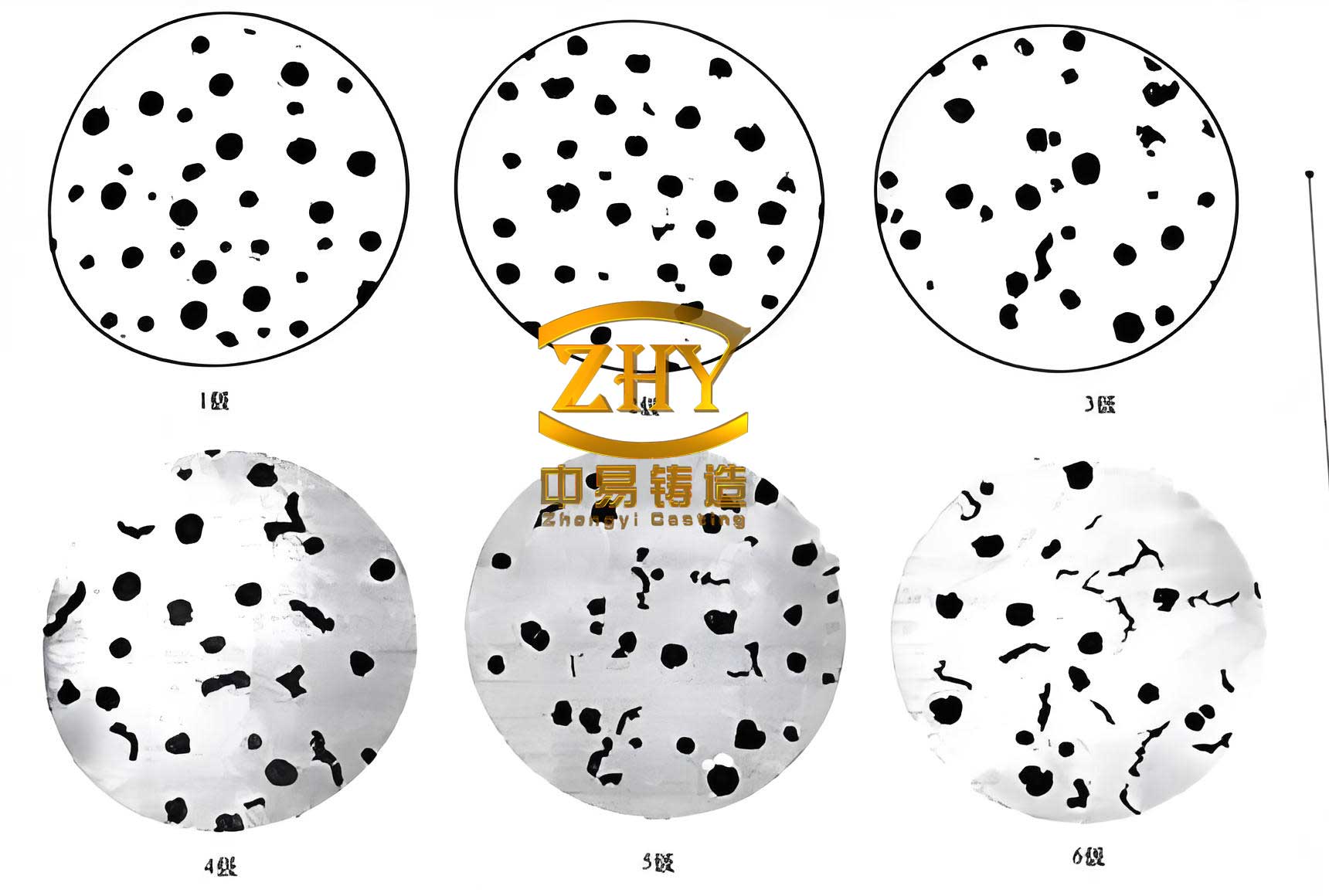
The effectiveness of this high-temperature steam oxidation treatment on spheroidal graphite cast iron was rigorously validated through comparative salt spray testing according to the standard GB/T 10125-2012 (equivalent to ISO 9227). Two sets of controlled experiments were conducted. The first set compared untreated spheroidal graphite cast iron manifolds with steam-oxidized ones. The second set compared steam-oxidized manifolds that underwent subsequent engine hot-run tests with those that did not, to assess the durability of the oxide layer under simulated service conditions.
For the first control group, samples were exposed to neutral salt spray for 2, 24, and 48 hours. The results were starkly different. Untreated spheroidal graphite cast iron surfaces began showing pinpoint red rust after just 2 hours. After 24 hours, widespread red rust coverage was observed, and after 48 hours, severe rusting occurred. In contrast, the steam-oxidized spheroidal graphite cast iron surfaces showed no rust at 2 hours, only minor pinpoint rust at 24 hours, and localized rust patches at 48 hours. This demonstrates a substantial improvement in short-term corrosion resistance due to the Fe₃O₄ layer.
The second control group aimed to evaluate if the engine testing process itself damaged the protective oxide on spheroidal graphite cast iron. Both steam-oxidized samples (with and without engine testing) were subjected to the same salt spray durations. The results, summarized in the table below, showed nearly identical rust progression patterns, confirming that the high-temperature exhaust gases during engine testing did not compromise the integrity of the steam-generated Fe₃O₄ layer on the spheroidal graphite cast iron.
| Sample Condition | Salt Spray 2h | Salt Spray 24h | Salt Spray 48h |
|---|---|---|---|
| Steam-oxidized (no engine test) | No rust | Pinpoint rust | Localized rust |
| Steam-oxidized (after engine test) | No rust | Pinpoint rust | Localized rust |
The protective mechanism of the magnetite layer on spheroidal graphite cast iron can be explained through its crystal structure and growth morphology. Fe₃O₄ has an inverse spinel structure that allows for relatively low diffusion rates of iron and oxygen ions compared to Fe₂O₃. The layer grown under steam is dense and adherent, acting as a diffusion barrier. The presence of silicon in the spheroidal graphite cast iron also plays a role. At high temperatures, silicon tends to oxidize internally, forming a sub-layer of SiO₂ or complex iron silicates at the oxide/metal interface. This sub-layer further impedes the diffusion of iron cations outward, thereby reducing the overall oxidation rate. The process can be described by a modified oxidation model considering the dual-layer structure:
$$ \frac{dx}{dt} = \frac{k}{x} \cdot \left(1 – \alpha \cdot \exp(-\beta \cdot x_{SiO_2})\right) $$
where \( k \) is a rate constant, \( \alpha \) and \( \beta \) are parameters related to the inhibiting effect of the silicon-rich layer of thickness \( x_{SiO_2} \). For the spheroidal graphite cast iron used, the high silicon content (4.0–4.5%) significantly contributes to this beneficial effect during steam oxidation.
Beyond corrosion resistance, the steam oxidation process offers additional benefits for spheroidal graphite cast iron exhaust manifolds. The Fe₃O₄ layer has a low coefficient of friction, which can improve the sealing performance at flange joints when coupled with gaskets. The consistent dark finish enhances aesthetic quality and allows for better visual inspection of surface defects. Most importantly, it eliminates the need for temporary rust preventives like oils, providing a long-term passive protection. I estimate that this treatment can extend the corrosion protection life of spheroidal graphite cast iron parts to 15 years or more in storage and service, far surpassing the few months offered by conventional oils.
Implementing this process on an industrial scale requires careful consideration of furnace design, fixture geometry to ensure steam access to internal passages, and energy efficiency. The process parameters—temperature, steam flow rate, pressure, and time—must be tightly controlled for different geometries and batches of spheroidal graphite cast iron to achieve the target 15–25 μm oxide thickness. Statistical process control charts can be used to monitor key variables. For instance, the relationship between steam partial pressure (\(P_{H_2O}\)), temperature (T), and oxide thickness (d) for our spheroidal graphite cast iron can be empirically modeled as:
$$ d = A \cdot \left( P_{H_2O} \right)^{0.3} \cdot \exp\left(-\frac{E_a}{R T}\right) \cdot t^{0.5} $$
where \( A \) is a pre-exponential factor, \( E_a \) is the apparent activation energy for the oxidation of this specific spheroidal graphite cast iron, \( R \) is the gas constant, and \( t \) is time. This allows for predictive control and optimization.
In conclusion, my research and implementation confirm that high-temperature steam oxidation is a highly effective and practical solution to the problem of inner surface rusting in spheroidal graphite cast iron exhaust manifolds. The process reliably generates a protective magnetite layer that significantly enhances the alloy’s oxidation resistance, as proven by accelerated corrosion tests. This layer remains intact even after exposure to actual engine hot-run conditions, solving the root cause of red rust formation and potential downstream damage. The adoption of this technique represents a significant advancement in the surface engineering of spheroidal graphite cast iron components for high-temperature applications, improving product reliability, longevity, and customer satisfaction. Future work could explore the synergistic effects of alloying elements like molybdenum on the steam oxidation kinetics of spheroidal graphite cast iron or develop combined treatments for even more demanding environments.