
In the rapidly advancing automotive industry, the demand for lightweight and high-performance components has driven significant research into material development. Among various materials, ductile iron casting offers a unique combination of strength, ductility, and cost-effectiveness, making it ideal for critical automotive parts. As a researcher focused on foundry metallurgy, I have been involved in projects aimed at improving the properties of as-cast high-strength ductile iron castings, specifically targeting materials like QT700-10. This grade requires a tensile strength exceeding 700 MPa and an elongation of at least 10%, which is challenging to achieve in the as-cast state without heat treatment. Through systematic adjustments in chemistry, processing, and inoculation techniques, we have successfully developed ductile iron castings that meet these stringent requirements. This article delves into the process technologies, microstructural evolution, and performance outcomes, emphasizing the role of innovative inoculants and optimized treatments. The keyword ‘ductile iron casting’ will be frequently referenced to highlight its centrality in this discussion, and we will incorporate tables and formulas to summarize key data and theoretical insights. Our goal is to provide a comprehensive guide for foundries seeking to produce high-integrity ductile iron castings for automotive applications.
The development process was structured into three phases, targeting progressively higher ductility while maintaining strength: QT900-5, QT700-8, and QT700-10. All test bars were sampled from castings with a wall thickness of 15 mm, representing the as-cast condition. Melting was conducted in medium-frequency induction furnaces, with green sand molding used for casting. The chemical compositions for each phase were carefully designed, as summarized in Table 1. For QT900-5 and QT700-8, pure steel scrap was used, whereas QT700-10 employed a blend of scrap steel and pig iron (Q10) in a 1:4 ratio, with alloying elements added separately. This approach allowed for better control over impurity levels and nucleation sites, which are critical for ductile iron casting quality.
| Test Bar | Grade | C | Si | Mn | P | S | Mg | Cu | Sn | Ni |
|---|---|---|---|---|---|---|---|---|---|---|
| #1 | QT900-5 | 3.58 | 2.51 | 0.21 | 0.02 | 0.01 | 0.039 | 0.72 | 0.01 | >1.0 |
| #2 | QT700-8 | 3.48 | 2.71 | 0.19 | 0.02 | 0.008 | 0.049 | 0.57 | 0.01 | 0.325 |
| #3 | QT700-10 | 3.49 | 2.80 | 0.25 | 0.02 | 0.007 | 0.043 | 0.53 | 0.01 | – |
The nodularizing and inoculation processes were pivotal in achieving the desired microstructure. We employed a three-stage treatment method: nodularizer was placed in the ladle, covered with inoculant, and then topped with 0.5% silicon steel chips. The ladle was preheated, and treatment was completed within 5 minutes of tapping, with the entire pouring cycle kept under 8 minutes to minimize fading effects. The nodularizers used were ZM-N6013 and ZM-N6003, both low-rare-earth, medium-magnesium alloys. For inoculation, specific inoculants were selected based on their functions: ZM-IPE for strength enhancement, ZM-IFE for improved nucleation uniformity, ZM-IFA for increasing graphite nodule count, and ZM-IFC for boosting elongation. Table 2 outlines the treatment parameters for each phase.
| Test Bar | Nodularizer Type | Nodularizer Addition (%) | In-Mold Inoculant Type | In-Mold Addition (%) | Stream Inoculant Type | Stream Addition (%) | Pouring Temperature (°C) | Pouring Time (min) |
|---|---|---|---|---|---|---|---|---|
| #1 | Mg5.5RE1.8 | 1.20 | ZM-IPE | 0.20 | ZM-IFA | 0.10 | 1380-1420 | ≤8 |
| #2 | ZM-N6013 | 1.05 | ZM-IFE | 0.20 | ZM-IFC | 0.10 | 1400-1440 | ≤8 |
| #3 | ZM-N6003 | 1.05 | ZM-IFE | 0.20 | ZM-IFC | 0.10 | – | ≤8 |
The mechanical properties and microstructural features of representative test bars are summarized in Table 3. For QT900-5 (#1), the ferrite volume fraction was below 5%, with tensile strength around 932 MPa but elongation fluctuating between 3% and 6%. QT700-8 (#2) showed improved ductility, with ferrite volume fraction of 15-30% and elongation exceeding 8%. Finally, QT700-10 (#3) achieved the target performance, with ferrite volume fraction of 30-45%, tensile strength over 700 MPa, and elongation above 10%. These results underscore the importance of microstructural control in ductile iron casting, where balancing ferrite and pearlite is key to achieving high strength and ductility simultaneously.
| Test Bar | Grade | Ferrite Volume Fraction (%) | Tensile Strength (MPa) | Elongation (%) | Brinell Hardness (HB) |
|---|---|---|---|---|---|
| #1 | QT900-5 | <5 | 932 | 5.0 | 334 |
| #2 | QT700-8 | 15-30 | 756 | 8.6 | 233 |
| #3 | QT700-10 | 30-45 | 722 | 10.2 | 251 |
To understand the microstructural evolution, we analyzed the ferrite distribution and pearlite morphology. In ductile iron casting, ferrite typically forms around graphite nodules, creating a “bull’s eye” structure that enhances ductility. For #3, the ferrite enveloped the graphite nodules completely, leading to a uniform distribution that contributed to the high elongation. The pearlite, which constitutes the matrix, also plays a crucial role. Pearlite is a lamellar mixture of ferrite and cementite, and its interlamellar spacing (λ) influences strength and toughness. We observed that in higher-ductility samples, the pearlite lamellae were more regular and finer, with spacings as low as 0.1-0.2 µm. This refinement can be described by the relationship between yield strength and interlamellar spacing:
$$ \sigma_y = \sigma_0 + k \lambda^{-1/2} $$
where σ_y is the yield strength, σ_0 is a friction stress, k is a constant, and λ is the interlamellar spacing. For ductile iron casting, reducing λ enhances strength without compromising ductility significantly, as seen in the QT700-10 grade. Additionally, the orientation of pearlite lamellae relative to the loading direction affects fracture behavior. When lamellae are aligned with the stress axis, micro-void coalescence leads to ductile fracture, whereas perpendicular alignment promotes cleavage failure. This explains the mixed fracture modes observed in our tests.
Microdefects, such as inclusions and slag particles, are inevitable in ductile iron casting and can severely impact performance stability. During inoculation, undissolved inoculant particles can act as nucleation sites or harmful defects, depending on their size and distribution. We compared two inoculants: a conventional silicon-barium type and our proprietary ZM-IFC. Differential scanning calorimetry (DSC) analysis revealed that ZM-IFC has a lower melting enthalpy and more uniform phase distribution, leading to faster dissolution and reduced slag tendency. The melting enthalpy (ΔH) values are:
$$ \Delta H_{\text{Si-Ba}} = 352.8 \, \text{J/g} $$
$$ \Delta H_{\text{ZM-IFC}} = 285.8 \, \text{J/g} $$
This translates to an energy saving of approximately 23.44% for ZM-IFC, making it more efficient and less prone to forming microslag. In production, using ZM-IFC as a stream inoculant significantly decreased defect rates and improved the consistency of ductile iron casting properties. For instance, in one batch, two test bars from the same melt showed different elongations (5.5% vs. 10.2%) due to slag location—edge-located slag caused brittle fracture, while internal slag had less impact. This highlights the need for careful inoculant selection in ductile iron casting processes.
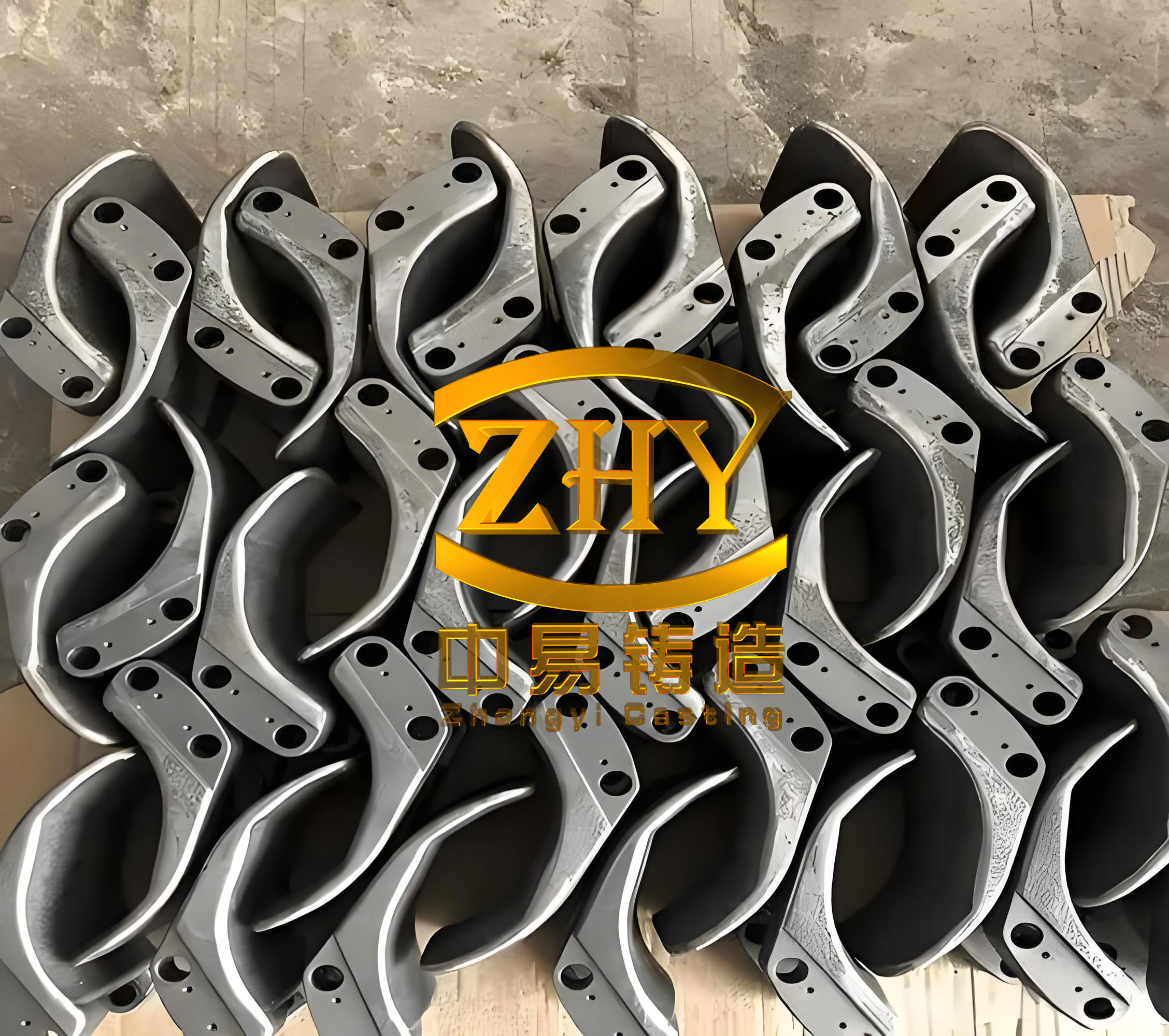
Intergranular precipitates, often rich in alloying elements like Ni, Cu, or Mo, can also affect ductility in ductile iron casting. Although these elements are added to enhance hardenability and strength, they may segregate at grain boundaries during solidification. We observed such precipitates in some samples, forming networks that could act as crack initiation sites. The volume fraction and dispersion of these precipitates are influenced by cooling rates and alloy content. To minimize their negative effect, we adjusted cooling conditions and used inoculants that promote homogeneous nucleation. The relationship between precipitate size (d_p) and ductility can be approximated by:
$$ \epsilon_f \propto \frac{1}{\sqrt{d_p}} $$
where ε_f is the fracture strain. By controlling solidification parameters, we achieved a more dispersed precipitate distribution, thereby preserving elongation in high-strength ductile iron casting.
Further analysis of the graphite morphology is essential for ductile iron casting performance. Graphite nodule count and roundness influence stress concentration and crack propagation. We used image analysis to quantify these parameters, finding that nodule counts exceeded 150 nodules/mm² for all grades, with roundness above 0.7. The nodule count (N) can be correlated with tensile strength through an empirical equation:
$$ \sigma_u = A + B \log(N) $$
where σ_u is the ultimate tensile strength, and A and B are material constants. For our ductile iron casting, higher nodule counts corresponded to better strength-ductility balance, as finer graphite disperses stress more effectively.
Cooling rate is another critical factor in ductile iron casting. Faster cooling promotes finer microstructures but may increase shrinkage defects. We optimized the molding sand properties and pouring temperatures to achieve a cooling rate of approximately 10-15 °C/s in the critical solidification range. The effect of cooling rate (Ṫ) on pearlite fraction (f_p) can be modeled as:
$$ f_p = 1 – \exp(-k \dot{T}^n) $$
where k and n are constants. By controlling Ṫ, we tailored the pearlite-to-ferrite ratio to meet specific grade requirements for ductile iron casting.
In summary, the development of high-strength, high-ductility ductile iron casting involves a multifaceted approach. Key lessons include the importance of inoculant design, precise chemistry control, and optimized cooling. Our work demonstrates that through systematic process refinement, ductile iron casting can achieve performance levels comparable to forged or heat-treated components, offering cost savings and sustainability benefits for the automotive sector. Future research could explore additive manufacturing techniques for ductile iron casting, further pushing the boundaries of lightweight design.
To conclude, the successful production of QT700-10 ductile iron casting hinges on understanding and manipulating microstructural features. Ferrite distribution, pearlite refinement, defect minimization, and precipitate control are all achievable through advanced inoculation and processing. As the demand for lightweight automotive parts grows, ductile iron casting will continue to play a pivotal role, and innovations in metallurgy will drive its evolution. We hope this article provides valuable insights for engineers and foundries working with ductile iron casting, emphasizing that continuous improvement in process technology is key to unlocking its full potential.