
High manganese steel casting represents a specialized class of wear-resistant steel, renowned for its exceptional combination of high strength, impact toughness, and superior wear resistance. The microstructure of high manganese steel casting after heat treatment is predominantly austenitic, which imparts excellent ductility and toughness. Under severe impact or heavy compression conditions, the surface of high manganese steel casting undergoes work hardening, leading to a significant increase in surface hardness and enhanced wear resistance. This unique property makes high manganese steel casting indispensable for manufacturing components subjected to intense impact and abrasive wear in various industrial applications.
With the trend toward equipment large-scale in sectors such as metallurgy, mining, and building materials,耐磨零件 like crusher parts and wear-resistant liners are evolving into thicker and larger configurations, often exceeding 100 mm in effective thickness. Traditional high manganese steel casting grades, such as ZGMn13, struggle to meet the technical and performance demands of these heavy-section applications. Thick-walled high manganese steel casting components are prone to defects like cracks and shrinkage porosity, and carbide precipitation in the core region can degrade their service performance. To address these challenges in producing large-scale components like crusher mantles and wear plates, comprehensive studies and process optimizations have been conducted, focusing on material re-alloying, molten steel refining, and adjustments in heat treatment protocols, yielding significant improvements in quality and performance.
The optimization of high manganese steel casting begins with the careful selection and control of chemical composition. According to the revised national standard GB/T5680-2010, high manganese steel casting is classified into ten grades, primarily differentiated by carbon content, which ranges from 0.7% to 1.35%, and manganese content, between 11% and 14%. For heavy-section components like large crusher mantles that endure substantial impact and wear, the ZG120Mn13Cr2 series is selected, with tailored chemical compositions to enhance performance.
Carbon and manganese are fundamental elements in high manganese steel casting. Carbon serves to strengthen the solid solution and promote the formation of a single-phase austenitic structure. However, increasing the carbon content enhances strength and hardness but reduces plasticity and impact toughness. Manganese stabilizes the austenite phase; higher manganese levels improve strength, ductility, and impact toughness but may hinder work hardening. For thick high manganese steel casting parts requiring a balance of strength, toughness, and wear resistance, the ratio of manganese to carbon is critical. The mass ratio w(Mn)/w(C) is maintained between 10 and 11, with carbon content controlled at 1.0% to 1.2% and manganese at 12% to 13%. Silicon, used for deoxidation and solid solution strengthening, is kept at a lower range of 0.3% to 0.5% to minimize adverse effects on impact toughness.
Phosphorus and sulfur are detrimental elements in high manganese steel casting, as they impair mechanical properties. Phosphorus, with low solubility in austenite, tends to form brittle phosphide eutectics, significantly reducing strength and ductility, increasing cracking susceptibility, and causing segregation in thick sections. Sulfur typically exists as spherical manganese sulfide inclusions, and elevated levels can negatively affect performance. For heavy high manganese steel casting, phosphorus is controlled below 0.05%, and sulfur below 0.03%.
Re-alloying with chromium and molybdenum enhances the strength, toughness, wear resistance, and work-hardening capability of high manganese steel casting. Chromium, a strong carbide-forming element, promotes stable (Fe, Cr)₃C carbides, increasing yield strength and initial hardness but potentially reducing plasticity and impact toughness. In high-impact abrasive conditions, chromium-alloyed high manganese steel casting exhibits improved work hardening and wear resistance. For thick sections, chromium content is optimized between 1.5% and 2.0%. To mitigate chromium’s effects, molybdenum is added, which increases yield strength without compromising impact toughness, delays carbide precipitation, reduces cracking tendencies during casting, welding, or cutting, and enhances hardening and wear performance. Given cost considerations, molybdenum is controlled within 0.3% to 0.7%.
Rare earth (RE) modification plays a crucial role in refining the properties of high manganese steel casting. RE elements grain refinement, enhance strength, surface hardness, plasticity, and work-hardening ability, thereby improving wear resistance. They also improve fluidity, reduce casting stress, and inhibit crack formation. By forming high-melting-point compounds with sulfur, oxygen, nitrogen, and hydrogen, RE elements purify the molten steel and suppress carbide growth, improving the castability of thick high manganese steel casting. Additionally, RE modifies the distribution of chromium, forming carbide nucleation sites and adsorbing at grain boundaries to prevent carbon accumulation. The combined effects of grain refinement, purification, and precipitation strengthening significantly boost the comprehensive mechanical properties, impact performance, and low-temperature impact toughness of high manganese steel casting, with wear resistance improvements being more pronounced under high-impact loads and hard abrasive conditions. RE addition is typically set at 0.2% to 0.3%.
| Element | C | Si | Mn | P | S | Cr | Mo | RE |
|---|---|---|---|---|---|---|---|---|
| Content (wt%) | 1.05–1.35 | 0.3–0.5 | 12–13 | ≤0.05 | ≤0.03 | 1.5–2.0 | 0.3–0.7 | 0.2–0.3 |
The chemical composition design for high manganese steel casting can be summarized by the relationship for optimal performance: $$ ext{Optimal Ratio} = \frac{w( ext{Mn})}{w( ext{C})} \approx 10 ext{ to } 11 $$ This ensures a balance between austenite stability and mechanical properties in heavy high manganese steel casting.
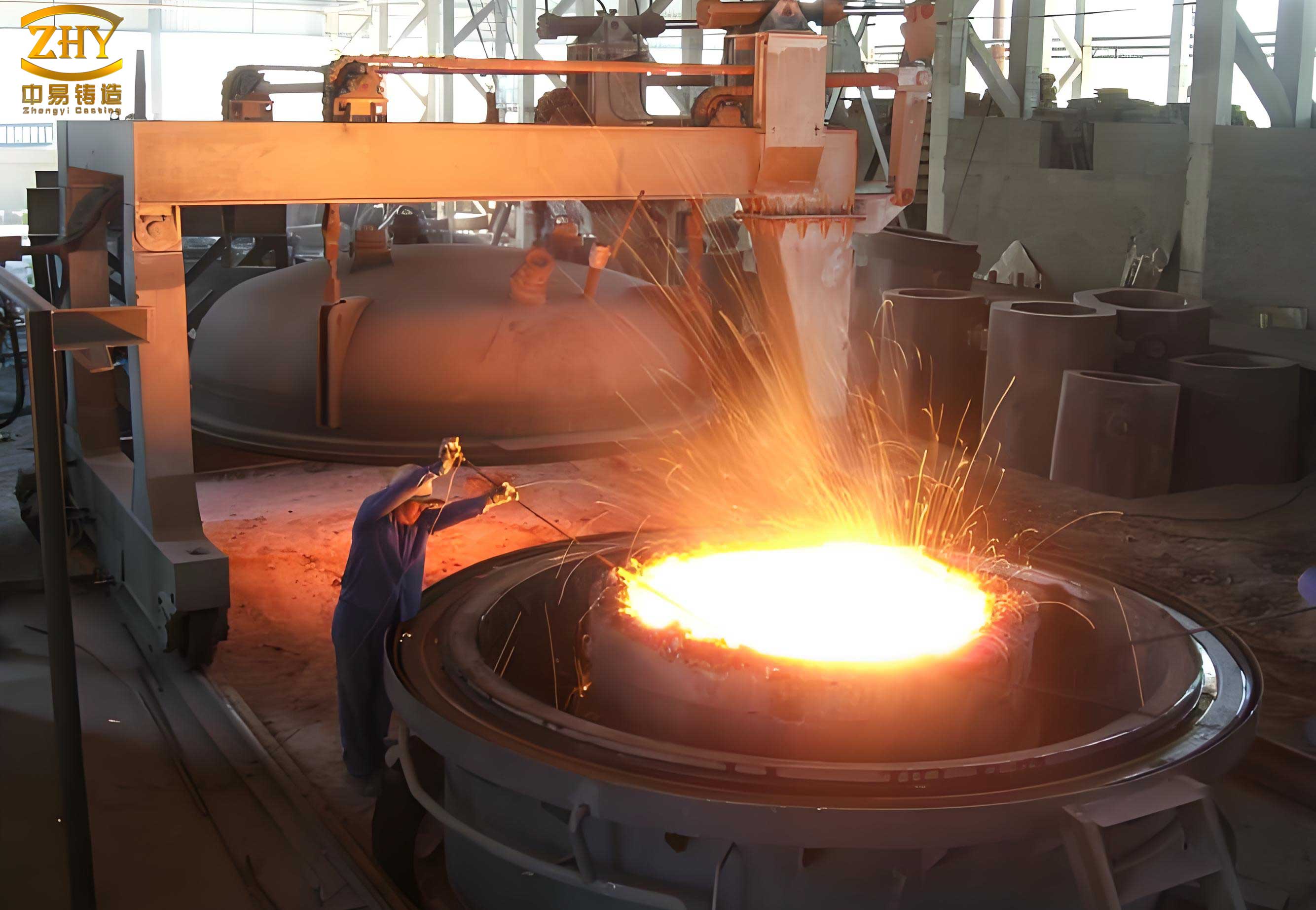
Molten steel refining is essential for achieving high-quality high manganese steel casting. Traditional melting methods, such as medium-frequency furnaces or electric arc furnaces, often result in low purity and difficulties in controlling harmful elements like sulfur, phosphorus, and oxygen. To enhance the metallurgical quality of thick high manganese steel casting components, refining processes like argon blowing are employed. Argon refining reduces oxygen, hydrogen, and inclusion content, yielding homogeneous, high-purity molten steel with low levels of detrimental elements. It also ensures uniform temperature distribution and improved fluidity, allowing for lower pouring temperatures that refine primary grains and enhance mechanical properties. In practice, using a 15 t electric furnace combined with a 25 t LF refining furnace for duplex production has shown significant benefits. For instance, manganese yield increased by 11.16%, and harmful elements were controlled at phosphorus below 0.04% and sulfur below 0.015%, reducing defect formation in high manganese steel casting.
The refining efficiency can be modeled using the equation: $$ ext{Refining Efficiency} = k \cdot \left( \frac{ ext{Ar Flow Rate}}{ ext{Molten Steel Volume}} \right) \cdot t $$ where \( k \) is a constant, and \( t \) is time. This highlights the importance of process parameters in high manganese steel casting production.
Casting process optimization is critical for defect-free high manganese steel casting. High manganese steel casting exhibits good fluidity but significant solidification and linear shrinkage, along with poor thermal conductivity, leading to hot tearing and shrinkage defects in thick sections. Numerical simulation tools, such as MAGMA software, are widely used to predict and prevent casting defects by optimizing工艺 parameters. Key measures for thick high manganese steel casting include enhancing the collapsibility of sand cores and molds to minimize restraint during contraction, reducing hot tearing tendency. The gating system is designed as open-type with multiple dispersed ingates introduced from thinner sections, ensuring rapid and平稳 filling to minimize temperature gradients and shrinkage defects. External chills are applied at hot spots, working in conjunction with risers to refine grain structure and eliminate shrinkage porosity and cavities.
For example, in the production of a large crusher mantle measuring 2738 mm × 2130 mm, weighing 20 t with a liquid weight of 27 t and wall thicknesses of 100–138 mm, initial simulations revealed significant shrinkage porosity and continuous shrinkage in central regions. After optimization, incorporating external chills and改进 gating systems, simulations showed nearly complete elimination of defects, aligning with actual casting inspections and ensuring high-quality high manganese steel casting.
The solidification time for thick high manganese steel casting can be estimated using Chvorinov’s rule: $$ t_s = k_v \cdot \left( \frac{V}{A} \right)^2 $$ where \( t_s \) is solidification time, \( k_v \) is a constant, \( V \) is volume, and \( A \) is surface area. This emphasizes the need for controlled cooling in high manganese steel casting processes.
Heat treatment is vital for achieving the desired microstructure and properties in high manganese steel casting. The as-cast structure consists of austenite and carbides, which embrittle the material. Water toughening (quenching) is employed to dissolve carbides and obtain a single-phase austenitic structure. For thick high manganese steel casting components, an additional tempering heat treatment is introduced to relieve stresses and improve impact toughness.
Key parameters in water toughening for high manganese steel casting include temperature, holding time, and cooling rate. Standard water toughening temperatures range from 1050°C to 1080°C, but for Cr- and Mo-alloyed high manganese steel casting, temperatures are increased by 30°C to 50°C to dissolve special carbides, resulting in an optimal range of 1080°C to 1100°C. Holding time is determined by section thickness, with a general rule of 1 hour per 25 mm of dominant wall thickness to ensure complete carbide dissolution and austenite homogenization. Cooling must be rapid; the casting should enter the water at no less than 1000°C within 1 minute of removal from the furnace, with quenching medium temperature maintained below 50°C to prevent carbide precipitation.
The water toughening process can be described by the kinetic equation for carbide dissolution: $$ ext{Dissolution Rate} = A \cdot \exp\left(-\frac{Q}{RT}\right) $$ where \( A \) is a pre-exponential factor, \( Q \) is activation energy, \( R \) is the gas constant, and \( T \) is temperature in Kelvin. This underscores the temperature sensitivity in high manganese steel casting heat treatment.
Tempering heat treatment follows water toughening, surface cleaning, and repair welding to relieve residual stresses and enhance performance. Since high manganese steel casting is susceptible to carbide precipitation and embrittlement in the 250°C to 800°C range, tempering is conducted at 250°C. Experiments demonstrate that low-temperature tempering increases impact energy by over 20% and eliminates casting stresses, significantly improving the performance and reducing crack susceptibility in thick high manganese steel casting.
| Material | Heat Treatment | Yield Strength (MPa) | Tensile Strength (MPa) | Elongation (%) | Impact Energy (J) | Hardness (HBW) |
|---|---|---|---|---|---|---|
| ZC-M (High Manganese Steel Casting) | Water Toughening | ≥390 | ≥735 | ≥20 | 88–145 | ≤300 |
| ZGMn13Cr2 (High Manganese Steel Casting) | Water Toughening + Tempering | 473 | 947 | 45 | 216 | 210 |
The improvement in impact toughness due to tempering can be expressed as: $$ \Delta K = K_{ ext{tempered}} – K_{ ext{as-quenched}} $$ where \( \Delta K \) represents the increase in impact energy, highlighting the benefit of post-quench treatments for high manganese steel casting.
In summary, the production of heavy-section high manganese steel casting components requires a holistic approach involving precise chemical composition control, advanced molten steel refining, optimized casting processes, and tailored heat treatments. Through re-alloying with chromium, molybdenum, and rare earth elements, argon refining, numerical simulation-based工艺 optimization, and controlled water toughening with tempering, significant enhancements in mechanical properties, defect reduction, and service performance have been achieved. These measures ensure that high manganese steel casting meets the rigorous demands of large-scale industrial applications, such as crusher mantles and wear-resistant liners, delivering reliable performance under extreme conditions. The continuous evolution of high manganese steel casting technologies promises further advancements in durability and efficiency for heavy-duty components.
The overall performance enhancement in high manganese steel casting can be quantified using a comprehensive performance index: $$ PI = \frac{ ext{Strength} \times ext{Toughness}}{ ext{Defect Density}} $$ where higher values indicate superior quality in high manganese steel casting applications. This integrative strategy underscores the importance of multidisciplinary optimizations in advancing high manganese steel casting for future challenges.