
Throughout my extensive research and industrial collaborations, the pursuit of improving the toughness and reliability of high-chromium white cast iron has been a central focus. This class of materials is renowned for its exceptional wear resistance, primarily due to the presence of hard M7C3-type eutectic carbides. However, its inherent brittleness, leading to premature fracture and failure in service, has historically limited its application spectrum. My work has been dedicated to developing and refining a series of novel processing techniques aimed at mitigating this limitation. The integrated approach involves sophisticated ladle treatment, precise control of casting processes, strategic selection of matrix microstructure, and the implementation of composite casting technologies. This article details these methodologies, presenting our findings and the significant enhancements achieved in the performance and application range of this vital wear-resistant material.
The fundamental challenge with high-chromium white cast iron lies in balancing its excellent abrasion resistance with adequate fracture toughness. The key factors influencing toughness are multifaceted. First, the morphology, size, and distribution of the carbides play a critical role. Isolated, spherical carbides are preferable to interconnected, coarse networks. Second, the metallurgical quality of the grain boundaries is paramount; the presence of embrittling inclusions such as sulfides and oxides severely compromises integrity. Third, casting defects like micro-shrinkage and gas porosity act as stress concentrators. Fourth, the refinement of the primary austenite grain size contributes to toughness. Finally, the composition and proportion of the matrix phases (austenite, martensite, bainite) govern the overall mechanical response under different stress states. Our strategy was to address each of these factors systematically.
1. Advanced Ladle Treatment with Comprehensive Modifiers
The initial and crucial step in refining the as-cast structure occurs during molten metal treatment. We conducted numerous trials with over 20 proprietary modifier formulations. The optimal modifiers were complex alloys containing both strong carbide-forming elements and graphitizing elements, coupled with components possessing potent deoxidizing and desulfurizing capabilities (denoted here as S-I and S-II types).
The base chemical composition range for our high-chromium white cast iron studies is shown in Table 1. While adjusting major elements within this range influences hardness, it does not drastically alter the fundamental carbide morphology.
| Element | C | Si | Mn | Cr | Mo | Cu | Ni | Ti | V |
|---|---|---|---|---|---|---|---|---|---|
| Content (wt.%) | 1.8-3.0 | 0.6-2.3 | 0.5-2.5 | 14-16 | <3.0 | 0.5-0.8 | 0.08-0.21 | 0.2-0.4 | <0.1 |
The effectiveness of modification was quantified using image analysis. We introduced the austenite nominal diameter ‘a’ and the carbide shape factor ‘P/A’ (Perimeter/Area). A lower ‘a’ indicates finer grains, and a lower ‘P/A’ indicates more compact, less interconnected carbides. The results, averaged over 15 fields of view, are compelling.
| Sample Condition | Austenite Area, A (mm²) | Austenite Nominal Diameter, a (mm) |
|---|---|---|
| Untreated | 3.512 | 0.1495 |
| Treated with Modifier S-I | 2.823 | 0.1349 |
$$ a = 2 \times \sqrt{\frac{A}{\pi}} $$
| Sample Condition | Carbide Perimeter, P (mm) | Carbide Area, A (mm²) | Shape Factor, P/A (mm⁻¹) |
|---|---|---|---|
| Untreated | 236.3 | 2.948 | 80.1 |
| Treated with Modifier S-I | 198.2 | 2.952 | 67.2 |
$$ \text{Shape Factor} = \frac{P_{\text{carbide}}}{A_{\text{carbide}}} $$
The data confirms that modification significantly refines the austenite grains and promotes a more favorable, less networked carbide morphology. Furthermore, the modifiers profoundly improve grain boundary cleanliness by reducing harmful impurity elements, as shown in Table 2.
| Modifier Type | Addition (%) | Final Sulfur (%) | Final Oxygen (ppm) |
|---|---|---|---|
| None (Untreated) | 0 | 0.065 | 84 |
| S-I | 0.8 | 0.023 | 32 |
The culmination of these microstructural improvements is a dramatic enhancement in mechanical properties, particularly toughness. The impact energy and low-energy multi-impact fatigue resistance are markedly increased, as demonstrated in Table 3.
| Modifier | Impact Toughness, ak (J/cm²) | Low-Energy Impacts (Counts)* | Hardness (HRC) |
|---|---|---|---|
| None | 5.3 – 6.3 | ~2,050 | 57 – 62 |
| Fe-Mg-B-C | 7.0 – 8.8 | ~3,250 | 54 – 58 |
| S-I | 10.6 – 13.2 | >3,500 | 52 – 56 |
* Number of impacts at 1.7 J impact energy until failure.
2. Critical Aspects of Casting Process and Quality Control
The casting process is arguably the most critical factor determining the final quality and performance of a white cast iron component. Our comparative studies, including analysis of imported grinding balls, revealed that the dominant cause for failure in domestic products was not chemical composition but casting defects. The primary deficiencies were micro-shrinkage porosity and grain boundary inclusions.
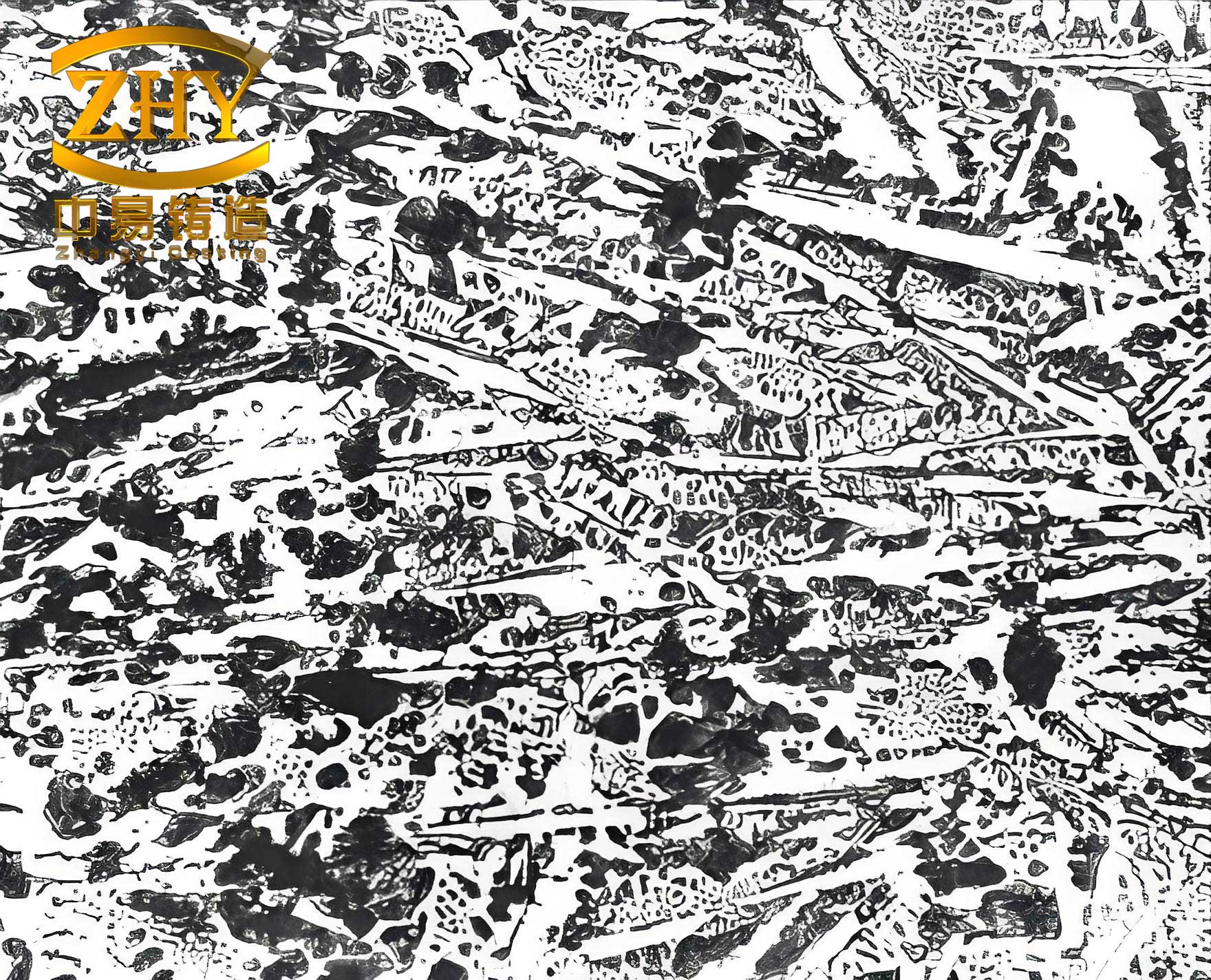
Processes that enhance cooling, minimize inclusions, and ensure adequate feeding are essential. The effect of different casting methods on the service performance of high-chromium white cast iron products is summarized in Table 4.
| Casting Method / Technique | Relative Service Life | Typical Failure Mode |
|---|---|---|
| Chill Casting (with external chills) | High (Baseline) | Uniform wear |
| Sand Casting (without chills) | 30-50% Lower | Severe localized wear, fracture |
| Metal Mold | High | Uniform wear, low breakage |
| Sand Mold | Low | High breakage, out-of-round |
| Gating with Filter | High | Improved integrity |
| Gating without Filter | Low | Inclusion-related failure |
| Use of Insulating Risers | High | Reduced shrinkage |
| No Insulating Risers | Low | Micro-porosity, shrinkage |
For example, grinding balls produced using metal molds with insulating risers exhibited minimal hardness gradient (within 2 HRC from surface to center) and virtually no detectable micro-porosity. In contrast, sand-cast balls often showed gradients exceeding 3 HRC and contained noticeable shrinkage and inclusions, directly correlating with higher breakage rates in service and lower counts in laboratory multi-impact tests. This underscores the non-negotiable requirement for foundries to implement rigorous process controls focused on rapid solidification and sound feeding to produce reliable high-chromium white cast iron parts.
3. Strategic Selection of Matrix Microstructure
A prevalent misconception is that a fully martensitic matrix with minimal retained austenite is universally optimal for all high-chromium white cast iron applications. Our research conclusively shows that the ideal matrix structure is dictated by the specific wear regime and stress state of the component.
We define two primary regimes:
- Low-Stress Abrasive Wear: Characterized by scratching or gouging with minimal impact (e.g., slurry pump liners, certain chute liners). In this regime, a hard, martensitic matrix provides the best support for the carbides, resulting in the highest wear resistance. The wear mechanism is primarily micro-cutting.
- High-Stress/Impact Abrasive Wear: Involves significant repetitive impact loads (e.g., grinding balls, crusher liners, hammer heads). Here, wear proceeds via a fatigue spalling mechanism. A purely martensitic matrix, while hard, is susceptible to crack initiation and propagation.
For high-stress conditions, a composite or multiphase matrix demonstrates superior performance. Specifically, a matrix consisting of martensite, bainite, and stabilized retained austenite offers an excellent combination of hardness and damage tolerance. The bainite provides good strength and toughness, while the surrounding austenite phase acts as a crack blunting medium. Even if cracks initiate at carbides, they are impeded by the surrounding bainite and austenite, preventing the rapid network linkage seen in a fully martensitic structure. This leads to superior impact fatigue resistance and lower material loss via spalling. Field trials on grinding balls have consistently shown that balls with this multiphase matrix outperform fully martensitic ones in terms of both wear rate and breakage rate in high-impact milling environments.
The relationship between wear volume (W) and material properties can be conceptually described for abrasive wear by a modified form of the Archard equation, though for brittle materials it is highly complex:
$$ W \propto \frac{P \cdot L}{H} \cdot f(\text{Toughness}, \text{Carbide Morphology}) $$
Where P is load, L is sliding distance, H is hardness, and the function *f* represents the mitigating effect of toughness and favorable carbide geometry, which is significantly amplified in impact-abrasion conditions.
4. Bimetallic Composite Casting Technology
To tackle applications demanding extreme wear resistance on a working surface coupled with exceptional overall toughness and impact strength, we developed and implemented a bimetallic composite casting process. This technology integrally bonds a wear-resistant high-chromium white cast iron section to a tough steel or ductile iron backing in a single casting operation.
The process typically involves pre-placing a chill or insert of the wear material in the mold and then pouring the backing material. Controlled interdiffusion at the interface creates a metallurgical bond. This approach synergistically combines the best properties of both materials: the white cast iron layer resists abrasion, while the steel backing absorbs impact energy, prevents catastrophic fracture, and facilitates easier mounting of large components.
This technology has been successfully scaled for massive components. Examples include:
- Large-diameter ball mill liners (e.g., Ø5m x 15.6m).
- Mining shovel teeth.
- Jaw crusher plates and cone crusher mantles/concaves.
- Various hammer heads and blow bars for impact crushers.
Field reports from numerous users indicate service life improvements of 4 to 8 times compared to traditional single-material solutions like Hadfield manganese steel, while providing much greater operational reliability and safety. This process represents a paradigm shift for manufacturing critical wear parts subjected to severe compound wear mechanisms.
5. Conclusion
The journey to enhance high-chromium white cast iron has revealed that no single silver bullet exists. Instead, a holistic, multi-faceted engineering approach is required. First, the implementation of comprehensive ladle treatment with sophisticated modifiers is fundamental to refining the as-cast microstructure, improving carbide morphology, and purifying grain boundaries, thereby unlocking higher inherent toughness. Second, meticulous control of the casting process—emphasizing rapid cooling, effective filtration, and adequate feeding—is critical to producing sound, defect-free castings, a factor where significant gains can still be made. Third, the matrix microstructure must be strategically engineered to match the service conditions; a multiphase matrix often outperforms a fully martensitic one in high-impact abrasive environments. Finally, for the most demanding applications, bimetallic composite casting provides an elegant solution by functionally grading the material properties within a single component. By integrating these novel processes, the performance envelope of high-chromium white cast iron can be dramatically expanded, enabling its reliable use in increasingly severe wear applications and contributing to greater efficiency and sustainability in mining, cement, power, and other heavy industries. The continuous evolution of these white cast iron technologies remains a vibrant and essential field of materials engineering.