
In my extensive experience working with abrasion-resistant materials, the quest for durability in harsh industrial environments is perpetual. High-chromium cast iron parts, such as grinding balls, liner plates, pump over-flow components, hammer heads, and furnace grates, are widely used due to their excellent wear resistance. However, their high hardness is often accompanied by relatively low toughness, leading to premature failure through cracking or spalling under impact. A significant and cost-effective pathway to extend the service life of these critical cast iron parts is to improve their impact toughness. The performance of these materials is influenced by a triad of factors: chemical composition, casting process parameters, and heat treatment regimens. Among these, modification treatment—particularly with rare earth (RE) elements—stands out as a remarkably convenient, low-cost, and effective method to refine microstructure and enhance mechanical properties.
China’s abundant rare earth resources have naturally led to the widespread adoption of RE-based modifiers in the production of high-chromium cast iron parts. The fundamental action of rare earths within the iron matrix is transformative. They promote the further isolation, fragmentation, and even spheroidization of the hard, brittle eutectic carbides (typically of the M7C3 type). This microstructural change is crucial because it reduces the continuous, skeletal network of carbides that severely割裂 (severely cuts through) the metallic matrix. By making the carbides more discrete and rounded, the stress-concentrating effect under impact loading is diminished. The matrix can then better absorb and distribute冲击 energy, acting as a buffer. Furthermore, RE elements are potent grain refiners. They segregate to grain boundaries, increasing boundary strength and pinning grain growth during solidification and heat treatment. A classic representation of this strengthening mechanism is the Hall-Petch relationship:
$$ \sigma_y = \sigma_0 + \frac{k_y}{\sqrt{d}} $$
where $\sigma_y$ is the yield strength, $\sigma_0$ is the friction stress, $k_y$ is the strengthening coefficient, and $d$ is the average grain diameter. By reducing $d$, rare earth modification directly contributes to higher yield strength and, consequently, improved toughness. An equally important function is the purification effect. RE elements have a strong affinity for elements like As, Bi, Pb, Sn, Sb, and others, which form low-melting-point phases at grain boundaries, inducing brittleness. Rare earths form stable, high-melting-point compounds with these impurities, effectively removing them from the grain boundaries and thereby enhancing the overall strength and toughness of the cast iron part. It is critical to note, however, that an excessive amount of RE can lead to the formation of brittle intermetallic phases at the grain boundaries, causing embrittlement—a classic case of “more is not always better.” While RE modification alone brings significant benefits, it often cannot completely alter the fundamental morphology and distribution of共晶 carbides. Therefore,复合变质 (composite modification), which combines RE with other micro-alloying elements like Ti, V, B, Nb, or Al, has been shown to yield a more substantial synergistic improvement in both toughness and hardness. For producers of specific high-chromium cast iron parts, finding the optimal复合 formula for RE and other alloying modifiers remains a vital research and development课题.
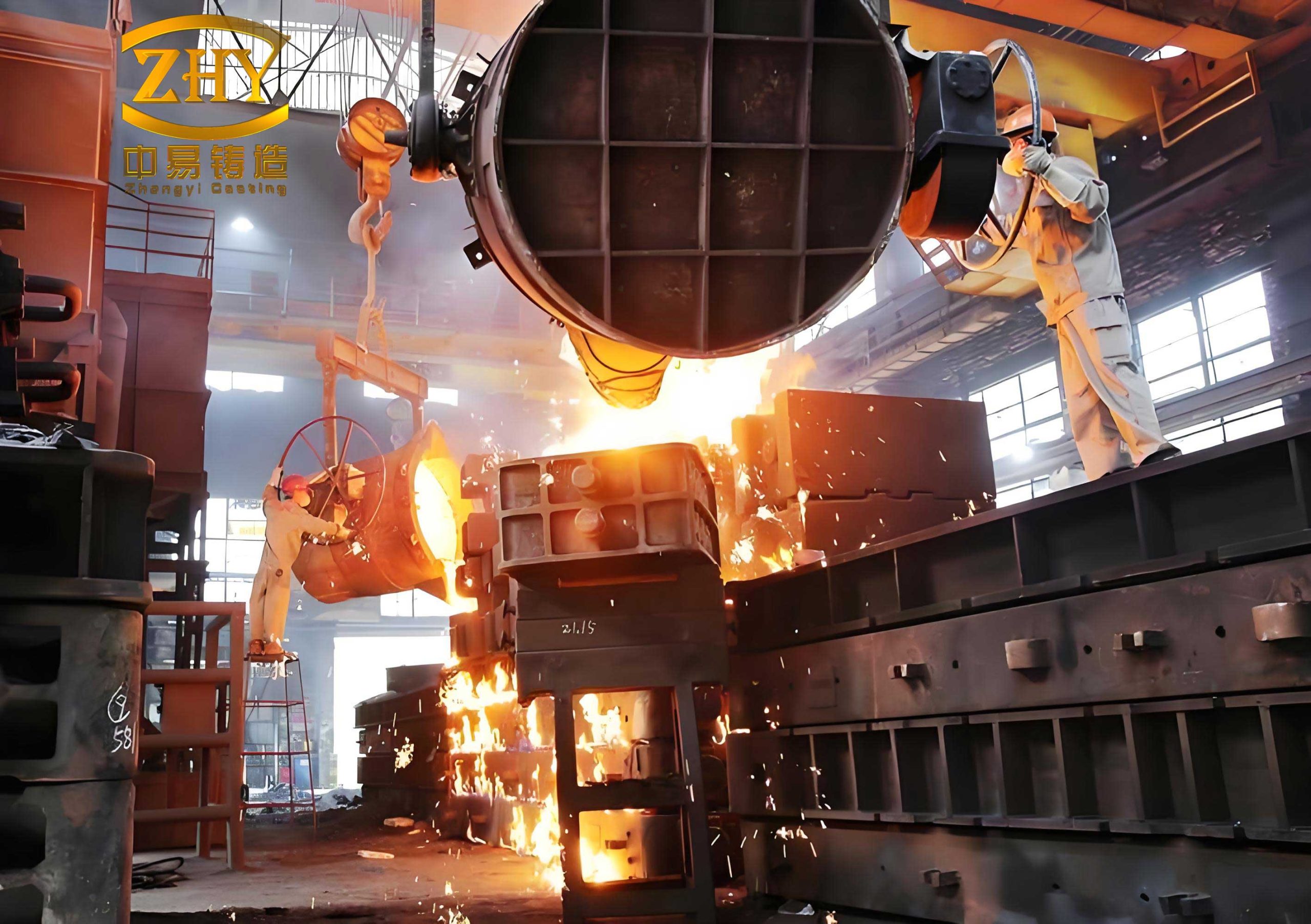
The performance of a modified high-chromium cast iron part is not solely determined by the modifier; it is the result of a holistic process. Casting工艺 parameters must be meticulously controlled to achieve the best results. This includes managing the tapping temperature from the furnace, the pouring temperature into the mold, and the use of techniques like risers配合 chills to promote directional solidification and soundness in the final casting. Subsequently, a tailored heat treatment—typically involving austenitizing (quenching) followed by tempering—is essential to develop the desired matrix microstructure (e.g., martensite with secondary carbides) and relieve stresses. The relationship between heat treatment temperature and final hardness/toughness can be complex, often optimized empirically for a given composition of the cast iron part.
Light Rare Earth Composite Modifiers
Rare earth elements are commonly categorized into light rare earths (the cerium group) and heavy rare earths (the yttrium group) based on their natural occurrence in ores. The cerium group includes elements like Cerium (Ce), Praseodymium (Pr), Neodymium (Nd), Promethium (Pm), Samarium (Sm), Europium (Eu), and Gadolinium (Gd). Composite modifiers based on these light RE elements, often in the form of ferroalloys like FeSiRE, have been extensively applied in foundries. Their effectiveness is well-documented across a wide range of high-chromium cast iron parts. The following table synthesizes data from numerous production案例 and experiments, illustrating the composition, modification approach, heat treatment, and achieved toughness for various components.
| Cast Iron Part / Sample | Typical Composition (wt.%) | Composite Modifier (wt.% addition) | Heat Treatment | Impact Toughness (J/cm²) |
|---|---|---|---|---|
| Slurry Pump Casing | 2.1-3.6 C, 15-26 Cr, Si, Mn, other alloys ≥3.5 | Efficient RE-composite (0.2-0.5%) | 980-1050°C Quench + 280-420°C Temper | 13-15 (Hardened) |
| Coal Chute Liner Plate | ~3.4 C, ~22 Cr, W, Ni | Efficient RE-composite (0.3-0.5%) | Normalize Air Cool + Temper | ~8 (Hardened) |
| Iron Ore Ball Mill Liner | 3.1-3.6 C, 20-25 Cr, W, Ni | RE-alloy modifier (0.3-0.9%) | 1000°C x 2h AC + 250°C Temper x 2h | ~8.1 (Hardened) |
| Coal Mill Grinding Ball (Φ50mm) | ~2.8 C, ~24.5 Cr, Mo | RE-alloy modifier + Al wire | 1010-1050°C Quench in special medium + 275-530°C Temper | ~5.84 (Hardened) |
| Refractory Brick Mold Plate | 2.0-2.5 C, 13-17 Cr, Mo, Cu | FeSiRE (0.3%) | Sub-critical (520°C x 4h) | ~6.25 (Hardened) |
| Hammer Head for Crusher | 2.6-3.2 C, 12-15 Cr, Si, Mn | 0.3%RE + 0.1%V + 0.2%Ti + 0.1%B | 950-980°C x 2-3h AC + 250-350°C Temper | ≥10 (Hardened) |
| Experimental Sample (Cr15Mo3) | Cr15Mo3 type | RE-Mg modifier (1.5%) | 1000°C Quench + 300°C Temper | 9.0 (Hardened) |
| Experimental Sample (Cr24) | ~2.9 C, ~24 Cr, Cu, Mo | FeTi + FeB + FeNb + FeSiRE + Al | 1050°C Quench + 250°C Temper | ~7.9 (Hardened) |
The success stories are compelling. For instance, liner plates for large cement ball mills, treated with FeSiRE and a复合变质剂 containing V and Ti, have demonstrated service lives approaching five years at nearly half the cost of imported equivalents. Similarly, hammer heads for limestone and iron ore processing, modified with a multi-element复合变质剂 (RE-V-Ti-B), showed a remarkable 123% increase in impact toughness compared to the unmodified version, with wear life 3.65-3.8 times that of standard Hadfield manganese steel. This translates directly to lower operational costs and less frequent downtime for replacement of these critical cast iron parts. The mechanism can be partially described by considering the change in the aspect ratio of the carbides. The modifier promotes a shift from elongated, sharp carbides to more globular ones, reducing the stress intensity factor at the carbide-matrix interface under load. The effectiveness of these treatments is highly dependent on precise process control, including tapping temperatures between 1480-1550°C and pouring temperatures in the range of 1360-1450°C, often using specialized molding sands and coatings to achieve optimal surface quality and cooling rates for these high-performance cast iron parts.
Heavy Rare Earth (Yttrium-based) Composite Modifiers
While light RE modifiers are well-established, the high and volatile market prices of traditional alloying elements like Nickel (Ni), Copper (Cu), and Molybdenum (Mo) have driven the search for alternative strategies to maintain or improve performance while reducing cost. This is where heavy rare earths, particularly yttrium (Y)-based composite modifiers, have shown significant promise. Heavy RE elements include Yttrium (Y), Scandium (Sc), and the lanthanides from Terbium (Tb) to Lutetium (Lu). Modifiers like YFB, developed commercially, contain a high proportion of Y (40-99.9% of the RE content). Yttrium, with its larger ionic radius and different chemical affinities compared to Ce or La, often exerts a more potent modification and purification effect.
The primary advantage of Yttrium-based复合变质剂 lies in their ability to achieve equivalent or superior properties in high-chromium cast iron parts while allowing for a substantial reduction—often 40-50% or more—in the content of expensive Ni, Mo, and Cu. This leads to direct and significant cost savings per ton of cast material without compromising the required in-service performance of the final cast iron part. The following table highlights applications and benefits of heavy RE modification.
| Cast Iron Part / Sample | Composition (wt.%) & Cost-Saving Focus | Heavy RE Modifier | Heat Treatment | Impact Toughness (J/cm²) | Key Outcome |
|---|---|---|---|---|---|
| Experimental Sample | 3.1C, 25Cr (Lower Mo, Cu, Ni target) | Y-based composite (YFB type) | 1020°C x 2h AC + 520°C x 2h Temper | 7.4-7.6 (Hardened) | Enables reduced alloy content. |
| Blast Furnace Top Chute Liner | 2.6-2.8C, 18-20Cr, Mo, Cu, Ni (Reduced alloy) | YFB-2 (0.3%) | 980°C x 3h AC + 350°C x 2h Temper | 9.0 (Sub-critically treated) | 40-50% reduction in Ni,Mo,Cu; 7-10% longer life. |
| Grinding Ball (Φ80mm) | 2.7-2.9C, 12-13Cr (Leaner composition) | YFB (0.5-0.6%) | 580°C x 6h (Sub-critical) | 7.2 (As-cast) | Low breakage & wear; cost down 800-1200 CNY/t. |
| Sintering Machine Grate Bar | 1.8-2.8C, 22-30Cr, Ni | Y+ZrAl+B composite | 1000°C x 2h AC + 300°C x 2h Temper | 12.8 (Hardened) | Excellent oxidation resistance; 3-year service life. |
The results from field applications are telling. For example, using YFB-modified high-chromium cast iron for grinding balls in power plant coal mills resulted in a ball consumption rate of 2.85-3.2 tons per 10,000 kW of installed capacity, which is significantly lower than the industry average. The cost reduction for hammer heads and liner plates was reported to be in the range of 2,500 to 3,800 CNY per ton. The enhanced performance is attributed to yttrium’s even stronger ability to refine primary and eutectic solidification structures, modify carbide morphology, and scavenge harmful impurities. The improvement in high-temperature properties, as seen in grate bars, can be linked to the formation of more stable protective oxide scales and the pinning of grain boundaries by fine RE-containing particles, resisting growth and deformation. This makes heavy RE-modified cast iron parts particularly attractive for applications involving both abrasion and elevated temperatures.
Conclusion and Technical Perspectives
The selection of an appropriate modifier is a critical decision in the production of high-performance, cost-effective high-chromium cast iron parts. A variety of复合变质剂 are available, from well-understood light RE systems (e.g., FeSiRE with V, Ti, B) to the increasingly impactful heavy RE systems based on yttrium. For liner plates, hammer heads, grinding balls, and pump casings, the choice depends on the specific service conditions (pure abrasion vs. impact-abrasion, presence of corrosion or elevated temperature) and the paramount economic constraints. It is vital to recognize that the benefits of modification—whether aiming for higher toughness, higher hardness, or a better balance of both—are fully realized only when integrated with optimized melting, casting, and heat treatment processes. The relationship between modifier addition, microstructure, and final properties can be framed as an optimization function:
$$ \text{Performance}(P) = f(C_{\text{comp}}, M_{\text{RE+X}}, T_{\text{pour}}, \Phi_{\text{solid}}, HT_{\text{cycle}}) $$
where $C_{\text{comp}}$ is the base composition, $M_{\text{RE+X}}$ is the type and amount of composite modifier, $T_{\text{pour}}$ is the pouring temperature, $\Phi_{\text{solid}}$ represents solidification conditions, and $HT_{\text{cycle}}$ is the heat treatment cycle. The goal is to maximize $P$ (e.g., a combination of toughness and hardness) for the specific cast iron part. While light RE composite modifiers represent a mature and reliable technology, heavy RE modifiers offer a compelling avenue for reducing dependency on costly alloying elements like nickel and molybdenum, thereby lowering the production cost of these essential wear-resistant cast iron parts without sacrificing service life. Future research and practical foundry work will continue to focus on fine-tuning these复合 formulas and processes to unlock further performance gains and cost efficiencies for the next generation of durable high-chromium cast iron parts.