
For over a century, the austenitic high manganese steel casting, pioneered by Sir Robert Hadfield, remains irreplaceable in applications demanding exceptional toughness combined with wear resistance under high-impact conditions. Its unique ability to work-harden from an initial hardness of approximately 200 HB to over 500 HB upon impact or heavy compression forms the cornerstone of its performance in mining, cement, railway, and earth-moving industries. However, the premature failure of many cast components due to inadequate wear life represents a significant economic loss. From my perspective as a researcher and practitioner, the key to unlocking the full potential of this material lies in a profound understanding of its work-hardening mechanism, a meticulous analysis of all factors influencing its wear behavior, and the rigorous implementation of optimized production and treatment protocols.
The extraordinary work-hardening capacity of high manganese steel castings is not merely a surface phenomenon but a complex microstructural evolution. Under severe impact or abrasive stress, the surface layer undergoes intense plastic deformation. This generates a high density of dislocations, stacking faults, and mechanical twins. The interaction between these crystal defects and the interstitial carbon atoms dissolved in the austenitic matrix creates a powerful “locking” effect on dislocation movement. This impediment to further deformation manifests as a dramatic increase in surface hardness. While the formation of deformation-induced martensite (ε-martensite) is often cited in literature, a comprehensive view acknowledges that the extreme hardening is primarily due to this synergistic effect of massive lattice defects and solute carbon. The relationship between the initial yield strength ($\sigma_{s}$) and the hardness after deformation ($H_{d}$) can be conceptually framed, though simplified, as:
$$ H_{d} \propto \sigma_{s} + \Delta \sigma_{defect} + \Delta \sigma_{solute} $$
where $\Delta \sigma_{defect}$ represents strengthening from dislocations/twins and $\Delta \sigma_{solute}$ from carbon-dislocation interactions. The core remains a tough, austenitic substrate, giving the component its renowned impact absorption capability.
The wear resistance of a high manganese steel casting in service is not an intrinsic property but the result of a complex interplay of multiple factors, which I categorize as follows:
| Factor Category | Key Parameters | Primary Influence on Wear |
|---|---|---|
| Metallurgical Quality | Inclusion type/size/distribution; Gas porosity; Macro/micro-shrinkage. | Initiates micro-cracking and spalling, accelerating material loss. |
| Chemical Composition | C, Mn, P, Si content; Mn/C ratio; Micro-alloying additions. | Dictates austenite stability, carbide formation, and work-hardening rate. |
| Cast Structure | Grain size; Columnar vs. equiaxed zone; Carbide network. | Affects toughness, crack propagation path, and hardening homogeneity. |
| Heat Treatment | Solutionizing temperature & time; Quench rate & uniformity. | Determines the dissolution of carbides and the final single-phase austenitic matrix. |
| Service Conditions | Impact energy; Abrasive type/hardness; Working temperature. | Drives the surface work-hardening response and potential microstructural degradation. |
Melting and pouring temperatures are critical process windows. Excessively high temperatures increase gas pick-up and promote coarse grain growth, while low temperatures hinder slag removal and fluidity. Research indicates an optimal melting range of 1500–1550°C. Pouring temperature directly affects soundness and mechanical properties. Empirical relationships show:
$$ a_{k} \approx 65 – 0.05 \cdot T_{p} $$
$$ \sigma_{b} \approx 65 – 0.03 \cdot T_{p} $$
$$ \delta \approx 28 – 0.02 \cdot T_{p} $$
where $a_{k}$ is impact toughness (J/cm²), $\sigma_{b}$ is tensile strength (kgf/mm²), $\delta$ is elongation (%), and $T_{p}$ is the pouring temperature (°C). Lowering $T_{p}$ from 1450°C to 1350°C can reduce the ductile-to-brittle transition temperature significantly.
Carbon is the most influential element for wear resistance in a high manganese steel casting. Within the solubility limit in austenite (typically up to ~1.4%), increasing carbon content raises the initial yield strength and the attainable hardened hardness. The relative wear loss decreases with higher carbon, as shown in tumbling mill tests:
| Carbon Content (%) | Relative Wear Loss |
|---|---|
| 1.05 | 1.00 (Baseline) |
| 1.20 | 0.92 |
| 1.32 | 0.87 |
However, carbon must remain in solid solution. The Mn/C ratio is crucial; a ratio between 8-10 is typically targeted. A lower ratio (e.g., ~7.5) can enhance work-hardening tendency but risks carbide precipitation during quenching. Data from crusher jaw plate trials illustrates the effect:
$$ \text{Unit Weight Crushing Capacity} = 140 + 210 \cdot (\text{Mn/C Ratio}) $$
This linear regression, derived from field data, underscores that an optimized Mn/C ratio directly correlates with improved service life. Phosphorus is highly detrimental, segregating to grain boundaries as brittle phosphides, severely reducing toughness and wear resistance. It must be kept below 0.06% for critical applications.
The state of carbides after heat treatment is paramount. A successful water quenching should yield a single-phase austenitic structure. Residual carbides, especially if continuous along grain boundaries (levels above 3-4 on a standard scale), act as stress concentrators and crack initiation sites, drastically accelerating wear. Even if not networked, excessive carbides reduce the matrix’s capacity to work-harden effectively.
The service environment dictates the performance of a high manganese steel casting. It requires substantial impact or high-stress abrasion to activate its work-hardening capability. Under low-stress sliding abrasion, its wear resistance may be inferior to white irons. Temperature is critical: prolonged exposure above 250–300°C leads to carbide precipitation, and above 500°C, pearlitic transformation occurs, destroying toughness and wear resistance.
Therefore, improving the wear life of high manganese steel castings is a multifaceted engineering challenge. Based on extensive research and practical experience, I advocate for the following integrated pathways:
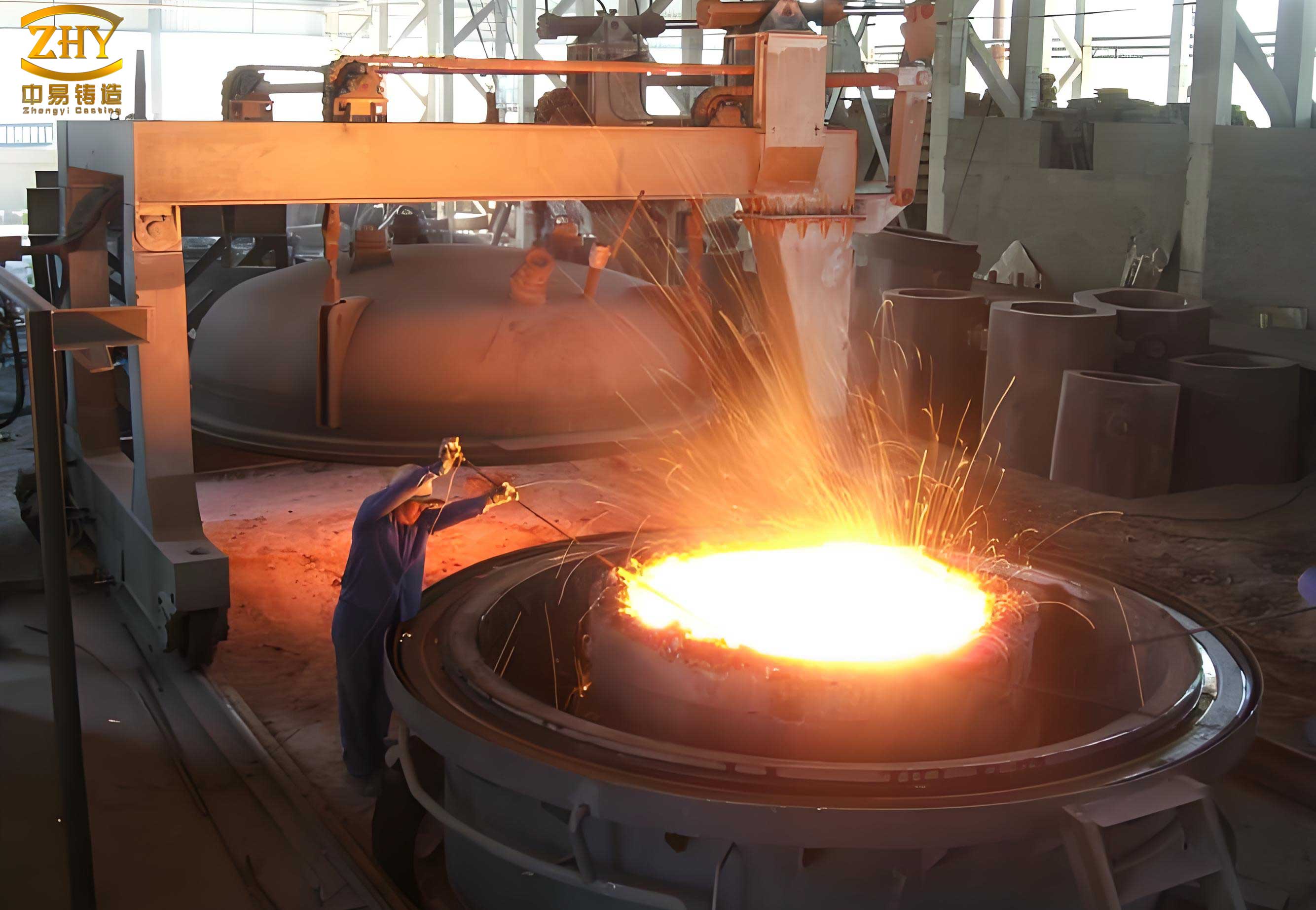
1. Optimizing Melting Practice for Superior Metallurgical Quality: The foundation for a durable high manganese steel casting is laid in the furnace. Key steps include: (a) Charging with adequate lime (1.5–2.0% of charge weight) for early dephosphorization. (b) Controlling the melt oxidation period to ensure a carbon drop of 0.40–0.60%, facilitating vigorous boiling for purification. (c) Employing a combination of ore and oxygen injection in a controlled manner to maintain a high oxygen potential at lower temperatures for efficient phosphorus removal. (d) Utilizing diffusion deoxidation (e.g., with a blended powder of lime, fluorspar, and ferrosilicon) instead of solely bulk deoxidation, followed by a final aluminum addition (0.10–0.15%) just before tapping to minimize oxide inclusions. (e) Adding micro-alloying elements like Niobium via ferroniobium during the melt. Nb forms fine, stable carbonitrides that pin grain boundaries and refine the as-cast structure, enhancing toughness and homogeneity. (f) Tapping with a slag carry-over practice to promote secondary metallurgical reactions in the ladle and, where possible, implementing argon stirring for temperature and composition homogenization.
2. Advanced Casting and Solidification Control: The goal is to produce a sound, dense, and fine-grained casting. This is achieved by: (a) Strategic use of external chills on heavy sections or hot spots to promote directional solidification, eliminate shrinkage, and refine grains. (b) Employing a gating system that facilitates sequential solidification toward adequately sized risers. For complex thin-wall castings, a simultaneous solidification approach with multiple gates is preferable. (c) Implementing the “suspended casting” technique, where fine, inert particles (e.g., crushed ferroalloy, cleaned steel shot) are injected into the metal stream during pouring. These particles act as additional nucleation sites and internal chills, significantly refining the microstructure and improving wear resistance by 20% or more. (d) Utilizing metal mold (permanent mold) casting where part geometry allows. This drastically increases cooling rate, leading to a much finer microstructure compared to sand casting. Field trials on crusher hammers have shown a 60–70% improvement in service life with metal mold cast high manganese steel components.
3. Precision Heat Treatment and Dispersion Strengthening: Water quenching (solution heat treatment) is not a one-size-fits-all process. Heating rate and soaking temperature must be adjusted based on casting design and carbon content. The soaking time ($t$) at the solution temperature ($T_{s}$, typically 1050–1100°C) must ensure complete carbide dissolution and can be estimated based on section thickness ($d$):
$$ t = k \cdot d $$
where $k$ is a factor ranging from 0.5 to 1.2 hours per cm, depending on casting complexity and initial carbide size. Quenching must be rapid and uniform, with vigorous water agitation to prevent film boiling and ensure a fully austenitic matrix.
For micro-alloyed high manganese steel castings containing elements like Titanium, Vanadium, or Molybdenum, a dispersion strengthening treatment post-quenching can be highly beneficial. This involves aging the quenched casting at 450–550°C for 4–10 hours. During this treatment, fine, stable carbides of the alloying elements precipitate uniformly within the austenite grains, providing secondary strengthening without compromising toughness. This can improve wear resistance under certain impact-abrasive conditions by 50–100%.
4. Modification with Rare Earth Elements: The addition of Rare Earth (RE) elements, typically via mischmetal or rare-earth silicides (0.10–0.20%), is a powerful modification technique for high manganese steel castings. REs act as strong deoxidizers and desulfurizers. More importantly, they modify the morphology of non-metallic inclusions, making them globular and finely dispersed. They also suppress the formation of columnar grains, leading to a uniform equiaxed structure. The result is improved toughness, fatigue strength, and consequently, wear performance.
5. Strategic Alloy Design and Surface Engineering: Beyond standard Hadfield steel (1.2%C, 13%Mn), modified chemistries have been developed. For example, steels with lower Mn (6-9%) and additions of Cr, Mo, and sometimes N, offer higher initial yield strength and better performance under low-to-medium impact conditions. For extreme abrasion with impact, composite approaches are viable. One method is explosive hardening, where controlled detonations on the working surface induce severe plastic deformation, pre-hardening the surface to over 500 HB before service, potentially doubling life. Another is the hardfacing of critical areas like bucket teeth with tungsten-carbide-rich weld overlays, creating a composite component that combines the toughness of the high manganese steel casting body with the extreme abrasion resistance of the surface layer.
In conclusion, the journey to maximize the service life of a high manganese steel casting is systematic. It begins with scrupulous control over melting and chemistry to ensure purity and optimal composition. It is followed by intelligent foundry engineering to achieve soundness and a refined as-cast structure. It culminates in precise thermal processing to unlock the desired microstructure, with optional secondary treatments for premium performance. By integrating these principles—leveraging both established foundry wisdom and modern metallurgical insights—producers and engineers can consistently manufacture high manganese steel castings that meet and exceed the severe demands of modern industry, transforming a century-old material into a cost-effective and reliable solution for the most punishing applications.