
In my years of experience as a materials engineer, I have observed that welded structures, such as frames, machine bases, and shells, form the backbone of numerous mechanical systems. Their durability and reliability are paramount for the overall performance and lifespan of the equipment. With advancements in welding technology, most of these components are now fabricated from steel plates using welding processes. However, a critical issue persists: the majority of failures in welded assemblies originate from fatigue cracks at the weld seams. Consequently, the weld zone is often the weakest link in terms of endurance. Therefore, in the development of high-performance welded components, enhancing the fatigue strength of welds is a crucial research objective. Furthermore, defects like slag inclusion can severely compromise integrity, making their study and mitigation equally vital.
To improve strength, critical welded structures are typically manufactured from high-strength steel plates. This is because, as the tensile strength of steel increases, its fatigue strength generally follows suit. However, experimental data indicates that for welds that are not subjected to post-weld treatment, the fatigue strength does not proportionally increase with the base metal’s strength. This discrepancy is primarily due to the presence of residual stresses and stress concentrations at the weld toe and root. The geometric profile of the weld bead—its reinforcement angle, toe radius, and undercut—plays a significant role in stress concentration. Thus, effective methods to enhance weld fatigue strength involve altering the residual stress state and improving the weld geometry. In this article, I will discuss various novel post-weld treatment processes and delve into the persistent problem of slag inclusion, particularly in cast materials like nodular iron, which shares analogous concerns with weld defects.
The fundamental relationship governing fatigue life is often described by the Basquin equation:
$$ S_a = \sigma_f’ (2N_f)^b $$
where \( S_a \) is the stress amplitude, \( \sigma_f’ \) is the fatigue strength coefficient, \( N_f \) is the number of cycles to failure, and \( b \) is the fatigue strength exponent. For welded joints, the presence of stress raisers modifies this behavior. The stress concentration factor \( K_t \) at the weld toe can be approximated based on geometry. For a typical weld reinforcement, an empirical formula is:
$$ K_t \approx 1 + \frac{h}{\rho} $$
where \( h \) is the weld reinforcement height and \( \rho \) is the toe radius. This clearly shows that a sharp toe (small \( \rho \)) drastically increases \( K_t \), reducing fatigue strength. Residual stresses \( \sigma_{res} \) superimpose on the applied stress, affecting the mean stress. The modified Goodman relation is often used:
$$ \frac{S_a}{S_e} + \frac{\sigma_m + \sigma_{res}}{\sigma_u} = 1 $$
where \( S_e \) is the endurance limit, \( \sigma_m \) is the mean applied stress, and \( \sigma_u \) is the ultimate tensile strength. Compressive residual stresses are beneficial as they reduce the effective mean stress.
Various post-weld treatment processes have been developed to introduce compressive residual stresses and improve geometry. Traditional methods like stress relief annealing are often inadequate or economically burdensome. The following table summarizes key modern techniques, their mechanisms, and comparative benefits.
| Process | Mechanism | Key Parameters | Typical Fatigue Improvement | Relative Cost |
|---|---|---|---|---|
| Grinding (Machining) | Removes weld toe irregularities, increases toe radius, may introduce shallow compressive layer. | Grinding depth, wheel grit, angle. | 20-50% increase in fatigue limit. | Low to Medium |
| Re-melting (TIG dressing, Laser) | Re-melts weld toe region, smoothens transition, refines microstructure. | Heat input, travel speed, shielding gas. | 50-100% increase, sometimes higher. | Medium |
| Shot Peening | Induces deep compressive residual stresses via plastic deformation from impingement. | Peening intensity, coverage, media size. | 30-70% increase. | Low |
| Heat Sink Cooling (Local Heating/Cooling) | Creates thermal gradients to generate compressive stresses at critical locations. | Heating temperature, cooling rate, area. | 20-40% increase. | |
| High-Pressure Water Jet Peening | Uses ultra-high-pressure water to induce plasticity and compressive stresses; minimal surface damage. | Water pressure, standoff distance, traverse speed. | 40-60% increase. | Medium to High |
Each process has its merits. For instance, grinding is straightforward but requires skill to avoid creating new stress raisers. Re-melting techniques like TIG dressing are highly effective but require precise control to avoid excessive heat input. Shot peening is widely applicable but may not be suitable for thin sections. A critical aspect often overlooked is the interaction between these treatments and material defects. For example, a subsurface slag inclusion can act as a stress initiator even after surface treatment, potentially negating benefits. This leads us to a detailed discussion on slag inclusion.
While welding defects like slag inclusions are well-known, similar issues plague casting processes, particularly in nodular cast iron used for components like crankshafts. A slag inclusion in this context refers to non-metallic impurities entrapped during the melting or treatment process. These inclusions, often originating from alloy additives, create localized stress concentrations and can drastically reduce fatigue life. The formation mechanism is complex. During the nodularizing treatment of molten iron with alloys like FeSiMg, certain refractory oxides or silicates (often termed “black slag”) may not fully dissolve. If the treatment temperature is too high, although it increases the decomposition of these alloys, it also prolongs the solidification time. This allows harmful elements from the slag inclusion to diffuse over a larger area, promoting the formation of unfavorable graphite shapes (like flake graphite) in the surrounding matrix. The detrimental effect of a slag inclusion is primarily determined by the size of this affected zone, not just the core inclusion itself.
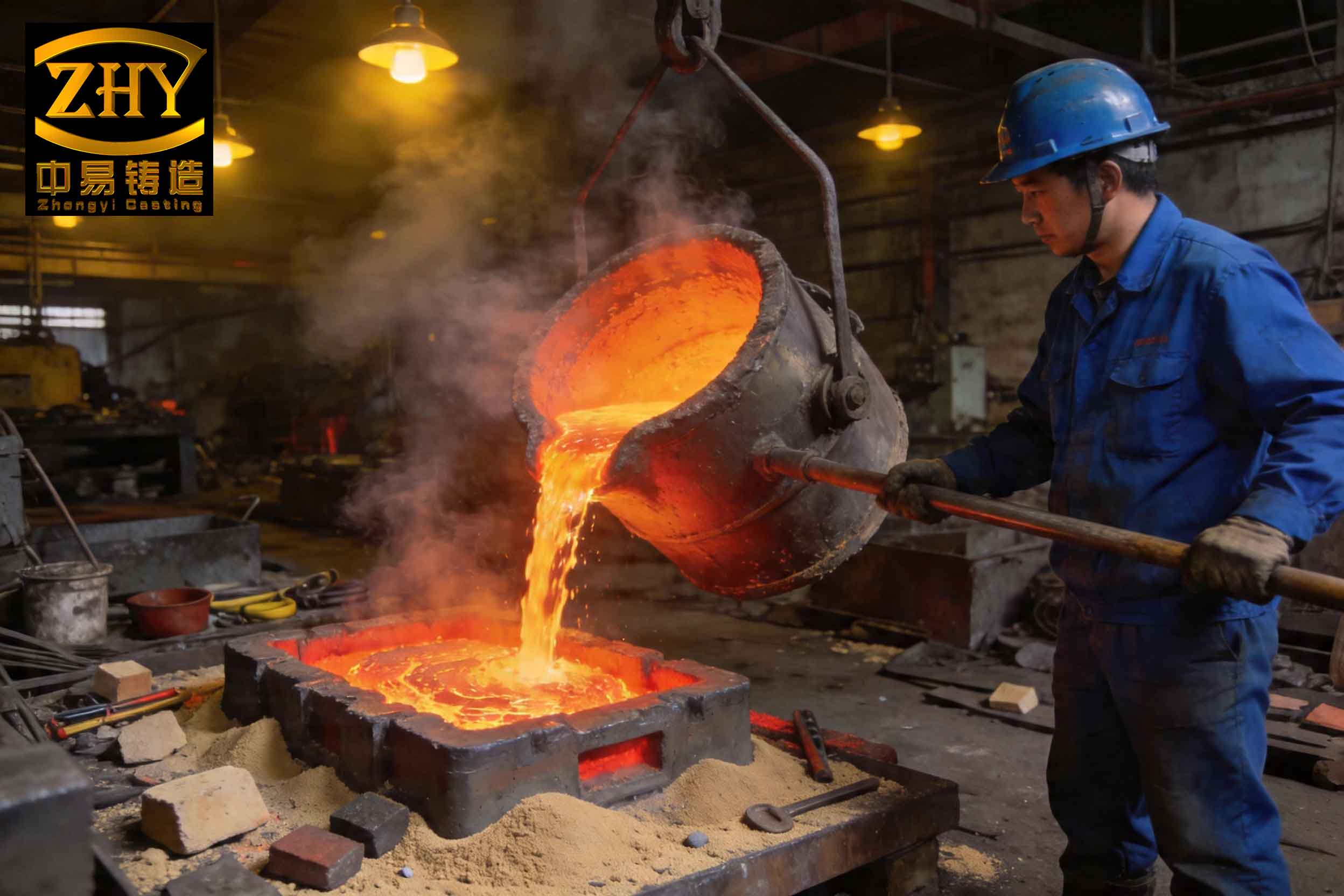
The graphite morphology around a slag inclusion can exhibit a gradient distribution: from flake near the inclusion to dendrite-like, and further to vermicular forms. This microstructural inhomogeneity creates a weak path for crack propagation. To model the stress field around an elliptical slag inclusion, we can use the solution for an elastic inclusion. The maximum stress \( \sigma_{max} \) at the tip of the inclusion (modeled as an ellipse with major axis \(2a\) and minor axis \(2b\)) under remote stress \( \sigma \) is given by:
$$ \sigma_{max} = \sigma \left(1 + 2\sqrt{\frac{a}{\rho}}\right) $$
where \( \rho \) is the radius of curvature at the tip (\( \rho \approx b^2/a \) for a sharp inclusion). For a typical slag inclusion, \( a \gg b \), leading to a very small \( \rho \) and high stress concentration. The fatigue crack growth rate \( da/dN \) from such an inclusion can be described by the Paris law:
$$ \frac{da}{dN} = C (\Delta K)^m $$
where \( \Delta K \) is the stress intensity factor range, and \( C \) and \( m \) are material constants. \( \Delta K \) for a crack emanating from an inclusion is a function of inclusion size and location.
Preventing such slag inclusion defects requires a multi-pronged approach. Firstly, the root cause must be addressed: eliminating the “black slag” from nodularizing alloys. However, commercially available FeSiMg alloys often contain such impurities, making complete elimination challenging. Therefore, process optimization becomes key. Lowering the nodularizing treatment temperature, within limits to avoid other casting defects like poor nodulization, can reduce the diffusion range of harmful elements from the slag inclusion. The effect of temperature on the diffusion coefficient \( D \) is given by the Arrhenius equation:
$$ D = D_0 \exp\left(-\frac{Q}{RT}\right) $$
where \( D_0 \) is a pre-exponential factor, \( Q \) is the activation energy for diffusion, \( R \) is the gas constant, and \( T \) is absolute temperature. A reduction in \( T \) significantly decreases \( D \), thereby shrinking the affected zone. Additionally, improved melt filtration and fluxing techniques can help remove inclusions before pouring.
The interplay between weld fatigue improvement techniques and inherent defects like slag inclusion is crucial. For instance, shot peening can introduce compressive stresses that may suppress crack initiation from subsurface inclusions, but only if the compressive layer is deeper than the inclusion. The required peening depth \( d_p \) should satisfy:
$$ d_p > a_i + \delta $$
where \( a_i \) is the depth of the slag inclusion and \( \delta \) is a safety factor. The compressive stress profile \( \sigma_c(y) \) as a function of depth \( y \) can be approximated by:
$$ \sigma_c(y) = \sigma_{c0} \left(1 – \frac{y}{d_p}\right)^n $$
where \( \sigma_{c0} \) is the surface compressive stress and \( n \) is an exponent (often ~1-2). If the inclusion lies beyond the compressive zone, its detrimental effect remains. This highlights the need for non-destructive testing to locate defects before applying treatments.
To quantitatively assess the benefit of a post-weld treatment in the presence of potential slag inclusion, a probabilistic approach is useful. The fatigue limit \( S_{e,treated} \) can be expressed as:
$$ S_{e,treated} = S_{e,base} \cdot K_{treatment} \cdot K_{defect} $$
where \( S_{e,base} \) is the base material endurance limit, \( K_{treatment} \) is the improvement factor from the treatment (e.g., 1.5 for TIG dressing), and \( K_{defect} \) is a reduction factor due to defects. For a component with a slag inclusion of effective size \( a_{eff} \), \( K_{defect} \) can be estimated using fracture mechanics:
$$ K_{defect} = \frac{\Delta K_{th}}{\Delta K_{inclusion}} $$
where \( \Delta K_{th} \) is the threshold stress intensity factor range for crack propagation, and \( \Delta K_{inclusion} = Y \Delta S \sqrt{\pi a_{eff}} \), with \( Y \) as a geometric factor and \( \Delta S \) the stress range. This underscores that even with treatment, the presence of a severe slag inclusion can nullify gains.
In practice, for critical components, a combination of processes is often employed. For example, weld toe grinding followed by shot peening can both improve geometry and introduce compressive stresses. For cast components prone to slag inclusion, processes like hot isostatic pressing (HIP) can heal internal voids and inclusions, but it is costly. The following table compares strategies for dealing with fatigue and inclusion issues across fabrication methods.
| Fabrication Method | Primary Fatigue Concern | Key Improvement Processes | Defect Focus (e.g., Slag Inclusion) | Synergistic Approach |
|---|---|---|---|---|
| Welding | Weld toe stress concentration, tensile residual stress. | Grinding, Re-melting, Shot Peening, HP Water Jet. | Weld slag inclusions, porosity. | NDT screening + compressive stress techniques. |
| Casting (Nodular Iron) | Microstructural inhomogeneity, shrinkage, inclusion stress raisers. | Optimized melting/treatment, Filtering, HIP, Surface hardening. | Black slag inclusions from alloys. | Low temperature treatment + alloy purity control. |
From my perspective, the future lies in integrated process design. For welding, in-process monitoring and adaptive control can minimize defect formation. For casting, advanced alloy production to eliminate impurity phases is essential. Research into new treatment methods, such as ultrasonic impact treatment or laser shock peening, offers promise for deeper compressive layers that can better mask the effects of subsurface slag inclusion. Computational modeling plays a key role. Finite element analysis can simulate residual stress fields from various treatments and predict fatigue life in the presence of defects. A simple model for fatigue life \( N_f \) incorporating an initial defect size \( a_0 \) (like an inclusion) and treatment effect might be:
$$ N_f = \int_{a_0}^{a_c} \frac{da}{C [\Delta K(a, \sigma_{res})]^m} $$
where \( a_c \) is critical crack size, and \( \Delta K \) now depends on the applied stress range and the residual stress \( \sigma_{res} \) induced by treatment.
In conclusion, enhancing the fatigue strength of welded joints requires a holistic approach that addresses both geometry and residual stresses. While novel post-weld treatments offer superior technical and economic outcomes compared to traditional stress relief, their effectiveness can be compromised by inherent material defects. The case of slag inclusion in nodular cast iron serves as a potent reminder that defect control at the source is paramount. By combining improved material processing to minimize slag inclusion with advanced surface engineering techniques to impart beneficial compressive stresses, we can significantly boost the durability and reliability of critical structural components. Continuous innovation in both areas will drive the development of safer and longer-lasting engineering systems.