
In my extensive involvement with the manganese steel casting foundry industry, I have observed a persistent challenge: the need for durable, cost-effective wear-resistant components. Traditional austenitic high manganese steel, while historically dominant, often falls short in demanding applications, leading to operational inefficiencies and financial strain for foundries. This article synthesizes my firsthand research and practical experiences, focusing on the development and implementation of chromium-alloyed high manganese steel castings. I will delve into the evolving trends in austenitic high manganese steel, detail the alloying and heat treatment strategies that enhance performance, and present empirical data from real-world applications. Throughout, I emphasize the critical role of modern manganese steel casting foundry practices in achieving superior product quality and economic viability.
The genesis of this work lies in a common scenario within the manganese steel casting foundry sector. A specific foundry, producing conventional high manganese steel castings, faced severe quality issues that threatened its sustainability. My investigation into contemporary advancements revealed that alloying, particularly with chromium, coupled with optimized heat treatment, could significantly improve wear resistance. By adopting these innovations, the foundry not only revived its operations but also achieved remarkable market success. This narrative underscores the transformative potential of applied research in the manganese steel casting foundry field.
Austenitic high manganese steel, renowned for its exceptional work-hardening capacity and toughness, has been the cornerstone of anti-wear applications for over a century. However, the relentless progression of industrial demands necessitates continuous improvement. My research into current development trajectories identifies two primary avenues: theoretical underpinnings and production process refinements. Theoretically, the mechanisms of deformation strengthening and abrasive wear have been scrutinized to inform better material design. Practically, advancements in melting, casting techniques like suspension pouring, surface hardening methods, and composite casting have emerged. For the scope of this article, I concentrate on alloying/micro-alloying and precipitation strengthening heat treatment, as these are most directly applicable to a typical manganese steel casting foundry.
Alloying high manganese steel serves three fundamental purposes in a manganese steel casting foundry context: refining the as-cast microstructure, enhancing mechanical and wear properties, and improving processability. Elements like chromium, molybdenum, vanadium, and niobium are added to form hard, dispersed carbides, while trace amounts of rare earths, titanium, or boron act as grain refiners and modifiers for non-metallic inclusions. The international standardization of such alloyed grades, as shown in Table 1, validates their efficacy. This table, compiled from my analysis of various national standards, illustrates the chemical compositions of several advanced high manganese steels, providing a benchmark for any progressive manganese steel casting foundry.
| Standard | Grade Designation | C | Mn | Cr | Mo | Other Notable Elements |
|---|---|---|---|---|---|---|
| ASTM A128 (USA) | Gr. B-3 | 1.05-1.35 | 11.0-14.0 | 1.5-2.5 | 0.9-1.2 | – |
| ASTM A128 (USA) | Gr. C | 1.05-1.35 | 11.0-14.0 | 1.8-2.2 | – | – |
| JIS G5131 (Japan) | SCMnH3 | 0.90-1.30 | 11.0-14.0 | 1.5-2.5 | 0.9-1.2 | – |
| JIS G5131 (Japan) | SCMnH11 | 0.90-1.20 | 11.0-14.0 | 2.0-3.0 | – | – |
| STAS (Romania) | GX120Mn13 | 1.10-1.40 | 11.5-14.5 | – | – | – |
| STAS (Romania) | GX120Mn13Cr2 | 1.10-1.40 | 11.5-14.5 | 1.8-2.2 | – | – |
Precipitation strengthening heat treatment is the key to unlocking the potential of alloyed grades in a manganese steel casting foundry. Unlike conventional water toughening (solution treatment), this process aims to precipitate fine, hard carbides uniformly within a refined austenitic matrix, thereby increasing yield strength and wear resistance without excessively compromising toughness. Based on my review of literature and industrial practices, four primary thermal processing modes have been established, as summarized in Table 2. The choice of mode depends on the specific alloy system and the operational constraints of the manganese steel casting foundry.
| Mode | Schematic Thermal Curve | Description & Applicability |
|---|---|---|
| 1 | Solutionize at 1050-1100°C → Water Quench → Reheat to 450-550°C for extended time → Cool | Produces finely dispersed carbides. Versatile but has a long cycle time. Suitable for a manganese steel casting foundry with good temperature control. |
| 2 | Solutionize at 1050-1100°C → Water Quench → Reheat to 250-350°C for a short period → Water Quench | Particularly effective for steels containing Cr and Mo. Simple process with a short cycle, advantageous for foundry productivity. |
| 3 | Heat to 1050-1100°C, hold → Cool slowly to 600-700°C, hold → Water Quench | Applicable to various alloying elements. Similar to conventional treatment but with prolonged low-temperature holding to precipitate carbides. |
| 4 | Solutionize at 1050-1100°C → Water Quench → Age at 450-500°C → Air Cool | Suitable for multiple alloying elements. Simple and short cycle, but requires precise control of aging temperature in the manganese steel casting foundry heat treatment facility. |
Guided by these principles, my applied research focused on chromium-alloyed high manganese steel. Chromium was selected due to its proven efficacy in enhancing wear resistance, its relative affordability as high-carbon ferrochrome, and its inclusion in international standards like ASTM A128 Grade D. For our manganese steel casting foundry trials, we designated a grade equivalent to this, named ZGMn13Cr2. Its target chemical composition is presented in Table 3, which was strictly adhered to during production. Controlling chemistry is a fundamental first step for any successful manganese steel casting foundry operation.
| Element | C | Mn | Si | Cr | P | S |
|---|---|---|---|---|---|---|
| Content | 1.10 – 1.35 | 11.5 – 14.0 | 0.30 – 0.80 | 1.80 – 2.20 | ≤ 0.070 | ≤ 0.040 |
The melting was conducted in a 500 kg medium-frequency induction furnace within the manganese steel casting foundry, using a magnesia crucible. The charge consisted of high manganese steel returns, general scrap steel, and ferrochromium. Standard induction melting practices were followed, with particular emphasis on thorough deoxidation and accurate temperature control. The tap temperature was carefully managed to ensure proper fluidity for casting while preventing excessive oxidation. The relative ease of composition control in induction melting is a significant advantage for a manganese steel casting foundry specializing in alloyed steels.
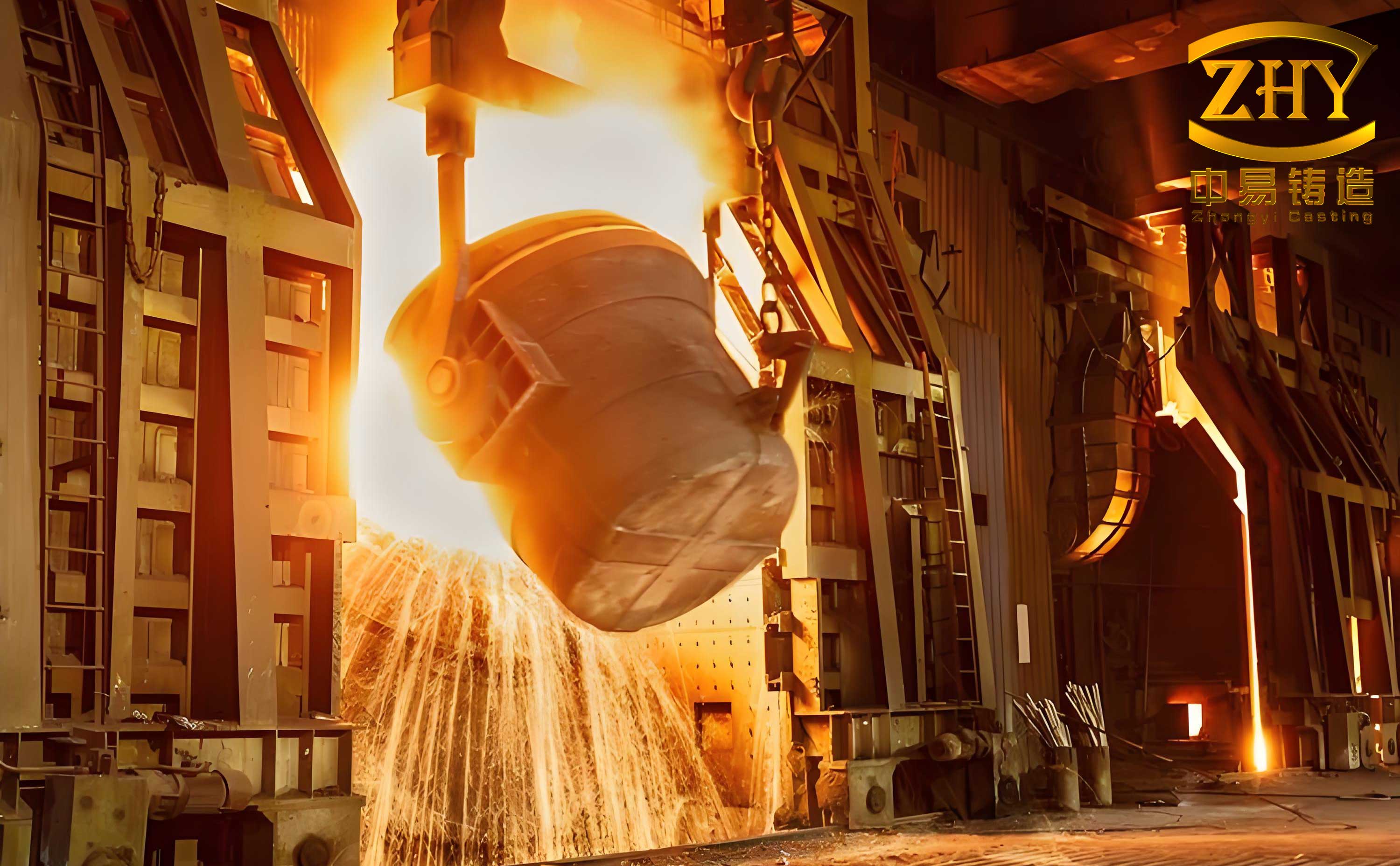
Casting was performed using green sand molds, a common and cost-effective method in many manganese steel casting foundry setups. The fluidity of the high manganese steel alloy was adequate for producing sound castings of complex shapes like hammer heads and jaw plates. After shakeout and cleaning, the castings were ready for heat treatment. The selection of the appropriate heat treatment cycle is critical. Based on the alloy composition (containing chromium) and reference to the modes in Table 2, we selected a variant of Mode 4 for its balance of effectiveness and operational simplicity in our manganese steel casting foundry. The process involved: austenitizing at 1050°C for sufficient time to dissolve carbides, followed by rapid water quenching to retain a supersaturated austenitic matrix, and finally aging at 480°C for a predetermined period to precipitate fine chromium carbides before air cooling. This treatment yielded a microstructure of fine-grained austenite with a uniform dispersion of hard (Cr, Fe)23C6 type carbides, significantly enhancing hardness and wear resistance.
The performance improvement can be modeled conceptually. The increase in yield strength $\sigma_y$ due to grain refinement (Hall-Petch effect) and precipitation strengthening can be approximated by:
$$ \sigma_y = \sigma_0 + k_y \cdot d^{-1/2} + M \cdot \tau $$
where $\sigma_0$ is the lattice friction stress, $k_y$ is the strengthening coefficient, $d$ is the average grain diameter, $M$ is the Taylor factor, and $\tau$ is the shear stress increment from precipitates. For a manganese steel casting foundry, controlling $d$ through alloying/processing and maximizing $\tau$ through optimal precipitation is key.
Furthermore, the relative wear resistance $W_r$ compared to standard high manganese steel can be related to the volume fraction $f_v$ and hardness $H_p$ of carbides:
$$ W_r \propto 1 + \alpha \cdot f_v \cdot (H_p – H_m) $$
where $\alpha$ is a constant and $H_m$ is the matrix hardness. This underscores why chromium addition, which increases $f_v$ and $H_p$, is so effective.
The true test of any development in a manganese steel casting foundry lies in field performance. We produced and supplied various castings, including jaw plates for颚式破碎机 (jaw crushers), hammer heads and plate hammers for反击式破碎机 (impact crushers), and shovel teeth for excavators. Service life comparisons were conducted with users who previously employed ordinary high manganese steel parts. The results, detailed in Tables 4 and 5, are compelling.
| Application Site | Crusher Model / Ore Type | Ordinary High Mn Steel Life (days) | ZGMn13Cr2 Life (days) | Life Increase | Wear Resistance Improvement |
|---|---|---|---|---|---|
| Iron Ore Mine A | PE400×600, Crystalline Iron Ore | ~30 | ~45 | ~15 days | Approximately 50% |
| Cement Plant | Material | Effective Service Time (hours) | Limestone Crushed (tons) | Hammer Consumption (kg/ton limestone) | Relative Wear Resistance Ratio (Ordinary Steel = 1) |
|---|---|---|---|---|---|
| Plant 1 | Purchased Ordinary | 96 | 12,500 | 0.080 | 1.00 |
| ZGMn13Cr2 | 144 | 18,000 | 0.056 | 1.43 | |
| Plant 2 | Purchased Ordinary | 120 | 15,000 | 0.080 | 1.00 |
| ZGMn13Cr2 | 192 | 22,500 | 0.071 | 1.13 |
The data unequivocally demonstrates the superiority of the chromium-alloyed grade produced by a dedicated manganese steel casting foundry. For jaw plates, service life increased by 50%, translating to significantly reduced downtime and replacement costs. For hammer heads in cement plants, the improvement in wear resistance ranged from 13% to 43%, with a corresponding reduction in consumption per ton of processed material. These gains directly enhanced the profitability of both the casting foundry and its end-users. The foundry that adopted this technology experienced a resurgence, expanding its melting capacity to meet surging demand—a testament to the economic power of technical innovation in the manganese steel casting foundry business.
My findings align with broader research. Studies globally report wear life improvements of 20% to 100% for chromium-alloyed high manganese steels, depending on specific conditions like impact stress and abrasive type. The consistency of these results validates the approach. The successful implementation hinges on integrated process control in the manganese steel casting foundry: precise chemistry, proper melting and casting to achieve sound castings, and meticulously controlled heat treatment to develop the optimal microstructure. This holistic view is essential for any manganese steel casting foundry aiming to upgrade its product line.
In conclusion, the application of chromium-alloyed high manganese steel castings represents a significant and readily achievable advancement for the manganese steel casting foundry industry. Based on my research and practical application, the integration of targeted alloying (1.8-2.2% Cr) with an appropriate precipitation strengthening heat treatment cycle reliably enhances wear resistance by 20% to 50% or more compared to standard high manganese steel. This leads to extended component life, reduced maintenance costs for users, and creates a competitive edge for the producing manganese steel casting foundry. The technology is not excessively complex; it builds upon the existing infrastructure and knowledge base of a typical manganese steel casting foundry. Therefore, I strongly advocate for its wider adoption. By embracing such material science innovations, manganese steel casting foundries can secure their market position, deliver greater value to customers, and contribute to more efficient and sustainable industrial operations. The future of the manganese steel casting foundry lies in such continuous improvement and adaptation to evolving technological frontiers.