
In the realm of lost foam casting, the white area represents a critical phase where the preparation of foam patterns directly influences the quality and efficiency of the final cast products. As an engineer with extensive experience in designing and implementing lost foam casting systems, I have observed that the white area, comprising processes such as bead pre-expansion, molding, drying, cutting, bonding, and coating, requires meticulous equipment selection and layout planning. Unlike the black area, which has evolved into automated sand-filling and molding lines, the white area remains largely composed of standalone equipment units that are challenging to integrate seamlessly. This article delves into the equipment selection criteria and layout strategies for the white area, emphasizing key factors like bead moisture control, drying parameters, and coating uniformity, which are pivotal for minimizing defects such as porosity and slag inclusion. Through practical insights gained from full project lifecycles—from design and procurement to installation and operation—I aim to provide a comprehensive guide that enhances productivity and product quality in lost foam casting operations.
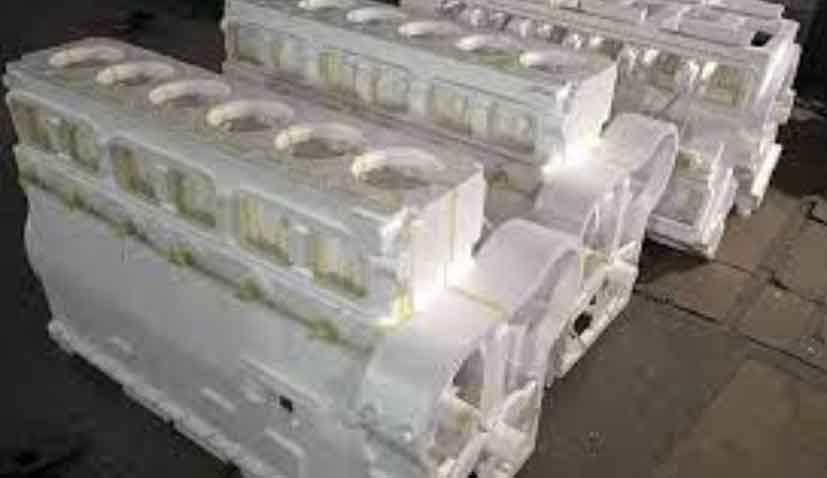
The white area processes in lost foam casting involve a series of interconnected steps that transform raw expandable polystyrene (EPS) or styrene-methyl methacrylate (STMMA) beads into coated foam patterns ready for casting. A typical workflow, as illustrated in Figure 1, begins with bead pre-expansion and aging, followed by molding, drying, cutting and bonding, and multiple coating and drying cycles. Each step demands precise control of parameters like temperature, humidity, and time to ensure pattern integrity. For instance, inadequate drying can lead to steam explosions during pouring, causing defects, while improper coating uniformity may result in surface imperfections. The entire cycle can span nearly a week, underscoring the importance of optimizing each process. In this article, I will analyze equipment options for each stage, propose layout configurations, and highlight best practices based on real-world applications. By incorporating tables and formulas, I will summarize critical parameters and relationships, ensuring that readers can apply these insights to their own lost foam casting projects.
Bead pre-expansion and aging form the foundation of the lost foam casting process, where raw beads are initially foamed to achieve a uniform density and low moisture content. The pre-expansion stage involves exposing beads to steam, causing them to expand to a target density, typically between 18 g/L and 25 g/L. The equipment of choice here is an intermittent automatic pre-expander, which utilizes steam to heat the beads and an electronic weighing system for precision. Key parameters include bead density and moisture content; the latter should be maintained below 2.5% to reduce gas evolution during casting, which can cause defects. For high-demand applications, such as steel castings, an electric-steam hybrid pre-expander is recommended, as it minimizes internal moisture content to approximately 1.0%. The aging process follows pre-expansion, where beads are stored in aging silos to allow air infiltration, making them pliable and elastic. Aging time depends on ambient temperature and humidity, generally ranging from 6 to 8 hours. A well-designed aging system ensures beads are free of clumps and surface imperfections, which is crucial for consistent molding in lost foam casting.
To quantify the relationship between bead properties and process parameters, consider the density control formula: $$\rho = \frac{m}{V}$$ where $\rho$ is the bead density (g/L), $m$ is the mass of beads (g), and $V$ is the volume (L). Maintaining $\rho$ within 18–25 g/L requires precise steam pressure and temperature control. For moisture content, the formula $$MC = \frac{W_w – W_d}{W_d} \times 100\%$$ where $MC$ is moisture content (%), $W_w$ is wet weight, and $W_d$ is dry weight, highlights the need for dehydration during pre-expansion. Table 1 summarizes key equipment and parameters for bead pre-expansion and aging in lost foam casting.
| Process | Equipment | Key Parameters | Recommended Values |
|---|---|---|---|
| Pre-expansion | Intermittent Automatic Pre-expander | Bead Density, Moisture Content | 18–25 g/L, <2.5% |
| Aging | Aging Silos | Aging Time, Ambient Conditions | 6–8 hours, 20–25°C |
Molding is the next critical step in lost foam casting, where pre-expanded beads are injected into molds and fused using steam to form foam patterns. The molding process involves several sub-steps: mold clamping, preheating, bead filling, heating, cooling, and mold opening. Equipment selection depends on product characteristics; for instance, hydraulic automatic molding machines offer speed and precision, while tilt-vacuum molding machines are suitable for thick-walled components requiring extensive cooling. The key to producing high-quality foam patterns lies in parameter optimization, such as steam temperature and pressure, as well as mold design. Molds for lost foam casting are typically made from cast or forged aluminum, with surfaces coated with non-stick materials like Teflon. Automated features, such as core pulling and ejection, can enhance efficiency and reduce manual errors. For example, automatic ejection prevents pattern damage during removal, which is common in manual operations. The molding area should be well-ventilated and equipped with drainage systems to handle steam and cooling water, often located on the ground floor for easy access to utilities.
The heat transfer during molding can be modeled using the formula $$Q = m \cdot c_p \cdot \Delta T$$ where $Q$ is the heat energy (J), $m$ is the mass of beads (kg), $c_p$ is the specific heat capacity (J/kg·K), and $\Delta T$ is the temperature change (K). This emphasizes the need for controlled steam application to achieve uniform fusion without overheating. In lost foam casting, maintaining a consistent mold temperature is vital to prevent defects like shrinkage or warping. Table 2 outlines molding equipment options and their applications.
| Equipment Type | Advantages | Typical Applications |
|---|---|---|
| Hydraulic Automatic Molder | High speed, precise clamping | General-purpose patterns |
| Tilt-Vacuum Molder | Reduced water splash, better cooling | Thick-walled castings |
Drying is essential for both white (uncoated) and yellow (coated) foam patterns in lost foam casting, as residual moisture can cause casting defects like gas porosity. White patterns are typically dried at 40–45°C, while yellow patterns require 55–60°C, with humidity controlled below 20% (ideally under 15%). Drying equipment includes conventional ovens and advanced heat pump drying rooms. Conventional ovens use steam, electric, or combustion-based heating, but may struggle with humidity control in humid climates. In contrast, heat pump drying rooms employ a closed-loop system where moist air is dehumidified and reheated, offering energy efficiency and precise humidity management. The drying process must avoid rapid temperature rises that could cause coating cracks, and internal temperature variations should be kept within 5°C. For lost foam casting in regions with high ambient humidity, integrating dehumidifiers with drying systems is advisable to ensure thorough drying.
The drying kinetics can be described by the formula $$\frac{dM}{dt} = -k \cdot (M – M_e)$$ where $M$ is the moisture content, $t$ is time, $k$ is the drying rate constant, and $M_e$ is the equilibrium moisture content. This highlights the importance of controlling temperature and humidity to achieve optimal drying rates. In lost foam casting, inadequate drying can lead to pattern deformation or casting failures. Table 3 compares drying methods for lost foam casting applications.
| Drying Method | Heat Source | Temperature Range | Humidity Control |
|---|---|---|---|
| Steam Oven | Steam | 40–60°C | Moderate, may require dehumidifier |
| Heat Pump Drying Room | Electricity | 40–60°C | High, built-in dehumidification |
Cutting and bonding are labor-intensive stages in lost foam casting, where foam patterns are trimmed and assembled into final shapes. Traditional methods rely on manual cutting and bonding, but automation through cutting machines and bonding equipment significantly improves efficiency and consistency. Cutting machines are used for precision trimming, while bonding involves joining pattern parts using hot or cold adhesives. Point glue applicators semi-automate the process by dispensing adhesive along predefined paths, followed by manual assembly. For high-volume production, automatic bonding machines are preferred; these devices handle pattern placement, adhesive application, and clamping in about one minute per cycle. However, hot adhesive systems require careful management, as prolonged heating can degrade adhesive quality, leading to issues like stringing. In lost foam casting, selecting the right adhesive and equipment based on production volume and pattern complexity is crucial. For instance, automatic bonders are ideal for batch production but may require longer setup times for mold changes.
The bonding strength can be approximated by the formula $$\sigma = \frac{F}{A}$$ where $\sigma$ is the adhesive strength (Pa), $F$ is the force applied (N), and $A$ is the bonded area (m²). This underscores the need for uniform adhesive application to prevent weak joints. In lost foam casting, improper bonding can result in pattern separation during handling or casting. Table 4 summarizes cutting and bonding equipment options.
| Equipment | Function | Advantages | Limitations |
|---|---|---|---|
| Cutting Machine | Pattern trimming | Precision, reduced labor | Limited to simple geometries |
| Point Glue Applicator | Semi-automatic bonding | Flexibility, cost-effective | Manual assembly required |
| Automatic Bonding Machine | Full automation | High throughput, consistency | High cost, long setup time |
Coating application is a vital step in lost foam casting, where a refractory coating is applied to foam patterns to create a barrier against molten metal. The coating process involves preparing the coating slurry and applying it via dipping or spraying. Typically, dry powder coatings are mixed with water using adjustable-speed mixers to achieve a homogeneous slurry, which is then maintained in slow-speed mixers to prevent sedimentation. Dipping is the most common method, but it often results in uneven coating thickness and manual labor challenges. Emerging technologies, such as automatic dipping and leveling machines or robotic coating systems, aim to automate this process, but they face issues like coating gaps or积液 (puddle formation). In lost foam casting, achieving uniform coating thickness is critical to prevent metal penetration and ensure smooth surface finishes. Equipment selection should focus on systems that minimize human intervention and enhance consistency, though current automated solutions require further refinement to address pattern-specific requirements.
The coating thickness $\delta$ can be related to the dipping parameters by the formula $$\delta = k \cdot \sqrt{\frac{\eta \cdot t}{\rho}}$$ where $\eta$ is the coating viscosity (Pa·s), $t$ is the dipping time (s), $\rho$ is the density (kg/m³), and $k$ is a constant. This illustrates the need for controlled viscosity and immersion time to avoid defects. In lost foam casting, multiple coating layers are often applied, with intermediate drying, to build up the required thickness. Table 5 outlines coating equipment and considerations.
| Equipment | Application Method | Key Parameters | Challenges |
|---|---|---|---|
| Adjustable-Speed Mixer | Slurry preparation | Mixing speed, time | Dust generation, noise |
| Dipping Tank | Manual dipping | Immersion time, viscosity | Uneven coating, labor-intensive |
| Robotic Coating System | Automated dipping | Path programming,夹具 design | Coating uniformity, adaptability |
Auxiliary equipment, such as boilers or steam generators, compressors, and mold storage systems, plays a supporting role in lost foam casting operations. Steam generators, for instance, provide the necessary steam for pre-expansion, molding, and drying, and modern electric or gas-fired units offer advantages over traditional boilers, including lower regulatory burdens and energy efficiency. Similarly, compressed air systems power various tools and actuators, while mold storage requires organized racks to handle multiple mold sets. In lost foam casting, the integration of these auxiliaries into the overall layout is essential for seamless workflow. For example, steam generators should be housed in separate utility rooms with proper ventilation and safety measures, while mold storage areas must support easy access and retrieval. Additionally, cooling towers and water treatment systems are often located outdoors to manage the large volumes of cooling water used in molding.
The steam demand for lost foam casting processes can be estimated using the formula $$Q_s = m_s \cdot (h_g – h_f)$$ where $Q_s$ is the heat required (kJ), $m_s$ is the mass of steam (kg), $h_g$ is the enthalpy of saturated vapor (kJ/kg), and $h_f$ is the enthalpy of liquid water (kJ/kg). This emphasizes the importance of sizing steam generators appropriately to avoid bottlenecks. In practice, lost foam casting facilities should prioritize equipment that aligns with environmental regulations and operational efficiency.
Layout planning for the white area in lost foam casting is crucial for optimizing space utilization and workflow efficiency. Given that white area processes involve multiple standalone equipment units and require significant space for pattern aging and storage, a multi-level layout is often adopted. The ground floor typically houses molding machines, coating preparation areas, and auxiliary systems like steam generators and cooling towers, due to their need for ventilation, drainage, and heavy load support. For instance, molding machines are positioned along walls with utility lines overhead and drainage channels leading to outdoor cooling ponds. The second floor or higher levels accommodate lighter operations such as bead aging, cutting, bonding, and pattern storage, leveraging elevators or lifts for vertical transportation. This stratification minimizes congestion and enhances material flow in lost foam casting operations. Moreover, the final drying stage should be located close to the black area for easy transfer to molding stations, potentially using automated conveyors or AGVs.
To illustrate, a sample layout for a lost foam casting white area might include: ground floor with molding zones, utility rooms, and coating areas; upper floors with pre-expansion, aging silos, and bonding stations; and connecting elements like升降机 for pattern movement. This approach not only maximizes floor space but also isolates processes with different environmental requirements, such as humid molding areas from dry bonding zones. In lost foam casting, such thoughtful layout design reduces handling time and improves overall productivity.
In conclusion, the white area of lost foam casting demands careful equipment selection and spatial planning to achieve high-quality castings and operational efficiency. Key considerations include controlling bead moisture and density during pre-expansion, optimizing molding parameters, ensuring thorough drying, and automating cutting and bonding for high-volume production. The integration of advanced technologies, such as heat pump drying rooms and automatic bonding machines, can address common challenges like humidity control and labor intensity. Additionally, a multi-level layout that separates heavy, utility-intensive processes from light, dry operations enhances workflow and space utilization. Through my experiences in lost foam casting projects, I have found that prioritizing these aspects in the design phase significantly reduces defects and costs. As the industry evolves, further innovations in automation and process integration will continue to refine the white area, making lost foam casting more robust and scalable for diverse applications.
Reflecting on the entire process, the success of a lost foam casting operation hinges on the white area’s ability to produce consistent, high-integrity foam patterns. By adhering to the principles outlined here—using precise equipment, implementing controlled processes, and adopting efficient layouts—manufacturers can overcome typical pitfalls and excel in this demanding field. The repeated emphasis on lost foam casting throughout this article underscores its centrality to modern casting techniques, and I hope these insights serve as a valuable resource for practitioners aiming to optimize their own facilities.