
From my perspective as a researcher and practitioner in the foundry industry, the development of cast iron parts for automobiles represents a dynamic intersection of material science, engineering innovation, and industrial economics. The automotive sector, a cornerstone of global economies, continuously demands advancements in cast iron parts to meet evolving challenges such as energy efficiency, weight reduction, and performance enhancement. In this article, I will delve into the technological progress in producing cast iron parts, emphasizing key trends, processes, and future directions, with a focus on integrating tables and formulas to summarize critical aspects. Throughout, the term “cast iron parts” will be frequently highlighted to underscore their centrality.
The significance of cast iron parts in vehicles cannot be overstated; historically, they have constituted a substantial portion of automotive weight, though their share is gradually declining due to factors like thin-walled designs, substitution by aluminum or plastics, and the use of alternative materials. However, cast iron parts remain indispensable for many components, thanks to their cost-effectiveness, versatility in complex shapes, and satisfactory mechanical properties. My analysis begins with the evolving landscape of automotive materials, where cast iron parts are adapting to new demands.
In the realm of automotive materials, the trend toward lightweighting is paramount. Cast iron parts are increasingly replacing forged steel components, such as crankshafts and connecting rods, to reduce weight while maintaining durability. For instance, switching to ductile iron for a connecting rod can save up to 200 grams per part. The performance of cast iron parts is enhanced through methods like squeeze casting, which minimizes porosity, and surface remelting热处理 for camshafts. Notably, austempered ductile iron (ADI) offers fatigue strength approximately twice that of pearlitic ductile iron, making it suitable for gears and crankshafts. Vermicular graphite iron provides improved tensile strength, yield strength, and thermal conductivity compared to gray iron, ideal for cylinder heads and exhaust manifolds. To quantify these advancements, consider the following table comparing key properties of different cast iron parts:
| Type of Cast Iron | Tensile Strength (MPa) | Fatigue Strength (MPa) | Weight Reduction vs. Steel | Common Applications in Automobiles |
|---|---|---|---|---|
| Gray Iron | 200-400 | 80-150 | 10-20% | Engine Blocks, Brake Drums |
| Ductile Iron | 400-900 | 200-350 | 15-30% | Crankshafts, Connecting Rods |
| Vermicular Graphite Iron | 350-500 | 180-250 | 10-25% | Cylinder Heads, Turbocharger Housings |
| Austempered Ductile Iron (ADI) | 800-1600 | 400-600 | 20-40% | Gears, Suspension Components |
The performance improvements in cast iron parts can be modeled using formulas. For example, the fatigue strength $\sigma_f$ of ADI relative to pearlitic ductile iron can be expressed as:
$$\sigma_f_{\text{ADI}} \approx 2 \times \sigma_f_{\text{pearlitic}}$$
Similarly, weight reduction $\Delta W$ when replacing steel with cast iron parts is given by:
$$\Delta W = W_{\text{steel}} – W_{\text{cast iron}} \approx 0.2 \times W_{\text{steel}}$$
for typical applications. These equations highlight the engineering benefits of advanced cast iron parts.
High productivity is another driver for cast iron parts, especially in mass production. By converting welded stampings into single-piece castings, such as clutch pressure plates, overall costs decrease due to reduced machining and assembly. Specialization in foundries—whether by material grade, process type, or specific part—enhances efficiency. For instance, dedicated plants for ductile iron cast iron parts optimize raw material handling and equipment utilization. The diversification of materials is crucial; cast iron parts now incorporate alloying elements, localized hardening (e.g., laser淬火 for valve seats), and even bi-metallic铸造 with steel inserts to meet varied service conditions. This complexity demands precision, with tolerances for cast iron parts like cylinder heads reaching as tight as $\pm 0.5$ mm for machined surfaces.
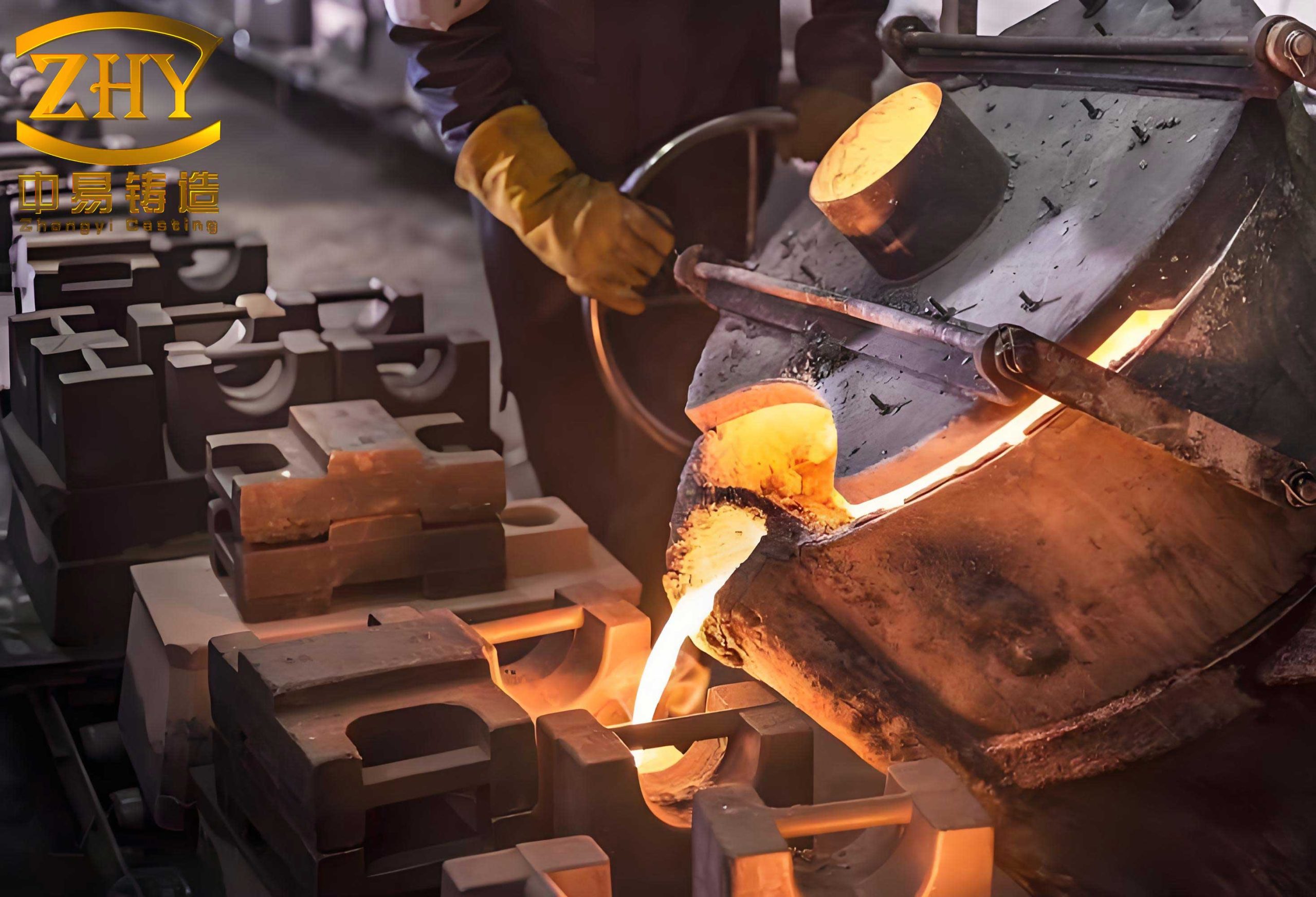
Moving to casting processes, melting is a foundational step for high-quality cast iron parts. The choice of furnace—cupola, electric arc, or induction—depends on production scale and material requirements. In my experience, duplex melting is prevalent in automotive foundries to ensure temperature stability within $\pm 10^\circ$C and compositional control with deviations as low as $\pm 0.05\%$ for key elements. Induction furnaces, particularly coreless types with frequencies up to 300 Hz, are favored for their flexibility and low pollution. Energy consumption in melting cast iron parts is a critical metric; typically, producing one ton of cast iron parts consumes energy equivalent to 10-15% of the part cost. Optimizing this involves using high-quality charge materials, reducing overheating time, and improving ladle designs. For instance, a taller ladle with height-to-diameter ratio of 1.5 can save energy and reduce nodularizing agent usage by 20%. The energy balance can be represented as:
$$E_{\text{total}} = E_{\text{melting}} + E_{\text{holding}} + E_{\text{pouring}}$$
where $E_{\text{melting}}$ dominates, and reductions are achieved through process improvements.
Molding techniques for cast iron parts have evolved toward automation and precision. High-pressure multi-piston molding lines are common, but newer methods like静压造型 and gas冲击造型 offer uniform compaction with minimal noise. Unboxed squeeze molding is gaining traction for complex cast iron parts like engine blocks due to its simplicity and high productivity. In sand preparation, properties are tightly controlled: green compressive strength of 120-180 kPa, moisture content of 3.0-3.5%, and clay addition below 0.5% per cycle. Automated systems use sensors and microcomputers to adjust parameters in real-time. Special processes such as evaporative pattern casting enable intricate geometries for cast iron parts like cylinder heads, reducing core needs and cleanup. The table below summarizes key molding methods for cast iron parts:
| Molding Method | Key Features | Applicability to Cast Iron Parts | Typical Dimensional Tolerance |
|---|---|---|---|
| High-Pressure Molding | High hardness,自动化 | Engine Blocks, Brake Drums | ±0.3 mm |
| 静压造型 (Static Pressure) | Low vibration, uniform density | Cylinder Heads, Housings | ±0.2 mm |
| Gas冲击造型 (Gas Impulse) | Rapid compaction, energy-efficient | Complex Structural Parts | ±0.25 mm |
| Evaporative Pattern | No cores, complex shapes | Exhaust Manifolds, Intakes | ±0.4 mm |
Core-making for cast iron parts has shifted toward cold-box processes, which offer fast curing at room temperature and high dimensional accuracy. While hot-box and shell cores are still used, cold-box systems reduce energy consumption and allow quick pattern changes. However, binder development remains an area of research to address environmental concerns. Cleaning of cast iron parts, once labor-intensive, is now automated with vibrating drums that handle 5-10 tons per hour, followed by shot blasting with controlled parameters to avoid surface hardening in ductile iron cast iron parts. The cleaning efficiency $\eta_c$ can be modeled as:
$$\eta_c = \frac{m_{\text{cleaned}}}{m_{\text{total}}} \times 100\%$$
where $m_{\text{cleaned}}$ is the mass of cast iron parts processed per hour, often exceeding 95% in modern systems.
Quality inspection of cast iron parts has transitioned from mere testing to total quality management, involving statistical process control at every stage. Non-destructive techniques like X-ray, ultrasonic, and eddy current testing are employed for 100%检查 of critical cast iron parts. For example, internal defect detection in cast iron parts such as crankshafts uses ultrasonic waves with sensitivity to flaws as small as 1 mm. The probability of detecting a defect $P_d$ in cast iron parts can be expressed using a reliability function:
$$P_d = 1 – e^{-\lambda t}$$
where $\lambda$ is the inspection rate and $t$ is time. Environmental aspects are increasingly vital; foundries generating cast iron parts must manage sand waste, dust, and noise. Recycling of used sand is essential, as producing one ton of cast iron parts yields approximately 0.8 tons of waste sand. Efforts focus on reducing emissions through source control and closed-loop systems.
Looking ahead, the production of cast iron parts faces challenges and opportunities. Lightweighting will drive further thin-walled designs, with target wall thicknesses below 3 mm for components like engine blocks. Material hybridizations, such as composite cast iron parts with ceramic inserts, will enhance functionality. Digitization and Industry 4.0 will revolutionize foundries for cast iron parts, with real-time monitoring and AI-driven optimization. Energy consumption per ton of cast iron parts is projected to decrease by 20-30% through advanced melting and recycling. The future value of cast iron parts lies in their adaptability; by leveraging new alloys and processes, they can maintain competitiveness against alternatives like aluminum or plastics.
In conclusion, as I reflect on the evolution of cast iron parts for automobiles, it is clear that continuous innovation in materials, processes, and management is essential. The integration of tables and formulas in this article underscores the technical depth required. From melting to inspection, each step contributes to the reliability and efficiency of cast iron parts. The keyword “cast iron parts” has been emphasized throughout to reinforce their role as a backbone of automotive manufacturing. As we move forward, the synergy between traditional foundry skills and modern technology will ensure that cast iron parts remain a vital component in the vehicles of tomorrow, balancing performance, cost, and sustainability.