
In the production of high-integrity steel castings, particularly complex sand casting products, achieving soundness in isolated heavy sections remains a persistent challenge. Traditional methods rely heavily on the application of metallic chills or, more commonly, metal feeder pads (or “wash”) to extend the effective feeding range of risers. These metallic pads, designed based on empirical data and solidification principles, create a directional thermal gradient that channels liquid metal from the riser to the casting’s isolated hot spot. However, this established technique carries significant drawbacks. The metal used for the pad itself is ultimately wasted, as it must be removed from the finished casting via cutting, grinding, or sawing. For high-alloy grades, such as duplex stainless steels, this represents a substantial loss of expensive raw material. Furthermore, the energy consumed and labor required for the removal operation add considerable cost to the final product. My exploration into advanced foundry techniques has therefore focused on identifying efficient alternatives that can maintain or improve casting quality while dramatically reducing waste and cost in the manufacture of sand casting products.
The core objective of this work was to evaluate the feasibility and performance of exothermic feeder pads as a direct replacement for traditional metallic pads in the sand casting of a duplex stainless steel valve body. The principle behind exothermic padding is fundamentally different. Instead of using a massive metal chunk to draw heat, an exothermic pad is composed of a specially formulated material that, upon contact with the molten metal, undergoes a highly exothermic chemical reaction. This reaction generates intense local heat, effectively insulating the adjacent metal and maintaining it in a liquid state for an extended period. This creates the necessary thermal gradient for feeding, but without the permanent addition of sacrificial metal. The success of this method hinges entirely on the performance characteristics of the exothermic material—its ignition temperature, heat output, duration of exothermic reaction, and the insulating properties of its residue.
After a thorough review of commercially available products, a specific exothermic blend, designated here as Type EX5 BLEND, was selected for trial. Preliminary data provided by the material supplier indicated superior performance compared to standard exothermic compounds. The key metric is the “hot-top” duration—the time the metal in the feeder zone remains above a critical temperature (e.g., the solidus). For a standard exothermic material, this duration might be 2-3 minutes, while the data for Type EX5 BLEND suggested an extension to nearly 6 minutes, a critical factor for feeding thicker sections in large sand casting products. The following formula conceptually represents the total heat available to the local metal from an exothermic pad, which must balance the heat loss through the sand mold:
$$ Q_{exo} = \int_{0}^{t_{rxn}} \dot{q}_{exo}(t) \, dt $$
where \( Q_{exo} \) is the total exothermic energy released per unit volume, \( \dot{q}_{exo}(t) \) is the time-dependent exothermic power density, and \( t_{rxn} \) is the total reaction time. This energy must compensate for the conductive and radiative losses:
$$ Q_{loss} = \int_{0}^{t_{solid}} k_{eff} \cdot A \cdot \nabla T(t) \, dt + \int_{0}^{t_{solid}} \epsilon \sigma A (T(t)^4 – T_{mold}^4) \, dt $$
where \( k_{eff} \) is the effective thermal conductivity of the mold/coating system, \( A \) is the interface area, \( \nabla T(t) \) is the time-varying temperature gradient, \( \epsilon \) is the emissivity, \( \sigma \) is the Stefan-Boltzmann constant, and \( t_{solid} \) is the local solidification time. A successful exothermic pad maximizes \( Q_{exo} \) and its delivery rate while the reaction residue minimizes \( k_{eff} \).
| Parameter | Standard Exothermic Material | Type EX5 BLEND Material |
|---|---|---|
| Hot-Top Duration (above ~1147°C) | ~2.25 minutes | ~5.70 minutes |
| Primary Mechanism | Rapid, high-intensity burn | Sustained exothermic reaction with insulating slag layer |
| Key Advantage | Quick ignition | Prolonged feeding window, better for heavier sections |
The test casting was a gate valve body produced via silica sand molding, a classic example of a complex, pressure-containing sand casting product. Its material was ASTM A890 5A (CD3MN duplex stainless steel), known for its corrosion resistance but also for its solidification shrinkage challenges. The nominal dimensions were 830 mm x 500 mm x 440 mm, with a finished casting weight of approximately 540 kg. Two identical casting setups were planned from the same melt: one employing traditional metallic feeder pads on its two flanges, and the other using identically sized exothermic pads in the same locations. This direct comparison was crucial for isolating the effect of the pad technology.
Process Design and Numerical Simulation
The initial step involved designing the conventional metallic pad geometry for the flange sections. Using established foundry engineering charts and applying necessary safety factors for a 100% radiographically inspected casting, a pad with dimensions 270 mm (width) x 260 mm (height) x 90 mm (thickness) was calculated. A full 3D solidification simulation model of the casting, including all gating, risers, and these metallic pads, was constructed. The simulation software, a standard tool in modern foundries for optimizing sand casting products, solves the transient heat transfer equation during phase change:
$$ \rho c_p \frac{\partial T}{\partial t} = \nabla \cdot (k \nabla T) + \rho L \frac{\partial f_s}{\partial t} $$
where \( \rho \) is density, \( c_p \) is specific heat, \( k \) is thermal conductivity, \( L \) is latent heat of fusion, and \( f_s \) is the solid fraction. The model was iteratively adjusted until the simulation predicted sound solidification without shrinkage porosity in the critical flange regions. This validated design served as the baseline, with a total pouring weight of 1050 kg, yielding a casting yield of 51.4%.
The next phase was to digitally replace the metallic pads with exothermic pads of the same external dimensions. This required importing the thermophysical properties of the Type EX5 BLEND material into the simulation software. These properties are non-trivial and change dynamically: a low initial thermal conductivity (like a sand core), a sharp peak in internal heat generation during the exothermic reaction, and finally, the formation of a highly insulating charred residue. The software model approximates this as a time-dependent boundary condition with enhanced effective heat flux into the casting at the pad interface. Running the simulation with these parameters was essential to pre-validate the design before committing to expensive metal and materials. The results showed a similar, and in some areas improved, thermal gradient leading from the riser through the exothermic pad zone and into the flange, confirming the theoretical feasibility for producing sound sand casting products.
| Process Parameter | Metallic Pad Process | Exothermic Pad Process | Change |
|---|---|---|---|
| Pad Dimensions (each) | 270 x 260 x 90 mm | 270 x 260 x 90 mm | 0% |
| Calculated Pad Weight (each, steel) | ~35 kg | ~0 kg (material mass negligible) | ~100% reduction |
| Total Pouring Weight | 1050 kg | 980 kg | -70 kg (-6.7%) |
| Casting Yield | 51.4% | 55.1% | +3.7 percentage points |
Manufacturing and Practical Application
The exothermic pads were manufactured on-site. The EX5 BLEND material, supplied as a dry blend of powders, was mixed with a liquid binder system to achieve a moldable consistency. This mixture was then compacted into a core box designed to the exact pad dimensions, creating a “green” pad. After curing, these pre-formed pads were handled like conventional sand cores. They were positioned in the mold cavity at the predetermined flange locations prior to molding. A critical step often overlooked is venting; the exothermic reaction produces gas, so ensuring adequate vent paths from the back of the pad into the molding sand is essential to prevent gas pressure from pushing metal back into the riser or even causing blows in the sand casting product. The pads were then coated with a refractory zirconia-based coating and dried along with the rest of the mold.
Both molds—one with metallic inserts and one with exothermic inserts—were poured from the same ladle of duplex stainless steel to ensure identical metallurgical conditions. After the standard cooling period, the molds were shaken out. The visual difference was immediate. In the traditional mold, the solid steel feeder pads were fused to the casting flanges, requiring subsequent thermal cutting. In the exothermic test mold, the pad location was covered in a fragile, black, carbonaceous residue. This residue was easily removed with standard vibration cleaning or light wire brushing, revealing a clean, slightly oxidized but smooth cast surface beneath.
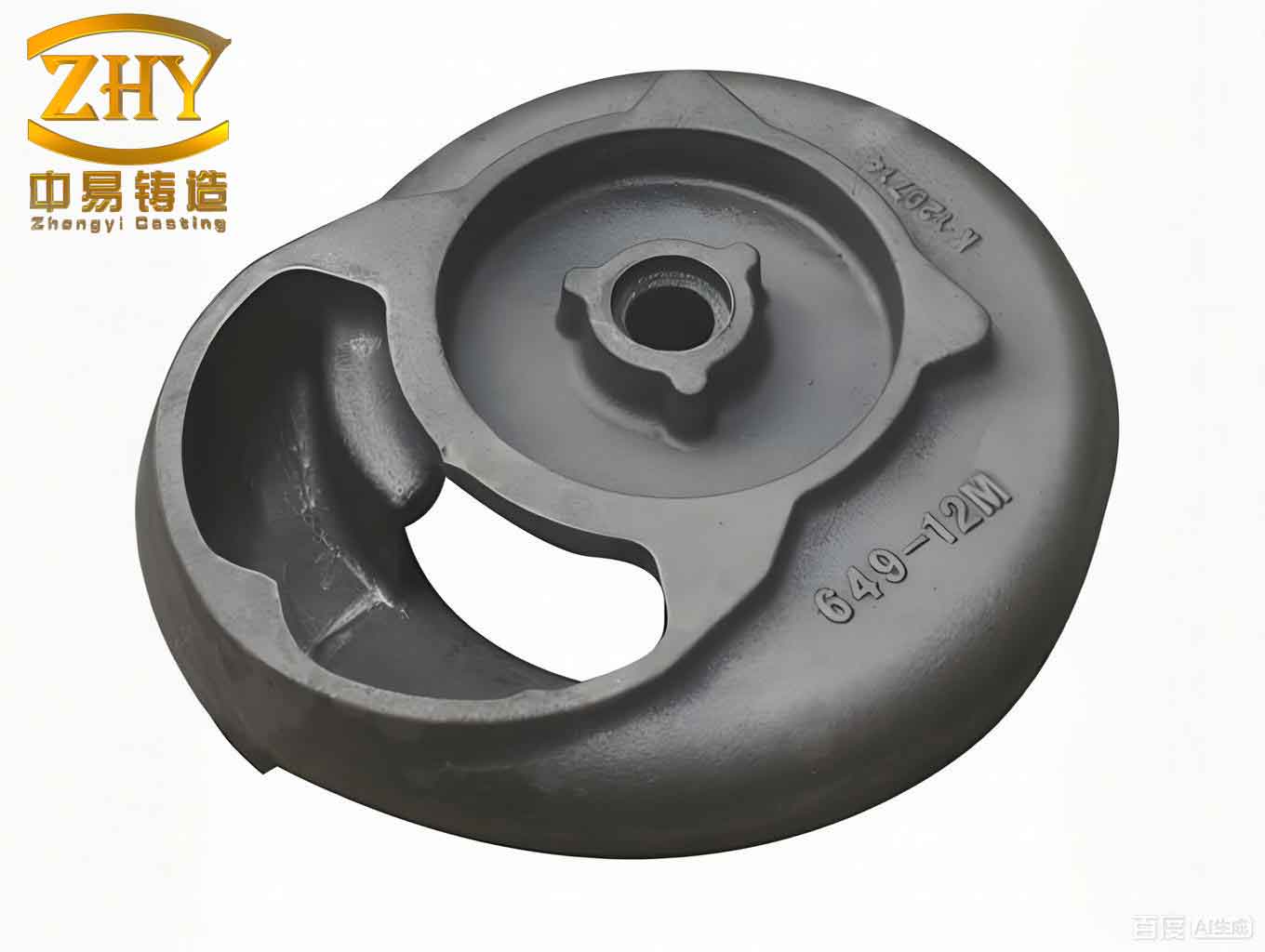
The surface finish at the exothermic pad site was excellent, with no signs of burn-on, fusion, or excessive penetration—common concerns when using reactive materials. This indicated that the coating had functioned correctly as a barrier. Most importantly, non-destructive evaluation via radiographic testing (RT) was conducted on the critical flange sections of both castings. The radiographs confirmed that both casting methods successfully produced sound material. No shrinkage porosity, cavities, or related defects were detected in the areas fed by either the metallic or the exothermic pads. This was the ultimate validation that the exothermic system could meet the stringent quality requirements for such high-performance sand casting products.
Technical and Economic Impact Analysis
The success of the trial allows for a detailed breakdown of the advantages offered by exothermic feeder technology. The benefits extend beyond the simple material substitution.
1. Direct Material Savings: The elimination of the sacrificial steel pad (70 kg in this case) is a direct saving on costly alloy. For duplex stainless steel, the cost per kilogram is significant. The yield improvement from 51.4% to 55.1% directly translates to less melt required per casting, reducing energy consumption for melting, alloying element losses, and slag generation. This efficiency gain is multiplicative in high-volume production of sand casting products.
2. Elimination of Secondary Operations: Removing a fused steel pad is a major operation. It typically requires plasma arc cutting, oxy-fuel cutting, or large band saws. These processes consume electricity/gas, expend consumables (plasma torches, cutting tips, saw blades), require significant labor time, and generate heat, noise, and fumes. All these costs—capital, operational, and environmental—are completely avoided with the exothermic pad, which disintegrates during shakeout.
3. Improved Working Environment and Safety: The removal of thermal cutting operations improves shop floor safety by eliminating risks associated with high-temperature sparks, intense UV radiation from plasma arcs, and handling of heavy cut-off pieces. The working environment becomes cleaner and less hazardous.
4. Design Flexibility and Precision: Pre-formed exothermic pads can be made to very precise shapes, potentially allowing for more optimized, conformal feeder designs that follow the casting contour more closely than a blocky metal pad. This can lead to further yield improvements and more efficient use of space in the mold for arranging other sand casting products.
To quantify the economic benefit, a simplified cost model can be applied. Let \( C_m \) be the cost per kg of liquid metal, \( C_{exo} \) be the cost per exothermic pad, \( C_{cut} \) be the cost to cut off one metallic pad (including labor, power, consumables, and overhead), and \( W_{pad} \) be the weight of one metallic pad.
For the traditional method, the total added cost per pad location is:
$$ Cost_{metal} = C_m \cdot W_{pad} + C_{cut} $$
For the exothermic method, the cost is simply:
$$ Cost_{exo} = C_{exo} $$
The saving per pad is therefore:
$$ Saving = (C_m \cdot W_{pad} + C_{cut}) – C_{exo} $$
Given that \( C_{exo} \) is typically much lower than the combined cost of the metal and its removal, the saving is substantial and scales directly with the number of pads used across all sand casting products in a foundry’s portfolio.
| Cost Category | Metallic Pad (per pad) | Exothermic Pad (per pad) | Notes |
|---|---|---|---|
| Material Cost | High (C_m * W_pad) | Low-Medium (C_exo) | C_m is high for alloy steels. |
| Removal Operation Cost | High (C_cut) | Zero | Includes labor, energy, consumables, machine depreciation. |
| Yield Impact | Lower overall yield | Higher overall yield | Improves furnace throughput and efficiency. |
| Environmental/Safety Cost | Higher (fumes, waste, risk) | Lower | Exothermic residue is minimal and often benign. |
In conclusion, the integration of high-performance exothermic feeder pads, such as those based on the Type EX5 BLEND technology, represents a significant technological advancement for the steel casting industry, particularly for high-value, complex sand casting products. My practical experience confirms that they can successfully replace traditional metallic pads without compromising internal or surface quality, as verified by simulation and rigorous NDT. The transition delivers profound economic benefits through direct metal savings, the elimination of costly and hazardous secondary operations, and an improvement in overall casting yield. Furthermore, it aligns with modern manufacturing goals of waste reduction and improved process sustainability. For foundries producing duplex, super duplex, high-alloy, or other premium steel sand casting products, the adoption of this technology is not merely an option but a compelling strategy for enhancing competitiveness, profitability, and operational safety. The initial validation on a valve body provides a strong foundation for extending this methodology to a wider range of geometries and alloys within the diverse family of sand casting products.