
In the evolving landscape of engineering education, there is a pressing need to bridge traditional manufacturing techniques with modern digital fabrication technologies. This article delves into the development and implementation of an innovative teaching platform that seamlessly integrates the investment casting process with computer-aided precision carving systems. From a first-person perspective, I will detail the conceptualization, design, and pedagogical outcomes of this platform, emphasizing how it fosters interdisciplinary learning and enhances students’ systemic understanding of industrial production workflows. The core of this initiative lies in merging the ancient art of investment casting with advanced subtractive manufacturing, thereby creating a holistic experiential learning environment. Throughout this exploration, the investment casting process will be a recurring theme, as it forms the bedrock of the practical exercises and technical investigations conducted.
The motivation for this project stemmed from observing a growing trend in engineering training: the compartmentalization of skills into isolated, single-process modules. While modules dedicated to CNC milling, 3D printing, or robotics are valuable, they often fail to convey the interconnected nature of real-world manufacturing. Students might become proficient in operating a single machine but lack the ability to design a product and see it through the entire chain of design, process planning, and multi-process fabrication. This platform was conceived to break down these silos. By creating a cross-fusion laboratory experience centered around creating a final metal product, we aimed to simulate a miniaturized industrial project. The investment casting process, known for its ability to produce complex, high-precision metal parts, was chosen as the culminating stage. It requires careful upfront planning and preparation, which is where precision carving of wax patterns comes into play. This integration forces students to think beyond a single operation and consider the entire product lifecycle.
The current state of engineering practice education often leans towards short-duration, modular training on specific equipment. This approach, while efficient for teaching basic operational skills, has significant limitations. It promotes a “siloed” mindset where the connection between different manufacturing domains—such as hot working (like casting) and cold working (like machining)—is rarely explored. For instance, a student might learn CNC milling in one lab and sand casting in another, with little opportunity to understand how a CNC-milled prototype could be used to create a pattern for a casting mold. This disconnection does not reflect the integrated nature of modern product development. Furthermore, such modular courses can sometimes lead to passive participation, as the learning objectives for each module are narrow and predefined. Our platform addresses this by framing the learning around a tangible goal: the design and fabrication of a personalized artifact, such as a pendant or a ring, which necessitates the sequential and interdependent application of both carving and casting skills. This project-based learning model inherently demands active engagement, teamwork, and systems thinking.
The design of the teaching platform and its associated curriculum was meticulously planned to ensure a logical flow from concept to finished metal part. The entire process is decomposed into stage-gate tasks, mimicking professional project management. The fundamental contents covered are twofold: the investment casting process and precision carving technology.
The investment casting process, also known as lost-wax casting, is a sophisticated manufacturing method where a wax pattern is invested (surrounded) by a refractory ceramic material to form a mold. After the mold is fired, the wax is melted out, leaving a precise cavity into which molten metal is poured. This process is renowned for its excellent surface finish, dimensional accuracy, and ability to cast intricate geometries. In our teaching context, we employ a plaster-based investment casting process suitable for non-ferrous alloys like bronze or silver. Students must master the sub-processes: wax pattern preparation, gating system assembly, investment (plaster mixing and pouring), burnout (wax removal and mold sintering), melting and pouring, and finally, post-processing (divesting, cutting, grinding, and polishing).
Precision carving in this context refers to the CNC milling of wax blocks to create the initial pattern. Students use CAD/CAM software to design their artifact and generate toolpaths. A desktop CNC milling machine then precisely carves the wax model. This step introduces students to digital design, CNC programming, and the fundamentals of subtractive manufacturing. The wax model produced here becomes the direct input for the investment casting process, creating a tangible link between digital design and metal casting.
The curriculum is structured as a 24-hour intensive project, typically spread over three days. The project is product-oriented, with students working in small teams. Each team member assumes specific functional roles, such as design engineer, process planner, or manufacturing technician, though all participate in hands-on tasks. This role-playing enhances their understanding of professional responsibilities and teamwork dynamics.
The following tables outline the detailed schedule and task breakdown for the project, using the example of creating a commemorative pendant.
| Day | Time Slot | Activity | Key Learning Objectives |
|---|---|---|---|
| Day 1 | 8:00-8:40 | Project Overview & Introduction | Understand the integrated workflow and safety protocols. |
| 8:40-9:10 | Brainstorming & Conceptual Sketching | Apply design thinking to generate and select ideas. | |
| 9:10-9:50 | Cross-training on Process Fundamentals | Learn basics of CAD, CAM, milling, and investment casting. | |
| 9:50-11:30 | CAD Design & Wax Pattern Roughing | Create digital model and begin physical wax pattern preparation. | |
| Day 2 | 8:00-9:00 | CAM Programming & Simulation | Generate and verify CNC toolpaths for wax carving. |
| 9:00-11:20 | CNC Milling of Wax Pattern | Operate CNC mill to produce the final wax pattern. | |
| 11:20-11:30 | Workshop Cleanup (6S) | Implement workplace organization standards. | |
| Day 3 | 8:00-10:00 | Investment Casting Process: Assembly, Investing, Burnout | Assemble wax tree, mix plaster, pour investment, begin mold burnout cycle. |
| 10:00-11:00 | Melting, Pouring & Cooling | Operate vacuum casting machine to pour molten metal. | |
| 11:00-11:30 | Divesting & Initial Post-processing | Break away plaster mold and perform rough finishing on casting. |
A second table details the specific tasks for the subsequent sessions focused on manual wax refinement and finishing, which often runs in parallel or following the CNC step.
| Phase | Activity | Technical Focus |
|---|---|---|
| Pattern Refinement | Manual carving, texturing, and gating system attachment to the wax pattern. | Skills in manual sculpting, use of hot knives and tools, understanding of gating design for the investment casting process. |
| Mold Preparation | Mixing investment plaster, vacuum de-airing, pouring over wax tree. | Precise control of plaster-water ratio, vacuum techniques to eliminate bubbles. |
| Burnout & Sintering | Programming and monitoring the furnace for wax elimination and mold hardening. | Thermal cycle optimization critical to the investment casting process. |
| Casting & Finishing | Metal melting under vacuum/inert gas, pouring, shot blasting, cutting, grinding, polishing. | Alloy handling, pouring techniques, and metal finishing skills. |
Assessment is multifaceted, focusing on process, outcome, and reflection. The following rubric is used to evaluate student performance, emphasizing the integration of skills.
| Criteria | Weight | Description |
|---|---|---|
| Safety & Workshop Practice (6S) | 15% | Adherence to safety rules and maintenance of an orderly workspace. |
| Design Creativity & Technical Rationale | 25% | Quality of design sketches, CAD models, and the reasoning behind design for manufacturing choices, especially for the investment casting process. |
| Process Execution & Skill | 35% | Competency in operating CNC mill, performing manual wax work, executing the investment casting steps (plaster mixing, burnout, pouring). |
| Final Product Quality | 15% | Dimensional accuracy, surface finish, and integrity of the final metal cast part. |
| Teamwork & Documentation | 10% | Collaboration within the team and completeness of the process portfolio (photos, notes, reflections). |
The heart of the technical innovation in this platform lies in the optimization of the investment casting process parameters for an educational setting. Two major challenges were identified and systematically addressed: determining the optimal plaster-to-water ratio for the investment material and establishing a reliable thermal cycle (burnout curve) for the mold to ensure casting success and quality.
First, the plaster mixture is fundamental. The investment must have sufficient strength to withstand handling and the pressure of molten metal, yet enough permeability to allow gases to escape during pouring. The optimal ratio depends on the volume of the flask (the container holding the wax tree and investment). Through extensive experimentation, we derived a formula to calculate the required mass of dry plaster powder:
$$ m_{\text{plaster}} = V_{\text{flask}} \times \rho_{\text{effective}} $$
Where \( m_{\text{plaster}} \) is the mass in grams, \( V_{\text{flask}} \) is the internal volume of the flask in cubic centimeters, and \( \rho_{\text{effective}} \) is an effective density factor determined empirically. For a standard gypsum-bonded investment, we found \( \rho_{\text{effective}} \approx 1.4 \, \text{g/cm}^3 \). For a cylindrical flask of radius \( r \) (cm) and height \( h \) (cm), the formula becomes:
$$ m_{\text{plaster}} = \pi r^2 h \times 1.4 $$
The water-to-powder ratio (W/P) by weight is then selected based on the desired mold properties. A higher water content increases permeability but reduces strength. For detailed wax patterns with fine features, a ratio closer to 0.40 (40 ml water per 100g plaster) is used. For simpler geometries, a ratio of 0.37 is sufficient. This can be expressed as:
$$ V_{\text{water}} = \frac{m_{\text{plaster}}}{100} \times \text{W/P Ratio} \times 100 $$
For example, for 150g of plaster with a W/P ratio of 0.38, the required water volume is \( 150 \times 0.38 = 57 \, \text{ml} \).
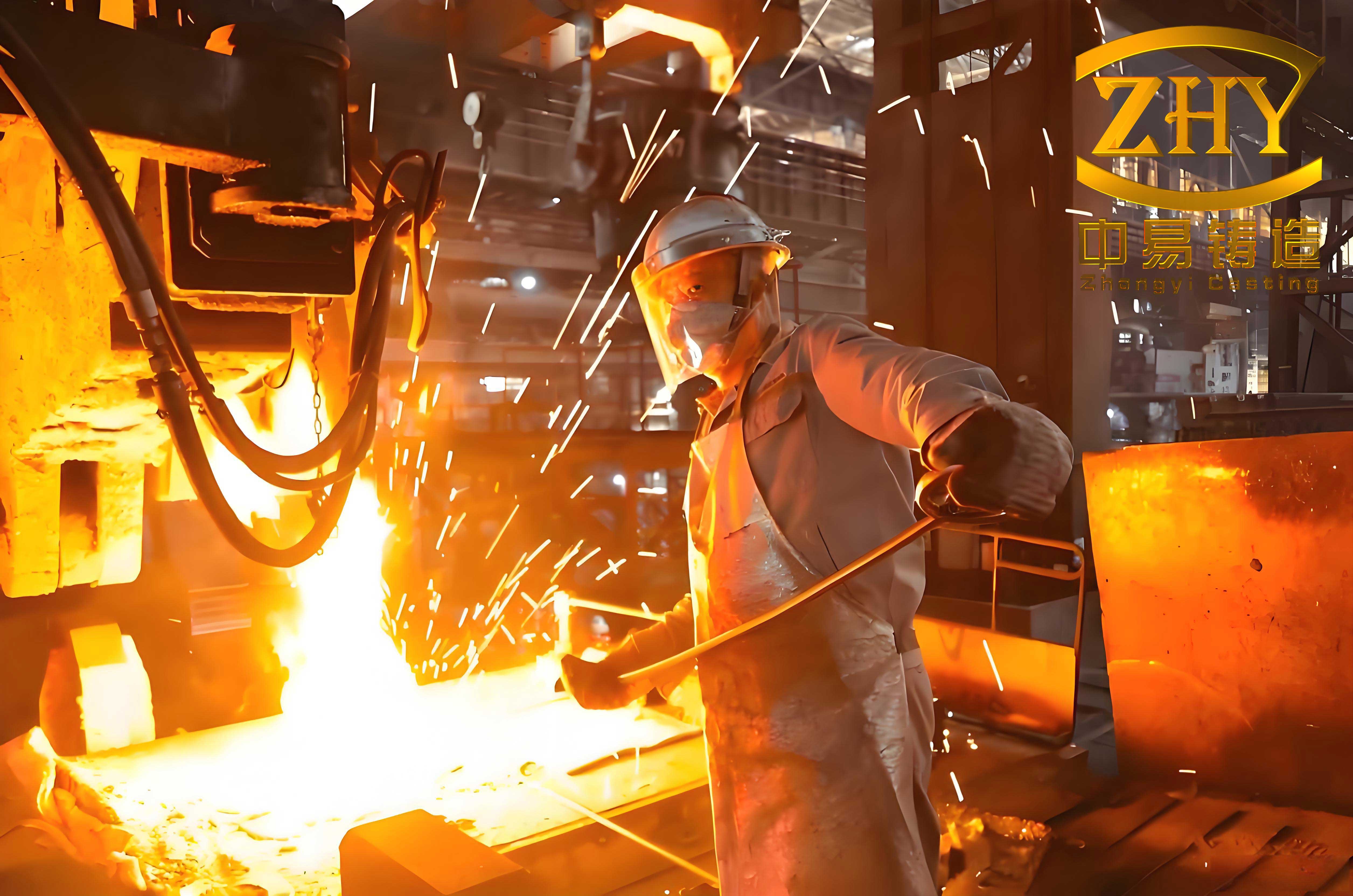
Second, the burnout and sintering cycle is critical in the investment casting process. An improper thermal cycle can cause mold cracking, incomplete wax removal, or poor surface finish on the final casting. The cycle consists of three distinct phases: dewaxing, sintering, and temperature stabilization for casting. We experimented with two types of cycles: a gentle cycle for maximum reliability and a faster cycle for improved efficiency in a teaching schedule where time is constrained.
The gentle burnout curve can be modeled as a piecewise linear temperature ramp. Let \( T(t) \) represent the furnace temperature in °C at time \( t \) in minutes.
Phase 1 (Dewaxing): $$ T(t) = \frac{180}{120} t \quad \text{for} \quad 0 \leq t \leq 120 $$ Hold at \( T=180^\circ C \) for 60 minutes to ensure complete wax evaporation.
Phase 2 (Sintering): $$ T(t) = 180 + \frac{550}{150} (t-180) \quad \text{for} \quad 180 \leq t \leq 330 $$ Ramp to \( 730^\circ C \). Hold at \( 730^\circ C \) for 60 minutes.
Phase 3 (Stabilization): Cool or hold at the target casting temperature (e.g., \( 500^\circ C \) for bronze) for 30 minutes before pouring.
The total cycle time exceeds 7 hours. For a faster process, we developed an accelerated curve, accepting a slightly higher risk for educational prototypes:
Phase 1: $$ T(t) = 5t \quad \text{for} \quad 0 \leq t \leq 60 $$ (Ramp to \( 300^\circ C \) in 60 min).
Phase 2: $$ T(t) = 300 + 7.167(t-60) \quad \text{for} \quad 60 \leq t \leq 120 $$ (Ramp to \( 730^\circ C \) in 60 min). Hold for 30 min.
The choice of cycle depends on the mold size and the alloy. Furthermore, the optimal casting temperature \( T_{\text{cast}} \) is determined by the alloy’s melting point and the part’s geometry. For thin-walled, intricate designs, a higher superheat is needed to ensure complete mold filling. We derived an empirical relation based on the alloy’s liquidus temperature \( T_L \):
$$ T_{\text{cast}} = T_L + \Delta T_{\text{superheat}} $$
Where \( \Delta T_{\text{superheat}} \) typically ranges from \( 50^\circ C \) to \( 150^\circ C \). For a silicon bronze with \( T_L \approx 1020^\circ C \), we found \( T_{\text{cast}} \approx 1100^\circ C \) works well for pendant-sized castings. This parameter is crucial for success in the investment casting process, as too low a temperature leads to misruns, while too high a temperature can cause mold erosion and gas porosity.
The following table summarizes key parameters for different stages of the investment casting process as implemented in our platform:
| Process Stage | Key Parameter | Typical Value / Formula | Remarks |
|---|---|---|---|
| Plaster Mixing | Plaster Mass (g) | \( m_p = \pi r^2 h \times 1.4 \) | For cylindrical flask of radius r, height h (cm). |
| Plaster Mixing | Water-to-Plaster Ratio | 0.37 – 0.40 (w/w) | Higher for finer patterns. |
| Burnout (Gentle) | Dewaxing Ramp Rate | \( 1.5^\circ C/\text{min} \) to \( 180^\circ C \) | Prevents mold cracking. |
| Burnout (Gentle) | Sintering Temperature | \( 730^\circ C \) | Hold for 60 min. |
| Burnout (Fast) | Average Ramp Rate | \( \approx 7^\circ C/\text{min} \) to \( 730^\circ C \) | For time-constrained sessions. |
| Casting | Superheat \( \Delta T \) | \( 80^\circ C \) for bronze | Adjust based on wall thickness. |
The integration of precision carving and the investment casting process within a single pedagogical framework has yielded significant benefits. Students are no longer passive recipients of module-based instruction but become active project managers of their own learning journey. They gain a systems-level understanding of manufacturing, appreciating how digital design decisions directly impact downstream processes like mold-making and casting. The investment casting process, with its sensitivity to pattern quality, gating design, and thermal cycles, teaches the importance of meticulous process planning and control. Students learn that a flaw in the CAD model or a rushed burnout cycle can lead to a failed casting, providing a powerful lesson in cause and effect within engineering systems.
Furthermore, this platform naturally fosters interdisciplinary collaboration. Students from mechanical engineering, materials science, and even design backgrounds find common ground, each contributing their unique perspectives to the product’s realization. The platform has proven to be an effective vehicle for teaching not just technical skills, but also project management, teamwork, and problem-solving—competencies essential for modern engineers. By grounding advanced digital fabrication in the tangible reality of molten metal and plaster, the platform makes complex engineering principles accessible and engaging. The repeated engagement with the investment casting process, from wax to metal, cements a deep, practical understanding of this vital manufacturing technique and its place in the broader technological ecosystem.
In conclusion, the development of this integrated teaching platform represents a meaningful step forward in engineering education. It moves beyond isolated skill training towards a holistic, project-based model that mirrors real-world product development. The seamless fusion of precision carving and the investment casting process provides a rich context for learning that is both technically challenging and creatively stimulating. The challenges encountered and overcome in optimizing plaster ratios and thermal cycles have not only improved the reliability of our educational castings but have also provided valuable data for instructional purposes. This platform stands as a testament to the power of integrating traditional and emerging technologies, creating a learning environment where students can truly experience the full arc of creation—from a digital idea to a physical, metal object held in their hands. The investment casting process, therefore, is not merely a topic taught but becomes the central narrative around which a comprehensive engineering experience is built.