
In my experience with manufacturing large automotive stamping dies, the shift toward as-cast pearlitic ductile iron has been driven by its superior mechanical properties, extended service life, cost-effectiveness, and consistent microstructure. These dies, often weighing between 3000 to 5000 kg with complex geometries and wall thicknesses ranging from 60 to 100 mm, demand a rigorous production methodology. The lost foam casting process, characterized by its use of expendable foam patterns embedded in unbonded sand, presents unique challenges and opportunities for achieving the required material specifications. Through systematic experimentation and refinement, I have developed a comprehensive approach that integrates precise chemical composition control, alloying, effective inoculation, and optimized lost foam casting process parameters. This article details my first-person perspective on the journey to successfully produce these large castings, emphasizing the critical role of the lost foam casting process in attaining the desired as-cast pearlitic matrix with minimal carbides.
The technical specifications for these stamping dies, derived from standards akin to Honda’s requirements, are stringent. The key acceptance criteria are summarized in the table below, which serves as our production benchmark.
| Property | Requirement |
|---|---|
| Tensile Strength (σ_b) | ≥ 550 MPa |
| Elongation (δ) | ≥ 3% |
| Nodularity Grade | 1 to 3 |
| Graphite Size | 5 to 7 |
| Pearlite Content | ≥ 60% |
| Carbide Content | ≤ 3% |
These properties must be verified on attached test blocks from the casting itself, ensuring the bulk material meets the standard. The foundation of achieving this lies in meticulous melt control and chemistry design.
Our melting operations utilize a 5 t/h acid-lined, cold-blast cupola, charged with Shanxi foundry coke. The charge composition primarily consists of Q10 pig iron and carbon steel scrap. To ensure adequate fluidity and graphitization potential, we maintain a target carbon equivalent (CE) range. The carbon equivalent for ductile iron is typically calculated using the formula:
$$ CE = \%C + \frac{\%Si + \%P}{3} $$
However, for our specific alloying strategy focusing on pearlite stabilization, we control the CE within a narrower window of 3.9% to 4.5%. The target chemical composition before and after treatment is critical and is outlined in the following table.
| Element | Pre-Treatment Target (wt.%) | Post-Treatment Target (wt.%) |
|---|---|---|
| Carbon (C) | 3.4 – 3.8 | 3.3 – 3.7 |
| Silicon (Si) | 0.7 – 1.2 | 1.8 – 2.4 |
| Manganese (Mn) | – | 0.5 – 0.8 |
| Sulfur (S) | ≤ 0.07 | ≤ 0.04 |
| Phosphorus (P) | ≤ 0.07 | ≤ 0.07 |
| Residual Magnesium (Mg_res) | – | 0.05 – 0.08 |
| Residual Rare Earth (RE_res) | – | 0.04 – 0.07 |
| Chromium (Cr) | – | 0.3 – 0.5 |
| Copper (Cu) | – | 0.6 – 1.0 |
The principle of “medium carbon, low silicon” is adhered to for optimal graphite nucleation and strength. The detrimental elements sulfur and phosphorus are kept as low as possible in the base iron. Alloying with copper and chromium is indispensable for promoting a pearlitic matrix in the as-cast condition, especially in thick sections where slow cooling might otherwise favor ferrite formation. The synergistic effect of multi-element alloying can be described by an empirical relationship for pearlite promotion potential (PPP):
$$ PPP = k_{Cu} \cdot \%Cu + k_{Cr} \cdot \%Cr + k_{Mn} \cdot \%Mn $$
where $k_{Cu}$, $k_{Cr}$, and $k_{Mn}$ are empirical coefficients. In our practice, the combination of 0.6-1.0% Cu and 0.3-0.5% Cr provided a robust and economical solution to achieve the target pearlite content exceeding 65% in the casting body.
The heart of ductile iron production is the nodularization treatment. Initially, we employed a standard FeSiMg8RE alloy (7-9% Mg, 2-3% RE). However, while it met basic specifications on separately cast test samples, the attached test blocks from large castings showed inconsistent results—typically nodularity grade 3 and pearlite content around 40-55%. To bridge this performance gap between separate and attached samples, we switched to a specialized nodularizer labeled D-2. Its composition is similar but includes a small amount of barium (Ba ≤ 1.0%), which enhances nodule count and reduces chilling tendency. The treatment process involves the sandwich method: the nodularizer (1.9-2.3% of the tapped iron weight) is placed at the bottom of a treatment ladle, covered with ferrosilicon granules and a proprietary covering compound, and then shielded with an iron plate. Approximately two-thirds of the iron is tapped to initiate a calm reaction, followed by the remaining third while simultaneously adding inoculant in the trough. This controlled process maximizes magnesium recovery and ensures consistent nodularization essential for the lost foam casting process, where metal-foam interactions demand a predictable and stable melt quality.
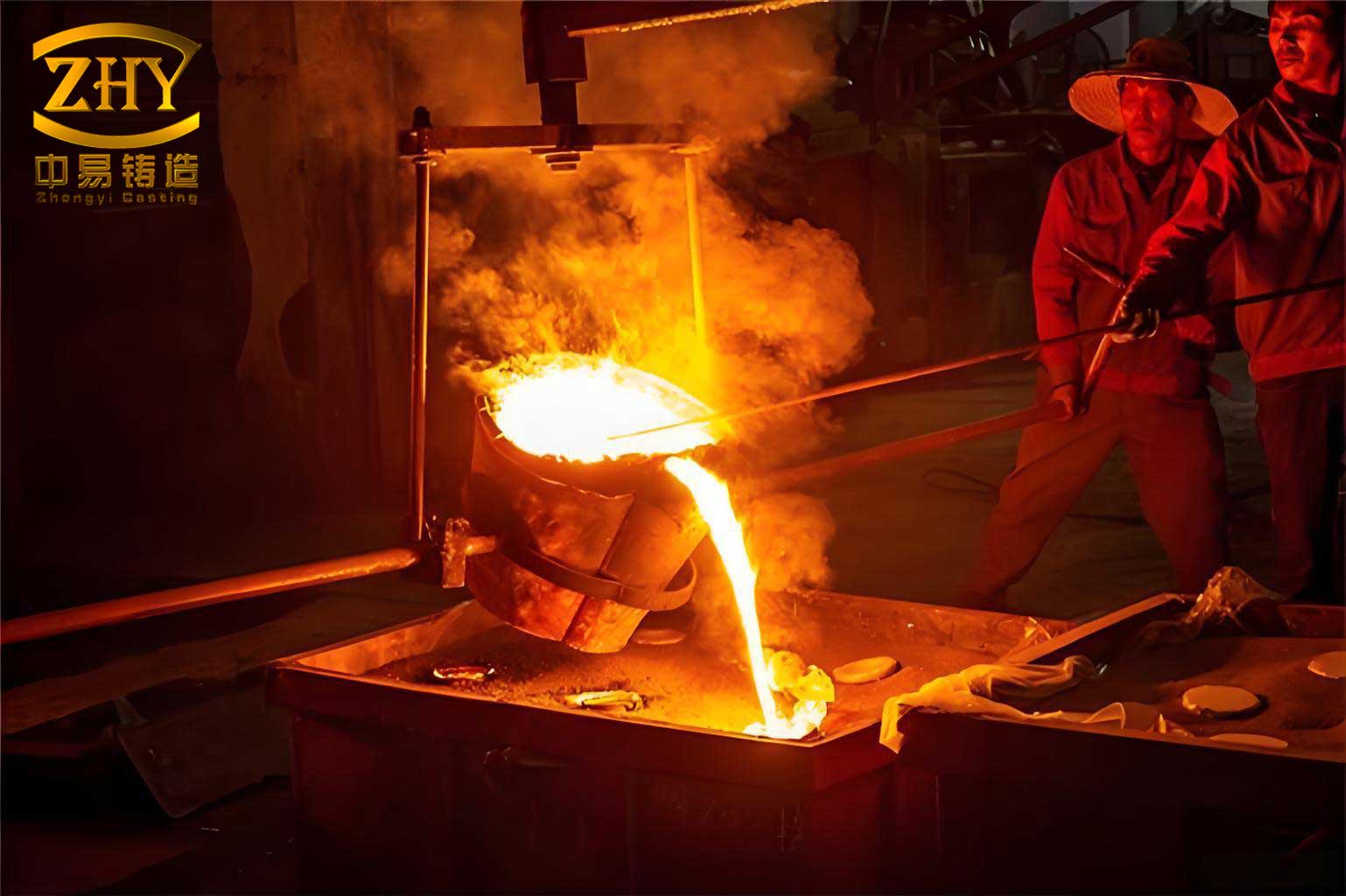
The image above conceptually represents the intricate interaction between the molten metal and the vaporizing foam pattern, a core aspect of the lost foam casting process. The success of this process hinges on managing the gaseous and liquid decomposition products generated during the replacement of the foam by the iron.
Inoculation is perhaps the most critical step for achieving a fine, uniform microstructure in as-cast ductile iron. We evaluated two methods: traditional ladle (or “floating silicon”) inoculation using FeSi75 and stream inoculation using a proprietary composite inoculant containing Si, Ba, and RE. The results were starkly different, as compiled in the table below, which compares key batches from our trials.
| Inoculation Method | Chemical Composition (wt.%) | Mechanical Properties | Microstructure | Nodularity |
|---|---|---|---|---|
| C, Si, Mn, Cr, Cu | σ_b (MPa), δ (%), HBW | Matrix, Graphite Size | Grade | |
| Floating Silicon (FeSi75) | 3.79, 2.06, 0.57, 0.24, 0.63 | 550, 4.5, 205 | 80% P+F, Size 5 | 3 |
| Stream Inoculation | 3.76, 2.01, 0.57, 0.33, 0.62 | 570, 3.6, 215 | 75% P+F, Size 5-6 | 3 |
| Stream Inoculation | 3.64, 1.85, 0.86, 0.38, 0.61 | 585, 4.4, 215 | 90% P+F, Size 5-6 | 2-3 |
| Floating Silicon (FeSi75) | 3.59, 1.94, 0.72, 0.34, 0.69 | 555, 3.0, 215 | 85% P+F, Size 5 | 3 |
| Stream Inoculation | 3.51, 1.82, 0.68, 0.32, 0.65 | 570, 3.1, 225 | 85% P+F, Size 5-6 | 2-3 |
| Stream Inoculation | 3.56, 1.91, 0.74, 0.41, 0.72 | 575, 3.8, 215 | 80% P+F, Size 5-6 | 2-3 |
Stream inoculation consistently yielded better nodularity (grade 2-3), finer graphite (size 5-6), higher and more consistent pearlite content, and improved mechanical properties. The efficiency of stream inoculation can be modeled by considering the inoculant fade time (t) and the effective nucleation sites (N) created. A simplified relation is:
$$ N = N_0 \cdot e^{-λ t} $$
where $N_0$ is the initial nucleation potential and $λ$ is the fade rate. By introducing the inoculant (0.05-0.1% of the metal stream weight) directly into the flow of metal entering the mold cavity, the time delay between inoculation and solidification is minimized, maximizing $N$. The composite elements (Ba, RE) in the stream inoculant act as potent nuclei and provide a buffer against late-stage fading and nodularization decay, which is crucial in the lost foam casting process where the cooling dynamics can vary.
The lost foam casting process itself requires careful adaptation for large ductile iron castings. We use no-bake resin-coated sand with a grain size of 0.60-0.355 mm (30-50 mesh) to ensure high permeability, which is vital for venting the large volume of gases from the decomposing polystyrene foam. The mold strength is critical; we target a tensile strength of 0.7-1.0 MPa at room temperature. Higher strength within this range is preferred for ductile iron to effectively contain the graphite expansion pressure, promoting feed metal movement and minimizing shrinkage porosity—a phenomenon described by the modulus of feeding, $M_f$, which relates to the casting geometry and solidification pattern.
The gating system design in the lost foam casting process is paramount for smooth filling and defect minimization. Unlike conventional casting, the foam pattern occupies the cavity initially, and its thermal degradation products resist metal flow. We have found that bottom-gated systems, such as bottom rain gates or side-bottom gating, are most effective. These designs allow for a steady, upward progression of the metal front, enabling gases and degradation products to be evacuated ahead of the liquid metal into the dry sand mold. The initial velocity of metal entry $v_0$ must be controlled to avoid turbulent entrainment of liquid polystyrene. An empirical rule we follow is to maintain a flow rate such that the foam degradation front velocity matches the metal advance velocity as closely as possible.
Pouring temperature is another decisive parameter in the lost foam casting process. While too low a temperature risks cold laps and mistruns due to the energy absorbed in decomposing the foam, too high a temperature can cause excessive gas generation and mold wall erosion. Through trials, I determined the optimal pouring temperature range to be just above 1400°C, typically 1400-1420°C. This ensures sufficient superheat to complete foam replacement while maintaining good casting finish and internal soundness. The heat balance during pouring can be approximated by:
$$ Q_{metal} = Q_{foam\_decomp} + Q_{sand\_heating} + Q_{casting\_solidification} $$
where $Q_{metal}$ is the heat content of the poured iron, and the terms on the right represent the energy consumed in decomposing the foam, heating the sand, and the latent heat of solidification of the casting, respectively.
The production validation phase involved manufacturing hundreds of tons of these stamping dies. The attached test blocks from production castings were rigorously evaluated. The results consistently showed pearlite content above 65%, with carbide content well below the 3% limit. The mechanical properties met and often exceeded the QT600-3 grade requirements. A statistical summary of the final achieved properties from a representative batch of 20 castings is presented below.
| Property | Average Value | Standard Deviation | Minimum Value | Maximum Value |
|---|---|---|---|---|
| Tensile Strength (MPa) | 568 | 12.5 | 550 | 590 |
| Elongation (%) | 3.8 | 0.6 | 3.0 | 4.7 |
| Hardness (HBW) | 218 | 8.2 | 205 | 235 |
| Pearlite Content (%) | 78 | 6.5 | 68 | 90 |
| Nodularity Grade | 2.5 | 0.4 | 2 | 3 |
The success of this integrated approach confirms the viability of the lost foam casting process for high-demand, large-scale ductile iron components. The combination of alloy design, advanced nodularization and inoculation, and tailored lost foam casting process parameters creates a robust production system.
In conclusion, my exploration into producing large as-cast pearlitic ductile iron stamping dies has yielded a reproducible and successful methodology centered on the lost foam casting process. Key findings include: First, a precise chemical composition with targeted alloying using Cu and Cr is essential for achieving a high pearlite matrix directly in the as-cast state. Second, the selection of an effective nodularizer like D-2 and, more importantly, the adoption of stream inoculation with a composite inoculant are critical for obtaining superior and consistent nodularity, microstructure, and mechanical properties in the casting body. Third, every aspect of the lost foam casting process—from sand grain size and mold strength to gating design and pouring temperature—must be optimized to manage the unique metal-foam interaction, ensuring sound, defect-free castings. The lost foam casting process, when executed with this level of control, is not merely a shaping technique but a fundamental enabler of the desired as-cast material properties. This comprehensive process chain has allowed us to reliably meet stringent automotive standards, proving that the lost foam casting process is a capable and efficient route for manufacturing high-integrity, large ductile iron components.