
As a practitioner in the foundry industry, I have long been engaged in the production of ductile iron castings, which are renowned for their superior mechanical properties and versatility. Among various casting methods, lost foam casting has gained prominence due to its ability to produce complex shapes with high precision and efficiency. However, when applied to ductile iron castings, this process presents unique challenges, particularly in the spheroidization treatment phase. The conventional ladle treatment often leads to insufficient graphite nodule count and low pearlite content, resulting in compromised quality and high rejection rates. This article delves into my exploratory efforts to refine the spheroidization and inoculation processes for ductile iron castings in lost foam casting, aiming to enhance graphite morphology and microstructural stability.
The core issue in lost foam casting of ductile iron castings stems from the high pouring temperatures required, typically ranging from 1560°C to 1600°C. Elevated temperatures accelerate the reaction of spheroidizing agents, reducing magnesium absorption and increasing burn-off rates. This leads to rapid spheroidization decay, manifested as low nodularity, fewer graphite nodules, and inadequate pearlite formation. Initially, our ductile iron castings exhibited graphite nodule counts as low as 30% and pearlite content around 85%, which fell short of the desired benchmarks for high-performance applications. To address this, we embarked on a systematic overhaul of the treatment methodology, focusing on inoculant selection and ladle design.
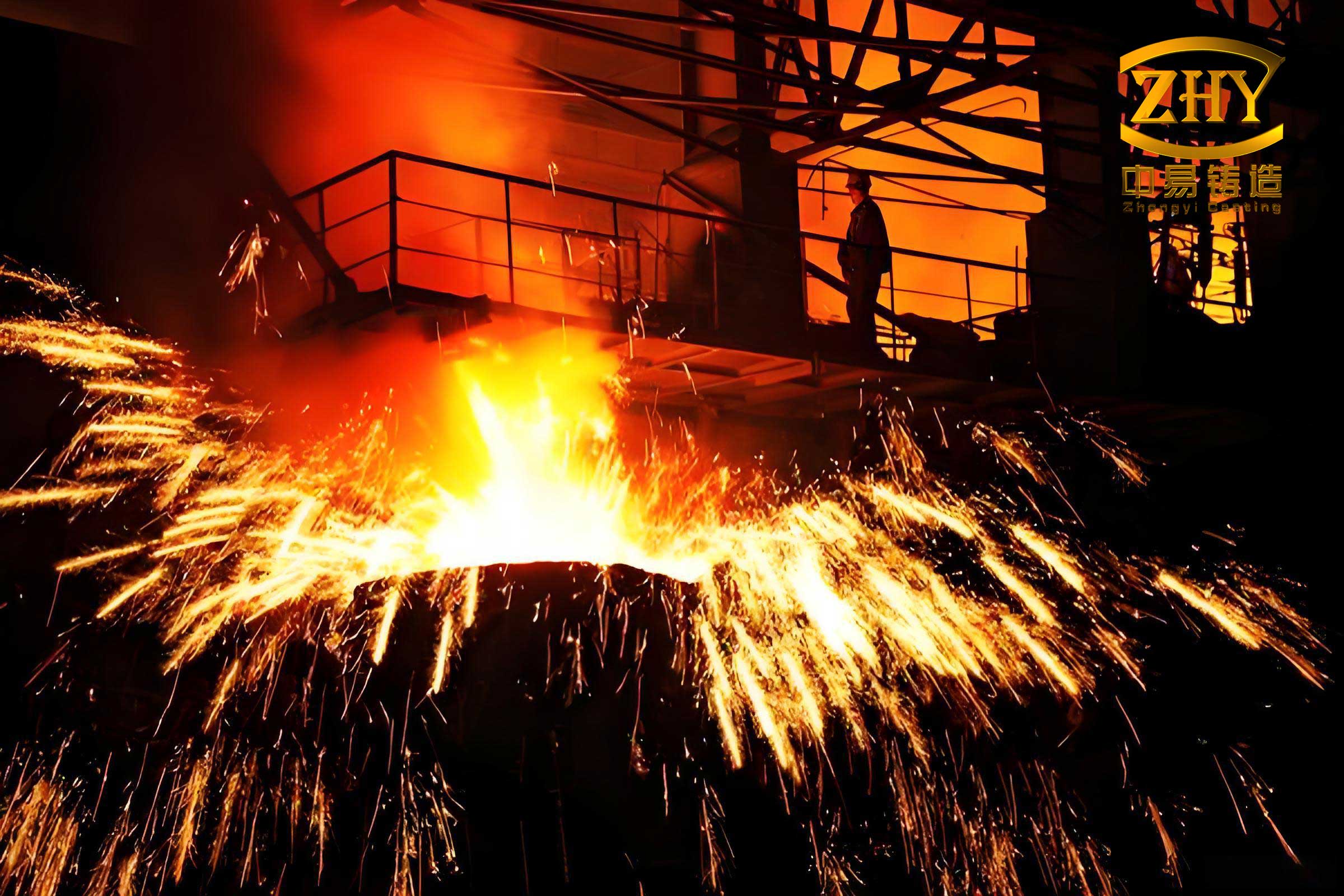
Inoculation plays a pivotal role in determining the graphite structure of ductile iron castings. To counteract the rapid衰退 associated with high temperatures, we adopted a multi-step inoculation approach using composite inoculants. The selection was based on melting points and anti-fade characteristics. We employed three distinct inoculants: a primary inoculant (silicon-based), a secondary inoculant (silicon-barium), and a tertiary inoculant (silicon-barium-calcium). Each serves a specific purpose in enhancing nucleation and delaying fade. The inoculation sequence is as follows: during the spheroidization reaction, after 20 seconds, we add the secondary inoculant at 0.35–0.45% of the iron weight, followed by the tertiary inoculant at 0.2–0.4%. This layered addition boosts inoculation effectiveness, minimizes graphite anomalies, and promotes a uniform distribution of spherical graphite in ductile iron castings.
To quantify the inoculant impact, we derived a formula for inoculation efficiency, which correlates inoculant addition with graphite nodule count. The relationship can be expressed as:
$$ N = k_1 \cdot I_1 + k_2 \cdot I_2 + k_3 \cdot I_3 – \alpha \cdot t $$
where \( N \) is the graphite nodule count per unit area, \( I_1, I_2, I_3 \) are the addition rates of primary, secondary, and tertiary inoculants, respectively, \( k_1, k_2, k_3 \) are efficiency coefficients, \( \alpha \) is the fade rate constant, and \( t \) is time after treatment. This model underscores the importance of timed inoculant additions in maintaining high nodule counts in ductile iron castings.
Complementing inoculation, we redesigned the ladle system to prolong spheroidization reaction time. We introduced a dam-type ladle with a partitioned setup. In one compartment, we layered spheroidizing agent, cover agent, and a steel or ductile iron plate, creating a two-stage reaction mechanism. The specifics are outlined in Table 1, which summarizes the materials and their proportions used in the improved process.
| Component | Purpose | Addition Rate (% of Iron Weight) | Position in Ladle |
|---|---|---|---|
| Spheroidizing Agent (Layer 1) | Initial magnesium source | 0.7–0.9 | Bottom of dam side |
| Cover Agent (Layer 1) | Insulation and reaction control | 0.05–0.15 | On top of spheroidizing agent |
| Plate | Delay mechanism | – | Above cover agent |
| Spheroidizing Agent (Layer 2) | Secondary magnesium source | 0.55–0.65 | On top of plate |
| Primary Inoculant | Initial inoculation | 0.05–0.15 | On top of spheroidizing agent |
| Cover Agent (Layer 2) | Protection | 0.05–0.15 | Top layer |
The plate acts as a barrier, causing the upper spheroidizing agent to react first. As it melts, the lower layer initiates a second reaction, effectively extending the overall reaction time. This staged approach enhances magnesium absorption, which can be modeled using the following kinetic equation:
$$ \frac{d[Mg]}{dt} = R_1 e^{-\beta_1 t} + R_2 e^{-\beta_2 (t – \tau)} $$
where \( [Mg] \) is the residual magnesium concentration, \( R_1 \) and \( R_2 \) are reaction rates for the first and second stages, \( \beta_1 \) and \( \beta_2 \) are decay constants, and \( \tau \) is the plate melting time. This formula illustrates how the two-stage reaction mitigates magnesium burn-off, crucial for producing high-quality ductile iron castings.
Prior to treatment, we pretreated the iron melt with silicon carbide at 0.05–0.15% to improve nucleation sites and refine the matrix. The iron is heated to 1560–1600°C, held for 9–11 minutes, and then poured into the ladle’s empty compartment. The reaction proceeds sequentially, with the plate ensuring a controlled release of magnesium. This method has shown remarkable improvements in our ductile iron castings, as evidenced by microstructural analysis.
To validate the efficacy, we conducted comparative trials between the conventional and improved processes. Key performance metrics are presented in Table 2, highlighting the advancements in graphite and pearlite characteristics for ductile iron castings.
| Parameter | Conventional Process | Improved Process |
|---|---|---|
| Graphite Nodule Count (%) | 30 | 60 |
| Pearlite Content (%) | 85 | 90 |
| Nodularity Grade | Low | High |
| Magnesium Absorption Rate (%) | ~40 | ~65 |
| Rejection Rate (%) | High | Significantly Reduced |
The data confirms that the improved process doubles the graphite nodule count and increases pearlite content, leading to superior mechanical properties in ductile iron castings. The enhancement in nodularity is critical for applications requiring high toughness and fatigue resistance.
Further, we analyzed the thermal dynamics of the process. The heat transfer during the two-stage reaction can be described by the Fourier heat equation, adapted for the ladle system:
$$ \rho C_p \frac{\partial T}{\partial t} = k \nabla^2 T + Q_{rxn} $$
where \( \rho \) is density, \( C_p \) is specific heat, \( k \) is thermal conductivity, \( T \) is temperature, and \( Q_{rxn} \) is the heat generated by spheroidization reactions. This model helps optimize ladle design and pouring parameters to maintain consistent quality across batches of ductile iron castings.
In addition to microstructural benefits, the improved process enhances the reproducibility of ductile iron castings. By standardizing the inoculant additions and ladle setup, we have minimized variability in graphite morphology. The relationship between inoculant composition and graphite shape can be expressed using a empirical formula:
$$ S = \gamma_1 [Si] + \gamma_2 [Ba] + \gamma_3 [Ca] $$
where \( S \) is a shape factor for graphite nodules (with higher values indicating better sphericity), and \( \gamma_1, \gamma_2, \gamma_3 \) are coefficients for silicon, barium, and calcium contributions, respectively. This underscores the importance of composite inoculants in achieving round graphite in ductile iron castings.
Looking ahead, while the current improvements have elevated the quality of ductile iron castings, there remains room for refinement. For instance, pearlite content, though increased to 90%, could be further boosted through alloying elements or controlled cooling. We are exploring the addition of copper or tin to promote pearlite formation without compromising graphite quality. The effect of such alloys can be predicted using the following regression model:
$$ P = \delta_0 + \delta_1 [Cu] + \delta_2 [Sn] – \delta_3 t_c $$
where \( P \) is pearlite percentage, \( [Cu] \) and \( [Sn] \) are alloy concentrations, \( t_c \) is cooling time, and \( \delta \) coefficients are derived from experimental data. This approach aims to push the boundaries of what is achievable with ductile iron castings in lost foam casting.
Moreover, we are investigating the environmental and economic impacts of the improved process. By reducing rejection rates, we minimize material waste and energy consumption per unit of ductile iron castings produced. A cost-benefit analysis can be framed as:
$$ C_{total} = C_{materials} + C_{energy} + C_{rework} $$
where \( C_{total} \) is the total cost, and the improved process lowers \( C_{rework} \) through higher yield. This makes the production of ductile iron castings more sustainable and competitive.
In conclusion, the exploration of spheroidization treatment for ductile iron castings in lost foam casting has yielded significant advancements. Through multi-step inoculation and a innovative dam-type ladle design, we have successfully increased graphite nodule count and pearlite content, thereby stabilizing the quality of ductile iron castings. The integration of theoretical models with practical adjustments provides a robust framework for continuous improvement. As we refine these techniques, the potential for producing high-integrity ductile iron castings expands, paving the way for broader industrial adoption. The journey underscores the importance of adaptive工艺 in overcoming the inherent challenges of lost foam casting, ensuring that ductile iron castings meet the ever-evolving demands of modern engineering applications.