
In the copper mining industry, the efficient processing of ore relies heavily on robust grinding equipment, with semi-autogenous mills being a preferred choice due to their high capacity and effectiveness. Within these mills, liners play a critical role in protecting the mill shell and facilitating the grinding process. However, these components often suffer from premature failure, such as fracture and excessive wear, leading to significant downtime and increased operational costs. In this study, I focus on the failure analysis of steel casting liners used in a large semi-autogenous mill at a copper mine. The objective is to investigate the mechanisms behind the early fracture of lifting strips and provide insights for improving liner longevity through material and process optimization, with a particular emphasis on steel casting quality.
The liners in question were subjected to wet grinding conditions, involving a slurry of ore and grinding balls. The repetitive impact and abrasion from these elements cause severe stress on the liner surface, especially at the lifting strips, which are designed to enhance the grinding action. To understand the failure, I conducted a comprehensive analysis of samples taken from both the top lifting strip area and the bottom region of a failed liner. The methodology included chemical composition analysis, microstructural examination using optical and scanning electron microscopy, X-ray diffraction for phase identification, and hardness measurements. The goal was to correlate the material properties with the observed failure modes and propose enhancements in steel casting practices.
The steel casting used for these liners is a bainitic low-alloy steel, chosen for its balance of strength and toughness. Steel casting processes are crucial in determining the final microstructure and inclusion content, which directly affect performance. In this analysis, I evaluated the chemical composition, which is typical for such applications, as shown in Table 1.
| Element | Content (wt.%) |
|---|---|
| C | 0.587 |
| Si | 1.672 |
| Mn | 0.887 |
| P | 0.04 |
| S | 0.023 |
| Cr | 1.652 |
| Ni | 0.303 |
| Mo | 0.277 |
| Cu | 0.486 |
The mechanical properties of the steel casting liner are summarized in Table 2. The high hardness and impact energy absorption indicate a material designed for demanding conditions, but the early failure suggests underlying issues.
| Property | Value |
|---|---|
| Surface Hardness (HRC) | 50.5 |
| Core Hardness (HRC) | 48.5 |
| Unnotched Impact Energy (J) | 214 |
Microstructural analysis revealed that the base material consists of bainitic ferrite and retained austenite, which is common in advanced steel casting for wear applications. However, the presence of inclusions, primarily manganese sulfides and oxides, was noted. These inclusions are often introduced during the steel casting process and can act as stress concentrators, initiating cracks under cyclic loading. The microstructure at both the top lifting strip and bottom regions was similar, but differences emerged in the subsurface layers due to operational stresses.
To quantify the phase composition, X-ray diffraction was used, and the volume fraction of retained austenite was calculated using the direct comparison method. The formula for this calculation is based on the integrated intensities of diffraction peaks:
$$ V_{\gamma} = \frac{1}{1 + \frac{K_{\alpha}}{K_{\gamma}} \cdot \frac{I_{\alpha}}{I_{\gamma}}} $$
where \( V_{\gamma} \) is the volume fraction of retained austenite, \( K_{\alpha} \) and \( K_{\gamma} \) are correlation coefficients for ferrite and austenite, respectively, and \( I_{\alpha} \) and \( I_{\gamma} \) are the integrated intensities of the diffraction peaks. For the top lifting strip, \( V_{\gamma} \) was approximately 18.46%, while for the bottom, it was 17.68%. This minor difference suggests that the bulk microstructure is uniform, but surface conditions vary due to wear.
The wear surface morphology was examined using scanning electron microscopy. At the top lifting strip, the surface exhibited numerous ploughing grooves and pits, indicative of both micro-cutting and fatigue spalling mechanisms. In contrast, the bottom region showed predominantly ploughing grooves with fewer pits, implying that micro-cutting is the dominant wear mode there. This aligns with the operational conditions: the lifting strips experience direct impact from grinding balls and ore, leading to higher stress and fatigue, while the bottom is more subject to sliding abrasion.
Further analysis of the subsurface microstructure revealed a deformed layer beneath the wear surface, which was thicker at the top lifting strip compared to the bottom. This deformation layer results from work hardening due to repeated impacts. Microhardness measurements confirmed this, showing a gradient from the surface to the bulk material. The hardness near the surface at the top lifting strip reached up to HV 695.5, decreasing to HV 588.3 in the bulk, whereas at the bottom, it ranged from HV 653.8 to HV 605.9. The higher surface hardness is attributed to strain-induced transformation of retained austenite to martensite, a phenomenon common in steel casting under high-stress conditions.
The relationship between hardness and depth can be modeled using an exponential decay function, often expressed as:
$$ H(d) = H_b + (H_s – H_b) \cdot e^{-k d} $$
where \( H(d) \) is the hardness at depth \( d \), \( H_b \) is the bulk hardness, \( H_s \) is the surface hardness, and \( k \) is a decay constant related to material properties. For the top lifting strip, \( k \) was estimated to be higher, indicating more severe work hardening.
Crack initiation was observed in the deformed layer, particularly around inclusions. The stress concentration factor \( K_t \) around an inclusion can be approximated by:
$$ K_t = 1 + 2\sqrt{\frac{a}{\rho}} $$
where \( a \) is the inclusion size and \( \rho \) is the radius of curvature at the inclusion-matrix interface. Larger or sharper inclusions lead to higher \( K_t \), promoting crack nucleation. In steel casting, controlling inclusion morphology and distribution is essential to mitigate this.
The overall wear mechanism involves a combination of impact abrasion and fatigue. The wear rate \( W \) can be described by a model incorporating both micro-cutting and fatigue components:
$$ W = k_c \cdot F_n \cdot v + k_f \cdot \sigma^m \cdot N $$
where \( k_c \) is the micro-cutting coefficient, \( F_n \) is the normal force, \( v \) is the sliding velocity, \( k_f \) is the fatigue coefficient, \( \sigma \) is the stress amplitude, \( m \) is a material exponent, and \( N \) is the number of cycles. For the top lifting strip, both terms are significant, while for the bottom, the first term dominates.
To improve liner performance, enhancing the steel casting process is paramount. Steel casting involves melting, refining, and solidification steps that directly influence inclusion content and microstructure. For example, using high-purity raw materials and optimized deoxidation practices can reduce sulfide and oxide inclusions. Additionally, heat treatment parameters must be controlled to achieve a fine bainitic structure with stable retained austenite, which improves toughness and wear resistance.
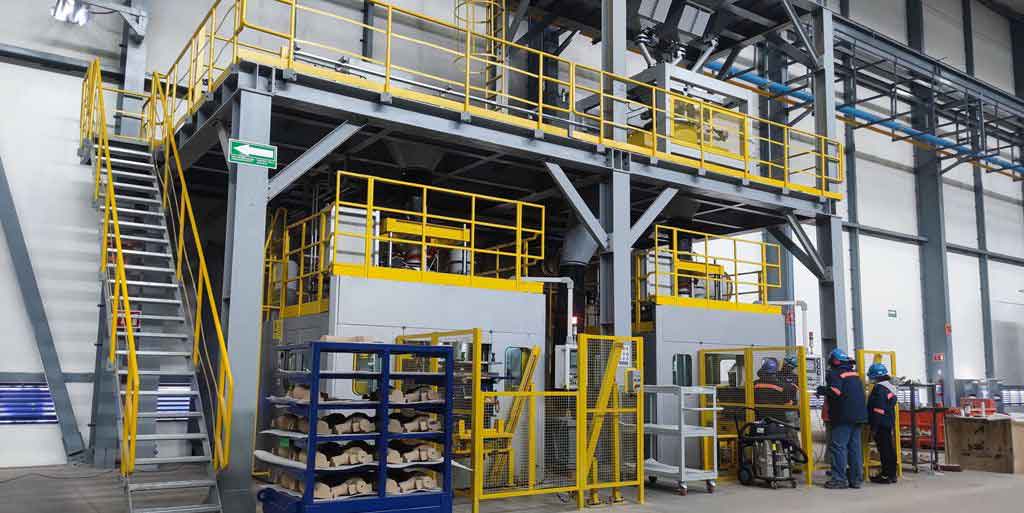
The image above illustrates modern steel casting equipment, highlighting the complexity involved in producing high-quality castings. Such equipment enables precise control over temperature and cooling rates, which is critical for achieving desired microstructures in steel casting liners. In my analysis, I recommend adopting advanced steel casting techniques, such as vacuum degassing or electroslag remelting, to further purify the steel and minimize inclusions.
Furthermore, alloy design plays a key role. The composition of the steel casting should balance hardenability and toughness. For instance, increasing nickel or molybdenum content can enhance toughness without compromising hardness, but cost considerations must be weighed. A proposed optimized composition range is shown in Table 3, based on industry standards for wear-resistant steel casting.
| Element | Optimal Range (wt.%) | Rationale |
|---|---|---|
| C | 0.5-0.6 | Provides hardness through martensite/bainite formation |
| Si | 1.5-2.0 | Enhances strength and retains austenite stability |
| Mn | 0.8-1.2 | Improves hardenability but should be controlled to avoid segregation |
| Cr | 1.5-2.0 | Increases corrosion and wear resistance |
| Ni | 0.3-0.5 | Boosts toughness and impact resistance |
| Mo | 0.2-0.4 | Refines microstructure and enhances strength |
| S | <0.015 | Minimized to reduce sulfide inclusions in steel casting |
| P | <0.03 | Limited to prevent embrittlement |
In terms of heat treatment, the steel casting should undergo austempering to develop a fine bainitic microstructure. The transformation kinetics can be described by the Johnson-Mehl-Avrami-Kolmogorov equation:
$$ f = 1 – \exp(-k t^n) $$
where \( f \) is the transformed fraction, \( k \) is a rate constant, \( t \) is time, and \( n \) is an exponent. For bainite, \( n \) typically ranges from 1 to 2, depending on alloying. Controlling the isothermal holding temperature and time is crucial for achieving optimal properties in steel casting liners.
Another aspect is the design of the liner itself. The geometry of lifting strips influences stress distribution. Finite element analysis can be used to model stress concentrations, with the von Mises stress \( \sigma_{vm} \) given by:
$$ \sigma_{vm} = \sqrt{\frac{(\sigma_1 – \sigma_2)^2 + (\sigma_2 – \sigma_3)^2 + (\sigma_3 – \sigma_1)^2}{2}} $$
where \( \sigma_1, \sigma_2, \sigma_3 \) are principal stresses. Redesigning the lifting strip profile to reduce stress peaks can complement material improvements in steel casting.
Field performance data from similar applications show that liners with lower inclusion content and higher toughness last significantly longer. For example, in some steel casting productions, the use of ceramic filters during pouring reduces inclusion counts by over 50%, leading to a 30% increase in liner life. This underscores the importance of process control in steel casting.
Moreover, non-destructive testing methods, such as ultrasonic inspection, should be employed to detect subsurface defects in steel casting components before installation. This proactive approach can prevent early failures and ensure reliability.
In conclusion, the failure of steel casting liners in semi-autogenous mills is primarily driven by impact abrasion and fatigue, exacerbated by inclusions and subsurface deformation. Through this analysis, I have identified key factors: the need for high-quality steel casting with minimal inclusions, optimized alloy composition, and controlled heat treatment. Implementing these measures can significantly enhance liner durability, reducing maintenance costs and improving mill efficiency. The future of steel casting for wear parts lies in advanced manufacturing techniques and material science innovations, ensuring that components meet the harsh demands of mining operations.
To summarize the recommendations in a actionable format, Table 4 outlines the steps for improving steel casting liner performance.
| Aspect | Action | Expected Outcome |
|---|---|---|
| Steel Casting Process | Use high-purity charge materials, vacuum degassing, and ceramic filters | Reduction in inclusion content by 40-60% |
| Alloy Design | Optimize C, Si, Mn, Cr, Ni, Mo within specified ranges | Improved toughness (impact energy >250 J) while maintaining hardness >50 HRC |
| Heat Treatment | Austemper at 250-350°C for 2-4 hours to form fine bainite | Enhanced microstructural stability and wear resistance |
| Quality Control | Implement ultrasonic testing and microstructure analysis | Early detection of defects, ensuring consistent steel casting quality |
| Liner Design | Optimize lifting strip geometry using FEA | Reduced stress concentrations, minimizing crack initiation |
This comprehensive approach to steel casting liner development highlights the interplay between material properties, manufacturing processes, and operational conditions. By focusing on steel casting excellence, we can achieve longer-lasting liners that contribute to sustainable mining practices. Further research could explore novel steel casting alloys, such as those with nanostructured bainite, or additive manufacturing techniques for customized liner geometries. The continuous evolution of steel casting technology promises even greater advancements in wear-resistant components for the mining industry.