
In the rapidly evolving landscape of national power grid systems, Gas Insulated Switchgear (GIS) has become a cornerstone technology due to its compact structure and high reliability. As market competition intensifies, manufacturers are driven to develop more compact and high-performance GIS products. A significant trend in this pursuit is the shift from welded aluminum alloy shells to shell castings within GIS assemblies. During operation, shell castings are subjected to internal pressure from the insulating medium, and their integrity is paramount to prevent leaks or ruptures. While both shell castings and welded shells can meet functional requirements, shell castings offer distinct advantages in mass production, including lower costs and better adaptability to complex geometries inherent in compact GIS designs. Consequently, the replacement of welded shells with shell castings is accelerating, making the design and validation of shell castings a critical focus. Unlike traditional cylindrical or spherical vessels, shell castings often feature intricate shapes, and their performance is influenced by factors such as casting alloy composition, process methods, and structural discontinuities. Manual calculations are inadequate for such complexities, necessitating advanced computational tools like finite element analysis (FEA) to simulate operational conditions, assess stress distributions, and ensure safety. This article delves into the design of shell castings for a specific voltage-level GIS, employing FEA to analyze stress and strain under internal pressure, followed by linearization analysis and hydraulic testing to validate the design.
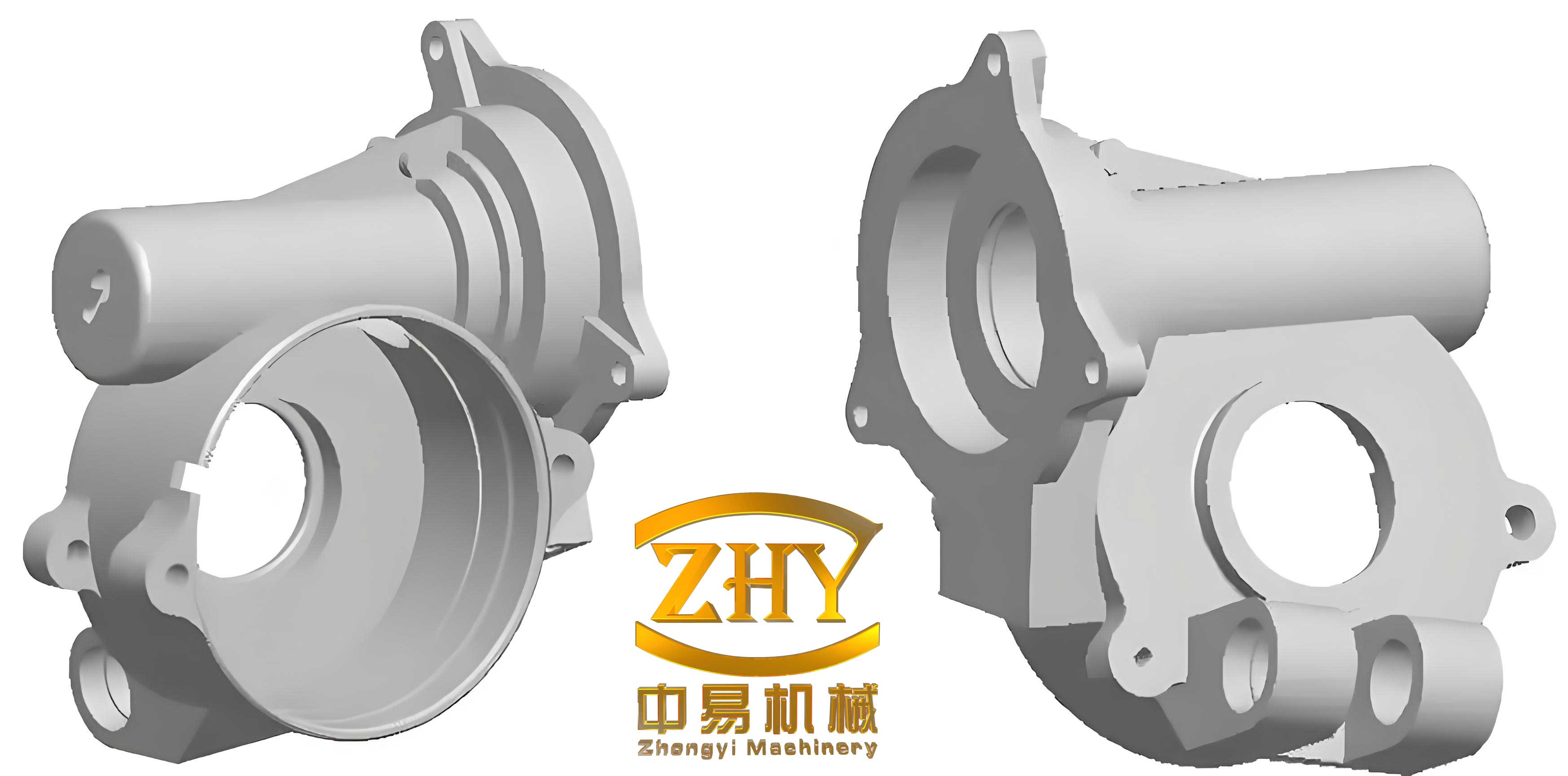
The analytical model for the GIS shell castings is depicted above. Under normal operation, the shell castings experience a working pressure of 0.80 MPa. Accounting for environmental factors like temperature rise and solar radiation, the design pressure is elevated to 1.02 MPa. The material selected for the shell castings is cast aluminum-silicon-magnesium alloy ZL101A-T6, while covers and bolts are modeled using carbon steel Q345R to reflect hydraulic test conditions. The material properties, sourced from mechanical design handbooks and standards, are summarized in Table 1 and Table 2. These parameters form the foundation for the finite element analysis, ensuring accurate simulation of the shell castings’ behavior under load.
Table 1: Material parameters for cast aluminum ZL101A-T6 used in shell castings.
| Parameter | Value |
|---|---|
| Density (kg/m³) | 2770 |
| Young’s Modulus (GPa) | 70 |
| Poisson’s Ratio | 0.33 |
| Yield Strength (MPa) | 275 |
| Allowable Stress Sm (MPa) | 55 |
Table 2: Material parameters for carbon steel Q345R used in covers and bolts.
| Parameter | Value |
|---|---|
| Density (kg/m³) | 7850 |
| Young’s Modulus (GPa) | 200 |
| Poisson’s Ratio | 0.3 |
| Yield Strength (MPa) | 345 |
Finite element analysis was conducted using ANSYS software, a robust tool for simulating physical phenomena. The governing equation for static structural analysis in FEA is expressed as:
$$ [K]\{u\} = \{F\} $$
where $[K]$ is the global stiffness matrix, $\{u\}$ is the displacement vector, and $\{F\}$ is the force vector. For the shell castings, the geometry was discretized into finite elements, with material properties assigned according to Table 1 and Table 2. To ensure result accuracy, a mesh convergence study was performed, refining the element size until stress values stabilized. The mesh sensitivity results are presented in Table 3, confirming that an element size of 5 mm for the shell castings and 3 mm for bolts yields reliable outcomes with minimal variation.
Table 3: Mesh convergence study for the GIS shell castings model.
| Element Size (mm) | Maximum Stress (MPa) | Percentage Change |
|---|---|---|
| 10 | 115.2 | — |
| 5 | 107.97 | -6.3% |
| 2.5 | 106.5 | -1.4% |
The boundary conditions and loading for the shell castings were meticulously defined. The bottom cover plate end face was constrained as a fixed support to simulate mounting. Contact surfaces between cover plates and the shell flange were set as frictional with a coefficient of 0.2, while other interfaces were bonded to represent welded or integral connections. The internal pressure of 1.02 MPa was applied uniformly to the inner walls of the shell castings, and pre-tightening forces were imposed on bolts to account for assembly effects. Under these conditions, the FEA solved for stress and strain distributions, highlighting areas of concern in the shell castings.
The stress distribution results revealed that the maximum stress in the shell castings occurred at the bolt holes on the flange, reaching 108 MPa. This stress arises from concentrated forces exerted by bolts to counteract shell deformation, encompassing both primary and secondary stresses. According to stress classification criteria outlined in pressure vessel standards, stresses are categorized into primary stress (which balances external loads), secondary stress (from constrained deformation), and peak stress (localized increments). For shell castings, the assessment prioritizes primary stresses due to their non-self-limiting nature, while secondary stresses are considered less critical for static failure, and peak stresses are often neglected. The allowable stress intensity limits for normal operation are defined as:
- Primary general membrane stress intensity: $S_m$
- Primary local membrane stress intensity: $1.5S_m$
- Primary membrane plus primary bending stress intensity: $1.5S_m$
- Primary plus secondary stress intensity: $3S_m$
where $S_m$ is the design stress intensity. For the shell castings material ZL101A-T6, $S_m = 55$ MPa. Thus, the bolt hole area, with a stress intensity of 108 MPa, is evaluated against the $3S_m$ limit (165 MPa), confirming compliance as 108 MPa < 165 MPa.
Beyond the bolt holes, stress concentrations in the shell castings were identified at two key locations: ① a thickened reinforcement patch on the outer wall, and ② a fillet transition on the inner wall. These represent structural discontinuities that can compromise the integrity of shell castings. To assess these regions, linearization analysis was performed, extracting stress components along paths through the shell thickness. The linearization process decomposes stress into membrane stress $\sigma_m$ and bending stress $\sigma_b$, calculated as:
$$ \sigma_m = \frac{1}{t} \int_0^t \sigma(x) \, dx $$
$$ \sigma_b = \frac{6}{t^2} \int_0^t \sigma(x) \left( x – \frac{t}{2} \right) \, dx $$
where $t$ is the thickness and $\sigma(x)$ is the stress distribution along the path. The results for the shell castings are summarized in Table 4, comparing the extracted stresses to allowable limits. In both locations, the primary membrane plus primary bending stress intensities are below the $1.5S_m$ threshold (82.5 MPa), validating the design of the shell castings.
Table 4: Strength assessment of stress concentration areas in the shell castings.
| Stress Type | Path Max Stress at Location ① (MPa) | Path Max Stress at Location ② (MPa) | Allowable Limit (MPa) |
|---|---|---|---|
| Primary Membrane Stress | 26.7 | 26.4 | 55.0 |
| Primary Bending Stress | 59.0 | 56.7 | — |
| Primary Membrane + Primary Bending Stress | 79.4 | 79.8 | 82.5 |
The equivalent stress intensity, often used in failure criteria, can be expressed via the von Mises formula:
$$ \sigma_{eq} = \sqrt{\frac{1}{2}[(\sigma_1 – \sigma_2)^2 + (\sigma_2 – \sigma_3)^2 + (\sigma_3 – \sigma_1)^2]} $$
where $\sigma_1$, $\sigma_2$, and $\sigma_3$ are the principal stresses. For the shell castings, this metric helps evaluate multi-axial stress states, though the linearization approach suffices for code compliance. The FEA results underscore that shell castings, despite their complex geometries, can be reliably designed using numerical methods, with stress concentrations managed through careful geometric optimization.
To empirically validate the shell castings design, hydraulic destruction tests were conducted on prototype samples. According to industry standards, cast aluminum shells must withstand a test pressure five times the design pressure. Given the design pressure of 1.02 MPa for these shell castings, the required test pressure is 5.10 MPa. The hydraulic pressure was increased incrementally at a controlled rate of 400 kPa/min, following the procedure in Table 5. This stepwise approach ensures gradual loading and allows for monitoring of the shell castings’ response.
Table 5: Hydraulic test pressure procedure for the shell castings.
| Hydraulic Pressure (MPa) | Hold Time (min) |
|---|---|
| 2.04 | 5 |
| 2.50 | 5 |
| 3.00 | 5 |
| 3.50 | 5 |
| 4.00 | 5 |
| 4.50 | 5 |
| 5.10 | 5 |
During testing, the shell castings maintained integrity at 5.10 MPa for 5 minutes without rupture or pressure drop. The pressure was further elevated to 5.20 MPa and held for an additional 5 minutes, again with no failure. This successful test demonstrates that the shell castings meet and exceed safety requirements, corroborating the FEA predictions. The hydraulic test serves as a critical validation step, ensuring that the shell castings can endure extreme conditions in real-world GIS applications.
In conclusion, the finite element analysis-based design for GIS shell castings has proven feasible and effective. The FEA provided detailed insights into stress and strain distributions, highlighting that stress concentrations in shell castings predominantly occur at structural discontinuities. Through linearization analysis, primary stresses were assessed against codified limits, confirming the adequacy of the shell castings design. The hydraulic destruction tests further validated the numerical findings, affirming the safety and reliability of the shell castings. This methodology offers a robust framework for designing, verifying, and optimizing shell castings, enabling cost-effective production without compromising performance. Future work on shell castings could explore advanced casting techniques, material enhancements, and topological optimizations to further reduce weight and stress concentrations. Ultimately, the integration of FEA into the design process for shell castings ensures that GIS equipment can operate safely under demanding conditions, contributing to the stability and efficiency of power grid systems.