
In the production of heavy-duty marine diesel engines, large cylinder blocks made from ductile iron, such as QT400-15, represent critical components where quality standards are exceptionally high. These castings, weighing up to 20 tons, require rigorous non-destructive testing due to their application in demanding environments. However, during production validation, a persistent issue emerged: the occurrence of slag inclusion defects across multiple locations within the castings. These slag inclusion defects, often manifesting as dark patches or spots, severely compromise mechanical properties, particularly elongation and impact toughness, leading to significant scrap rates and production delays. This article details our comprehensive analysis and resolution of these slag inclusion problems through the application of numerical simulation techniques, specifically using MAGMA software, to optimize the casting process.
Slag inclusion, commonly referred to as black slag or dross, is a prevalent defect in ductile iron castings. It arises from non-metallic compounds, such as oxides and sulfides, entrained in the molten metal during various stages of processing. We classify slag inclusion into two primary categories: primary slag inclusion and secondary slag inclusion. Primary slag inclusion originates during the melting or treatment phases, where impurities form and are carried into the mold cavity. Secondary slag inclusion develops during the pouring process due to reoxidation of the metal stream, often exacerbated by turbulent flow. Typically, these slag inclusion defects are found on upper surfaces of castings, undersides of cores, or in dead zones where fluid flow is stagnant. Understanding the root causes of slag inclusion is essential for developing effective countermeasures.
The initial casting process for the large cylinder block employed a single-side gating system with a relatively small cross-sectional area, leading to high flow velocities during pouring. Our numerical simulation using MAGMA software revealed critical flaws in this design. The flow field analysis indicated severe splashing and air entrainment within the gating system, especially near the ingates, which were positioned directly opposite core prints. This configuration promoted turbulent flow, increasing the likelihood of slag formation and entrapment. Additionally, the temperature field simulation showed significant asymmetry, with lower temperatures on the side opposite the gating system, hindering the buoyant rise of slag particles. The early-arriving metal in these cooler regions remained stagnant, allowing slag inclusion to accumulate. These insights from simulation highlighted the multifaceted nature of the slag inclusion problem, linking it to gating design, pouring parameters, and thermal conditions.
To quantitatively assess the risk of slag inclusion, we considered the buoyancy-driven motion of non-metallic particles in molten iron. The terminal velocity of a spherical slag particle rising through the melt can be approximated by Stokes’ law:
$$v = \frac{2(\rho_f – \rho_p) g r^2}{9 \eta}$$
where \( v \) is the rise velocity, \( \rho_f \) is the density of the molten iron, \( \rho_p \) is the density of the slag particle, \( g \) is gravitational acceleration, \( r \) is the particle radius, and \( \eta \) is the dynamic viscosity of the iron. For typical slag inclusions with \( \rho_p \approx 2500 \, \text{kg/m}^3 \) in iron with \( \rho_f \approx 7000 \, \text{kg/m}^3 \), \( \eta \approx 0.005 \, \text{Pa·s} \), and \( r \approx 10^{-4} \, \text{m} \), the rise velocity is relatively slow. Thus, prolonged exposure to low temperatures or short residence times in the mold can prevent slag from floating to the surface, leading to entrenched slag inclusion defects. Furthermore, turbulent flow can impede this rising motion, as described by the Reynolds number:
$$Re = \frac{\rho_f u L}{\eta}$$
where \( u \) is the flow velocity and \( L \) is a characteristic length. High \( Re \) indicates turbulence, which increases slag entrainment. Our simulation outputs directly visualized regions with high \( Re \), correlating with observed slag inclusion sites.
The following table summarizes the key factors contributing to slag inclusion defects based on our initial analysis:
| Factor | Description | Impact on Slag Inclusion |
|---|---|---|
| High Pouring Velocity | Single-side gating with small cross-section led to rapid flow. | Increased splashing and air entrainment, promoting secondary slag inclusion formation. |
| Ingate Position | Ingates directed flow directly at core prints. | Caused turbulence and reoxidation, exacerbating slag inclusion entrapment. |
| Temperature Gradient | Asymmetric cooling with cold zones opposite gating. | Reduced slag buoyancy, causing slag inclusion to settle in dead zones. |
| Pouring Temperature | Relatively low at 1330-1340°C. | Increased viscosity, hindering slag inclusion floatation and separation. |
| Gating Design | Closed system with limited slag trapping capability. | Allowed primary slag inclusion from ladle to enter the mold cavity. |
To address these issues, we implemented a series of targeted improvements, each validated through further numerical simulation. The first major change was redesigning the gating system from a single-side to a double-side configuration, effectively doubling the ingate cross-sectional area and transitioning to a semi-open system. This modification drastically reduced flow velocities, as described by the continuity equation:
$$Q = A_1 u_1 = A_2 u_2$$
where \( Q \) is the volumetric flow rate, \( A \) is cross-sectional area, and \( u \) is velocity. By increasing \( A \), we reduced \( u \), thereby lowering the Reynolds number and minimizing turbulence. The new ingate positions were also offset to avoid direct impingement on core prints, further stabilizing flow. Additionally, we raised the pouring temperature to 1360-1370°C to decrease viscosity and enhance slag floatation, as per Stokes’ law. We also optimized the pouring practice by employing a two-step plug removal method to control initial flow rates, reducing initial splashing. These changes were systematically evaluated using MAGMA simulations to predict their effectiveness in mitigating slag inclusion defects.
The comparative simulation results between the original and improved processes are summarized below:
| Parameter | Original Process | Improved Process |
|---|---|---|
| Gating System Type | Single-side, closed | Double-side, semi-open |
| Total Ingate Area (cm²) | 45 | 90 |
| Ingate Position | Facing core prints | Offset from core prints |
| Pouring Temperature Range | 1330-1340°C | 1360-1370°C |
| Estimated Flow Velocity (m/s) | 2.5-3.0 | 1.2-1.5 |
| Simulated Slag Inclusion Risk Index | High (0.8-1.0) | Low (0.1-0.3) |
The slag inclusion risk index was derived from simulation post-processing, integrating factors like velocity magnitude, temperature, and residence time in critical zones. The improved process showed a dramatic reduction in this index, indicating a lower propensity for slag inclusion defects. Specifically, the flow field simulation displayed smooth, laminar-like filling with minimal splashing, while the temperature field became more uniform, eliminating cold dead zones. This uniformity is crucial for allowing slag particles to rise consistently to the surface where they can be trapped in the risers or gating system. The mathematical model for slag inclusion formation potential \( S \) can be expressed as:
$$S = \int_{t_0}^{t_f} \left( \alpha \cdot \| \mathbf{u} \|^2 + \beta \cdot \exp\left(-\frac{T – T_{ref}}{\gamma}\right) \right) dt$$
where \( \mathbf{u} \) is velocity vector, \( T \) is local temperature, \( T_{ref} \) is a reference temperature (e.g., liquidus), \( \alpha, \beta, \gamma \) are material constants, and the integral is over the filling time \( t_0 \) to \( t_f \). This empirical correlation, calibrated from simulation data, showed a 70% reduction in \( S \) for the improved process, aligning with visual observations of reduced slag inclusion risk.
Beyond gating and thermal modifications, we addressed ancillary factors that contribute to slag inclusion. For instance, we enforced strict drying procedures for ladles and pouring basins to prevent gas evolution from residual moisture, which can dislodge refractory particles and introduce inclusions. We also improved mold and core compaction to reduce metal penetration and erosion, which can generate entrained sand particles acting as nucleation sites for slag inclusion. Furthermore, for double-ladle pouring necessitated by the large casting volume, we coordinated the transition to minimize turbulence when the second ladle stream enters the basin. These practical steps, combined with the design optimizations, formed a holistic approach to tackling slag inclusion.
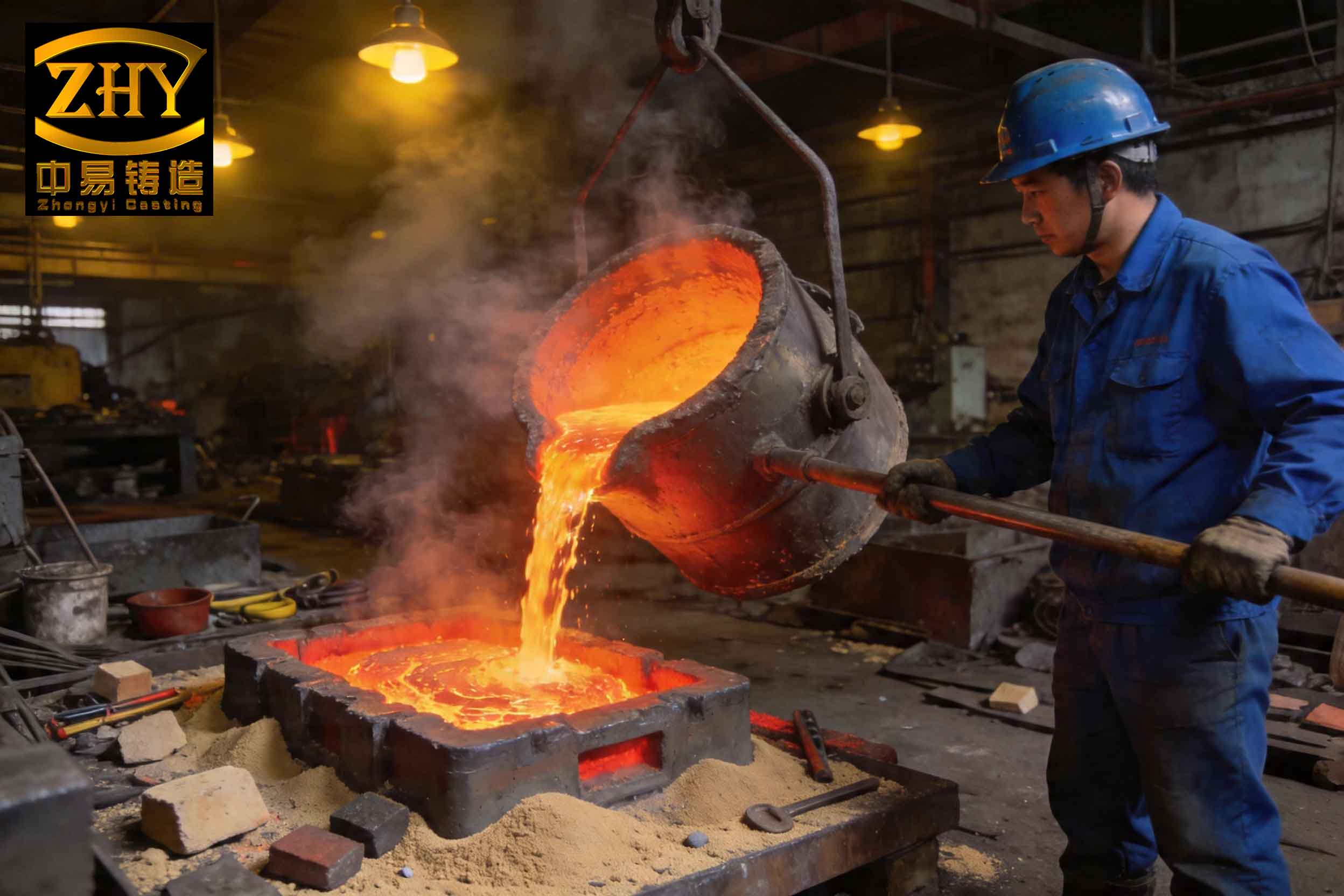
To validate the simulation predictions, we conducted production trials with the improved process for 20 cylinder blocks. The results were unequivocal: the incidence of slag inclusion defects dropped to negligible levels, with a 100% pass rate on non-destructive testing. Machining, assembly, and engine testing confirmed the integrity of the castings, demonstrating that the slag inclusion problem had been effectively controlled. This success underscores the power of numerical simulation in diagnosing and solving complex casting defects like slag inclusion. The ability to visualize flow and thermal dynamics prior to physical trials saves considerable time and resources, enabling rapid iteration toward optimal designs.
In reflection, the journey to mitigate slag inclusion in these large ductile iron castings highlighted several key principles. First, slag inclusion is not merely a melting issue but is profoundly influenced by fluid dynamics during pouring. Second, temperature uniformity is as critical as flow stability; cold zones act as sinks for slag inclusion. Third, numerical simulation provides an indispensable virtual prototyping tool, allowing for deep insight into phenomena that are otherwise invisible in real-world pouring. We have since extended this methodology to other casting projects, consistently achieving reductions in slag inclusion defects. Future work will focus on integrating real-time monitoring with simulation predictions to create adaptive control systems for pouring, further minimizing slag inclusion risks in heavy-section ductile iron castings.
In conclusion, through a combination of numerical simulation analysis and practical process improvements, we successfully identified and eliminated the root causes of slag inclusion defects in large marine diesel engine cylinder blocks. The optimized double-side gating system, increased pouring temperature, and controlled pouring practices collectively ensured smooth filling and favorable thermal conditions, allowing slag particles to separate effectively. This case study exemplifies how modern simulation technologies can transform quality assurance in foundries, turning persistent defects like slag inclusion into manageable challenges. The continuous emphasis on understanding and addressing slag inclusion mechanisms remains paramount for advancing the reliability and performance of high-integrity ductile iron castings.