
In the evolving landscape of industrial manufacturing, the demand for adaptability in production systems has become paramount. As an engineer deeply involved in the process design, guidance, and quality management of steel and iron castings production, I have witnessed firsthand the challenges faced by specialized sand casting lines. Traditionally, these lines were designed for high-volume, single-product outputs, leveraging dedicated equipment and streamlined processes to achieve economies of scale. However, with market dynamics shifting towards diverse, small-to-medium batch orders—driven by customer-specific requirements and rapid technological changes—the rigidity of such specialized systems has exposed vulnerabilities. This article delves into the imperative for柔性化 (flexibility) improvements in specialized sand casting production lines, outlining the principles guiding such transformations and detailing practical implementations across key process stages. Through these enhancements, we have not only sustained operational viability but also expanded our capability to produce a wide range of sand castings, from lightweight components to heavy-duty parts, thereby meeting the multifaceted demands of modern industries.
The core of our discussion revolves around sand castings, which are fundamental to numerous sectors, including automotive, railway, energy, and machinery. Sand castings offer versatility in shape and material, but their production often hinges on the efficiency and adaptability of the manufacturing line. In our facility, which focuses on砂型铸造 (sand casting), we initially operated a专业化 (specialized)生产线 (production line) tailored for specific railway components like bolsters and side frames. This line incorporated advanced dedicated equipment for molding, melting, and cleaning, optimized for castings weighing between 300 kg and 1,000 kg. While this specialization yielded high productivity and consistent quality for bulk orders, it struggled to accommodate market fluctuations, such as the sharp decline in railway freight demand that led to order shortages. Consequently, we embarked on a journey to柔性化改进 (flexibly improve) our line, enabling it to handle multi-variety, variable-batch production of sand castings, including those as light as 10 kg or as heavy as 5 tonnes, in both steel and iron materials. This transformation underscores the critical balance between specialization and flexibility in sustaining competitive advantage.
To contextualize our improvements, it is essential to understand the inherent characteristics of专业化生产 (specialized production) and柔性化生产 (flexible production). Specialized production concentrates on a single product type, utilizing purpose-built machinery and fixed工艺流程 (process flows) to maximize output and minimize costs. Its advantages include enhanced labor productivity, streamlined management, and improved quality control due to repetitive operations. However, its drawbacks are significant: it exhibits weak risk resistance, as over-reliance on one product line makes the enterprise vulnerable to industry downturns; it limits developmental space, often leaving surplus resources idle; and it fails to respond swiftly to changing market needs. In contrast,柔性化生产 (flexible production) is a manufacturing paradigm designed to overcome these limitations. It encompasses two dimensions: “质”的柔性 (qualitative flexibility), referring to the system’s ability to adapt to different products or components—the greater the variety, the better the flexibility; and时间上的柔性 (temporal flexibility), denoting the speed of switching between products—shorter changeover times enhance flexibility. Flexible production systems excel in handling multi-variety, small-to-medium batch (including single-piece) orders, boosting rapid response capabilities, shortening time-to-market for new products, improving technical装备水平 (equipment levels), refining工艺手段 (process methods), and ensuring higher manufacturing quality. For sand castings production, this means the capacity to produce diverse geometries, materials, and weights without compromising efficiency or standards.
The necessity for柔性化改进 (flexibility improvement) in specialized sand casting lines stems from broader market trends. The era of mass production is gradually being replaced by dynamic, demand-driven manufacturing. Traditional high-volume models, aimed at scale economies, often lead to excess inventory of finished and semi-finished sand castings, reducing capital efficiency. Moreover, contemporary markets prioritize customer diversity, rendering少品种生产模式 (few-variety production models) obsolete. To survive and thrive, sand casting enterprises must embrace flexibility. This is particularly crucial for specialized lines that, while efficient, risk obsolescence without adaptation. Our experience confirms that柔性化改进 (flexibility improvements) are not merely optional upgrades but essential strategic moves to capture emerging opportunities in sectors like high-speed rail, wind power, nuclear energy, and precision machinery, all of which demand high-quality, customized sand castings.
In undertaking柔性化改进 (flexibility improvements), we adhered to key principles to ensure sustainability and effectiveness. First, modifications must integrate with existing equipment and facilities, forming a cohesive system to avoid redundant investments. Second, improvements should reduce能源消耗 (energy consumption),资源消耗 (resource consumption), and污染物排放 (pollutant emissions), aligning with清洁生产 (clean production) and绿色生产 (green production) goals. Third, enhancements must possess一定的先进性和前瞻性 (a degree of advancement and foresight), satisfying current manufacturing requirements while accommodating future product developments for years to come. These principles guided our phased approach across the production line, focusing on molding, melting, and cleaning processes—the core stages in sand castings fabrication.
Our molding and core-making工序 (process stages) originally comprised a dedicated setup for ester-hardened sodium silicate sand, including a 100-ton continuous mixer, jolt squeeze machines, automatic pattern draw devices, drying ovens, and a sand reclamation system. To achieve flexibility, we implemented several innovations. One pivotal change was the transformation of the混砂系统 (mixing system) into a dual-function unit. Recognizing the need to produce iron sand castings weighing 3–5 tonnes with high dimensional accuracy and surface finish—suited for furan resin sand—we retrofitted the existing continuous mixer. We added a supplemental sand storage tank, two liquid resin tanks, and a corresponding delivery system, all connected to the same mixer auger. By programming separate control routines for ester-hardened sodium silicate sand and furan resin sand, we enabled swift切换 (switching) between sand types. Before mixing a different sand, the auger is run empty for minutes to clear residual material, ensuring consistency. This dual capability allows concurrent production of steel and iron sand castings on the same line, boosting utilization and maintaining quality stability. Additionally, we installed an automatic temperature control device to adjust hardener ratios based on ambient conditions, governed by the formula for optimal setting time:
$$ t_s = k \cdot e^{\frac{E_a}{RT}} $$
where \( t_s \) is the setting time, \( k \) is a constant, \( E_a \) is the activation energy, \( R \) is the gas constant, and \( T \) is the temperature. This ensures reliable砂型 (sand mold) properties. The sand reclamation lines were also configured to separately regenerate used sands, with dedicated落砂机 (shakeout machines) directing旧砂 (used sand) to respective再生线 (reclamation lines). This not only cuts costs by reusing sand but also meets environmental standards, a critical aspect for sustainable sand castings production.
For smaller sand castings (e.g., 10–50 kg), we introduced modular molding底板 (pattern plates). Standard small plates are fixed with various pattern molds and then mounted onto universal plates via定位销 (dowels) for use in standard砂箱 (flasks) on the production line. This approach facilitates quick模具转换 (pattern changes) without major downtime, preserving dimensional precision. The system’s flexibility is summarized in Table 1, comparing original and improved molding capabilities.
| Aspect | Original Specialized Line | After Flexible Improvement |
|---|---|---|
| Sand Types Supported | Ester-hardened sodium silicate only | Ester-hardened sodium silicate, furan resin, and potential others |
| Castings Weight Range | 300–1,000 kg | 10 kg to over 5,000 kg |
| Material Compatibility | Steel only | Steel and iron |
| Changeover Time for New Patterns | Days (major retooling) | Hours (modular plate swaps) |
| Core-Making Methods | Manual for complex cores | Automated: box-in compression, shooting, robotic setting |
| Sand Reclamation | Single-type dry regeneration | Multi-type segregated regeneration |
In core-making, we advanced from manual methods for intricate cores to automated processes. For complex sand cores in high-end sand castings, we adopted a盒内挤压锁芯成形工艺 (box-in compression locking core-forming process). This technique, based on shooting principles, involves filling sand into a lower core box, closing with an upper box, and compressing the unbonded sand via an automatic core assembler. Locking pins secure the core, yielding seamless internal cavities without fins or steps, which enhances wall thickness accuracy and reduces defects like sand inclusions and poor chaplet fusion. The core quality can be expressed in terms of dimensional tolerance \( \Delta d \):
$$ \Delta d = \frac{F}{A \cdot E} $$
where \( F \) is the compressive force, \( A \) is the core area, and \( E \) is the sand’s elastic modulus. We also integrated an intelligent core storage system that manages and tracks cores through an information network, optimizing space and retrieval efficiency. For sodium silicate砂芯 (sand cores), we modified horizontal shooting machines originally dedicated to side-frame cores. By designing interchangeable shooting barrels, blow plates, and shooting plates for different core boxes, we enabled multi-variety core production, improving efficiency and quality consistency. Furthermore, robotic automation was introduced for placing complex cores. Robots with adaptable grippers perform recognition, scanning, and placement tasks without human intervention, ensuring precision and long-term stability. This reduces人为因素 (human factors) and minimizes defects, crucial for high-integrity sand castings.
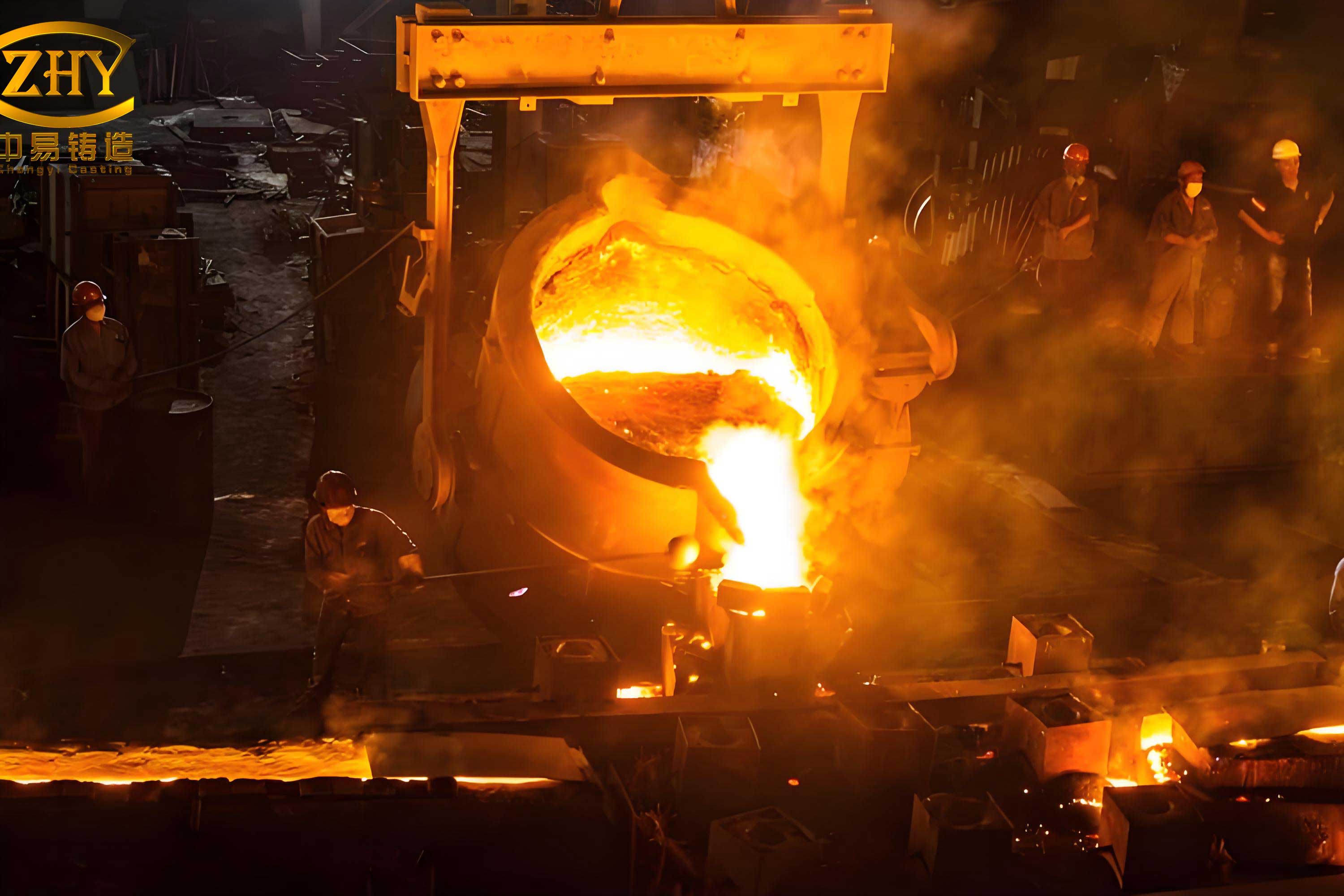
The熔炼 (melting) and浇注 (pouring) stages, centered on a 30-ton EBT electric arc furnace, LF ladle refining furnace, wire feeders, and hot-top stopper systems, also underwent柔性化改进 (flexibility improvements). A key challenge was pouring small sand castings with low weight, where the钢液 (molten steel) temperature in a 30-ton ladle would drop excessively during extended pouring times. To address this, we refined ladle lining techniques, optimized argon stirring during refining, controlled slag volume, and added ladle covers. These measures reduced the temperature drop rate from 0.9°C per minute to below 0.5°C, extending viable pouring time to over 80 minutes. This is governed by the heat loss equation:
$$ \frac{dT}{dt} = -\frac{hA}{\rho V c_p} (T – T_{\text{env}}) $$
where \( \frac{dT}{dt} \) is the cooling rate, \( h \) is the heat transfer coefficient, \( A \) is the surface area, \( \rho \) is density, \( V \) is volume, \( c_p \) is specific heat, and \( T_{\text{env}} \) is ambient temperature. For small sand castings, we now pair them with larger同钢种 (same steel grade) castings in a single heat to utilize the entire ladle efficiently. Additionally, we designed a简易轨道浇注机 (simple rail pouring machine) for simultaneous two-end pouring of large sand castings. Previously, manually aligning浇口箱 (pouring basins) with ladle nozzles was hazardous and time-consuming. The rail machine, movable along浇注线 (pouring lines), allows precise positioning with minimal crane movement, cutting pouring time by half and ensuring consistent temperature control for后续浇注 (subsequent pours). Its adjustable rollers accommodate various flask heights, making it versatile for different sand castings. These improvements ensure that both large and small sand castings are poured effectively, eliminating defects like misruns and cold shuts.
清理 (Cleaning) operations, involving shakeout, hydraulic cleaning, heat treatment, shot blasting, inspection, and painting, were similarly enhanced for flexibility. The continuous heat treatment lines, featuring heating, soaking, and cooling zones with积放推式悬链 (accumulating conveyor chains), were made adaptable through吊具 (lifting fixture) redesign. Originally, monolithic fixtures for specific railway components limited versatility. We developed主、副组合吊具 (main-sub combination fixtures) where sub-fixtures are swapped for different product types, avoiding empty runs and enabling batch-specific treatment. Moreover,多钩吊具 (multi-hook fixtures) were introduced to handle multiple small sand castings or distribute load for heavy ones, reducing breakage risks and improving safety. This flexibility allows continuous treatment of varied sand castings, ensuring consistent mechanical properties and metallurgical structure. The heat treatment efficacy can be modeled using the Austin-Rickett equation for phase transformation:
$$ X = 1 – \exp(-k t^n) $$
where \( X \) is the transformed fraction, \( k \) is a rate constant, \( t \) is time, and \( n \) is an exponent. Uniform正火组织 (normalized structures) are achieved, as shown in micrographic analyses, enhancing the durability of sand castings. Other cleaning stages, such as shot blasting and non-destructive testing, were also optimized for multi-product flows, with adjustable parameters for different sizes and geometries of sand castings.
The成效 (effects) of these柔性化改进 (flexibility improvements) are substantial. Our production line now accommodates an expansive range of sand castings, from miniature components to massive structures, across steel and iron materials. The molding system supports multiple sand binders, enriching process options. Automation levels have risen, particularly in core-making and pouring, boosting productivity and quality stability. Economically, we have reduced changeover costs, minimized idle capacity, and tapped into new markets. Environmentally, segregated sand reclamation lowers waste and energy use, supporting green manufacturing goals. To quantify these outcomes, Table 2 summarizes key performance metrics before and after improvements.
| Performance Metric | Before Improvement | After Improvement |
|---|---|---|
| Product Variety (Number of Distinct Sand Castings) | 2 (bolster, side frame) | Over 50 (including高铁件 high-speed rail,风电 wind power,核电 nuclear parts) |
| Batch Size Flexibility | Large batches only (>100 pieces) | Small to large batches (1 piece to thousands) |
| Weight Range of Sand Castings | 300–1,000 kg | 10 kg to 5,000+ kg |
| Material Types | Cast steel only | Cast steel and cast iron |
| Average Changeover Time Between Products | 24–48 hours | 4–8 hours |
| Defect Rate (Critical Defects per 100 Tons) | 2.5% | 1.2% |
| Energy Consumption per Ton of Sand Castings | 550 kWh | 480 kWh |
| Sand Reclamation Rate | 85% | 92% |
| Time-to-Market for New Sand Castings Design | 12 weeks | 6 weeks |
These enhancements underscore the transformative power of柔性化改进 (flexibility improvements) in specialized sand casting lines. By integrating advanced technologies like robotics, automated control systems, and modular tooling, we have created a production environment that is both resilient and progressive. The ability to swiftly adapt to market shifts—such as the diversification into wind turbine components or nuclear plant fittings—has fortified our business against sector-specific downturns. Moreover, the emphasis on sustainability through efficient resource use aligns with global trends towards eco-friendly manufacturing, making our sand castings more appealing to environmentally conscious clients.
Looking ahead, we plan to further refine our柔性化 (flexibility) capabilities. Potential areas include implementing digital twins for real-time process simulation, adopting additive manufacturing for rapid pattern prototyping, and enhancing IoT connectivity for predictive maintenance. These steps will continue to elevate the quality, efficiency, and adaptability of our sand castings production. In conclusion, the journey from a rigid, specialized line to a flexible, multi-purpose system has not only safeguarded our operations but also unlocked new growth avenues. It demonstrates that in the realm of sand castings manufacturing, the fusion of specialization with flexibility is not just a tactical adjustment but a strategic imperative for long-term success. As markets evolve, so must our approaches, ensuring that every sand casting produced meets the highest standards of precision, durability, and sustainability.
Throughout this article, the term ‘sand castings’ has been repeatedly emphasized to highlight its centrality in our discussions. From molding innovations to pouring adjustments and cleaning optimizations, every improvement ultimately serves to enhance the production of diverse sand castings. This focus underscores the enduring importance of sand castings in industrial applications and the need for continuous innovation in their manufacturing processes. By sharing our experiences, we hope to inspire other enterprises in the砂型铸造 (sand casting) industry to embrace柔性化改进 (flexibility improvements), fostering a more dynamic and resilient manufacturing ecosystem for sand castings worldwide.