
In my extensive work with wear-resistant materials, I have long been intrigued by the paradoxical nature of white cast iron. This alloy is renowned for its exceptional hardness and resultant abrasion resistance, stemming from its unique microstructure—a network of hard, brittle cementite (Fe3C) embedded in a pearlitic or martensitic matrix. The inherent high carbon content, typically between 2.0% and 3.6%, is the source of this desirable hardness. However, this very structure is also its Achilles’ heel. The continuous, interlocking network of eutectic cementite acts as a brittle skeleton, severely compromising toughness. Cracks propagate effortlessly along these carbide boundaries. Furthermore, casting defects like micro-porosity, shrinkage cavities, and inherent micro-cracks are almost unavoidable, further driving down impact resistance. This fragility limits the application of conventional white cast iron, particularly in high-impact environments such as the large ball mills used in thermal power plants, where grinding balls are subjected to severe repetitive impact loads.
Traditional approaches to mitigate this brittleness have primarily focused on high-alloying and sophisticated heat treatments. Alloying with elements like chromium, molybdenum, and nickel promotes the formation of isolated, blocky carbides instead of the continuous network, and can enable matrix transformation to tougher structures like martensite or austenite through heat treatment. While effective, these methods significantly increase cost due to the reliance on expensive, sometimes scarce, alloying elements. The improvement in impact toughness, though notable, often remains insufficient for the most demanding applications. This led me to explore an alternative, more fundamental approach: thermomechanical processing. The premise is compelling—if the detrimental carbide network could be physically broken up and the cast defects healed through hot deformation, a dramatic improvement in toughness could be achieved without necessarily increasing alloy content or sacrificing hardness. This report details my systematic investigation into the forging of white cast iron grinding balls, a process aimed at refining its microstructure and unlocking a superior combination of properties.
Experimental Methodology: Composition and Process Design
The success of forging white cast iron hinges on a carefully balanced chemical composition that ensures forgeability while maintaining high as-forged hardness. Excessive carbon leads to massive, unforgeable carbides; too little carbon undermines wear resistance. My target composition was designed to sit within a readily forgeable yet hardenable range. The key elements and their roles are summarized below:
| Element | Target Range (wt.%) | Primary Function & Rationale |
|---|---|---|
| Carbon (C) | 2.4 – 3.0 | Primary carbide-forming element. Dictates volume fraction of cementite and matrix carbon content. Lower carbon improves forgeability; higher carbon increases hardness but reduces toughness. |
| Silicon (Si) | < 1.0 | A potent graphitizer. Kept low to prevent the detrimental formation of graphite flakes during high-temperature forging, which would destroy integrity. |
| Manganese (Mn) | 0.5 – 1.2 | Strengthens the matrix, enhances hardenability, and helps neutralize sulfur’s harmful effects. |
| Chromium (Cr) | 0.3 – 1.0 | Promotes “chill” (white iron structure), refines carbides, improves hardenability, and can slightly enhance hot plasticity. A modest addition is beneficial. |
| Sulfur (S), Phosphorus (P) | < 0.05 each | Harmful impurities. Kept to an absolute minimum to avoid hot shortness (S) and embrittlement (P). |
The material was melted in a medium-frequency induction furnace using a charge of scrap steel, pig iron, and necessary ferroalloys. The melting point of this white cast iron is approximately 1200°C, with a recommended pouring temperature range of 1350–1400°C. After tapping, the melt was deoxidized with aluminum and treated with a rare-earth modifier in the ladle to refine the as-cast structure before being poured into green sand molds. The cast preforms were elliptical balls with a major axis of approximately 90-95 mm and a minor axis of 70-75 mm, designed to provide sufficient stock for subsequent forging.
The critical forging process began with reheating the sound, defect-free cast preforms in a reverberatory furnace. The forging temperature window is narrow for white cast iron. The lower limit is defined by the precipitation of secondary carbides and a rapid loss of ductility, while the upper limit is dangerously close to the solidus temperature, where incipient melting and catastrophic failure can occur. Based on my trials, the optimal heating range was established at 1050–1100°C, with a sufficient soak time to ensure uniform temperature. Forging was performed using an air hammer, following a “light-heavy-light” deformation sequence. After initial deformation along the major axis, the workpiece was consistently “rounded” along the minor axis to ensure uniform deformation and a homogeneous final microstructure. The extent of deformation is quantified by the forging ratio, K:
$$K = \frac{A_0}{A} = \frac{H_0}{H}$$
where \(A_0\) and \(H_0\) are the initial cross-sectional area and height, and \(A\) and \(H\) are the final values. In this study, a forging ratio (K) between 1.5 and 2.0 was targeted and achieved. Post-forging, the balls were either air-cooled or subjected to various heat treatments including tempering at 200–250°C, or more intensive processes like oil quenching or austempering.
Results and Analysis: The Transformative Power of Forging
The effect of forging on the mechanical properties of white cast iron was nothing short of transformative. The comparison between the as-cast and as-forged states is stark, as shown in the table below. Hardness was measured on a Rockwell C scale (HRC), and impact toughness was evaluated using unnotched 10×10×55 mm specimens taken from the core of the ball.
| Property | As-Cast State | As-Forged State | Improvement |
|---|---|---|---|
| Hardness (HRC) | 50 – 55 | 53 – 58 | Slight Increase / Maintained |
| Impact Toughness (J/cm²) | 2 – 4 | 6 – 10 | 200% – 400% Increase |
This data confirms the core hypothesis: forging can drastically enhance the toughness of white cast iron without compromising its hallmark hardness. In fact, a slight increase in hardness is often observed due to work hardening and microstructural refinement. To assess hardness distribution, a forged ball was sectioned and hardness was mapped from the center to the surface. The results demonstrated exceptional uniformity, a direct consequence of the homogeneous deformation during forging.
| Measurement Location | Hardness (HRC) |
|---|---|
| Center | 56.5 |
| At 1/2 Radius | 57.0 |
| At 3/4 Radius | 56.8 |
| Surface (Sub-surface) | 57.2 |
The volume-averaged hardness, \( \bar{H}_{vol} \), calculated by integrating over the cross-section, closely matched the arithmetic mean, underscoring the uniformity:
$$\bar{H}_{vol} \approx \frac{1}{\pi R^2} \int_0^R 2\pi r \, H(r) \, dr \approx 57.0 \, \text{HRC}$$
The fundamental reason for this property enhancement lies in the profound microstructural changes induced by forging.
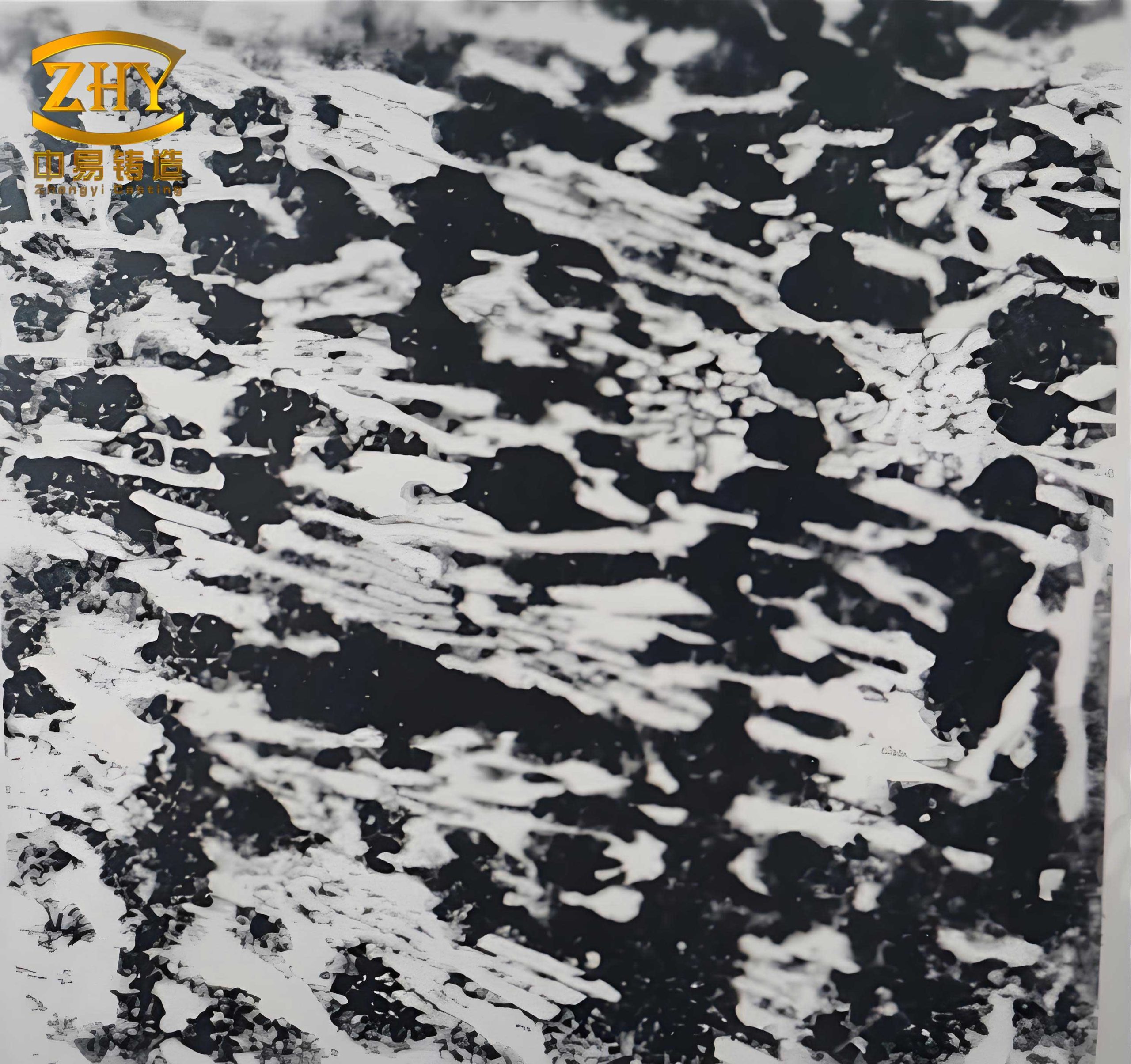
- Healing of Defects: The high compressive stresses during forging effectively close internal porosity, micro-shrinkage, and heal incipient micro-cracks that are endemic to the cast state. This drastically increases the density and structural integrity of the material.
- Carbide Network Fragmentation: This is the most critical change. The continuous, brittle network of eutectic cementite is broken apart into discrete, isolated particles. These fragmented carbides are then redistributed within the metallic matrix. This transition transforms the microstructure from one where cracks propagate easily along interconnected brittle paths to one where hard particles are surrounded by a continuous, more ductile matrix that can blunt and deflect cracks. The mean free path between carbides, \(\lambda\), increases significantly, which is beneficial for toughness. The applied true strain, \(\epsilon\), must exceed a critical value, \(\epsilon_c\), to effectively fragment the network, which is related to the carbide morphology and volume fraction \(f_c\):
$$\epsilon > \epsilon_c \propto \frac{1}{\sqrt{f_c}}$$ - Matrix Refinement: The hot deformation dynamically recrystallizes the austenitic matrix, leading to a much finer grain size upon subsequent cooling. A finer grain size, according to the Hall-Petch relationship, strengthens the matrix and improves toughness simultaneously:
$$\sigma_y = \sigma_0 + k_y d^{-1/2}$$
where \(\sigma_y\) is yield strength, \(\sigma_0\) and \(k_y\) are constants, and \(d\) is the average grain diameter.
The forgeability of white cast iron itself is a fascinating subject. Contrary to its reputation for brittleness at room temperature, white cast iron exhibits reasonable plasticity in the austenitic temperature range (above approximately 900°C). This is because the hardness differential between the cementite and the austenitic matrix narrows considerably at high temperatures. While cementite retains a higher hardness, both phases become sufficiently soft to allow coordinated plastic flow under compressive stress. However, the process is not without challenges. The forging temperature window remains narrow, demanding precise control. Overheating leads to grain growth and incipient melting, while underheating causes cracking due to the re-precipitation of brittle carbides. Furthermore, the deformation resistance is high, necessitating powerful equipment and favoring multiple light blows over heavy single reductions.
Post-Forging Heat Treatment and Industrial Application
While forging alone yields excellent results, further property tailoring is possible through heat treatment. I investigated several post-forging treatments:
- Air Cooling: The simplest method, resulting in a pearlitic-ferritic matrix with fragmented carbides. Provides a good balance of toughness and hardness.
- Quenching and Tempering: Forging into the austenite region followed by rapid quenching (oil) can produce a martensitic matrix, offering the highest hardness and good wear resistance, though with some compromise on toughness unless tempered appropriately.
- Austempering: This isothermal heat treatment holds significant promise. It involves quenching to a temperature range (typically 250–400°C) where the matrix transforms to bainite—a microstructure offering an outstanding combination of strength, hardness, and toughness, often superior to tempered martensite for this class of materials.
The ultimate validation came from field trials in large ball mills at a major thermal power plant. Several tons of Ø60 mm forged white cast iron balls were produced and installed in mills grinding highly abrasive coal. After over 6 months of continuous operation, the performance was outstanding:
- Wear Rate (Ball Consumption): ~120 g/ton of coal, a very competitive figure.
- Breakage Rate: Effectively 0%.
- Deformation (Out-of-Roundness): Less than 5%, indicating excellent resistance to impact deformation.
This demonstrated that forged white cast iron balls could reliably withstand the high-impact environment where traditional cast white iron balls would frequently fracture.
Conclusion and Perspectives
My investigation conclusively demonstrates that forging is a powerful and viable technique to revolutionize the properties of white cast iron. The key outcomes are:
- White cast iron is forgeable within a specific compositional and thermal window. The process requires careful control but is implementable with conventional forging equipment.
- Forging acts as a microstructural surgeon: it heals casting defects, fragments the continuous carbide network, and refines the matrix grain structure. These changes are the direct cause of the dramatic property enhancement.
- The improvement is most spectacular in impact toughness, which can be increased by 200-400%, while the essential hardness is maintained or even slightly improved. This decoupling of hardness and toughness is the primary achievement.
- The forged white cast iron grinding balls exhibit exceptional performance in industrial service, with low wear loss, minimal deformation, and, most importantly, zero breakage—solving the key failure mode of their cast counterparts.
This approach offers a cost-effective alternative to high-alloy white irons, leveraging thermomechanical processing rather than expensive alloying to achieve performance. Future research directions could explore controlled rolling for grinding balls, optimization of austempering cycles specifically for forged white cast iron, and finite element modeling of the stress-strain and temperature fields during forging to further refine the process. The successful application of forging opens a new chapter for white cast iron, transforming it from a brittle, niche material into a robust, high-performance candidate for demanding wear-resistant applications.