
In the realm of metal casting, lost foam casting has emerged as a significant process due to its ability to produce complex geometries with minimal finishing requirements. However, when applied to steel castings, this method is notoriously prone to defects such as slag inclusions and gas holes, which severely compromise the integrity and performance of the final components. Through extensive research and practical observations, I have analyzed the underlying mechanisms driving these defects. This article delves into the sources, distribution, and formation dynamics of slag inclusions in lost foam steel castings, emphasizing the unique characteristics of the filling process, thermodynamic and kinetic factors, and strategies for mitigation. The keyword ‘lost foam casting’ will be frequently referenced to maintain focus on this specific technique.
The prevalence of slag inclusion defects in lost foam steel castings is alarmingly high, often accounting for 60–80% of production failures. These defects typically manifest as irregular clusters located 1–3 mm beneath the casting surface, extending into a zone 10–30 mm deep. They appear as diffuse, boundary-ambiguous accumulations in metallographic examinations, making them difficult to remove via machining. For thin-walled steel castings, defects concentrate near gates or risers due to prolonged thermal exposure, while thicker sections exhibit subsurface slag inclusions. The formation is intrinsically linked to the distinctive filling behavior in lost foam casting, which differs markedly from conventional cavity casting.
| Defect Type | Typical Location | Morphology | Primary Contributing Factors |
|---|---|---|---|
| Slag Inclusion | Subsurface (1–30 mm depth) | Irregular clusters, blurred edges | Foam degradation residues, turbulent filling, negative pressure |
| Gas Holes | Gate/riser junctions | Spherical or elongated voids | Gas entrapment from foam pyrolysis, oxide formation |
| Carbon Pick-up | Surface layer (1–3 mm) | Non-uniform carbon enrichment | Reactions with foam material, inadequate process control |
The filling process in lost foam casting is fundamentally different, especially under negative pressure conditions commonly used for ferrous alloys. In traditional lost foam casting of aluminum alloys without vacuum, metal advances in a relatively stable frontal pattern. However, for steel castings, the application of negative pressure (typically 0.03–0.05 MPa) to stabilize the unbonded sand mold introduces severe turbulence. The metal flow becomes highly disordered, with the前沿呈现锯齿状形态, leading to easy entrapment of gases and slag particles. This turbulent state can be quantified using the turbulence intensity parameter:
$$ I = \frac{u’}{U} $$
where $u’$ is the root-mean-square velocity fluctuation and $U$ is the mean flow velocity. In lost foam casting, $I$ values are significantly elevated due to rapid foam degradation and negative pressure effects, exacerbating defect formation.
Moreover, the negative pressure induces a pronounced wall attachment effect. As molten steel enters the mold, it preferentially flows along the walls, quickly forming a chilled solid layer that encloses a U-shaped cavity. This creates a barrier that hinders the escape of gases and slag from the central region. The pressure gradient driving this effect can be expressed as:
$$ \nabla P = -\rho \frac{\partial \mathbf{v}}{\partial t} – \rho (\mathbf{v} \cdot \nabla) \mathbf{v} + \eta \nabla^2 \mathbf{v} $$
where $P$ is pressure, $\rho$ is density, $\mathbf{v}$ is velocity vector, and $\eta$ is dynamic viscosity. The negative pressure from side or bottom vacuum chambers alters this gradient, promoting lateral flow over vertical buoyancy-driven movement.
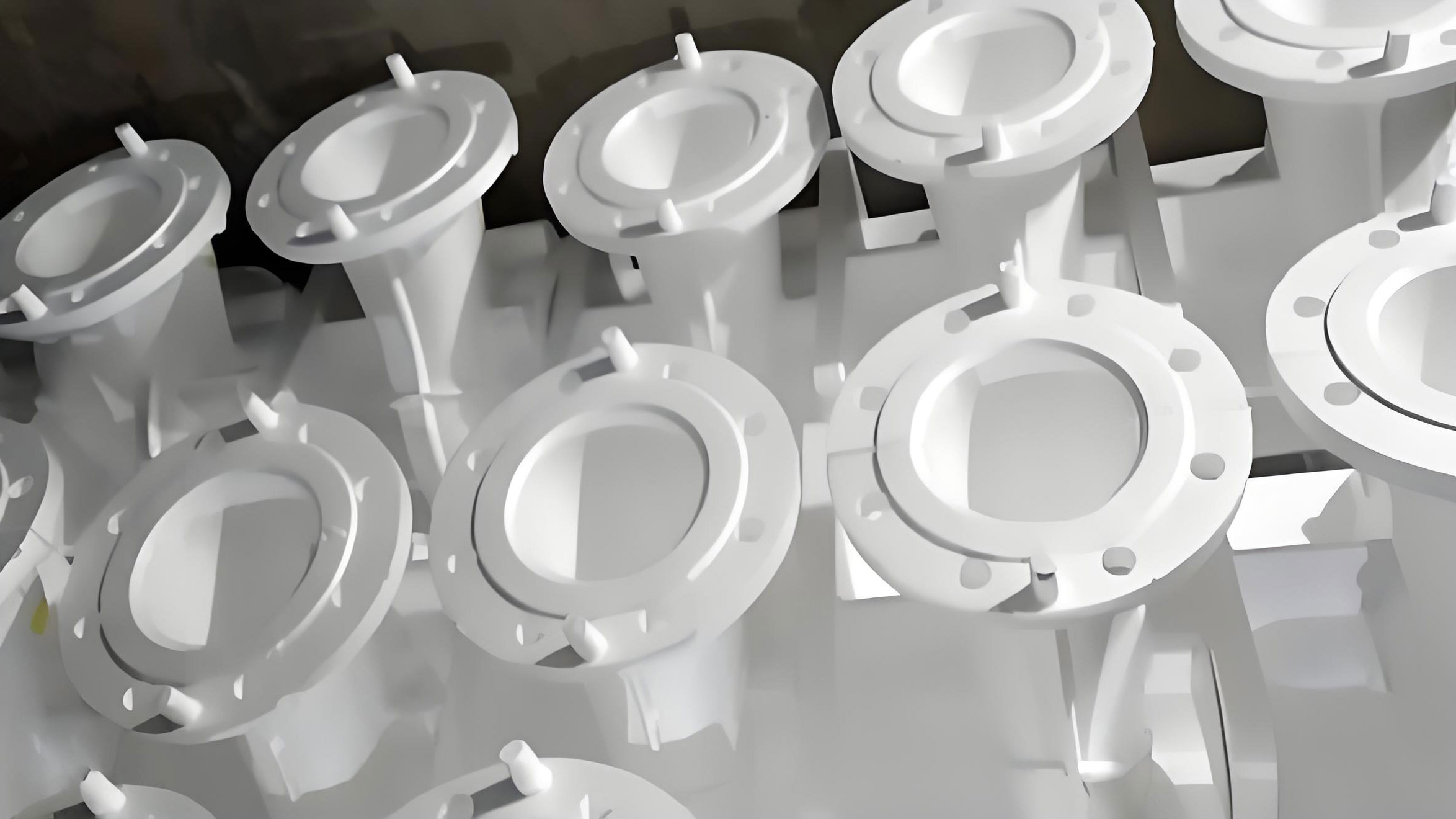
The image above illustrates the complex interaction during filling in lost foam casting, highlighting the turbulent front and potential slag entrapment zones. This visual underscores the challenges unique to this process.
Slag inclusions in lost foam steel castings originate from multiple sources: (1) pyrolysis residues of the foam pattern (e.g., polystyrene), which generate gaseous and solid byproducts; (2) indigenous slag from steel melting, often exacerbated by impurities in scrap materials; (3) oxide formation due to re-oxidation of molten steel; and (4) dissolved gases that precipitate during cooling. Thermodynamically, the formation of these inclusions involves reactions such as:
$$ \text{C}_n\text{H}_m \text{(foam)} \rightarrow \text{C} + \text{H}_2 + \text{CH}_4 + \text{other hydrocarbons} $$
$$ \text{Fe} + \frac{1}{2}\text{O}_2 \rightarrow \text{FeO} $$
The carbon from foam decomposition can lead to uneven carbon pick-up in low-carbon steels, while solid residues mix into the melt. Kinetically, the removal of slag particles is governed by Stokes’ law, where the terminal rising velocity $v$ of a spherical particle in a liquid is:
$$ v = \frac{2g(\rho_m – \rho_s)r^2}{9\eta} $$
Here, $g$ is gravitational acceleration, $\rho_m$ and $\rho_s$ are densities of molten steel and slag respectively, $r$ is particle radius, and $\eta$ is viscosity. In lost foam casting, turbulent flows and the横向抽气方向 of negative pressure oppose this natural buoyancy, reducing $v$ and trapping particles. The dimensionless Reynolds number $\text{Re} = \frac{\rho v L}{\eta}$ often exceeds critical values, indicating turbulent regimes that hinder slag flotation.
| Source | Composition | Formation Temperature | Typical Size Range | Mitigation Difficulty |
|---|---|---|---|---|
| Foam Pyrolysis | C, H, polymers | 500–1200°C | 1–100 µm | High (intrinsic to process) |
| Melting Slag | SiO2, Al2O3, CaO | >1500°C | 10–1000 µm | Medium (depends on refining) |
| Oxide Inclusions | FeO, MnO | >1450°C | 5–50 µm | High (reaction with air/foam) |
| Coatings Debris | Refractory particles | Ambient to liquidus | 50–500 µm | Medium (process control) |
To reduce slag inclusions, a multi-faceted approach is essential. Firstly, minimizing initial slag content in the molten steel is critical. This can involve using cleaner charge materials, employing slag coagulants or purifying agents that adsorb fine inclusions, and implementing filters in the gating system. The efficiency of a filter can be modeled via the capture probability $P_c$:
$$ P_c = 1 – \exp\left(-\frac{\alpha A_f Q}{v}\right) $$
where $\alpha$ is adhesion coefficient, $A_f$ is filter area, $Q$ is flow rate, and $v$ is kinematic viscosity. Secondly, process optimization in lost foam casting is vital. Reducing negative pressure to the minimum required for mold stability (e.g., 0.04–0.05 MPa for steel) alleviates turbulence and wall attachment. Ideally, top vacuum systems should be used to align suction direction with buoyancy, enhancing slag removal. The pressure difference $\Delta P$ between the mold cavity and vacuum source influences flow:
$$ \Delta P = P_{\text{atm}} – P_{\text{vacuum}} $$
Lower $\Delta P$ values decrease turbulent kinetic energy $k$, approximated by $k \propto \Delta P^{2/3}$.
Gating design also plays a key role. Avoiding multiple castings per box minimizes flow length and turbulence in runners. Direct gating with short paths is preferable. Additionally, reducing pattern assembly seams and adhesive usage limits the formation of涂料刺 (coating protrusions) that break off as slag. The geometry of foam patterns, especially cut surfaces, should be smoothed to prevent coating infiltration. A well-designed lost foam casting system must balance filling speed $v_f$ with foam degradation rate $v_d$, which follows an Arrhenius-type relation:
$$ v_d = A \exp\left(-\frac{E_a}{RT}\right) $$
where $A$ is pre-exponential factor, $E_a$ is activation energy, $R$ is gas constant, and $T$ is temperature. Optimal conditions ensure steady front advancement without excessive residue.
From a thermodynamic perspective, the stability of slag phases can be assessed using Ellingham diagrams or activity coefficients. For instance, the deoxidation reaction:
$$ x[\text{M}] + y[\text{O}] \rightleftharpoons \text{M}_x\text{O}_y $$
has an equilibrium constant $K = \frac{a_{\text{M}_x\text{O}_y}}{a_{\text{M}}^x a_{\text{O}}^y}$, where $a$ denotes activity. In lost foam casting, the presence of carbon from foam alters oxygen activity, complicating control. Kinetic models for slag particle growth and removal involve population balance equations:
$$ \frac{\partial n}{\partial t} + \nabla \cdot (n \mathbf{v}) = \text{nucleation} + \text{growth} – \text{removal} $$
where $n$ is particle number density. The removal term is hindered by turbulent dispersion, quantified via eddy diffusivity $D_t \approx \nu_t / \text{Sc}_t$, with $\nu_t$ as turbulent viscosity and $\text{Sc}_t$ as turbulent Schmidt number.
| Strategy | Mechanism | Expected Defect Reduction | Implementation Cost | Suitability for Steel |
|---|---|---|---|---|
| Lower Negative Pressure | Reduces turbulence and wall attachment | 30–50% | Low (process adjustment) | High |
| Top Vacuum Design | Aligns suction with buoyancy | 40–60% | Medium (equipment mod) | High |
| Gating Filters | Traps large inclusions | 20–40% | Low to Medium | Medium (clogging risk) |
| Foam Density Reduction | Decreases pyrolysis residues | 10–30% | Medium (material cost) | High |
| Steel Refinement | Lowers initial slag content | 50–70% | High (metallurgical control) | Essential |
| Pattern Seam Minimization | Prevents coating intrusion | 15–25% | Low (design effort) | High |
The dynamics of slag movement during solidification further influence final defect distribution. As steel cools, slag particles may be pushed by advancing solidification fronts, described by the critical velocity $v_c$ for engulfment:
$$ v_c = \frac{\Delta \sigma \cdot r}{3\eta \cdot d_0} $$
where $\Delta \sigma$ is interfacial energy difference, $r$ is particle radius, and $d_0$ is boundary layer thickness. In lost foam casting, rapid chilling from wall attachment can trap particles before they float out. Computational fluid dynamics (CFD) simulations of lost foam casting processes reveal complex velocity and temperature fields. For example, the energy equation coupled with foam degradation:
$$ \rho C_p \frac{\partial T}{\partial t} + \rho C_p \mathbf{v} \cdot \nabla T = \nabla \cdot (k \nabla T) + \dot{q}_{\text{foam}} $$
where $C_p$ is heat capacity, $k$ is thermal conductivity, and $\dot{q}_{\text{foam}}$ is heat source from foam pyrolysis. These models help optimize pouring temperature $T_p$ and velocity to minimize defects.
Empirical studies in lost foam casting show that slag inclusion frequency correlates with process parameters. A regression model might take the form:
$$ \text{Defect Density} = \beta_0 + \beta_1 (\Delta P) + \beta_2 (v_f) + \beta_3 (T_p) + \beta_4 ([\text{S}]) $$
where $\beta_i$ are coefficients, and $[\text{S}]$ is sulfur content in steel. Controlled experiments indicate that lower pouring speeds and moderate temperatures reduce slag entrapment. Additionally, the use of alternative foam materials, such as polymethyl methacrylate (PMMA), can lower carbonaceous residues, though cost and availability are constraints.
In summary, the formation of slag inclusions in lost foam steel castings is a multifaceted issue rooted in the process’s unique filling behavior, material interactions, and thermodynamic-kinetic balances. The inherent turbulence and wall attachment under negative pressure, combined with diverse slag sources, create a challenging environment for producing clean castings. Effective mitigation requires integrated strategies: refining steel quality, optimizing gating and vacuum design, controlling foam properties, and meticulous pattern assembly. As lost foam casting continues to evolve for steel applications, deeper understanding of these mechanisms through modeling and experimentation will be crucial for improving yield and quality. The repeated emphasis on ‘lost foam casting’ throughout this analysis underscores its procedural specificity, distinguishing it from other casting methods where such defects may be less prevalent or differently manifested.
Future research directions could focus on real-time monitoring of filling in lost foam casting, advanced filtration technologies, and development of foam patterns with reduced degradation byproducts. By addressing these aspects, the potential of lost foam casting for high-integrity steel components can be fully realized, minimizing defects and enhancing competitiveness in the manufacturing sector.