
In the field of internal combustion engine components, piston rings play a critical role in sealing, heat transfer, and support functions. The development and application of spheroidal graphite cast iron for piston rings represent a significant leap in manufacturing history, offering superior wear resistance, elasticity, and thermal stability compared to traditional materials. However, producing high-quality spheroidal graphite cast iron piston rings stably remains a formidable challenge, particularly under constraints such as locally available raw materials with high impurity levels. Through extensive research and practical trials, I have developed a comprehensive foundry technology that adapts to these conditions, ensuring consistent production of premium spheroidal graphite cast iron piston rings. This article delves into the intricacies of this technology, from raw material analysis to process optimization, emphasizing the use of specialized nodulizers and inoculants, precise control of molten iron composition, and advanced casting techniques. The goal is to provide a detailed guide that leverages first-hand experience and scientific principles to overcome common hurdles in spheroidal graphite cast iron casting.
The foundation of producing spheroidal graphite cast iron lies in the quality of raw materials. Ideally, high-purity pig iron or synthetic iron with low levels of manganese, phosphorus, and sulfur is preferred to facilitate effective graphite nodulization and minimize defects. However, in many regions, including China, the available pig iron often contains elevated impurities, such as manganese (Mn) at 0.2%–0.5%, phosphorus (P) up to 0.07%, and sulfur (S) up to 0.03%, alongside higher silicon (Si) content. These elements pose significant challenges: high Mn can promote carbide formation, high P may lead to phosphide eutectics that reduce toughness, and high S consumes nodulizing agents and increases slag inclusion risks. To address this, I conducted a feasibility analysis, selecting pig iron with compositions like 4.0%–4.2% carbon (C), 0.80%–0.9% Si, 0.20%–0.4% Mn, 0.04%–0.06% P, and S below 0.026%. While this still exceeds ideal limits, strategic adjustments in melting and treatment processes can mitigate adverse effects. For instance, the use of medium-frequency induction furnaces allows controlled melting, and subsequent annealing treatments can manage microstructure issues caused by high Mn. The key is to balance these factors through rigorous process control, ensuring that the spheroidal graphite cast iron meets performance standards despite material constraints.
Central to the production of spheroidal graphite cast iron is the nodulization process, which involves adding magnesium-based agents to transform graphite into spherical shapes. The nodulizer used in my work is a custom blend containing 38%–48% Si, 5.0%–6.5% Mg, rare earth (RE) ≤1.0%, and aluminum (Al) ≤1.0%, with a particle size of 5–40 mm. This composition offers a balanced reaction, reducing magnesium loss and controlling residual Mg levels effectively. The amount of nodulizer added is critical and depends on factors such as the V/O ratio (cross-sectional area to perimeter ratio) of the piston ring and the sulfur content of the base iron. The general formula for nodulizer addition can be expressed as:
$$ \text{Nodulizer Addition (\%)} = \text{Mg Loss} + \text{S Removal Mg} + \text{Residual Mg} $$
Where Mg loss is influenced by operating conditions, S removal Mg is proportional to the initial sulfur content, and residual Mg targets around 0.04%–0.06% for optimal nodulization. Using a carbon-sulfur analyzer, I monitor the base iron’s sulfur content in real-time, enabling precise adjustments. For example, with S levels of 0.02%–0.03%, the Mg required for desulfurization is approximately 0.0076%. Table 1 summarizes the impact of nodulizer addition on graphite morphology and nodule count, based on experimental data. Insufficient addition leads to vermicular graphite, while excess causes carbides and reduced nodule counts, both detrimental to the spheroidal graphite cast iron’s properties.
| Nodulizer Addition (%) | Nodulization合格 Rate (%) | Nodule Count合格 Rate (%) | Observations |
|---|---|---|---|
| 1.2 | 0 | — | Insufficient residual Mg, vermicular graphite present |
| 1.4 | 80 | 80 | Marginal nodulization, some carbides |
| 1.6 | 100 | 100 | Optimal: spherical graphite, high nodule count |
| 1.8 | 100 | 95 | Excess Mg, carbides formed, nodule count slightly reduced |
To ensure consistency, I maintain a nodulization temperature of 1500–1550°C, using a ladle with a pit for agent addition, and complete pouring within 6–8 minutes to minimize Mg fading. This approach has proven effective in producing spheroidal graphite cast iron with over 85% nodulization rate and nodule counts exceeding 40,000 particles/cm², meeting stringent requirements for piston ring applications.
Following nodulization, inoculation is essential to refine graphite nodules, prevent chill formation, and enhance the microstructure of spheroidal graphite cast iron. I employ a mixed inoculant composed of custom S-inoculant (73%–78% Si, 0.7%–1.0% Sr, 0.6%–1.0% Ca, Al ≤1.0%) and M-inoculant (43%–47% Si, 1.0%–1.5% Mg, 0.6%–0.9% Ca, Al ≤1.0%). This blend not only promotes ferrite formation but also supplements trace Mg, Sr, and Ca at lower temperatures, stabilizing nodulization and increasing nodule density. The inoculation effect is quantified by nodule count and graphite morphology, with optimal addition determined through trials. As shown in Table 2, an inoculant addition of 0.4% yields the best results, achieving full nodule count合格率 without graphite floating or开花现象. Excessive addition beyond 0.6% leads to enlarged graphite and defects, highlighting the need for precise control.
| Inoculant Addition (%) | Nodule Count合格 Rate (%) | Graphite Characteristics |
|---|---|---|
| 0.2 | 54 | Reduced nuclei, larger nodules, some carbides |
| 0.3 | 82 | Improved nodule refinement, fewer carbides |
| 0.4 | 100 | Optimal: fine spherical nodules, no carbides |
| 0.5 | 100 | Increased graphite content, slight开花 |
| 0.6 | 100 | Graphite floating,开花严重 |
The inoculation process is conducted as a late addition, often during pouring, to maximize effectiveness. This step is crucial for achieving the desired microstructure in spheroidal graphite cast iron, where high nodule counts (>30,000 particles/cm²) are necessary to limit carbides to below 5% in the as-cast state. The mixed inoculant’s unique composition helps disperse phosphide eutectics and lowers final Si content, thereby improving toughness—a key attribute for piston rings subjected to cyclic stresses.
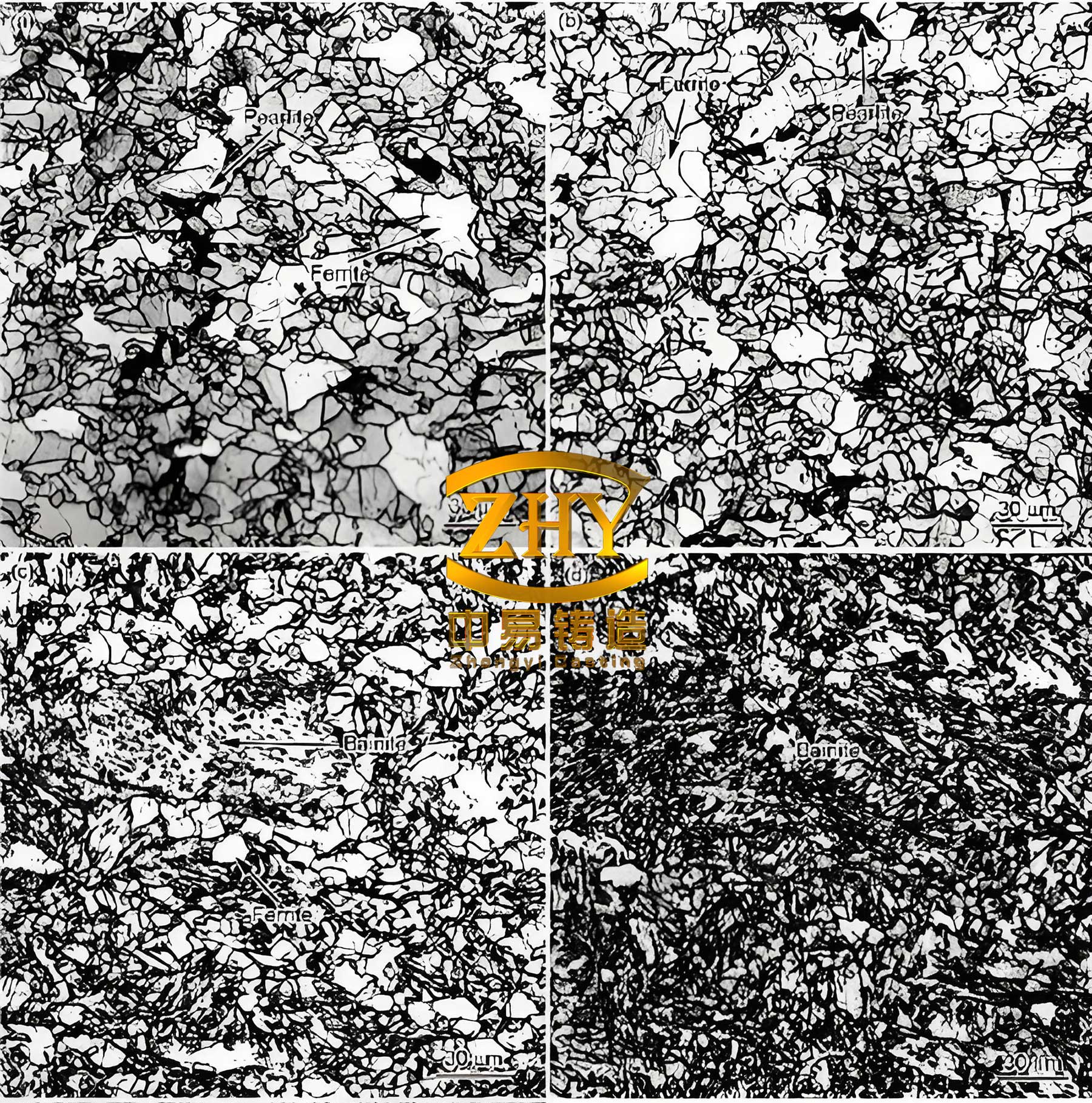
Control of carbon and silicon in the base iron is paramount for optimizing the properties of spheroidal graphite cast iron. Carbon, unlike in gray cast iron, does not detrimentally affect mechanical properties in spheroidal graphite cast iron; instead, higher carbon content (within limits) benefits nodulization by increasing graphite nucleation sites and enhancing fluidity. The target carbon range is 3.65%–3.8%, balanced to avoid graphite floating, which can occur above the eutectic point and lead to defects like surface pinholes. The carbon equivalent (CE) is a useful metric, calculated as:
$$ \text{CE} = C + \frac{1}{3}(Si + P) $$
For spheroidal graphite cast iron piston rings, CE should be maintained near 4.3–4.5 to ensure near-eutectic composition, promoting sound casting. Silicon, a strong graphitizer, is controlled through both base iron and inoculation. Total Si content is kept at 2.4%–2.8%, with base iron Si adjusted based on the V/O ratio of the ring, as detailed in Table 3. This stratification ensures adequate graphitization without excessive Si that could cause开花状石墨.
| V/O Ratio | Base Iron Si Content (%) | Rationale |
|---|---|---|
| ≤1.80 | 1.9 | Higher cooling rate requires more Si for graphitization |
| 1.81–2.50 | 1.7 | Moderate cooling, balanced Si |
| 2.51–4.50 | 1.6 | Lower cooling rate, reduced Si to prevent开花 | >4.50 | 1.1 | Minimal Si to avoid defects in thick sections |
In practice, I use medium-frequency furnaces to melt a charge of 40%–100% selected pig iron and up to 60% returns, carefully monitoring composition via spectral analysis. The melting process is optimized to achieve superheating temperatures of 1500–1550°C, which aids in degassing and homogeneity. After nodulization and inoculation, the molten spheroidal graphite cast iron is poured quickly into molds designed for mono-block double-piece casting—a method where the casting is machined to remove central shrinkage and surface defects, yielding superior rings. The pouring time is critical; I limit it to under 10 minutes to preserve nodulization effects, with ideal windows of 6–8 minutes. Mold design incorporates gating systems that facilitate rapid filling and slag trapping, further reducing defects. Post-casting, the rings undergo annealing to transform any residual carbides into ferrite, enhancing machinability and elasticity. This heat treatment involves heating to 900–950°C, holding for 1–2 hours, and slow cooling, which also stabilizes dimensions for precision machining.
The success of this technology is evidenced by its application in mass-producing spheroidal graphite cast iron piston rings for various engines, such as those in Santana sedans and heavy-duty vehicles. Key performance metrics, summarized in Table 4, demonstrate that the rings exceed standard requirements, with nodulization rates over 85%, nodule counts above 40,000 particles/cm², hardness of 104–112 HRB, bending strength ≥1600 MPa, and elastic modulus ≥155,000 MPa. These properties ensure reliable sealing and durability under engine operating conditions. The production scrap rate is minimal, underscoring the process’s robustness. This achievement stems from meticulous attention to each step—from raw material selection to final heat treatment—validating the adaptability of spheroidal graphite cast iron technology to local material constraints.
| Property | Standard Requirement | Achieved Performance |
|---|---|---|
| Graphite Morphology | Approximately spherical | Spherical with minimal团状 |
| Nodulization Rate (%) | ≥80 | ≥85 |
| Nodule Count (particles/cm²) | >30,000 | >40,000 |
| Hardness (HRB) | 104–112 | 104–112 |
| Bending Strength (MPa) | ≥1300 | ≥1600 |
| Elastic Modulus (MPa) | ≥150,000 | ≥155,000 |
Beyond the core processes, several ancillary factors contribute to the quality of spheroidal graphite cast iron piston rings. For instance, the use of advanced ladle preheating techniques minimizes thermal shock during nodulization, preserving magnesium efficiency. Additionally, real-time monitoring systems for temperature and composition, coupled with statistical process control, enable proactive adjustments, reducing variability. The importance of mold coatings cannot be overstated; I apply refractory coatings that withstand high temperatures and prevent metal-mold reactions, ensuring smooth surface finish. Furthermore, the design of the mono-block double-piece casting itself is optimized through simulation software, which predicts solidification patterns and minimizes shrinkage porosity. This holistic approach integrates traditional foundry wisdom with modern technology, making spheroidal graphite cast iron production both efficient and reliable.
In terms of material science, the microstructure of spheroidal graphite cast iron is governed by nucleation and growth kinetics. The nodule count (N) can be modeled as a function of cooling rate (T) and inoculant potency (I), expressed empirically as:
$$ N = k \cdot I \cdot e^{-E_a / (RT)} $$
where k is a constant, E_a is activation energy, R is the gas constant, and T is temperature. This underscores why fast cooling in thin sections requires higher inoculation levels. Similarly, the role of trace elements like antimony (Sb) or bismuth (Bi) in disrupting nodulization is mitigated by using low-RE nodulizers, as RE elements can counteract these impurities. My experiments show that maintaining residual RE below 0.005% prevents carbide stabilization while still neutralizing干扰元素. This balance is critical for achieving the desired ferritic-pearlitic matrix in spheroidal graphite cast iron, which offers an optimal blend of strength and ductility for piston rings.
Environmental and economic aspects also play a role in this technology. By utilizing locally sourced pig iron with higher impurities, the process reduces reliance on imported high-purity materials, lowering costs and carbon footprint. However, this requires careful management of slag and emissions; I implement closed-loop recycling of returns and slag treatment systems to minimize waste. The energy consumption of medium-frequency furnaces is optimized through power modulation and scrap preheating, aligning with sustainable manufacturing practices. These considerations make the production of spheroidal graphite cast iron piston rings not only technically feasible but also economically viable and environmentally responsible.
Looking forward, ongoing research aims to further enhance the properties of spheroidal graphite cast iron through microalloying and advanced heat treatments. For example, adding small amounts of copper (Cu) or nickel (Ni) can improve hardness and corrosion resistance without compromising nodulization. Similarly, isothermal quenching processes could yield austempered spheroidal graphite cast iron with exceptional wear resistance for high-performance engines. These developments promise to expand the applications of spheroidal graphite cast iron beyond piston rings to other critical components like crankshafts and gears. My work continues to explore these avenues, driven by the goal of pushing the boundaries of spheroidal graphite cast iron technology.
In conclusion, the production of high-quality spheroidal graphite cast iron piston rings is a multifaceted endeavor that demands precision at every stage. From selecting and adapting raw materials to mastering nodulization and inoculation, and from controlling carbon-silicon ratios to implementing robust casting and heat treatment processes, each element is interlinked. My experience demonstrates that even with suboptimal raw materials, through scientific analysis and tailored practices, it is possible to consistently manufacture spheroidal graphite cast iron components that meet rigorous standards. The key lies in understanding the underlying principles—such as the effects of Mn, P, and S on graphite formation—and leveraging specialized agents and real-time controls. This technology not only supports the automotive industry but also contributes to the broader field of advanced cast iron materials. As engines evolve toward higher efficiency and lower emissions, the role of spheroidal graphite cast iron will only grow, underscoring the importance of continuous innovation in foundry techniques. By sharing these insights, I hope to foster further advancements in the casting of spheroidal graphite cast iron, ensuring its continued relevance in modern engineering.