
The pursuit of high-performance wear-resistant materials has placed high-chromium white cast iron at the forefront of industrial applications. Achieving the optimal microstructure in this alloy—one that balances exceptional abrasion resistance with adequate toughness and thermal stability—requires a deep understanding of phase transformations. Furthermore, mastery over the influences of chemical composition, metallurgical treatments, and heat treatment protocols on microstructural evolution is paramount. The high alloy content fundamentally alters the behavior of white cast iron, most notably by transforming the carbide phase from the brittle, network-forming M3C type to the harder, more isolated M7C3 type. This shift in carbide morphology, from a continuous web to a three-dimensional, open-skeleton distribution, is a cornerstone of its improved properties.
However, these benefits come with challenges, such as increased internal stress due to changes in thermal conductivity and solidification mode. Therefore, component design must carefully control the volume fraction of carbides to achieve high hardness without excessive stress. Beyond composition, enhancing toughness necessitates a multifaceted approach focused on grain refinement, purification of grain boundaries, control over carbide morphology and distribution, and reduction of non-metallic inclusions. Effective modification of high-chromium white cast iron is only realized through the synergistic combination of several factors: the selection and treatment process of modifiers, the selection and treatment process of inoculants, smelting practices, foundry techniques, and final heat treatment.
This article delves into the specific practice of graded complex inoculation and its associated kinetic conditions. The effectiveness of this sophisticated treatment is inherently governed by the dynamics of the metallurgical process. Conversely, the inoculation treatment itself exerts a significant kinetic effect on the solidification sequence. To facilitate the successful numerical simulation of solidification for such modified high-chromium white cast iron castings, a discussion on setting appropriate boundary conditions for the simulation is also undertaken. The overarching goal is to understand how these factors influence non-equilibrium crystallization conditions, thereby aiding the development of more accurate and efficient simulation software for casting process optimization.
Kinetic Conditions for Graded Complex Inoculation
The application of graded complex modification and inoculation has been shown to fundamentally eliminate the networked carbide structure in high-chromium white cast iron. During solidification, carbides appear as rods, blocks, or particles, accompanied by significant grain refinement (often improving from an ASTM grain size number of 1-2 to 5-6). This directly translates to enhanced mechanical and fatigue properties. This success stems from the deliberate, albeit sometimes intuitive, adherence to kinetic principles governing solidification, effectively harnessing the combined power of graded modification, graded inoculation, and microalloying.
The Synergy of Modification and Inoculation
In the metallurgical treatment of high-chromium white cast iron, modification and inoculation are complementary yet distinct processes. Their combined action addresses key metallurgical objectives: reducing or eliminating ledeburite and networked carbides while promoting isolated blocky carbides and controlling their total volume fraction; refining, strengthening, and stabilizing the austenitic matrix to achieve uniform multiphase distribution and reduce internal stresses; and diminishing non-metallic inclusions while improving their morphology and distribution. Ultimately, the aim is to maximize hardness while minimizing residual stress.
A typical practice involves a two-step process using a RE-Si-Ca composite modifier, applied both in-furnace and in-ladley, with the treatment sequence designed according to the heterogeneous nucleation potency of the modifying elements. Similarly, a V-Ti-containing composite inoculant is applied in a graded manner based on nucleation potency. Elements like B, Cr, and Mo (with Nb added for large sections) are introduced as microalloying additions after pre-deoxidation.
Role of Modification Treatment
1. Rare earth (RE) additions reduce undercooling and shorten solidification time, indicating a higher nucleation rate leading to refined austenite grains. This occurs because RE, being strong segregating elements, enrich at the solid/liquid interface, creating constitutional undercooling that promotes austenite nucleation. Furthermore, RE’s powerful deoxidizing and desulfurizing capabilities purify the melt, and the resulting complex inclusions can act as substrates for austenite nucleation.
2. Surface-active RE elements adsorb on growing carbide surfaces, hindering the diffusion of carbide-forming elements like Cr and Mo, thereby slowing their growth along preferred directions and preventing network formation.
3. Modification drastically reduces oxygen, nitrogen, and sulfur content. This prevents the oxidation, sulfidation, or nitridation of primary inoculant elements like V and Ti, which would otherwise form compounds that poison potential nucleation sites, thus preserving the melt’s capacity for effective heterogeneous inoculation.
4. Unmodified white cast iron contains high levels of irregular, brittle inclusions like SiO2, MnO, and Al2O3, which weaken grain boundaries. Modification removes many inclusions as slag and transforms residual inclusions into more benign, globular complex silicates containing Mg, Ce, Ca, and Sr.
Role of Inoculation Treatment
1. Austenite nucleation and growth are diffusion-controlled. Elements like V and Ti are strong segregating elements (with distribution coefficients k<1), creating significant constitutional undercooling at the interface. This promotes dendritic refinement and overall grain coarsening of the austenite.
2. As strong carbide-forming elements, V and Ti create numerous carbide-based nucleation sites within the mushy zone. These sites attract carbon atoms, promoting the formation of blocky carbides rather than networks. Titanium protects vanadium from reaction with interstitials, and the resulting complex vanadium-titanium carbides are highly stable.
3. The addition of V and Ti fosters the development of highly branched austenite dendrites, confining subsequent carbide formation and growth within the interdendritic regions. Their strong affinity for carbon also locally slows carbon diffusion, disrupting the continuous growth of carbide networks and reducing their overall amount. Effective inoculation increases heterogeneous nucleation sites and can shift the precipitation of carbon from austenite to preferentially occur on existing blocky carbides.
4. Inoculated iron exhibits a greater tendency for undercooling and relies on uniformly distributed exogenous nuclei. This makes the crystallization process less sensitive to cooling rate, occurring more uniformly throughout the volume—a critical advantage for achieving consistent microstructure and properties in heavy-section castings.
The primary goal of the graded treatment approach is twofold: to control the nucleation and growth processes of the various modified/inoculated structures, and to enhance their resistance to fading.
Kinetic Effects of Factors Influencing Graded Complex Inoculation
The kinetic effect of modification on the subsequent inoculation is multifunctional, relying on the modifier’s ability to simultaneously act as a grain refiner, a controller of phase crystallization, a deoxidizer/desulfurizer/de-gasser for melt and grain boundary purification, and a reductant to recover oxidized alloy elements at high temperatures.
The design of the base composition, particularly the C and Cr content, has a direct kinetic effect. Excessive carbon increases concentration fluctuations, favoring homogeneous nucleation of carbides over the desired heterogeneous nucleation on inoculant particles. Silicon, primarily a deoxidizer, can be reduced when using RE modification, as its role is partly supplanted. A careful balance of Cr, Mo, Nb, V, and Ni can stabilize a fine martensite-austenite matrix in the as-cast state, enabling secondary hardening during subsequent heat treatment.
Microalloying with elements like V, Ti, Nb, and B exerts its kinetic effect through segregation. As shown in Table 1, these elements have segregation coefficients (ks) > 1 and distribution coefficients (k) < 1, meaning they enrich in the liquid ahead of the austenite front, enhancing constitutional undercooling and promoting dendritic refinement. They also strengthen and stabilize the austenite through solid solution, increasing its resistance to carbon depletion.
| Element | Avg. in Cast Iron (wt.%) | Austenite Dendrite Core (wt.%) | Austenite Dendrite Edge (wt.%) | Distribution Coefficient (k) | Segregation Coefficient (ks) |
|---|---|---|---|---|---|
| Ti | 0.18 | Trace | 0.35 | ~0.0 | >1.0 |
| V | 0.42 | 0.11 | 0.58 | 0.19 | 5.27 |
| Nb | 1.22 | 0.44 | 1.93 | 0.23 | 4.39 |
| B | 0.07 | 0.03 | 0.04 | 0.75 | 1.33 |
The design of the inoculant itself (e.g., B-bearing slag + Ti + V) has critical kinetic implications. A graded sequence where B (via slag) and Ti are added first, followed by V, stabilizes the boron’s effect. The low-melting-point Ti protects B early on, and the highly reactive V later sacrifices itself to protect both Ti and B from oxidation. This inoculation alters the carbon precipitation mechanism from continuous growth to discontinuous precipitation on heterogeneously nucleated blocky carbides, forming lamellar structures. This shift, driven by lower nucleation barriers in the solid state, is key to breaking the continuous carbide network.
Interfacial perturbations during crystal growth, describable by wave theory, are inevitable. The stability of an interface under a perturbation of amplitude η is given by η(t) ∝ eωt, where ω determines stability (ω<0 stable, ω>0 unstable). Inoculation-induced perturbations reflect the effectiveness of the treatment. Furthermore, external forces like vibration can significantly influence nucleation kinetics. A relationship between pressure (P) and nucleation rate (I) can be expressed as:
$$ I = A \cdot \exp\left(-\frac{\Delta G^*}{kT}\right) = A \cdot \exp\left(-\frac{B}{\Delta T^2}\right) \cdot \exp\left(-\frac{P \cdot \Delta V}{kT}\right) $$
Taking the logarithm, we get:
$$ \ln I = \ln A – \frac{B}{\Delta T^2} – \frac{P \cdot \Delta V}{kT} $$
Where A and B are constants, ΔG* is the activation energy for nucleation, ΔV is the activation volume, k is Boltzmann’s constant, and T is temperature. This indicates that within a certain range, increased pressure during solidification can refine the grain structure, making divorced eutectic structures more prominent under dynamic, non-equilibrium conditions.
The Action of Kinetic Conditions on Process Effectiveness
The engineering goal of complex inoculation is twofold: to reduce the amount of carbon depleted from the austenite, and to change the morphology of carbon precipitation from a continuous network to primarily heterogeneous nucleation on inoculant particles.
The kinetic condition for reducing carbon depletion is largely governed by diffusion. The diffusion coefficient of carbon in austenite (DCγ) is influenced by alloying elements; it decreases with additions of Mo, W, V, Ti, and Cr. Thus, at a given temperature, modifying the alloy composition directly regulates the diffusion rate of carbon, with a slower rate leading to less precipitation under continuous cooling conditions. This underscores the importance of compositional design across base, modifier, inoculant, and microalloying elements.
The kinetic condition for promoting heterogeneous carbide nucleation depends on accelerating the diffusion of carbon atoms away from the melt or austenite surface towards the inoculant particles. Key factors include: the wetting angle (θ) between the nucleant particle and the new carbide phase; the state of the diffusion medium (gas, liquid, solid—with gas having the highest coefficient); temperature (hence inoculation is best performed above ~1380-1420°C); increasing the number of effective nucleants by maintaining low O/S/N levels and sufficient inoculant concentration; controlling slag chemistry to prevent re-sulfurization/re-oxidation; using a two-step inoculation process to combat fade; and meticulously controlling melt state (temperature, cleanliness) to maximize diffusion coefficients.
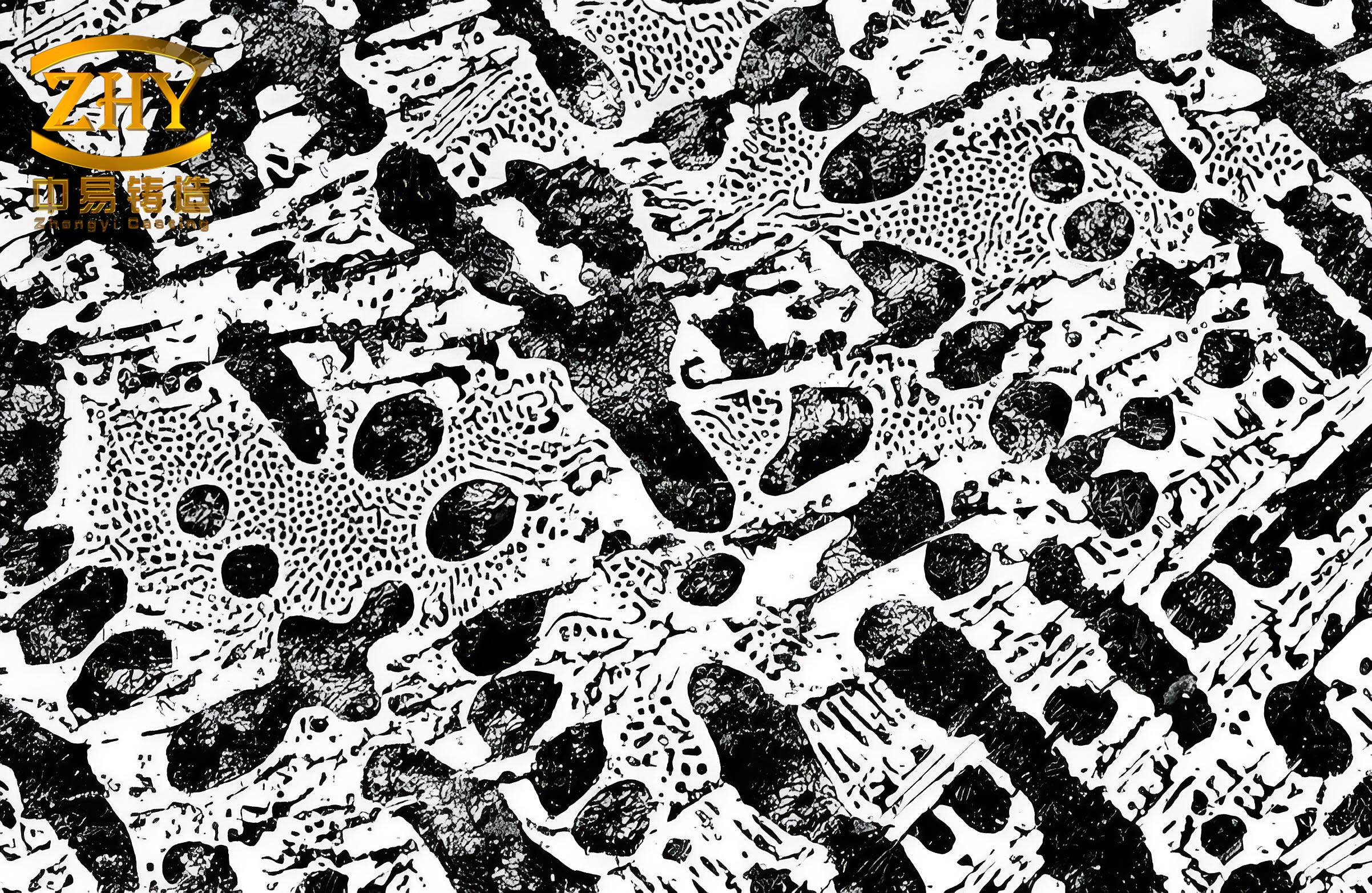
The figure above illustrates the typical microstructural outcome of successful treatment, showcasing the refined matrix and isolated carbide morphology achievable in high-chromium white cast iron.
Setting Boundary Conditions for Solidification Simulation
Solidification is a complex, multi-physics phenomenon involving coupled heat, mass, and momentum transfer alongside phase transformations. Precise simulation requires solving and coupling the continuity, Navier-Stokes, and energy equations—a formidable task. Simplifications are often made by simulating the dominant process for a specific goal. When local features (like grain structure) cannot be directly linked to macroscopic fields, models based on formation mechanisms are developed and coupled with continuum equations. This process invariably involves the critical task of defining boundary conditions (BCs). For simulating the solidification of graded-complex-inoculated high-chromium white cast iron, BCs can be categorized as system-wide and interface-specific.
System Boundary Condition Settings
Key system-level settings include:
1. Solidification Mode: High-chromium white cast iron is a medium freezing-range alloy. For many castings, it solidifies initially with an external chill (skin) with columnar growth potential, finishing with a mushy center. External stirring or vibration can promote equiaxed growth.
2. Effect of Inoculation: The increased undercooling tendency from inoculation reduces the sensitivity of microstructure to cooling rate, leading to more uniform properties across sections.
3./4. Coupling with Filling: If filling time is negligible compared to solidification time, the mold can be assumed instantaneously filled, and only the temperature field needs solving. For thin walls or similar time scales, filling simulation must be coupled to provide the initial temperature field for the solidification simulation.
5. Symmetry Planes: When exploiting symmetry, the symmetric plane is typically treated as an adiabatic (no heat flux) and no-slip (u=0) boundary.
Interface Boundary Condition Settings
The aim of solidification simulation is to track the moving solid-liquid interface, predicting soundness, microstructure, and solid fraction. Defining BCs for the various interfaces is crucial. Common interface BCs include:
1. Velocity BCs: For mold walls, either no-slip (u=0) or free-slip (∂u/∂n=0) conditions are applied. For free surfaces, the pressure is set to atmospheric, and surface tracking algorithms are used.
2. Morphology BCs: Carbide morphology is influenced by interface roughness. While cementite-type carbides have faceted (smooth) interfaces, they can transition to rough growth at high undercoolings (ΔT), affecting the simulated morphology.
3. Thermal BCs at Defect Interfaces: When shrinkage or other defects form, the thermal exchange changes from metal-metal to metal-gas (atmosphere). The BC must be updated accordingly to reflect this change in heat transfer mode.
4. Thermal BCs in Die Casting: Simulating die casting requires defining interfacial heat transfer coefficients (IHTC) for die/casting, die/air, die/cooling channel, and die/coating layer interfaces. For cooling channels, the IHTC can be estimated using correlations like:
$$ h = \frac{Nu \cdot \lambda_f}{D_h} $$
where $Nu = C Re^m Pr^n$ (Dittus-Boelter type correlation), λf is fluid thermal conductivity, and Dh is the hydraulic diameter.
5. Pressure BCs in Die Casting: These consist of wall pressure, inflow pressure, and free surface pressure conditions.
6. Stress BCs at Casting/Mold Interface: This is a complex, nonlinear contact problem with friction and possible air gap formation. The contact area is unknown a priori and is part of the solution.
7. Microstructure Simulation BCs: This involves coupling nucleation BCs (based on undercooling), interface stability/perturbation BCs, and growth kinetics BCs (e.g., using the KGT model for dendritic growth). Coupling these with thermal, solutal, and fluid fields remains an area of active research.
| Boundary Type | Physical Interface | Typical Boundary Condition Settings | Key Parameters/Models |
|---|---|---|---|
| System | Domain/Symmetry Plane | Adiabatic, No-slip | Heat flux = 0; Velocity = 0 |
| Interface | Mold Wall / Liquid Metal | No-slip or Free-slip; Heat Transfer | u=0 or ∂u/∂n=0; Interfacial Heat Transfer Coefficient (IHTC) |
| Solidification Front (S/L) | Morphology, Growth Kinetics | Interface undercooling (ΔT=ΔTther+ΔTsol+ΔTcurv+ΔTkin); KGT Model | |
| Casting / Defect (e.g., pore) | Thermal Exchange Change | Switch from conductive to convective/radiative BC |
Conclusion
1. The kinetic conditions for successful graded complex inoculation of high-chromium white cast iron are clearly defined. Reducing the amount of carbon depleted from austenite and the overall carbide volume fraction is intimately linked to the base composition, inoculation, modification, and microalloying. Enhancing the diffusion of carbon towards inoculant particles is directly governed by these treatments. Furthermore, refining, strengthening, and stabilizing the austenite matrix plays a crucial role in promoting heterogeneous nucleation on inoculant particles, which is essential for achieving the desired microstructure free from deleterious carbide networks.
2. Regarding the numerical simulation of solidification for this alloy, boundary conditions are multifaceted and dependent on the simulation objectives. Interfaces possess multiple physical and chemical parameters that must be defined as BCs. A practical and effective methodology involves analyzing the constituent phenomena, making reasoned assumptions, simplifying where possible, and then reconstructing and coupling the relevant BC models to represent the complex reality.
3. The graded treatment strategy—designing the modification sequence based on the heterogeneous nucleation potency of the modifier elements, and the inoculation sequence based on the potency of the inoculant elements—proves highly effective. This approach minimizes non-metallic inclusions, purifies the melt, and combats inoculant fade. It not only enables the production of high-quality high-chromium white cast iron castings but also establishes a more stable and predictable foundation for conducting accurate numerical simulations of their solidification process.
| Process Stage | Typical Additions / Actions | Primary Kinetic Goal | Desired Microstructural Outcome |
|---|---|---|---|
| Base Melt & Modification | Control C, Cr; RE-Si-Ca modifier (two-step) | Purify melt, reduce O/S/N, create nucleation sites | Clean melt, refined prior-austenite grain size |
| Microalloying | B, Mo, Nb (post pre-deoxidation) | Enhance constitutional undercooling, strengthen austenite | Fine dendrites, stabilized matrix |
| Graded Inoculation | B-slag + Ti, followed by V (e.g., ladle treatment) | Maximize effective heterogeneous nuclei, protect active elements from fade | Blocky/rod-like M7C3 carbides, no continuous network |
| Process Control | Temperature control, reduced holding time | Maximize diffusion coefficients, minimize fade | Consistent, reproducible microstructure |