
In my daily work at a foundry producing diesel engine components, clay green sand molding is the primary method we employ. This process, which uses a mixture of silica sand, bentonite clay, additives such as coal dust and starch, and water, accounts for approximately 60% to 70% of all sand casting operations worldwide. The advantages are well‑known: low production cost and short cycle times. However, the inherent limitations—low mold strength, low hardness, and high gas evolution—make the process particularly prone to various casting defects. Over the years, I have been directly involved in analyzing and mitigating these defects, and I want to share a systematic summary of the typical sand casting defects encountered in our production line and the practical solutions we have implemented.
Our foundry operates a green sand molding line dedicated to manufacturing flywheels, flywheel housings, and a variety of small miscellaneous parts such as bent tubes and pulleys. The product mix is characterized by small‑batch, high‑diversity production, which places stringent demands on the consistency and stability of the green sand. To meet these challenges, we installed a frequency‑controlled rotor mixer with an automatic online monitoring system. The return sand is cooled on the conveyor belt using multiple spray nozzles controlled by temperature sensors. We strictly avoid using sand whose temperature exceeds 10–15 °C above ambient, because such “hot sand” is a major source of casting defects. Despite these controls, the overall scrap rate from sand‑related defects was initially around 8%. The main defects observed were sand holes, gas porosity, sand inclusions (scabs), and sand sticking. In this article, I will present a detailed analysis of each defect category and the countermeasures we developed, supported by data tables and relevant formulas.
1. Overview of the Production Environment and Defect Classification
The green sand system at my company is designed to handle a wide range of casting weights and geometries. The sand is recycled continuously; only about 5%–10% of fresh sand and additives are added per cycle. The sand preparation equipment includes a high‑speed rotor mixer with online measurement of compactability (CB value), moisture content, and other key parameters. The sand properties are monitored every 30 minutes. Table 1 summarizes the typical target ranges we maintain for the main green sand properties.
| Property | Symbol / Unit | Target Range |
|---|---|---|
| Compactedability (CB) | % | 32–36 |
| Moisture content | % | 3.2–3.8 |
| Green compression strength | MPa | 0.11–0.16 |
| Permeability | cm/min (AFS) | 100–140 |
| Hot wet tensile strength | kPa | ≥2.5 |
| Loss on ignition (LOI) | % | 3.0–5.0 |
| AFS grain fineness (main fraction) | sieve number | 50–140 (4‑sieve) |
The main sand casting defects we observe can be grouped into four categories: sand holes, gas porosity, sand inclusions (scabs), and sand sticking. Each defect has distinct root causes linked to sand properties, mold preparation, pouring practice, and core quality. In the following sections, I discuss each defect in detail, starting with the analysis of formation mechanisms and then presenting the corrective actions we have taken.
2. Sand Holes (Sand Inclusions)
Sand holes are cavities in the casting filled with loose or broken sand particles. They typically form when mold or core sand is eroded by the molten metal stream, or when sand falls into the cavity during core setting or mold closing. The primary causes in our experience include:
- Insufficient green strength of the sand, leading to erosion at gates or at sharp corners of the mold.
- Excessive moisture or gas‑forming additives causing steam explosion and sand detachment.
- Non‑uniform ramming density, especially in vertical walls, leading to weak areas that break off.
- Improper core print design causing interference and sand spalling during assembly.
- Prolonged mold waiting time after finishing, causing sand surface drying and weakening.
To quantify the effect of green compression strength, we established a simple relation between the erosion resistance and the compressive strength. The critical flow velocity \(v_{crit}\) at which sand erosion begins can be approximated by:
$$
v_{crit} \approx k \cdot \sqrt{\frac{\sigma_c}{\rho_m}}
$$
where \(\sigma_c\) is the green compression strength (MPa), \(\rho_m\) is the density of the molten metal (kg/m³), and \(k\) is a dimensionless constant (typically 0.5–1.0). For our cast iron (density ~7000 kg/m³) and a target strength of 0.13 MPa, the critical velocity is roughly 0.9 m/s, which is safely above typical pouring velocities. However, if the strength drops to 0.09 MPa, the critical velocity falls to about 0.75 m/s, increasing the risk of erosion at gates.
The countermeasures we implemented are summarized in Table 2.
| Factor | Control measure | Typical value / practice |
|---|---|---|
| Green compression strength | Adjust water and bentonite addition; target range 0.11–0.16 MPa For small parts use lower end; for heavy flywheels use upper end |
0.13 MPa average |
| Ramming density | Use jolt‑squeeze machine with side ramming for vertical walls Ensure mold hardness >85 on side walls, >90 on top face |
Hardness units (scale A) |
| Core print clearance | Increase taper angle from 5° to 10° Horizontal clearance: 0.5 mm per side (no coating); 1.0 mm if coated |
Checked with go/no‑go gauges |
| Mold waiting time | Synchronize molding and core setting to <15 minutes Avoid spraying water on dried surfaces |
Line balancing |
| Pouring system | Use streamlined gating with multiple ingates to reduce velocity Avoid direct impingement on cores |
Simulation verified |
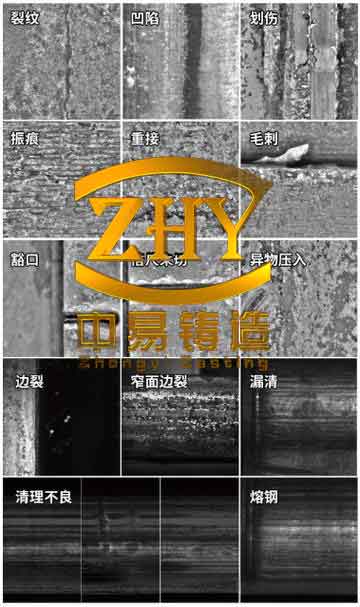
By implementing these measures, the occurrence of sand holes dropped significantly. The figure below (inserted once in the article) illustrates a typical example of a sand hole defect we encountered before the improvements.
3. Gas Porosity (Blowholes and Pinholes)
Gas porosity is the most frequent defect in green sand casting, accounting for the largest share of our scrap. It arises from gases (mainly water vapor, decomposition products of coal dust, and core binders) that are trapped in the solidifying metal. The primary sources are moisture in the mold, volatile matter in the sand, and insufficient venting. The relationship between the gas pressure inside the mold and the critical pressure to form a bubble is given by the Laplace equation:
$$
P_{gas} > P_{atm} + \frac{2\gamma}{r}
$$
where \(\gamma\) is the surface tension of the molten iron (about 1.5 N/m) and \(r\) is the bubble radius. For a typical pore radius of 0.1 mm, the required overpressure is about 0.03 MPa, which is easily reached if mold permeability is low or moisture is high.
We control gas porosity by rigorously managing moisture, compactability, and permeability. Table 3 lists the key control parameters and their optimal ranges.
| Parameter | Formula / relation | Target |
|---|---|---|
| Moisture content \(W\) | – | 3.2%–3.8% |
| Compactability \(CB\) | \(CB =\) (height reduction)/original height \(\times 100\%\) | 32%–36% |
| Ratio \(CB / W\) | Indicates optimum moisture state | 10–12 |
| Permeability \(P\) | AFS permeability number | 100–140 |
| Loss on ignition (LOI) | – | 3%–5% |
The ratio \(CB/W\) is a sensitive indicator: if it falls below 10, the sand is too wet and vulnerable to gas defects; if above 12, the sand is too dry and becomes brittle. We adjust the water addition in the mixer automatically based on the online CB measurement. Additionally, we seasonally tweak the CB target: slightly lower in autumn and winter, and lower on humid days, to maintain the ratio in the sweet spot.
Other preventive actions include:
- Ensuring adequate venting by pricking vent holes on the cope surface (density ~1 hole per 50 cm²) and lighting the vents with a torch during pouring to promote gas evacuation.
- Controlling core binder content (for cold‑box and resin‑coated sand cores) to avoid excessive gas evolution; we monitor the core gas evolution using a standard test.
- De‑gassing the melt when hydrogen content is high, using nitrogen flushing or holding at high temperature for 10 minutes.
- Drying laddles and charge materials thoroughly to prevent moisture pickup.
4. Sand Inclusions (Scabs and Expansion Defects)
Scabs, also known as sand inclusions or expansion defects, occur when the sand mold surface expands rapidly under the heat of the molten metal, forming a thin layer that peels off and becomes entrapped in the casting. This defect is especially common in large, flat castings such as flywheels. The primary cause is insufficient hot‑wet tensile strength of the sand, which allows the surface layer to delaminate. The thermal gradient generates compressive stress \(\sigma_{th}\) in the surface layer:
$$
\sigma_{th} = E \cdot \alpha \cdot \Delta T
$$
where \(E\) is the elastic modulus of the sand (~10 GPa), \(\alpha\) is the thermal expansion coefficient of silica sand (~15 × 10⁻⁶ K⁻¹), and \(\Delta T\) is the temperature difference across the layer (~1000 K). This stress can exceed the hot‑wet tensile strength of untreated sand (typically <2 kPa) and cause spalling.
To prevent scabs, we focus on three main areas:
- Increasing the hot‑wet tensile strength by using sodium‑exchanged bentonite (Na‑bentonite) and optimizing its addition level. We maintain a minimum of 2.5 kPa (measured at 1000 °C).
- Adding coal dust (or other carbonaceous additives) to improve the thermoplastic behavior of the sand. The coal dust melts and forms a deformable layer that relieves thermal stress. The proportion of coal dust relative to bentonite is normally 50%, but for scab‑prone castings we increase it to 80%, while keeping the LOI within 3%–5%.
- Using nails or chills on large flat surfaces of the cope to anchor the sand layer. We insert steel nails (about 25 mm long, 1.5 mm diameter) at a spacing of 50 mm × 50 mm, flush with the mold surface.
We also modified the pouring practice: for flywheels, we use a tilt pouring technique with a tilt angle of 3°–15°, which reduces the dwell time of the metal on the top surface and thus lowers the heat input. Table 4 shows the effect of these measures on the scab defect rate.
| Period | Hot‑wet tensile strength (kPa) | Coal dust / bentonite ratio | Nails used? | Scab rate (%) |
|---|---|---|---|---|
| Before | 1.8–2.2 | 50% | No | 7.2 |
| After | 2.5–3.1 | 80% | Yes | 1.8 |
5. Sand Sticking (Burn‑on and Metal Penetration)
Sand sticking refers to the adherence of sand to the casting surface, which can be either mechanical (metal penetration into sand pores) or chemical (reaction between iron oxides and silica forming a low‑melting eutectic). The prevention strategy differs for each type. For mechanical sand sticking, the key is to reduce the pore size in the sand mold by using finer sand and maintaining adequate compaction. The critical permeability for penetration can be estimated from the capillary pressure equation:
$$
P_{cap} = \frac{2\gamma \cos\theta}{r}
$$
where \(\theta\) is the contact angle (typically ~90° for iron on silica), and \(r\) is the effective pore radius. Mechanically, the metal pressure must exceed the capillary pressure to penetrate. In practice, we keep the permeability below 140 (AFS) to avoid coarse pores.
For chemical sand sticking, the formation of fayalite (Fe₂SiO₄) occurs at the metal‑mold interface when iron oxide reacts with silica. The reaction is:
$$
2\text{FeO} + \text{SiO}_2 \rightarrow \text{Fe}_2\text{SiO}_4
$$
This low‑melting phase (melting point ~1205 °C) can wet the sand and cause strong adhesion. To prevent this, we rely on coal dust, which forms a reducing atmosphere and produces a carbonaceous film on the sand grains, hindering the oxidation of iron. The LOI value is the main control parameter; we keep it in the range 3%–5%. If the LOI exceeds 5%, the casting surface becomes blue‑gray and rough (we have observed this in some small parts).
Other measures include controlling pouring temperature (1,320–1,420 °C for thin‑walled parts, 1,300–1,380 °C for heavy sections) and using refractory coatings on the mold surface when necessary. We apply a fast‑drying zircon‑based coating, but we avoid any ignition drying that could dehydrate the sand and create sand holes.
A summary of the sand sticking prevention parameters is given in Table 5.
| Parameter | Control range | Effect on sand sticking |
|---|---|---|
| Permeability (AFS) | 100–140 | Lower reduces metal penetration |
| LOI | 3%–5% | Optimal coal dust level prevents chemical sticking |
| AFS grain fineness (main 4 sieves) | 50–140 (70% retained on 50–100 was corrected) | Finer sand reduces pore size |
| Pouring temperature | 1300–1420 °C | Lower temperature reduces fluidity and penetration |
| Coating | Zircon, fast‑drying, no ignition | Provides refractory barrier |
6. Overall Scrap Rate Reduction
After implementing the comprehensive set of countermeasures described above over a period of six months, we observed a dramatic reduction in the total scrap rate attributed to sand casting defects. The data is shown in Table 6 and Figure 1 (the figure is represented by the image we inserted earlier). We continuously monitor the scrap rate monthly and analyze defect categories separately.
| Defect category | Before improvement (%) | After improvement (%) | Reduction factor |
|---|---|---|---|
| Sand holes | 2.4 | 0.9 | 2.7× |
| Gas porosity | 3.1 | 1.2 | 2.6× |
| Scabs / sand inclusions | 1.8 | 0.5 | 3.6× |
| Sand sticking | 0.7 | 0.3 | 2.3× |
| Total | 8.0 | 2.9 | 2.8× |
Note: The total scrap rate dropped from ~8% to about 4–5% in the first few months as we gradually refined the process. After full implementation of all measures, the rate stabilized below 3% for most product families. The economic benefit is substantial, saving approximately 5% of the total production cost, and the customer satisfaction has improved remarkably.
7. Conclusion
Through systematic analysis of sand casting defects in clay‑green sand molding—including sand holes, gas porosity, scabs, and sand sticking—I have developed and validated a set of practical countermeasures. The key lessons are:
- Rigorous control of basic sand properties (moisture, compactability, permeability, strength) is essential. Using automated online measurement and closed‑loop adjustment ensures consistency.
- For each defect type, a combination of process parameter optimization and mold design improvements is more effective than relying on a single fix.
- The ratio \(CB/W\) is a simple yet powerful indicator of the moisture state; maintaining it between 10 and 12 eliminates many gas‑related issues.
- Coal dust plays a dual role in preventing both scabs and sand sticking; its optimal LOI range of 3%–5% must be strictly followed.
- Core print design and mold handling procedures are often overlooked but are critical for preventing sand holes.
By adhering to these principles, our foundry reduced the overall scrap rate from 8% to under 4–5%, and in many runs to about 3%. This achievement has not only cut costs but also strengthened our reputation among engine manufacturers. I believe that the systematic approach described here can be readily adapted to other green sand foundries facing similar challenges.
In the future, we plan to implement machine‑learning‑based predictive models using real‑time sand data to forecast the risk of sand casting defects and adjust parameters proactively. The foundation built on the understanding of defect mechanisms will continue to guide our process improvement.