
As a researcher in the field of metallurgy, I have extensively studied the heat treatment techniques for nodular cast iron, a material that has revolutionized the foundry industry due to its exceptional mechanical properties and versatility. Nodular cast iron, also known as ductile iron, is characterized by its spherical graphite nodules embedded in a metallic matrix, which significantly reduces stress concentration and enhances strength. In this article, I will delve into the intricacies of heat treatment processes for nodular cast iron, exploring how they alter the microstructure and improve performance. The goal is to provide a comprehensive understanding that can aid in optimizing applications such as diesel engine crankshafts, gears, and machine tool spindles. Throughout this discussion, I will emphasize the importance of nodular cast iron in modern engineering and repeatedly highlight its unique attributes.
The foundation of nodular cast iron’s superiority lies in its graphite morphology. During solidification, through spheroidization and inoculation treatments, carbon precipitates as spherical graphite rather than flake-like forms. This results in minimal notch effect and improved toughness. However, the as-cast microstructure often contains undesirable phases like cementite or pearlite, which can limit ductility. Heat treatment is thus crucial to tailor the matrix for specific demands. I will cover various processes, including aging, annealing, normalizing, quenching and tempering, and isothermal quenching, each contributing to distinct property enhancements. To illustrate, consider the basic relationship between heat treatment temperature and time, often described by kinetic equations. For instance, the diffusion-controlled transformation during annealing can be modeled using Fick’s laws. A simplified form for carbon diffusion in nodular cast iron might be expressed as:
$$ \frac{\partial C}{\partial t} = D \nabla^2 C $$
where \( C \) is the carbon concentration, \( t \) is time, and \( D \) is the diffusion coefficient, which depends on temperature via the Arrhenius equation: \( D = D_0 \exp\left(-\frac{Q}{RT}\right) \). Here, \( D_0 \) is a pre-exponential factor, \( Q \) is the activation energy, \( R \) is the gas constant, and \( T \) is the absolute temperature. Such formulas help in predicting microstructural changes during heat treatment of nodular cast iron.
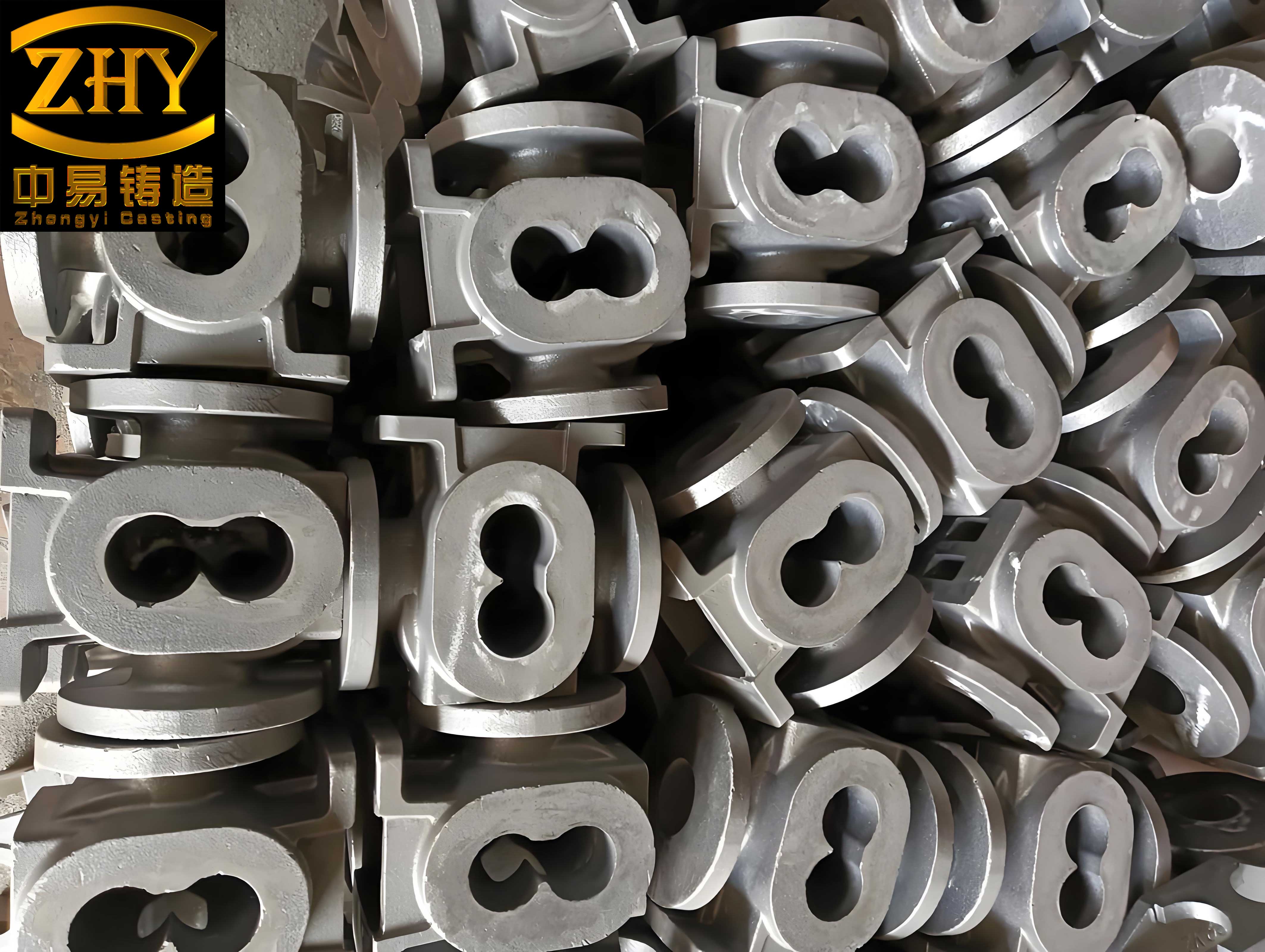
Now, let’s begin with the concept of aging, which is critical for stress relief. In nodular cast iron casting, differential cooling rates between the surface and interior generate residual stresses. If not relieved, these can lead to cracking during machining or service. I typically recommend two approaches: artificial aging and natural aging. Artificial aging involves heating the castings to about 550°C, holding for a sufficient time—often 2 to 4 hours depending on section thickness—and then air cooling. This process accelerates stress relaxation through dislocation movement and recovery. Natural aging, where castings are stored outdoors for months, is less efficient and rarely used in industry. The effectiveness of artificial aging can be quantified by the stress reduction over time, approximated by:
$$ \sigma(t) = \sigma_0 \exp\left(-\frac{t}{\tau}\right) $$
where \( \sigma_0 \) is the initial stress, \( t \) is aging time, and \( \tau \) is a relaxation time constant that depends on temperature and material composition. For nodular cast iron, \( \tau \) decreases with higher aging temperatures, making artificial aging more rapid.
Next, annealing processes are employed to improve machinability and toughness. One common issue in nodular cast iron is the formation of white iron, a hard and brittle phase containing cementite, due to rapid cooling. To eliminate this, I perform a graphitization annealing. The casting is heated to around 890°C, held for 2 hours to dissolve cementite, and then slowly cooled to 450°C before air cooling. This allows cementite to decompose into graphite and ferrite, softening the material. Another annealing variant aims to achieve a fully ferritic matrix for maximum ductility. Here, the nodular cast iron is heated to 900–950°C, held for extended periods, furnace-cooled to 600°C, and then air cooled. This high-temperature annealing promotes graphite precipitation and transforms the matrix to ferrite. The kinetics of graphitization can be described using the Johnson-Mehl-Avrami-Kolmogorov (JMAK) equation:
$$ X(t) = 1 – \exp\left(-(kt)^n\right) $$
where \( X(t) \) is the fraction transformed, \( k \) is a rate constant dependent on temperature, and \( n \) is the Avrami exponent. For nodular cast iron, \( n \) typically ranges from 1 to 2 for graphitization processes. The table below summarizes key annealing parameters for nodular cast iron.
| Annealing Type | Temperature Range (°C) | Holding Time (hours) | Cooling Method | Resulting Matrix |
|---|---|---|---|---|
| White Iron Elimination | 880–900 | 2–4 | Slow cool to 450°C, then air cool | Ferrite + Graphite |
| Ferritizing Annealing | 900–950 | 3–6 | Furnace cool to 600°C, then air cool | Predominantly Ferrite |
| Subcritical Annealing | 740–760 | 2–3 | Air cool | Ferrite + Pearlite |
Normalizing is another vital heat treatment for nodular cast iron, aimed at increasing strength and wear resistance. I often normalize by heating to 900°C, holding to austenitize the matrix, and then air cooling. This transforms the austenite into a fine pearlitic structure, enhancing hardness. The process refines the microstructure and increases the pearlite content. However, one must be cautious of decarburization, where carbon diffuses out from the surface, reducing hardness. To minimize this, I control heating time and use protective atmospheres. The normalized microstructure of nodular cast iron typically consists of pearlite and ferrite, with graphite nodules uniformly dispersed. The strength improvement can be correlated to the interlamellar spacing of pearlite, given by the Hall-Petch type relation:
$$ \sigma_y = \sigma_0 + \frac{k}{\sqrt{\lambda}} $$
where \( \sigma_y \) is the yield strength, \( \sigma_0 \) is a friction stress, \( k \) is a constant, and \( \lambda \) is the pearlite interlamellar spacing. For nodular cast iron, normalizing reduces \( \lambda \), thereby boosting strength.
Quenching and tempering are essential for high-hardness applications, such as bearings. I quench nodular cast iron by heating to 900°C to austenitize, then rapidly cooling in oil or water to form martensite. This is followed by tempering at 550–600°C to relieve stresses and improve toughness. The resulting tempered martensite offers excellent wear resistance. The hardness after quenching depends on the carbon content in austenite, which is influenced by graphite dissolution. The quench hardness \( H \) can be estimated using empirical formulas:
$$ H = H_0 + \alpha C_{\gamma} $$
where \( H_0 \) is a base hardness, \( \alpha \) is a coefficient, and \( C_{\gamma} \) is the carbon concentration in austenite. For nodular cast iron, \( C_{\gamma} \) is typically around 0.6–0.8 wt% due to carbon from graphite. Tempering reduces hardness but increases ductility, following a trade-off relationship. I often use tempering curves to optimize properties, as shown in the table below for nodular cast iron.
| Tempering Temperature (°C) | Hardness (HRC) | Tensile Strength (MPa) | Impact Toughness (J) |
|---|---|---|---|
| 200 | 50–55 | 1200–1400 | 10–20 |
| 400 | 40–45 | 1000–1200 | 20–30 |
| 600 | 30–35 | 800–1000 | 30–40 |
Isothermal quenching, or austempering, produces a unique microstructure called ausferrite, which consists of bainitic ferrite and retained austenite. I perform this by heating nodular cast iron to 850–900°C, austenitizing, then quenching into a salt bath at 250–400°C, holding isothermally to form bainite. This process yields high strength and toughness simultaneously. The transformation kinetics during austempering are complex, involving nucleation and growth of bainite. The time-temperature-transformation (TTT) diagram for nodular cast iron is crucial here. A simplified model for bainite formation fraction \( f_B \) over time \( t \) at temperature \( T \) is:
$$ f_B(t) = 1 – \exp\left(-\int_0^t \nu(T) \, dt\right) $$
where \( \nu(T) \) is a temperature-dependent rate function. For nodular cast iron, austempering at 300°C often results in optimal properties. The table compares properties from different heat treatments for nodular cast iron.
| Heat Treatment | Matrix Structure | Tensile Strength (MPa) | Elongation (%) | Hardness (HB) |
|---|---|---|---|---|
| As-Cast | Ferrite + Pearlite | 500–700 | 10–20 | 150–250 |
| Normalized (900°C) | Pearlite + Ferrite | 800–1000 | 5–10 | 250–300 |
| Quenched & Tempered | Tempered Martensite | 1000–1400 | 2–5 | 300–400 |
| Austempered (300°C) | Ausferrite | 1200–1600 | 5–15 | 300–350 |
Now, let’s analyze the effects of heat treatment on the microstructure and mechanical properties of nodular cast iron in detail. Starting with carbon content and retained austenite, I have observed that during austempering, the amount of retained austenite and its carbon concentration significantly influence performance. At around 350°C, retained austenite can reach volumes of 20–30% with carbon contents of 1.75–2.00 wt%, stabilizing it against transformation. This high-carbon austenite enhances ductility. The relationship between austempering temperature \( T_a \) and retained austenite volume fraction \( V_\gamma \) can be approximated by:
$$ V_\gamma = V_{\gamma,0} \exp\left(-\beta (T_a – T_0)^2\right) $$
where \( V_{\gamma,0} \) is the maximum fraction, \( \beta \) is a constant, and \( T_0 \) is the temperature for peak retention (around 350°C for nodular cast iron). Similarly, the carbon content in austenite \( C_\gamma \) increases with temperature up to a point, then decreases. This is due to carbon partitioning between ferrite and austenite during bainite formation.
The tensile strength of nodular cast iron is strongly affected by the bainite morphology. At lower austempering temperatures (e.g., 250°C), bainite forms as fine needles, creating high interfacial strength and thus high tensile strength. As temperature rises, bainite becomes feathery, reducing strength. I have found that tensile strength \( \sigma_t \) decreases linearly with austempering temperature in the range of 250–400°C for nodular cast iron:
$$ \sigma_t = \sigma_{t,0} – m T_a $$
where \( \sigma_{t,0} \) is the strength at 0°C (extrapolated) and \( m \) is a negative slope. For example, in my experiments with nodular cast iron, \( m \) is about 2 MPa/°C. This highlights the importance of precise temperature control during heat treatment of nodular cast iron.
Elongation, or ductility, is another critical property. It is influenced by the retained austenite content and its stability. As austempering temperature increases, elongation typically peaks at around 350°C due to optimal retained austenite, then declines as austenite decomposes or transforms to martensite under stress. The elongation \( \epsilon \) can be modeled as a function of retained austenite fraction \( V_\gamma \) and its carbon content \( C_\gamma \):
$$ \epsilon = \epsilon_0 + \eta V_\gamma C_\gamma $$
where \( \epsilon_0 \) is the base elongation and \( \eta \) is a proportionality constant. This equation underscores how heat treatment tailors the ductility of nodular cast iron.
Furthermore, I have investigated the impact of heat treatment on fatigue resistance and wear behavior. Normalized nodular cast iron shows good fatigue strength due to fine pearlite, while austempered nodular cast iron excels in impact fatigue thanks to its ausferritic matrix. The fatigue limit \( \sigma_f \) can be related to tensile strength via Marin’s equation:
$$ \sigma_f = k_a k_b k_c \sigma_t $$
where \( k_a \), \( k_b \), and \( k_c \) are factors for surface finish, size, and loading, respectively. For nodular cast iron, \( \sigma_f \) is typically 0.4–0.5 times \( \sigma_t \). Wear resistance, crucial for gears, improves with hardness, but also depends on graphite nodules that act as solid lubricants. The wear rate \( W \) can be expressed as:
$$ W = \frac{K P v}{H} $$
where \( K \) is a wear coefficient, \( P \) is load, \( v \) is sliding velocity, and \( H \) is hardness. Heat treatments like quenching increase \( H \), reducing \( W \) for nodular cast iron components.
In practice, selecting the right heat treatment for nodular cast iron involves balancing multiple factors. For instance, if high strength and wear resistance are needed, quenching and tempering are suitable, but for applications requiring good machinability and toughness, annealing is preferred. I often use computational tools to simulate heat treatment outcomes, such as finite element analysis for temperature distributions and phase transformations. These simulations rely on constitutive equations for nodular cast iron, like the Koistinen-Marburger equation for martensite formation during quenching:
$$ f_M = 1 – \exp\left(-\alpha (M_s – T)\right) $$
where \( f_M \) is the martensite fraction, \( \alpha \) is a constant, \( M_s \) is the martensite start temperature, and \( T \) is the temperature. For nodular cast iron, \( M_s \) ranges from 200 to 300°C depending on alloying elements.
To summarize, heat treatment of nodular cast iron is a multifaceted discipline that enables property optimization for diverse engineering applications. From stress relief through aging to strength enhancement via normalizing and quenching, each process modifies the matrix structure around the spherical graphite nodules. The key is understanding the interplay between temperature, time, and composition. I have presented various formulas and tables to encapsulate these relationships, emphasizing the versatility of nodular cast iron. As technology advances, new heat treatment methods, such as laser hardening or cryogenic treatment, are being explored for nodular cast iron, promising even better performance. Ultimately, mastering these techniques ensures that nodular cast iron continues to replace steel in critical components, offering cost savings and design flexibility. I hope this detailed exploration inspires further innovation in the heat treatment of nodular cast iron.