
The production of high-performance wear parts, particularly liners for grinding mills, represents a significant challenge and opportunity within the field of high manganese steel casting. The classic Hadfield steel, typically designated as ZGMn13, is renowned for its exceptional work-hardening capability under impact and abrasion. However, achieving consistent and superior performance in large castings like mill liners requires meticulous control over every stage of the manufacturing process, from melt chemistry and metallurgical quality to precise heat treatment protocols. Our extensive exploration and practice in optimizing high manganese steel casting have revealed that the instability in microstructure and mechanical properties often stems from variations in these critical areas. This article delves into the systematic approach we have developed to enhance the quality, durability, and reliability of high manganese steel castings, focusing on the synergistic control of composition, solidification, and thermal processing.
The fundamental appeal of high manganese steel casting lies in its unique austenitic microstructure, which provides remarkable toughness in the bulk material. Upon severe surface deformation during service, this austenite transforms to martensite, creating an extremely hard wear-resistant surface while the core remains ductile. The traditional production route involves a high-temperature solution treatment followed by rapid water quenching to obtain this single-phase austenitic structure. Yet, the inherent characteristics of the as-cast state—such as carbide networks at grain boundaries, segregation, and coarse grain structure—can severely undermine this potential if not properly addressed. Therefore, the journey toward a superior high manganese steel casting begins long before the heat treatment furnace.
Precise Chemical Composition: The Foundational Blueprint
Optimal performance in high manganese steel casting is not achieved by adhering to broad specification ranges but by targeting a precise, balanced chemistry tailored to specific service conditions. The primary elements—Carbon (C) and Manganese (Mn)—must be managed as an interactive pair, not in isolation.
The role of Carbon is dualistic: it is essential for solid solution strengthening and work-hardening capacity, but excessive carbon leads to the formation of coarse, brittle carbides, typically at grain boundaries, which act as stress concentrators and crack initiation sites. Manganese is the primary austenite stabilizer; it suppresses the formation of pearlite and ensures the austenitic structure is retained at room temperature after quenching. However, an excessively high Mn content can reduce hardenability and the driving force for work-hardening. The Mn/C ratio is, therefore, a pivotal parameter. For large mill liners operating in harsh, wet environments, we have found that controlling the Mn/C ratio to approximately 11 provides an optimal balance of toughness, hardenability, and work-hardening potential.
Furthermore, modern high manganese steel casting often incorporates alloying modifications. Chromium (Cr) is frequently added to improve corrosion resistance, which is crucial for wet grinding applications. Its presence also contributes to solid solution strengthening. Silicon (Si), while primarily a deoxidizer, must be kept at moderate levels to avoid promoting carbide formation. Strict control over impurities like Phosphorus (P) and Sulfur (S) is non-negotiable, as they form low-melting-point eutectics at grain boundaries, drastically reducing impact toughness. Our optimized composition for large-diameter mill liners is detailed in Table 1, contrasting it with a more conventional specification.
| Element | Conventional Range | Optimized Range | Primary Function & Rationale |
|---|---|---|---|
| C | 1.10 – 1.30 | 1.00 – 1.20 | Solid solution strengthener; controls work-hardening. Lower range minimizes harmful carbides. |
| Mn | 11.0 – 14.0 | 11.0 – 14.0 | Austenite stabilizer. Controlled relative to C to achieve target Mn/C ratio. |
| Si | 0.40 – 1.00 | 0.30 – 0.60 | Deoxidizer. Restricted level to avoid promoting carbide precipitation. |
| Cr | 0 – 2.0 | 2.6 – 3.2 | Enhances corrosion/abrasion resistance and solid solution strength. |
| P | ≤ 0.070 | ≤ 0.040 | Harmful impurity. Strictly limited to prevent grain boundary embrittlement. |
| S | ≤ 0.040 | ≤ 0.025 | Harmful impurity. Forms MnS inclusions; strictly limited. |
| RE (Residual) | – | 0.08 – 0.12 | Modifying agent for grain refinement and inclusion shape control. |
This careful balancing act can be conceptually summarized by a carbon equivalence formula tailored for high manganese steel casting, which considers the austenite-stabilizing effects:
$$C_{eq} = C + \frac{Mn}{6} + \frac{Cr}{5} + \frac{Mo}{4}$$
While Mo is not used here, the formula highlights how elements contribute to the overall “hardenability” of the austenitic matrix. Our target is a specific $C_{eq}$ range that guarantees a fully austenitic structure post-quench without excessive carbon segregation.
Metallurgical Quality Enhancement: From Melt to Mold
Superior chemistry alone is insufficient. The metallurgical quality of the liquid metal before casting determines the final microstructure’s homogeneity and cleanliness. Two key practices are employed: advanced deoxidation/desulfurization and targeted inoculation/modification.
Rare Earth (RE) element treatment has proven transformative for high manganese steel casting. The RE elements, such as Cerium and Lanthanum, are potent modifiers with several beneficial effects:
- Inclusion Morphology Control: RE elements react with sulfur and oxygen to form high-melting-point, globular oxy-sulfides (e.g., Ce2O2S) instead of the brittle, elongated MnS stringers. This transformation dramatically improves ductility and impact toughness by reducing stress concentration sites.
- Grain Refinement: The dispersed RE-containing particles act as heterogeneous nucleation sites for austenite grains during solidification, leading to significant grain refinement. According to the Hall-Petch relationship, finer grains directly enhance yield strength:
$$σ_y = σ_0 + \frac{k_y}{\sqrt{d}}$$
where $σ_y$ is the yield strength, $σ_0$ is the friction stress, $k_y$ is the strengthening coefficient, and $d$ is the average grain diameter. - Carbide Modification: RE elements segregate to the growing interfaces of carbides, altering their growth kinetics and promoting a more discrete, less interconnected morphology rather than a continuous network at grain boundaries.
The impact of RE modification on the properties of high manganese steel casting is quantitatively significant, as shown in Table 2.
| Property | Conventional ZGMn13 | RE-Modified High Mn Steel | Improvement |
|---|---|---|---|
| Tensile Strength, σb (MPa) | 600 – 650 | 880 – 950 | > 40% |
| Elongation, δ (%) | 15 – 20 | 30 – 38 | > 70% |
| Impact Toughness, αK (J/cm²) | 100 – 120 | 170 – 200 | > 60% |
| As-Quenched Hardness (HBS) | 200 – 210 | 220 – 230 | ~10 Points |
Effective process control necessitates rapid, on-the-spot assessment. While advanced spectrometry provides accurate chemistry, a simple yet effective bend test is used for a qualitative assessment of metallurgical quality. A standardized wedge-shaped or stepped-cone sample is poured from the heat, allowed to cool to a dull red heat (approximately 800°C), and then quenched in water. The sample is then fractured and examined. A fine, silky, fibrous fracture surface indicates good toughness and the absence of excessive carbides or inclusions, validating the melt quality for the high manganese steel casting. A coarse, crystalline, or intergranular fracture signals problems requiring corrective action, such as adjustment of pouring temperature or modification practice.
Casting Process Parameters: Solidification Engineering
The transition from liquid to solid must be managed to preserve the refined metallurgical quality achieved in the ladle. Key parameters include mold media, pouring temperature, and gating/risering design.
For large, complex high manganese steel castings like liners, the choice of molding sand is critical. CO2-sodium silicate sand offers good rigidity and collapsibility but can react with manganese oxides to form severe chemical burn-on, especially in deep pockets and around bolt holes. To mitigate this, a multi-media approach is adopted: the main mold uses improved silicate sand, while cores for complex features are made from furan resin sand, which provides excellent peel-off characteristics. Furthermore, all mold and core surfaces are coated with a refractory, high-alumina or magnesia-based zircon coating to create a thermal and chemical barrier between the sand and the reactive high manganese steel casting.
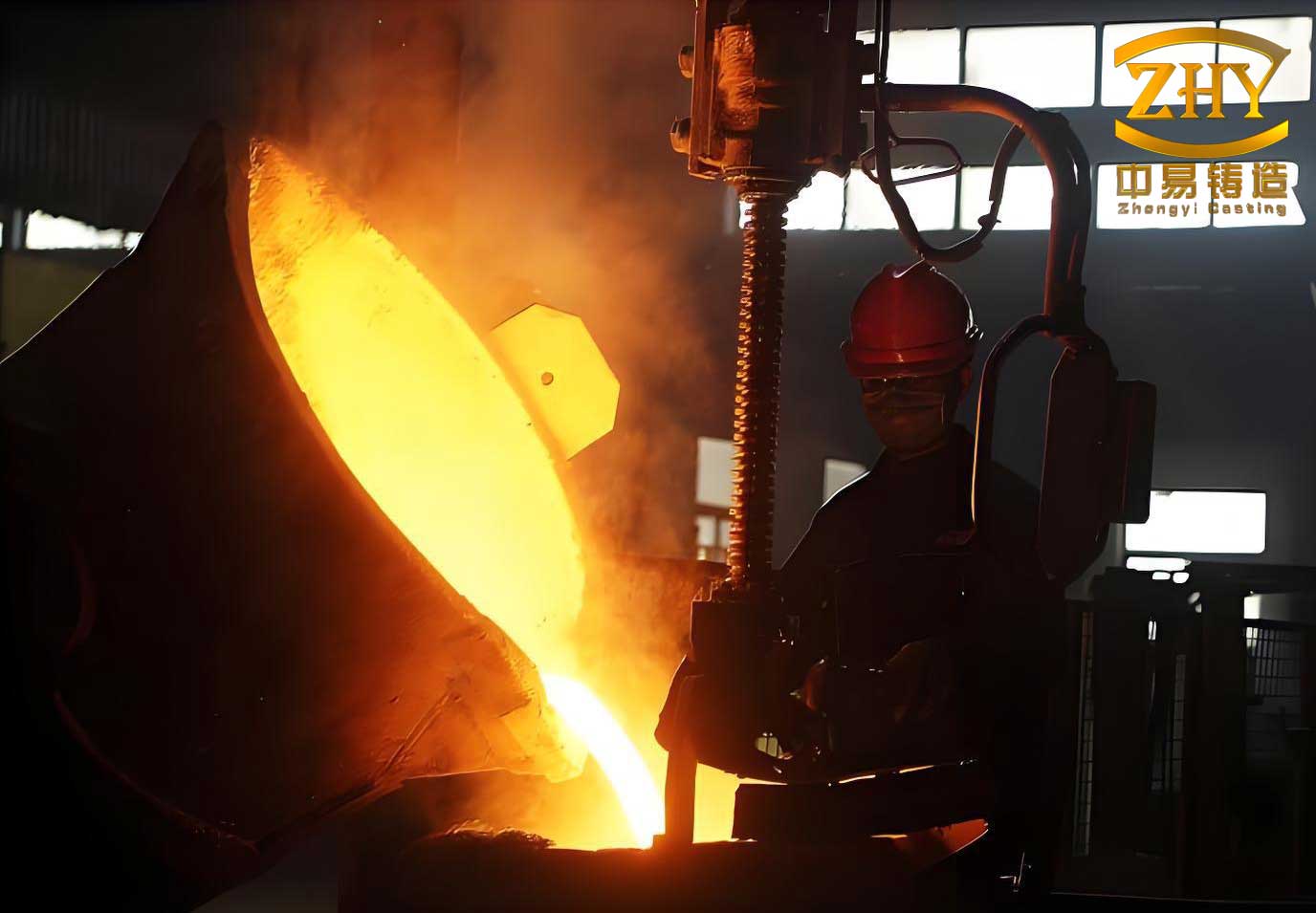
Pouring practice follows the principle of “high temperature tapping, low temperature pouring.” The metal is tapped from the furnace at 1500-1520°C to ensure complete dissolution of additives and homogeneity. It is then allowed to calm in the ladle, promoting slag and inclusion flotation. The pouring temperature is deliberately lowered to 1400-1440°C. This lower superheat reduces the total heat content entering the mold, promoting faster solidification rates, finer dendrite arm spacing (DAS), and a denser, more homogeneous casting. The relationship between secondary dendrite arm spacing (λ) and local solidification time (tf) is well-established:
$$λ = k \cdot (t_f)^n$$
where $k$ and $n$ are material constants. A shorter $t_f$ (from lower pouring temp) leads to a smaller λ, improving microstructural homogeneity and mechanical properties. Gating systems are designed to fill the mold smoothly and rapidly to avoid cold shuts, using a controlled “slow-fast-slow” pour sequence to minimize turbulence and oxidation.
| Process Stage | Parameter | Target/Standard | Purpose & Rationale |
|---|---|---|---|
| Melting & Pouring | Tapping Temperature | 1500 – 1520 °C | Ensure homogeneity and complete dissolution. |
| Pouring Temperature | 1400 – 1440 °C | Reduce superheat for finer as-cast structure. | |
| Molding | Main Mold Media | CO2-Silicate Sand | Good rigidity and collapsibility. |
| Core Media (Complex features) | Furan Resin Sand | Excellent collapsibility, prevents burn-on. | |
| Coating | Mold/Core Wash | Magnesia/Zircon-based | Prevents metal-sand reaction and penetration. |
The Critical Role of Solution Heat Treatment
Heat treatment is the most decisive step in unlocking the legendary properties of a high manganese steel casting. The objective is to dissolve all the carbides (primarily (Fe,Mn)3C) formed during solidification into the austenitic matrix and then “freeze” this supersaturated solid solution by rapid quenching. Any deviation here can nullify all prior careful controls.
1. Heating and Soaking: The castings must be heated to a temperature where the carbide phase is fully dissolved into austenite. For standard ZGMn13 with Cr addition, this temperature is 1050°C ±10°C. Soaking time is critical and is a function of section thickness and the initial carbide dispersion. It can be estimated based on the diffusion-controlled dissolution process. The time ($t$) required to dissolve a carbide particle of a given size is related to temperature ($T$) by an Arrhenius-type relationship:
$$t \propto \exp\left(\frac{Q}{RT}\right)$$
where $Q$ is the activation energy for carbon diffusion in austenite, and $R$ is the gas constant. Under-soaking leaves undissolved carbides, acting as brittle phases. Over-soaking leads to excessive grain growth, reducing toughness. For large liner castings, a stepped heating cycle is used to prevent thermal shock and distortion, with intermediate holds at 650°C and 850°C before reaching the final solution temperature.
2. Quenching: This is the non-equilibrium step that retains the high-temperature single-phase structure. The quench must be rapid enough to bypass the “nose” of the Time-Temperature-Transformation (TTT) curve for carbide precipitation. The critical quenching rate ($V_{cr}$) must be exceeded:
$$V_{cr} > \frac{T_s – T_n}{t_n}$$
where $T_s$ is the solution temperature, $T_n$ is the temperature at the nose of the TTT curve, and $t_n$ is the time to the nose. For high manganese steel casting, this necessitates a violent water quench.
3. Operational Rigor: Two practical rules are paramount. First, the quench water temperature must be maintained below 50°C, ideally using agitated, circulating water to avoid steam blanketing that insulates the casting and slows cooling. Second, the transfer time from furnace to quench tank must be minimized—less than 10 seconds for heavy sections. Any delay allows surface cooling and the onset of undesirable carbide precipitation at grain boundaries, creating a brittle envelope around the casting.
Quality Verification and Performance Outcomes
The efficacy of this integrated approach for high manganese steel casting is validated through both destructive and non-destructive testing. Microstructural analysis reveals a uniform, fine-grained austenitic matrix free of continuous carbide networks. Mechanical testing consistently meets or exceeds the enhanced property profile outlined in Table 2. Most importantly, the in-service performance of liners produced via this optimized route shows a marked improvement. The more homogeneous and refined microstructure leads to more uniform work-hardening during operation, delaying the onset of deep cracking and spalling. The enhanced toughness from RE modification and strict impurity control reduces the risk of catastrophic fracture under heavy impact loads. Consequently, the overall service life of mill liners, a key metric for any high manganese steel casting product, is significantly extended, reducing total cost of ownership for the operator.
| Control Area | Key Parameter | Target | Consequence of Deviation |
|---|---|---|---|
| Chemistry | Mn/C Ratio; P, S levels | ~11; P≤0.04%, S≤0.025% | Poor toughness, intergranular brittleness. |
| Metallurgy | RE Modification | 0.08-0.12% addition | Coarse grains, brittle inclusions, lower properties. |
| Casting | Pouring Temperature | 1400-1440 °C | Coarse microstructure or mistruns. |
| Heat Treatment | Solution Temperature | 1050°C ±10°C | Residual carbides or excessive grain growth. |
| Quench Delay & Water Temp | <10 s; <50 °C | Precipitation of grain boundary carbides, soft skin. |
In conclusion, the production of high-integrity, long-life components via high manganese steel casting is a complex, multi-variable engineering challenge. It cannot be reduced to a simple recipe but requires a holistic, controlled-process philosophy. By fundamentally understanding and precisely managing the interactions between chemistry (optimizing the Mn/C ratio and adding Cr), melt quality (employing RE modification), solidification dynamics (controlling pouring temperature and mold media), and most critically, the solution heat treatment kinetics (strict adherence to temperature, time, and quench parameters), it is possible to consistently produce high manganese steel castings that fully realize their theoretical potential. The resultant fine-grained, clean, and homogeneous austenitic structure provides an unparalleled combination of initial toughness and in-service work-hardening capability, making it the material of choice for the most demanding impact-abrasion applications. This systematic exploration and practice underscore that in the realm of high manganese steel casting, excellence is truly forged through the meticulous integration of science and controlled art.