
In the production of large-diameter gears, obtaining a suitable gear blank is a primary and critical step. Among the available methods—casting, forging, and welding—casting is often preferred for large components due to its cost-effectiveness, simplicity of required equipment, and near-unlimited freedom in shaping complex geometries. Forged blanks, while offering improved as-cast microstructure, involve complex processes, are unsuitable for very large or intricate shapes, and incur significantly higher costs. Welded blanks represent a newer technology with excellent surface quality and minimal machining allowance, and their internal quality can approach that of a monolithic forging. However, their higher production cost compared to cast or forged blanks limits their widespread application. The selection of material is equally crucial. Spheroidal graphite cast iron, commonly known as ductile iron, presents a compelling combination of properties including excellent damping capacity, good wear resistance, relatively simple production processes, and low cost. A significant branch of this material family is heavy-section spheroidal graphite cast iron, which is increasingly replacing gray iron and cast steel in applications like end covers, mill disks, and cylinder bodies, owing to its favorable mechanical properties.
This article details the first-person experience and technical development involved in manufacturing a large gear from spheroidal graphite cast iron grade QT700-2A. The challenge stemmed from the gear’s substantial wall thickness, with a maximum of 145 mm, categorizing it squarely as a heavy-section casting. Such thick sections present significant difficulties in spheroidal graphite cast iron production due to extended solidification times. These long solidification periods increase the risk of critical defects such as nodule degeneration (graphite distortion, fading) and the formation of undesirable chunky graphite, which severely degrade mechanical properties. To mitigate these risks, manage production cycles, and control costs, a segmented manufacturing approach was adopted. The full circular gear was divided into sixteen identical segments. A single gear segment blank had a chord length of 1,340 mm, a width of 460 mm, a height of 315 mm, and a weight of 820 kg. Key processing surfaces were subjected to 100% ultrasonic testing (according to GB/T 34904—2017) and 100% magnetic particle inspection (according to GB/T 9444—2019), with acceptance criteria demanding Grade 2 quality or better. Separately cast test blocks were also produced for destructive evaluation.
Chemical Composition Design for Heavy-Section Spheroidal Graphite Cast Iron
The design of chemical composition for heavy-section spheroidal graphite cast iron is a delicate balancing act, primarily aimed at ensuring sound graphite formation throughout the thick section while achieving the required matrix structure and mechanical strength. The foundation lies in the carbon equivalent (CE), which must be high enough to promote graphitization and counteract chilling tendencies but controlled to prevent graphite flotation. A principle of high carbon and low silicon is typically followed, targeting the eutectic point vicinity to optimize fluidity and graphitization potential. Silicon plays a dual role: it is a potent graphitiser and provides solid solution strengthening. However, excess silicon, especially in heavy sections, promotes the formation of degenerate “chunky” graphite. Therefore, its content must be carefully limited.
The influence of alloying and trace elements becomes paramount in controlling the matrix and mitigating segregation. Manganese, a common pearlite promoter, tends to segregate strongly at the eutectic cell boundaries in slow-cooling heavy sections, forming stable carbides that are difficult to eliminate even with prolonged annealing, thus severely reducing toughness. Copper is a more favorable pearlite promoter with less severe segregation tendency; it also enhances uniformity of properties across the section. Molybdenum is a weak carbide former but significantly increases hardenability and strength, offering a potent means to strengthen the matrix without excessive chill risk. Chromium, a strong carbide former, must be strictly limited as it promotes hard, brittle carbides that impair ductility and impact strength. The levels of “tramp” or anti-nodularizing elements like lead, antimony, titanium, and bismuth must be minimized through the use of high-purity charge materials.
The post-inoculation residuals of magnesium (Mg) and rare earth (RE) elements are critical process control parameters. Magnesium is the primary nodulizing agent; insufficient residual Mg leads to poor nodularity (spheroidization), while excessive amounts increase the likelihood of dross and pinhole defects. Rare earth elements help counteract the effects of trace impurities and improve nodule count. Based on this comprehensive analysis, the target composition range was established as shown in the table below.
| Element | Target Range (wt.%) | Primary Function & Rationale |
|---|---|---|
| C | 3.5 – 3.8 | High carbon for graphitization, fluidity; controls CE near eutectic. |
| Si | 1.9 – 2.3 | Promotes graphitization, solid solution strengthening; kept low to avoid chunky graphite. |
| Mn | 0.4 – 0.6 | Pearlite promoter; limited to minimize boundary segregation & carbide formation. |
| P | ≤ 0.05 | Harmful element; forms brittle phosphide eutectic at boundaries; limited by charge selection. |
| S | ≤ 0.02 | Detrimental to nodulization; consumes Mg; low level required but essential for nucleation. |
| Cu | 0.4 – 0.6 | Promotes pearlite, improves section uniformity, solid solution strengthening. |
| Mo | 0.1 – 0.3 | Enhances strength & hardenability, refines structure, weak carbide former. |
| Cr | < 0.3 | Strong carbide former; strictly limited to preserve ductility & toughness. |
| Mgres | 0.04 – 0.06 | Residual from treatment; ensures nodularity. Key control parameter. |
| REres | 0.01 – 0.03 | Residual from treatment; neutralizes trace elements, aids nucleation. |
The carbon equivalent (CE) is calculated using the standard formula for cast iron:
$$ CE = \%C + \frac{\%Si + \%P}{3} $$
Using the mid-range values from our target composition (C=3.65%, Si=2.1%, P=0.03%), the CE calculates to approximately 4.38%, which is near the eutectic point, providing a sound foundation for producing heavy-section spheroidal graphite cast iron.
Casting Process Design and Numerical Simulation
The gear segment was oriented vertically in the mold, with the thick outer rim (145 mm) positioned as the side wall. A two-part cope and drag mold was used, split along the horizontal mid-plane of the segment. The pattern was constructed from durable red pine to ensure dimensional stability during handling and molding. The tooth profile area on the outer diameter was cast solid (machined later), and all bolt holes were also left solid to be machined. To manage the pronounced variation in section thickness and to promote directional solidification from the thin sections towards the feeders, an extensive array of external chills was strategically placed around the thicker regions of the gear segment. These chills, made of cast iron, were thoroughly cleaned, shot-blasted, and pre-heated before use to eliminate moisture and gas sources. Their function is described by the fundamental heat transfer equation:
$$ q = -k \cdot A \cdot \frac{dT}{dx} $$
where \( q \) is the heat flow rate, \( k \) is the thermal conductivity of the chill material, \( A \) is the contact area, and \( \frac{dT}{dx} \) is the temperature gradient. The chills rapidly extract heat, increasing the local solidification rate and promoting a finer microstructure while helping to establish the desired thermal gradient. Three insulating feeder heads (risers) were placed on the top surface of the casting to provide the necessary liquid metal feed to compensate for solidification shrinkage. The gating system was designed as a bottom-pouring, open type to ensure a tranquil fill and minimize turbulence and oxide formation, using pre-formed ceramic parts for consistency. A schematic of this process layout is shown conceptually in the earlier figure.
Prior to committing to production, the entire process was subjected to rigorous numerical simulation analysis. This step is indispensable for modern casting of complex heavy-section spheroidal graphite cast iron components, as it allows for the prediction and mitigation of defects before any metal is poured. The simulation model incorporated the geometry of the casting, feeders, chills, and gating system. Key simulation parameters were set based on material properties and process knowledge: an initial pouring temperature of 1,350°C, a solidus temperature of ~1,100°C (for the iron-carbon eutectic), and a simulation end temperature of 800°C to capture all relevant solidification phenomena.
The simulation of the solidification sequence, particularly through the central thick section, confirmed the effectiveness of the chills. Solidification initiated preferentially at the chilled surfaces and progressed upwards and inwards, with the three top feeders remaining liquid longest. This created a clear temperature gradient and established directional solidification towards the feeders, which is the ideal condition for producing sound spheroidal graphite cast iron castings. The final output of the simulation was a prediction of shrinkage porosity. The results showed that the vast majority of the predicted shrinkage was contained within the feeder heads. Within the gear segment itself, only minimal, scattered, and finely distributed micro-porosity was predicted, primarily in non-critical, non-machined areas. The simulation validated the fundamental soundness of the proposed casting process, giving high confidence for the trial production.
Melting, Treatment, and Heat Treatment Practices
The melting was conducted in a medium-frequency coreless induction furnace. Charge material purity is non-negotiable for high-quality heavy-section spheroidal graphite cast iron. The principle of “one high, three low, one little” was followed for pig iron selection: high carbon, low manganese, low phosphorus, low sulfur, and low silicon (to allow flexibility with inoculant additions). Clean, low-alloy steel scrap was used as a significant portion of the charge to help control baseline silicon and impurity levels. All charge materials were inspected to be clean, dry, and free from excessive rust, oil, or contaminants that could introduce gases or undesirable elements.
The treatment process was meticulously controlled. Molten metal was transferred to a preheated ladle. Nodulization was performed using the sandwich/sandwich cover method, where a 3-8 grade FeSiMg nodulizing alloy (20-30 mm size) was placed in the bottom of the ladle and covered with steel punchings before receiving the base iron. Inoculation is arguably the most critical step for ensuring a high nodule count and preventing undercooling defects in the final microstructure of the spheroidal graphite cast iron. A dual-inoculation practice was employed for maximum effectiveness:
- Stream Inoculation: A fine-grade ferrosilicon-based inoculant (containing barium) was added into the metal stream during transfer from the treatment ladle to the pouring ladle.
- Late Inoculation (Pocket/Ladle Inoculation): Additional chunks of 75% ferrosilicon (20-30 mm) were added to the top of the metal in the pouring ladle after nodulization and slag removal.
The efficiency of inoculation in increasing nodule count (Nv) can be conceptually related to the number of potent nuclei introduced and their survival time, which is adversely affected by fading. The practice aims to maximize nuclei at the latest possible moment before solidification. Pouring was conducted within a strict 20-minute window after the start of nodulization to minimize fade. The metal was poured at a temperature between 1,310°C and 1,350°C to balance fluidity and minimize total solidification time.
To achieve the required tensile strength of 700 MPa with good ductility (QT700-2A), a quenching and tempering (Q&T) heat treatment was specified. The as-cast microstructure of heavy-section spheroidal graphite cast iron is often not uniform enough to guarantee these properties directly. The heat treatment cycle consisted of:
- Austenitizing/Quench: Heating to 860 ±10°C, holding for 6 hours to achieve a homogeneous austenitic matrix saturated with carbon, followed by oil quenching to form a martensitic or lower bainitic structure.
- Tempering: Reheating to 520 ±10°C, holding for 6 hours to precipitate carbides and transform the quenched structure into a tempered martensite or fine ferrite-carbide aggregate (tempered troostite/sorbite), followed by furnace cooling to below 150°C.
The tempering process relieves internal stresses and imparts the final combination of strength and toughness. The kinetics of tempering can be described by an Arrhenius-type relationship for the rate of property change, where time and temperature are interconnected. The chosen parameters ensured complete transformation and stabilization of the matrix in the heavy-section spheroidal graphite cast iron casting.
Results, Inspection, and Conclusions
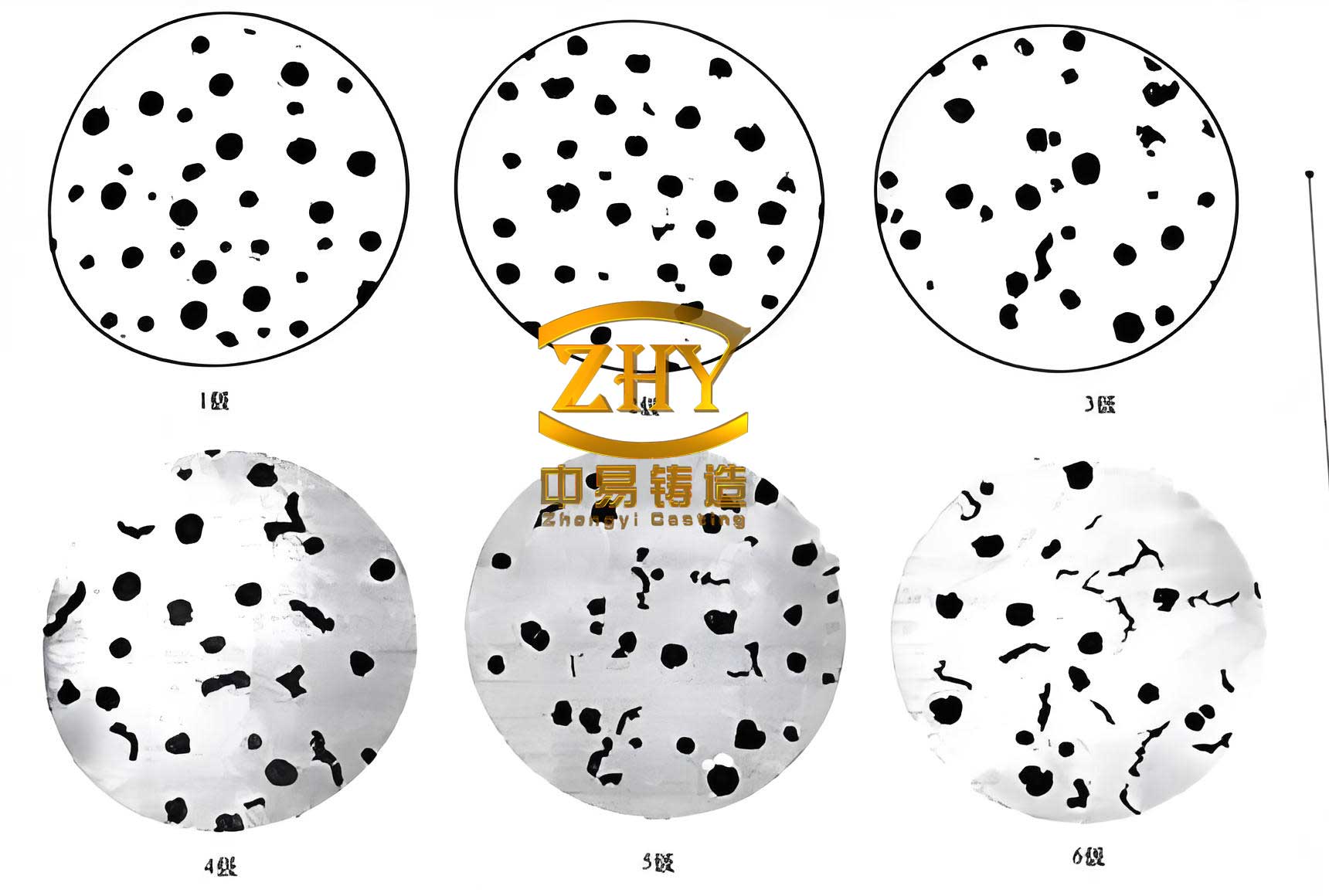
The cast gear segments were cleaned, and the feeders and gating system were removed. Visual and dimensional inspection confirmed the segments met all required specifications without major defects. Samples for metallographic and mechanical testing were taken from the separately cast test blocks attached to the segments, as per standard procedures (e.g., ASTM A536). The microstructure evaluation revealed a well-nodularized graphite structure with nodularity exceeding 90% and a graphite size rating of 6 (ASTM A247). The matrix, after heat treatment, consisted of a predominantly tempered structure (tempered martensite/sorbite) with a small amount of free ferrite, providing an excellent balance of strength and ductility. No significant carbides or degenerate graphite forms were observed.
The mechanical properties, measured on test specimens machined from the separately cast blocks, significantly exceeded the minimum requirements for QT700-2A, as summarized below. This demonstrates the success of the integrated process from chemistry design through to heat treatment in producing high-integrity heavy-section spheroidal graphite cast iron.
| Mechanical Property | QT700-2A Standard Min. | Average Measured Value |
|---|---|---|
| Tensile Strength, Rm (MPa) | 700 | 815 |
| Yield Strength, Rp0.2 (MPa) | 420 | 670 |
| Elongation, A (%) | 2 | 5 |
| Hardness (HBW) | 240 – 305 | 275 |
Following rough machining, the critical surfaces of the gear segments underwent non-destructive testing (NDT). Both 100% ultrasonic testing and 100% magnetic particle inspection were performed. The results confirmed the internal and surface quality met the stringent Grade 2 requirements of the respective standards, with no reportable defects found in critical areas. This confirmed the casting’s integrity for its final application.
In conclusion, the successful development and production of this heavy-section spheroidal graphite cast iron gear segment validate a comprehensive and controlled manufacturing methodology. Key pillars of this success include:
- A carefully balanced chemical composition designed to promote stable nodular graphite formation in a slow-cooling section while achieving a strong, tough matrix.
- A robust casting process utilizing strategic chilling to control solidification and promote directional feeding, validated upfront by numerical simulation.
- The use of high-purity charge materials combined with a controlled melting, dual-inoculation treatment, and timely pouring practice to ensure consistent metallurgical quality.
- A defined quenching and tempering heat treatment to reliably achieve the required mechanical properties throughout the thick section.
This project definitively demonstrates that the segmented manufacturing of large components from spheroidal graphite cast iron is not only feasible but represents a practical and cost-effective strategy for producing large-diameter gears and other heavy-section parts, providing a valuable alternative to more expensive forging or welding routes. The process knowledge and validation gained form a solid foundation for the production of similar high-performance spheroidal graphite cast iron castings.