
The rapid advancement of power infrastructure and heavy-duty transportation creates a significant demand for large, thin-walled, and geometrically complex aluminum components. These parts, such as pressure vessels for high-voltage electrical equipment and critical structural housings for engines and apparatus, must meet stringent requirements. They must possess excellent mechanical properties, superior pressure tightness, and often high electrical conductivity. Traditionally, manufacturing these components through welding or conventional gravity sand casting often resulted in issues with structural integrity, leakage, and inconsistent quality. My research and development efforts have focused on perfecting a robust and economical solution: low-pressure casting using sand molds. This integrated technology, refined over more than a decade of industrial application, successfully addresses these challenges, producing high-integrity aluminum sand castings that compete and succeed in the global market.
The core challenge lies in the inherent conflict within the required material properties. For instance, electrical enclosures need good castability for thin sections and high conductivity, yet these properties are often inversely related in aluminum-silicon alloys. Our approach begins with a fundamental re-optimization of the Al-Si-Mg alloy system specifically for this process. By narrowing the compositional ranges of key elements beyond standard specifications, we achieve a superior balance.
| Element | Standard Range (Typical) | Optimized Range | Primary Effect & Rationale |
|---|---|---|---|
| Si | 6.5 – 7.5 wt.% | 6.8 – 7.2 wt.% | Ensures fluidity for thin walls; minimized to maximize electrical conductivity, as conductivity ($\kappa$) decreases with Si content: $\kappa \propto 1/[Si]$. A narrow range ensures consistency. |
| Mg | 0.25 – 0.45 wt.% | 0.30 – 0.50 wt.% | Forms strengthening phase Mg$_2$Si. The optimized range provides the optimal trade-off between tensile strength, elongation, and conductivity. |
| Ti | ≤ 0.20 wt.% | Controlled Addition | Grain refiner via formation of Al$_3$Ti nuclei. A secondary addition technique is employed to maximize nucleation efficiency. |
| Fe | ≤ 0.20 wt.% | ≤ 0.15 wt.% | Strictly controlled to prevent formation of brittle $\beta$-Al$_5$FeSi platelets, preserving ductility and toughness. |
| P, Ca | Often unspecified | ≤ 10 ppm, ≤ 20 ppm |
The detrimental effects of impurities like Phosphorus (P) and Calcium (Ca) are critical. P, primarily originating from metallurgical grade silicon, promotes the formation of AlP, which acts as a potent nucleation site for primary silicon, leading to coarse microstructure and degraded mechanical and electrical properties. The relationship can be modeled as a decrease in effective strength with increasing [P]. We mandate the use of high-purity silicon to keep P levels extremely low. Similarly, trace Ca increases melt susceptibility to hydrogen pickup and causes surface defects. Therefore, selecting primary aluminum with minimal Ca content is essential.
Metallurgical quality is further enhanced through advanced melt treatment. A multi-functional flux is employed for combined refining, modification, and slag removal. For hydrogen removal, the principle is based on Sieverts’ Law, where the hydrogen solubility in aluminum is given by: $$[H] = K_H \sqrt{P_{H_2}}$$ where $[H]$ is the dissolved hydrogen concentration, $K_H$ is the equilibrium constant, and $P_{H_2}$ is the partial pressure of hydrogen. By introducing inert gas bubbles (e.g., Argon), the local $P_{H_2}$ at the bubble-melt interface is nearly zero, creating a strong driving force for hydrogen diffusion into the bubble, which is then removed as the bubble rises. Furthermore, the addition of Rare Earth (RE) elements like Cerium not only modifies the eutectic silicon morphology but also getters residual hydrogen by forming stable hydrides (e.g., CeH$_3$), preventing the formation of gas pores during solidification.
Grain refinement is achieved through a patented “secondary addition” technique. While master alloys provide Ti, the Al$_3$Ti particles can coalesce and lose potency during holding. Our method involves adding a Ti-B-Zr based salt compound just before casting. This in-situ reaction generates a high population of fine, active nucleation sites (Al$_3$Ti, TiB$_2$, Al$_3$Zr), leading to a dramatic increase in grain count, which improves both strength and feeding characteristics for sound sand castings. The grain size ($d$) can be related to the nucleant particle density ($N_v$) by: $$d \propto \left( \frac{1}{N_v} \right)^{1/3}$$ A high $N_v$ results in a fine $d$.
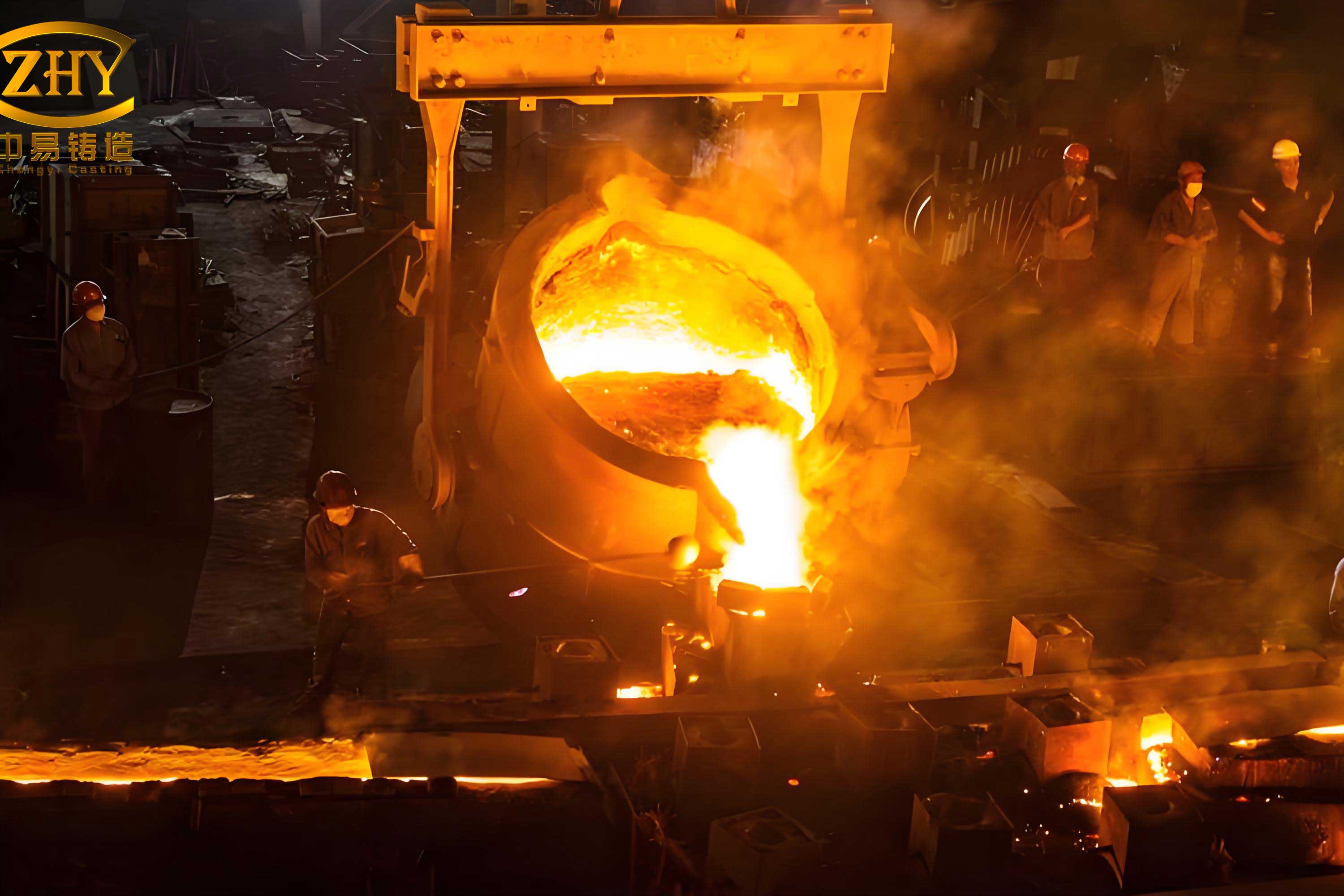
The heart of the manufacturing innovation is the low-pressure sand casting process itself. For large components like switchgear tanks (e.g., Ø870mm x 2350mm, weighing 620kg), gravity pouring is problematic due to turbulence, oxide entrapment, and inadequate feeding of thick sections. Low-pressure casting provides a controlled, bottom-up fill from a sealed furnace, which is ideal for producing dense, high-quality sand castings. The pressure ($P$) in the furnace is governed by: $$P = \rho g h$$ where $\rho$ is the molten metal density, $g$ is gravity, and $h$ is the effective height of the metal column from the bath surface to the top of the mold cavity. By carefully controlling the pressure ramp, we achieve laminar filling and sustained feeding pressure during solidification.
A key innovation is the self-developed low-pressure casting apparatus utilizing a crucible sealing design. Unlike conventional machines where the entire furnace vessel is pressurized (bearing the mold weight), our system seals only the crucible. The heavy mold assembly (sometimes over 13 tons) is supported independently by a sturdy frame and columns, transferring load directly to the foundation. This offers significant advantages:
| Feature | Crucible-Sealing Design | Traditional Furnace-Sealing Design |
|---|---|---|
| Load Bearing | Mold weight on external frame; crucible/furnace lining bears only pressure. | Mold weight sits on furnace shell and refractory lining. |
| Pressure Control | Stable, smooth pressure curve with minimal fluctuation. | Potential for pressure waves due to furnace shell flexing. |
| Equipment Longevity | Greatly extended furnace and refractory life. | Higher stress on furnace structure limits life. |
| Flexibility & Cost | Simple structure, lower investment, easily adaptable for very large sand castings. | Complex, heavy-duty construction required for large molds. |
Complementing the equipment is a suite of precision sand mold engineering techniques. Large sand castings often suffer from core shift and wall thickness variation. We revolutionized core positioning by integrating machined metallic core prints with strategically placed iron chills. For critical sealing flanges, we use ductile iron chills that are machined, sand-blasted, and nitride-treated to prevent oxidation. These chills form a precise “core seat.” The corresponding core is built with a machined metallic print plate. This metal-to-metal alignment system reduces the fitting gap to about 0.5mm, akin to permanent mold accuracy, resulting in wall thickness variations of less than ±1mm in the final sand castings.
The chills serve a dual purpose: precision location and enhanced thermal management. Their high thermal diffusivity ($\alpha$) accelerates solidification at critical sections: $$\alpha = \frac{k}{\rho C_p}$$ where $k$ is thermal conductivity, $\rho$ is density, and $C_p$ is specific heat. The rapid heat extraction promotes directional solidification towards the risers (aided by low pressure), eliminating shrinkage porosity in thick flanges and sealing grooves—a common failure point for pressure integrity.
For complex internal passages that require a smooth as-cast finish, we developed a “reverse-modeling” core-making technique. A precision-machined metal positive model of the desired cavity is created. A zero-shrinkage silicone rubber is molded around it to create a perfect negative core box. A modified, highly collapsible sodium silicate sand is then used to produce the core in this rubber mold. This process yields cores with exceptional dimensional accuracy and surface finish. After casting, the sand easily collapses, allowing for effortless removal and resulting in intricate internal geometries with a clean, high-gloss surface directly from the mold, which is vital for fluid flow or electrical field distribution in the final component.
The entire process is underpinned by computational tools. CAD 3D modeling and solidification simulation are used extensively for virtual prototyping. By inputting the thermophysical properties of the alloy and the sand mold, we can predict shrinkage defects, hot spots, and optimize the placement of feeders, chills, and gating. This virtual optimization drastically reduces trial-and-error, shortens lead time, and conserves resources during the development of new sand castings.
The efficacy of this integrated low-pressure sand casting technology is proven by over a decade of production. It has been implemented across multiple foundries, producing thousands of large aluminum sand castings for global markets. The applications are diverse:
- High-Voltage Electrical Equipment: SF6 circuit breaker tanks, current transformer housings, and insulator shells for up to 500kV systems, where pressure tightness and conductivity are paramount.
- Heavy-Duty Powertrains: Diesel engine blocks, crankcases, and turbocharger housings requiring high strength and fatigue resistance.
- Specialized Apparatus: Housings for medical imaging (CT, MRI) and other precision equipment.
The table below summarizes the key benefits realized in production:
| Aspect | Benefit Achieved |
|---|---|
| Metallurgical Quality | High tensile strength, elongation, and electrical conductivity meeting international specs (e.g., A356, AlSi7Mg). |
| Structural Integrity | Dense microstructure, pressure tightness (SF6 leakage rate <1%/year), absence of shrinkage in thick sections. |
| Dimensional Accuracy | Excellent wall thickness control (±1mm) and precise geometry from sand molds. |
| Surface & Internal Finish | Smooth as-cast surfaces on complex internal passages, eliminating need for intrusive internal machining. |
| Process Economy | Lower equipment investment, high material yield, reduced scrap rates, and suitability for low-to-medium volume production of large sand castings. |
In conclusion, the developed low-pressure sand casting technology represents a comprehensive manufacturing solution for high-performance heavy aluminum components. It synergistically combines:
1. A precisely engineered Al-Si-Mg alloy with controlled microstructure.
2. An innovative crucible-sealed low-pressure casting machine offering stability and scalability for large sand castings.
3. Precision mold and core engineering techniques using metallic aids to achieve permanent-mold accuracy from sand molds.
4. Advanced thermal management through treated chills.
5. Sophisticated core-making methods for complex internal features.
This holistic approach transforms the traditional sand casting process into a precision foundry method, capable of consistently producing large, complex, thin-walled, and leak-tight aluminum sand castings that satisfy the most demanding mechanical, pressure, and electrical specifications of global industries.