
In the field of metallurgy, high manganese steel casting represents a critical area of expertise, particularly for applications requiring exceptional wear resistance under impact conditions. As someone deeply involved in this domain, I have witnessed how the unique properties of high manganese steel make it indispensable for components like crusher hammers, track shoes, and bucket teeth. The invention of high manganese steel dates back to the late 19th century, and since then, its production has evolved to meet demanding industrial standards. High manganese steel casting involves a meticulous process from melting to heat treatment, ensuring that the final product exhibits the desired toughness and hardness. Throughout this discussion, I will delve into the intricacies of high manganese steel casting, emphasizing key aspects such as composition control, casting techniques, and performance optimization. By sharing insights from practical experience, I aim to provide a comprehensive guide that underscores the importance of precision in high manganese steel casting.
High manganese steel casting primarily focuses on austenitic steels, which are renowned for their ability to work-harden under impact, forming a durable surface layer while retaining a tough core. This characteristic is central to the success of high manganese steel casting in harsh environments. For instance, in mining and construction machinery, components produced through high manganese steel casting endure significant abrasive and impact loads, leading to extended service life. The process begins with careful melting in electric furnaces, where controlling impurities is paramount to achieving high-quality high manganese steel casting. In my work, I have found that maintaining a reducing atmosphere post-manganese addition minimizes oxidation and enhances steel purity, which is a cornerstone of reliable high manganese steel casting. Moreover, the use of rare earth elements for grain refinement has proven effective in improving the mechanical properties of high manganese steel casting, making it a preferred method in advanced foundries.
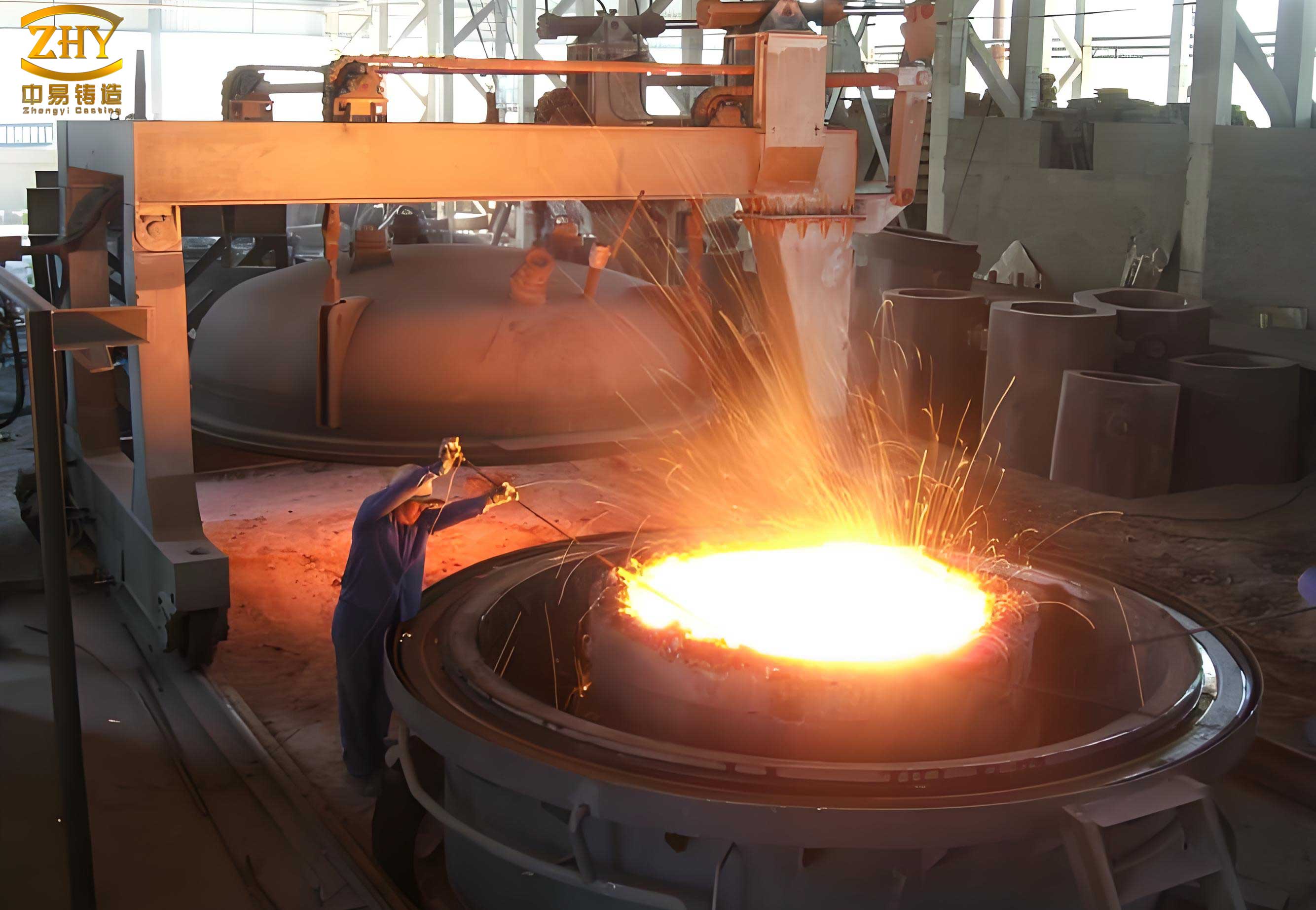
The melting process for high manganese steel casting demands strict adherence to parameters to avoid defects. Typically, high manganese steel casting involves melting in basic-lined furnaces to prevent reactions with silica-based refractories, which could lead to inclusions. The liquidus and solidus temperatures for high manganese steel are approximately 1400°C and 1350°C, respectively, and controlling the pouring temperature between 1420°C and 1440°C is crucial for minimizing coarse grains. In high manganese steel casting, the equation for estimating the ideal pouring temperature can be expressed as: $$ T_p = T_l + \Delta T $$ where \( T_p \) is the pouring temperature, \( T_l \) is the liquidus temperature (1400°C), and \( \Delta T \) is a superheat factor typically ranging from 20°C to 40°C. This ensures fluidity without excessive grain growth, a common challenge in high manganese steel casting. Additionally, deoxidation practices, such as using aluminum or silicon-based agents, are vital to reduce oxide inclusions that could compromise the integrity of high manganese steel casting components.
When it comes to chemical composition, high manganese steel casting encompasses various grades tailored to specific applications. The table below summarizes the standard grades for high manganese steel casting according to common specifications, highlighting the role of elements like carbon, manganese, and chromium in determining performance. Each grade in high manganese steel casting is designed to balance hardness and toughness, with variations in carbon and manganese ratios influencing work-hardening behavior. For example, in high manganese steel casting, a higher manganese-to-carbon ratio often enhances impact resistance, making it suitable for complex shapes like track shoes.
| Grade | C (%) | Mn (%) | Si (%) | P (%) (max) | S (%) (max) | Cr (%) | Mo (%) | Application |
|---|---|---|---|---|---|---|---|---|
| Grade A | 1.00–1.45 | 11–14 | 0.30–1.00 | 0.09 | 0.04 | – | – | Low impact |
| Grade B | 0.90–1.35 | 11–14 | 0.30–1.00 | 0.09 | 0.04 | – | – | General parts |
| Grade C | 0.95–1.35 | 11–14 | 0.30–0.80 | 0.07 | 0.035 | – | – | Complex shapes |
| Grade D | 0.90–1.30 | 11–14 | 0.30–0.80 | 0.07 | 0.04 | 1.50–2.50 | – | High impact |
| Grade E | 0.75–1.30 | 11–14 | 0.30–1.00 | 0.07 | 0.04 | – | 0.90–1.20 | Low temperature |
The mechanical properties of high manganese steel casting after heat treatment are critical for performance evaluation. As I have observed in numerous projects, high manganese steel casting components exhibit high tensile strength and elongation, which are essential for absorbing impact energy. The table below provides typical mechanical properties for high manganese steel casting grades, demonstrating how water quenching enhances toughness and hardness. In high manganese steel casting, the hardness can increase significantly during service due to work-hardening, often reaching values above 450 HB, which underscores the dynamic nature of high manganese steel casting materials.
| Grade | Tensile Strength (MPa) | Elongation (%) | Impact Energy (J) | Hardness (HB) |
|---|---|---|---|---|
| Grade A | ≥637 | ≥20 | ≥147 | ~229 |
| Grade B | ≥637 | ≥20 | ≥147 | ~229 |
| Grade C | ≥686 | ≥25 | ≥147 | ~229 |
| Grade D | ≥735 | ≥35 | ≥147 | ~229 |
| Grade E | ≥686 | ≥30 | ≥147 | ~229 |
Understanding the influence of individual elements is paramount in high manganese steel casting. Carbon, for instance, plays a dual role: it promotes austenite formation and increases hardness, but excessive carbon can reduce toughness and increase cracking susceptibility in high manganese steel casting. The relationship between carbon content and toughness can be modeled using the equation: $$ \delta = k_1 – k_2 \cdot C $$ where \( \delta \) is the elongation, \( C \) is the carbon percentage, and \( k_1 \) and \( k_2 \) are constants derived from empirical data in high manganese steel casting. Manganese stabilizes the austenitic structure, and in high manganese steel casting, a manganese content between 11% and 14% is typical; however, levels above 14% can lead to brittleness and white spot formation. Silicon, while improving hardness, must be controlled to avoid carbide precipitation at grain boundaries, which is a common defect in high manganese steel casting if silicon exceeds recommended limits.
Phosphorus is particularly detrimental in high manganese steel casting due to its tendency to form low-melting phosphides that cause hot tearing. In high manganese steel casting, the maximum phosphorus content is often kept below 0.07% to maintain ductility. Sulfur, though less harmful, forms manganese sulfides that may act as nucleation sites for inclusions, but its effect is minimal in well-deoxidized high manganese steel casting. Alloying elements like chromium and molybdenum are incorporated in specific high manganese steel casting grades to enhance performance. Chromium, for example, increases yield strength and wear resistance in high-impact applications, but it necessitates higher solution treatment temperatures in high manganese steel casting, as described by: $$ T_s = T_b + \Delta T_c $$ where \( T_s \) is the solution temperature, \( T_b \) is the base temperature (around 1050°C), and \( \Delta T_c \) is an increment of 30°C to 50°C for chromium-containing high manganese steel casting. Molybdenum refines the grain structure and improves low-temperature toughness, making it valuable for high manganese steel casting used in cold environments.
The casting properties of high manganese steel present unique challenges that require careful consideration in high manganese steel casting. Due to its low thermal conductivity—approximately one-fourth that of carbon steel—high manganese steel casting is prone to shrinkage and cracking during solidification. The linear shrinkage for high manganese steel casting ranges from 2.4% to 3.6%, and the volumetric shrinkage is about 6.5%, which is higher than that of carbon steels. This necessitates the use of specialized molding materials in high manganese steel casting to prevent defects. For instance, silica sand is avoided because it reacts with manganese oxide to form low-melting compounds that cause chemical burning. Instead, high manganese steel casting often employs neutral or basic sands like magnesite, olivine, or alumina, which improve surface finish and reduce sticking. In my practice, I have optimized high manganese steel casting by selecting resins with good gas permeability to enhance mold yield and minimize hot tearing.
Gating and risering systems in high manganese steel casting are designed to facilitate smooth metal flow and effective feeding. A common approach in high manganese steel casting is to use multiple, thin, and wide gates that are easy to remove without hindering contraction. Open gating systems are preferred in high manganese steel casting to reduce turbulence and oxide formation. For risers, high manganese steel casting often incorporates breakable neck risers with insulating sleeves to improve yield and simplify removal. Although high manganese steel casting has high fluidity, which allows for lower pouring temperatures, riser design does not need to be oversized due to the material’s lower liquid contraction compared to carbon steels. In complex high manganese steel casting components, external chills are used to promote directional solidification, but internal chills are avoided to prevent fusion issues. The pouring process in high manganese steel casting follows a “slow-fast-slow” sequence, with careful control to avoid splashing and ensure proper feeding into risers, often supplemented with coverings to enhance thermal efficiency.
After casting, the cleaning of high manganese steel casting components is a critical step to prepare them for heat treatment. In high manganese steel casting, parts are typically shaken out at temperatures below 200°C to avoid thermal shock, and for simple geometries, this can be done at up to 400°C. It is essential in high manganese steel casting to handle components gently to prevent cracking, and any cutting or welding before heat treatment is prohibited. The removal of fins and flash is done manually with hammers to avoid introducing stress concentrations in high manganese steel casting parts. Once cleaned, the high manganese steel casting undergoes heat treatment, known as water quenching or solution treatment, which is vital for dissolving carbides and achieving a homogeneous austenitic structure. The table below outlines typical quenching temperatures for various high manganese steel casting grades, highlighting the need for rapid cooling to prevent carbide reprecipitation.
| Grade | Quenching Temperature (°C) | Remarks |
|---|---|---|
| Grade A | 1050–1070 | Transfer time ≤1 min; water temperature ≤30°C |
| Grade B | 1050–1070 | Transfer time ≤1 min; water temperature ≤30°C |
| Grade C | 1050–1070 | Transfer time ≤1 min; water temperature ≤30°C |
| Grade D | 1070–1090 | Transfer time ≤1 min; water temperature ≤30°C |
| Grade E | 1070–1090 | Transfer time ≤1 min; water temperature ≤30°C |
Water quenching in high manganese steel casting involves immersing the heated components in agitated water to achieve rapid cooling, with a water-to-part weight ratio of at least 10:1 to maintain temperature control. The process can be described by the heat transfer equation: $$ Q = h \cdot A \cdot \Delta T $$ where \( Q \) is the heat flux, \( h \) is the heat transfer coefficient, \( A \) is the surface area, and \( \Delta T \) is the temperature difference between the high manganese steel casting and water. This ensures that the high manganese steel casting reaches a fully austenitic state without carbide networks. Post-quenching, high manganese steel casting components must not be reheated above 350°C to avoid embrittlement from carbide precipitation, which limits their use in high-temperature environments. In applications like bucket teeth, where work-hardening occurs, the hardened layer may need grinding before any repair welding in high manganese steel casting.
Welding and repair of high manganese steel casting are generally discouraged due to poor weldability, but when necessary, specific techniques are employed. In high manganese steel casting, welding is performed using high manganese or austenitic stainless steel electrodes with low current inputs to minimize heat input. The interpass temperature must be controlled, often with water cooling of adjacent areas, to prevent the formation of brittle zones in high manganese steel casting. The formula for estimating the heat input during welding in high manganese steel casting is: $$ H = \frac{V \cdot I \cdot t}{v} $$ where \( H \) is the heat input, \( V \) is voltage, \( I \) is current, \( t \) is time, and \( v \) is travel speed. This helps in managing the thermal effects on high manganese steel casting microstructure. For used components in high manganese steel casting, such as those with work-hardened surfaces, pre-weld grinding is essential to remove the hardened layer and ensure sound repairs.
In conclusion, high manganese steel casting remains a vital process for producing durable components in demanding industries. The success of high manganese steel casting hinges on precise control over composition, melting, casting, and heat treatment. Through years of involvement in high manganese steel casting, I have seen how innovations like rare earth additions and optimized quenching protocols enhance performance. However, high manganese steel casting is not without limitations; its low yield strength in non-impact conditions and susceptibility to reheat embrittlement require careful application. Future advancements in high manganese steel casting may focus on developing new alloys with improved weldability and higher temperature resistance. Ultimately, mastering high manganese steel casting involves a deep understanding of metallurgical principles and practical adjustments to achieve the ideal balance of toughness and wear resistance. As industries evolve, high manganese steel casting will continue to play a crucial role in providing reliable solutions for abrasive and impact-intensive environments.