
In my extensive experience within the mining and mineral processing industry, the reliability and durability of equipment components are paramount. Among the various materials used, high manganese steel casting plays a critical role due to its exceptional work-hardening capability and abrasion resistance, making it ideal for components subjected to severe impact and wear, such as crusher liners, shovel dippers, and large plane plates. However, the casting process for high manganese steel is fraught with challenges, particularly the propensity for fracture in large, planar castings. This article delves into the root causes of such fractures, drawing from practical case studies and theoretical analysis, and presents effective mitigation strategies. I will explore the material science behind high manganese steel casting, detail process improvements, and integrate insights from related equipment maintenance, such as DC motor adjustment and control system upgrades, to provide a holistic view of enhancing operational longevity in mining machinery.
The fundamental issue encountered in producing large plane components via high manganese steel casting is the occurrence of cracks or complete fractures during cooling or after shakeout. These fractures typically manifest in the central regions of the casting, as illustrated in the following conceptual diagram. The cracks often appear irregular and darkened, indicating characteristics of both thermal and cold cracking. Understanding this dichotomy is essential for developing effective solutions.
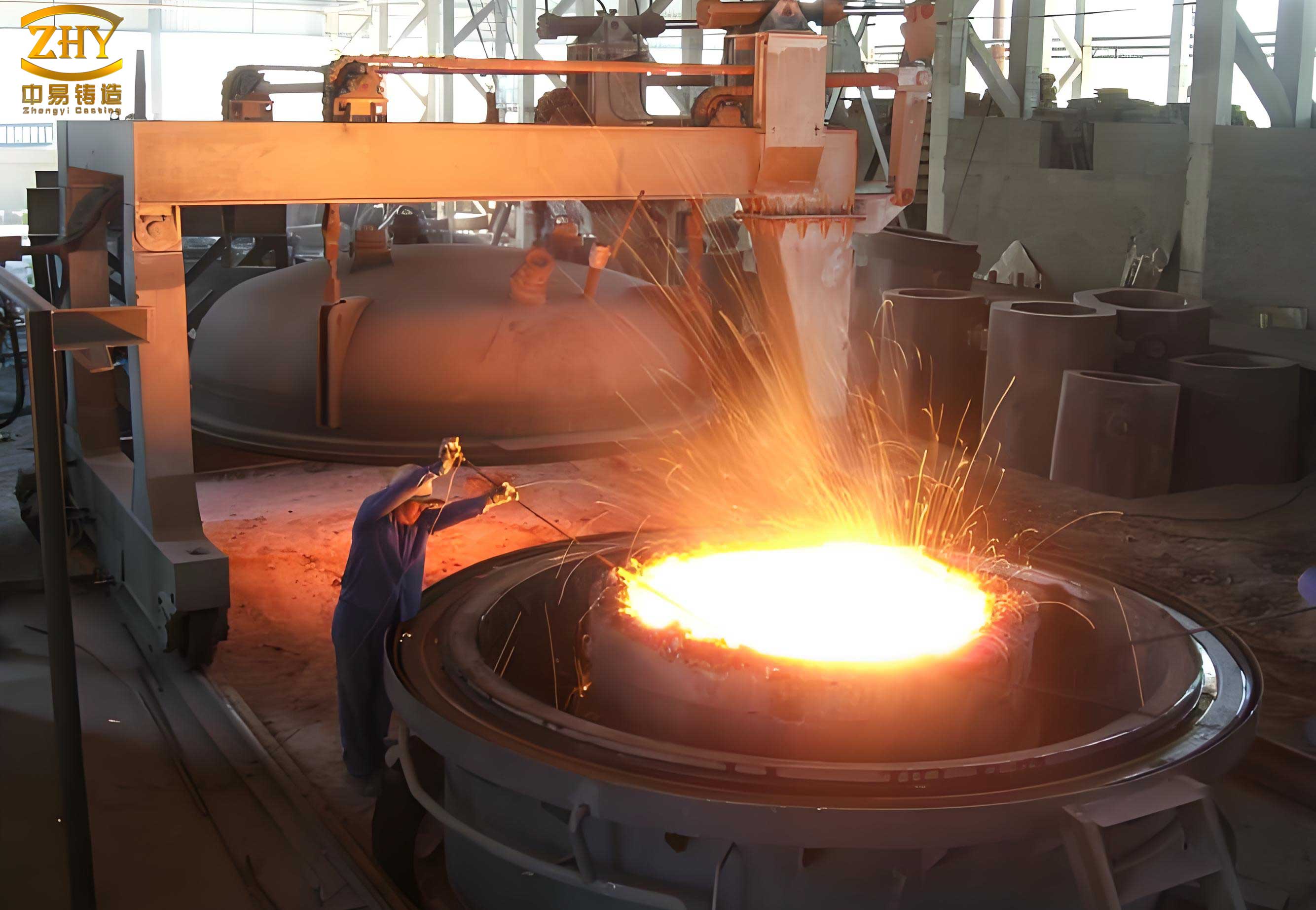
High manganese steel, typically conforming to specifications like ASTM A128, has a unique chemical composition that governs its behavior. The key elements include high carbon (1.0-1.4%), manganese (11-14%), and often elevated phosphorus levels. This composition leads to several intrinsic properties affecting the high manganese steel casting process:
| Element | Typical Range (%) | Influence on Casting |
|---|---|---|
| Carbon (C) | 1.0 – 1.4 | Increases hardness and strength but reduces ductility; promotes carbide formation. |
| Manganese (Mn) | 11 – 14 | Enhances austenite stability and work-hardening; but increases thermal expansion coefficient. |
| Phosphorus (P) | <0.07 (ideally) | Increases brittleness and hot tearing susceptibility if high. |
| Silicon (Si) | 0.3 – 0.8 | Deoxidizer; affects fluidity and carbide precipitation. |
The low thermal conductivity of high manganese steel, approximately 12 W/m·K at room temperature, is a critical factor. This low conductivity creates significant temperature gradients during solidification and cooling, which can be described by Fourier’s law of heat conduction. The heat flux $$q$$ is given by:
$$q = -k \nabla T$$
where $$k$$ is the thermal conductivity (low for high manganese steel casting) and $$\nabla T$$ is the temperature gradient. A steep gradient promotes directional solidification, leading to coarse columnar grain structures. The relationship between cooling rate and grain size can be approximated by:
$$d = a \cdot (\frac{dT}{dt})^{-n}$$
where $$d$$ is the grain diameter, $$\frac{dT}{dt}$$ is the cooling rate, and $$a$$ and $$n$$ are material constants. Slower cooling or high gradients in high manganese steel casting result in larger grains, which are more prone to micro-segregation and defect formation.
Fractures in high manganese steel casting components arise from a combination of thermal stresses and mechanical restraint. Thermal stresses develop due to differential cooling, and the total stress $$\sigma_{thermal}$$ can be estimated using:
$$\sigma_{thermal} = E \cdot \alpha \cdot \Delta T$$
Here, $$E$$ is Young’s modulus (around 200 GPa for high manganese steel), $$\alpha$$ is the coefficient of thermal expansion (approximately 18 × 10⁻⁶ /°C), and $$\Delta T$$ is the temperature difference between the core and surface. In large plane castings, this $$\Delta T$$ can be substantial, leading to stresses that exceed the material’s high-temperature strength. Furthermore, mechanical restraint from the mold sand exacerbates the situation. The resulting stress state often triggers hot tearing during the late stages of solidification when a coherent solid skeleton exists but intergranular liquid films remain. The criterion for hot tearing susceptibility $$S$$ can be related to the strain rate $$\dot{\epsilon}$$ and the solid fraction $$f_s$$:
$$S \propto \int_{f_s^{coherent}}^{1} \frac{\dot{\epsilon}}{\mu(f_s)} df_s$$
where $$\mu(f_s)$$ is the viscosity of the semi-solid material. For high manganese steel casting, the wide freezing range and coarse grains increase $$S$$. Cold cracks, on the other hand, occur at lower temperatures when the material is fully solid but constrained. The fracture stress $$\sigma_f$$ must satisfy:
$$\sigma_f \geq \sigma_{applied} + \sigma_{residual}$$
where $$\sigma_{applied}$$ is from external restraint and $$\sigma_{residual}$$ is from internal stresses. The following table summarizes the key differences between hot and cold cracking in the context of high manganese steel casting:
| Aspect | Hot Tearing | Cold Cracking |
|---|---|---|
| Temperature Range | Within solidification range (approx. 1350-1100°C) | Below 400°C (elastic regime) |
| Crack Appearance | Irregular, oxidized (dark), often interdendritic | Straighter, cleaner, transgranular |
| Primary Cause | Inability to accommodate thermal strain in mushy zone | Exceedance of tensile strength due to restraint |
| Influencing Factors | Alloy composition, grain size, mold rigidity | Component design, notch effects, phosphorus content |
To address these issues in high manganese steel casting, several process modifications have been proven effective. First, optimizing the gating system is crucial. Instead of a few large ingates, using multiple smaller ingates distributed along the length of the casting helps achieve more uniform temperature distribution, reducing $$\nabla T$$. The fluid flow and heat transfer can be modeled using Bernoulli’s principle and energy conservation. For a gating system with $$n$$ ingates, the total flow area $$A_{total}$$ should be designed to maintain a low pouring velocity $$v_p$$:
$$v_p = \frac{Q}{A_{total}}$$
where $$Q$$ is the volumetric flow rate. A lower $$v_p$$ minimizes turbulence and air entrainment. Second, controlling the pouring temperature is vital. For high manganese steel casting, a lower superheat (pouring temperature ~1420°C or below) refines the as-cast structure by increasing nucleation sites. The relationship between secondary dendrite arm spacing (SDAS), $$\lambda$$, and local solidification time $$t_f$$ is:
$$\lambda = b \cdot t_f^m$$
where $$b$$ and $$m$$ are constants. Lower pouring temperature reduces $$t_f$$, yielding finer $$\lambda$$ and better mechanical properties. Third, mold restraint management is essential. Releasing mold constraints early during cooling can dramatically reduce stress. In practice, for a large plane high manganese steel casting, loosening the flask clamps 10-20 minutes after pouring allows the casting to contract freely. The effective strain relief $$\epsilon_{relief}$$ can be approximated by:
$$\epsilon_{relief} = \alpha \cdot \Delta T_{release} \cdot L$$
where $$L$$ is a characteristic dimension and $$\Delta T_{release}$$ is the temperature drop during the unclamped period. Additionally, tilting the mold so that the pouring basin is lower than the opposite end promotes directional solidification from the bottom up, improving feeding and reducing shrinkage porosity. The pressure head $$h$$ for feeding is given by:
$$P_{feeding} = \rho g h$$
with $$\rho$$ being the metal density and $$g$$ gravity. A summary of the improved high manganese steel casting parameters versus the original problematic practice is as follows:
| Process Parameter | Original Practice | Improved Practice | Impact on High Manganese Steel Casting |
|---|---|---|---|
| Number of Ingates | 4 | 10 or more | Reduces thermal gradients, minimizes hot spots. |
| Pouring Temperature | High (>1420°C) | Low (≤1420°C) | Refines grain structure, decreases hot tearing tendency. |
| Mold Restraint | Tight flask clamping | Clamps loosened after 10-20 min | Allows free contraction, lowers residual stress. |
| Mold Orientation | Horizontal | Tilted (pouring end lower) | Enhances directional solidification and feeding. |
| Sand Mold Properties | High rigidity | Improved collapsibility | Reduces mechanical hindrance to shrinkage. |
The success of these modifications in high manganese steel casting is not isolated; it parallels advancements in other mining equipment maintenance domains. For instance, the precise adjustment of DC motors in excavators—involving insulation resistance measurement, commutator condition assessment, and neutral zone alignment—underscores the importance of systematic characterization and parameter control. Just as maintaining the correct brush position and oxide film on a commutator ensures spark-free operation and longevity, controlling the thermal and mechanical environment in high manganese steel casting ensures crack-free components. The principle of minimizing gradients applies universally: in DC motors, uneven current distribution leads to hot spots and brush arcing; in high manganese steel casting, uneven cooling leads to stress concentration and fracture.
Furthermore, the evolution from analog to digital control systems in mine hoists offers a metaphor for the precision needed in high manganese steel casting process control. Analog systems, prone to drift and complex calibration, are akin to relying on empirical, non-quantified foundry practices. Digital systems, with their programmable logic controllers (PLCs) and precise feedback loops, mirror the need for data-driven control of pouring temperature, cooling rates, and restraint timing in modern high manganese steel casting. Implementing real-time monitoring of mold temperatures and stresses could further optimize the process, using algorithms to predict and prevent cracking. A simplified model for safe processing window might involve constraints on cooling rate $$\dot{T}$$ and strain rate $$\dot{\epsilon}$$:
$$\dot{T}_{min} \leq \dot{T} \leq \dot{T}_{max}, \quad \dot{\epsilon} \leq \dot{\epsilon}_{critical}$$
where the limits are derived from the specific high manganese steel alloy properties.
The formation and preservation of the oxide layer on commutators in DC motors is another insightful analogy for high manganese steel casting. This layer, composed of copper oxides and carbon, reduces friction and ensures good electrical contact. Similarly, the surface quality of a high manganese steel casting is influenced by the mold-metal interface reactions. While not an oxide film per se, controlling the mold atmosphere and using appropriate coatings can prevent surface defects that might act as crack initiators. The interaction between the molten high manganese steel and the mold sand involves complex thermodynamics, where the Gibbs free energy change $$\Delta G$$ for potential reactions must be negative for them to occur spontaneously:
$$\Delta G = \Delta H – T \Delta S$$
Selecting mold materials with high chemical inertness towards manganese and carbon is therefore beneficial for high manganese steel casting.
In terms of metallurgical transformations, high manganese steel casting undergoes significant microstructural evolution during cooling. The as-cast structure typically consists of austenite grains with intergranular carbides. The volume fraction of carbides $$V_c$$ can be estimated using the Lever rule applied to the Fe-C-Mn phase diagram, though precise calculation requires considering multiple alloying elements. Heat treatment, such as water quenching (solution annealing) from around 1050°C, is usually performed to dissolve these carbides into a homogeneous austenitic matrix, unlocking the material’s full toughness and work-hardening capacity. The kinetics of carbide dissolution follow an Arrhenius-type equation:
$$t_{dissolve} \propto \exp(\frac{Q}{RT})$$
where $$Q$$ is the activation energy, $$R$$ the gas constant, and $$T$$ the solution temperature. However, the focus here is on the casting process itself, where avoiding cracks ensures the integrity of the component prior to any heat treatment. Even minor cracks from casting can propagate during service under impact loads, leading to catastrophic failure in mining applications.
To quantify the improvement from the process changes, consider the reduction in defect rate. If the original high manganese steel casting process for large planes yielded a fracture incidence of, say, 30%, implementing the multi-ingate, low-temperature, and early restraint-release methods could lower this to below 5%. The economic impact is substantial, considering the high cost of high manganese steel scrap and the downtime associated with component replacement in a continuous mining operation. The total cost of ownership for mining equipment heavily depends on the reliability of such critical high manganese steel casting parts.
Looking forward, the integration of computational simulation tools like Finite Element Analysis (FEA) for stress prediction and Computational Fluid Dynamics (CFD) for mold filling analysis will become standard in optimizing high manganese steel casting processes. These tools solve the governing equations of momentum, energy, and mass conservation numerically. For example, the Navier-Stokes equations for fluid flow during pouring:
$$\rho \left( \frac{\partial \mathbf{v}}{\partial t} + \mathbf{v} \cdot \nabla \mathbf{v} \right) = -\nabla p + \mu \nabla^2 \mathbf{v} + \rho \mathbf{g}$$
coupled with the heat equation:
$$\rho c_p \frac{\partial T}{\partial t} = \nabla \cdot (k \nabla T) + \dot{q}$$
can simulate temperature fields and predict potential defect zones. By iteratively designing gating and cooling systems in silico, foundries can achieve first-time-right high manganese steel casting with minimal experimental trials.
In conclusion, the challenge of fracture in large plane components is a significant hurdle in high manganese steel casting, but it is surmountable through a deep understanding of the material’s thermal and mechanical properties and precise control of the casting process. The strategies discussed—manipulating gating design, lowering pouring temperature, managing mold restraint, and orienting the mold for better feeding—have proven effective in industrial settings. These principles echo the meticulous adjustments required in maintaining other mining equipment, from DC motors to hoist control systems. As the industry moves towards greater automation and data-driven processes, the art of high manganese steel casting will increasingly become a science, ensuring that these robust components meet the relentless demands of mining and processing operations. Continuous innovation in this field will further enhance the performance and longevity of high manganese steel casting, solidifying its indispensable role in heavy industry.