
In my extensive experience with high manganese steel casting, particularly the Mn13 grade, I have found it to be a cornerstone in the production of wear-resistant components for mining and industrial applications. The unique properties of this material, such as its exceptional toughness and ability to work-harden under impact, make it ideal for parts like grinding rings, crusher hammers, and excavator teeth. The high manganese steel casting process involves a meticulous approach to composition, heat treatment, and quality control to achieve the desired austenitic structure and performance characteristics. This article delves into the detailed工艺流程, emphasizing key aspects like chemical composition, pattern-making, pouring techniques, and water toughening treatment, all critical to successful high manganese steel casting.
The foundation of high manganese steel casting lies in its chemical composition, which must be precisely controlled to ensure the formation of a single-phase austenitic structure after water toughening. The standard composition for Mn13 high manganese steel, as per industry norms, includes carbon and manganese as primary elements, with careful limits on impurities like phosphorus and sulfur. Below is a table summarizing the typical chemical composition ranges for high manganese steel casting:
| Element | Mass Fraction (%) |
|---|---|
| Carbon (C) | 1.00 – 1.45 |
| Manganese (Mn) | 11.00 – 14.00 |
| Silicon (Si) | 0.30 – 1.00 |
| Sulfur (S) | ≤ 0.04 |
| Phosphorus (P) | ≤ 0.09 |
In high manganese steel casting, carbon plays a dual role: it facilitates the formation of austenite and contributes to solid solution strengthening. The relationship can be expressed as: $$ \sigma_y = \sigma_0 + k \cdot C^{1/2} $$ where $\sigma_y$ is the yield strength, $\sigma_0$ is the lattice friction stress, $k$ is a constant, and $C$ is the carbon content. Increasing carbon enhances hardness but reduces ductility, so balancing it with manganese is crucial. Manganese stabilizes the austenitic phase, and the manganese-to-carbon ratio (Mn/C) is often targeted around 10 for optimal toughness and wear resistance. This ratio can be calculated as: $$ \text{Mn/C ratio} = \frac{\text{Mn content}}{\text{C content}} $$ Deviations below 10 may improve wear resistance but require careful control to avoid brittleness. Phosphorus, a harmful element, forms brittle phosphides that degrade mechanical properties; thus, selecting low-phosphorus raw materials is essential in high manganese steel casting.
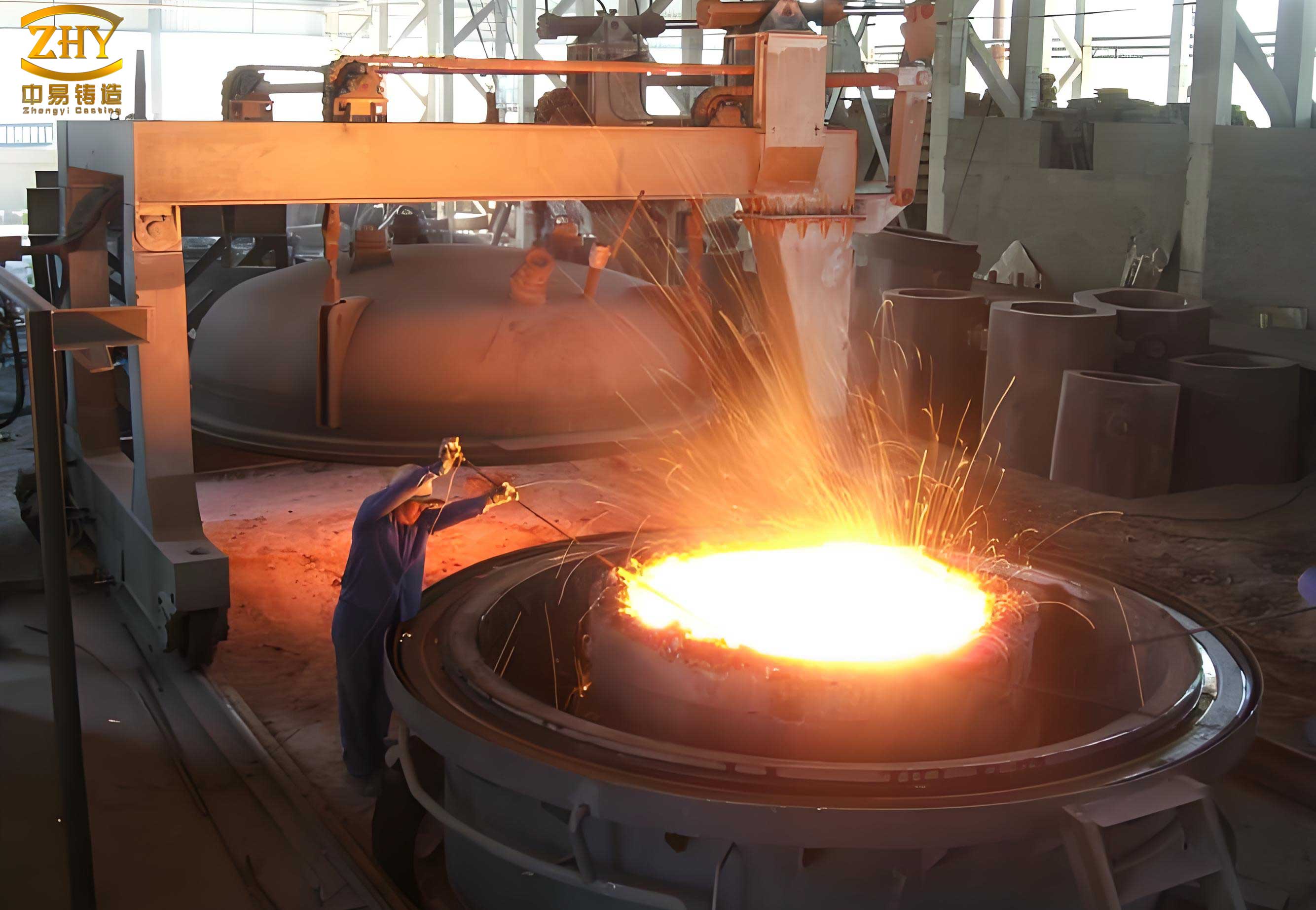
When preparing charges for high manganese steel casting, we prioritize the use of recycled materials, supplemented with manganese to compensate for losses during melting. The selection of scrap steel must be rigorous, excluding incompatible grades like carbon or structural steels, to prevent compositional deviations. For instance, if uncertain about a batch, we conduct spectroscopic analysis to verify elements. The melting process involves heating the steel to 1540°C to ensure thorough boiling and degassing, followed by pouring at 1450–1480°C after a 5–10 minute镇静 period to allow inclusions to float. This step minimizes defects like gas porosity, common in high manganese steel casting due to its tendency to form oxides. The loss of manganese during extended furnace operations must be monitored, as it affects the final Mn/C ratio and overall quality.
Pattern-making in high manganese steel casting often employs the lost foam process, which allows for complex geometries and minimizes machining needs. However, dimensional accuracy is critical due to the material’s poor weldability and work-hardening characteristics. We account for a solidification shrinkage of approximately 6%, incorporating allowances in the pattern design. Gating systems must be optimized for effective feeding and shrinkage compensation. For example, the modulus method can be used to calculate riser sizes: $$ M = \frac{V}{A} $$ where $M$ is the modulus, $V$ is the volume, and $A$ is the surface area. This ensures adequate liquid metal supply to prevent shrinkage defects. Coatings for molds and cores in high manganese steel casting should be neutral or basic, such as those based on magnesite, to resist reactions with manganese oxides that cause sand adherence. The coating thickness must be controlled—too thin, and it fails as a thermal barrier; too thick, and it becomes difficult to remove. Refractoriness and application consistency are vital for defect-free surfaces.
Pouring and solidification in high manganese steel casting require precise temperature and time management. After pouring, vacuum extraction times are adjusted based on wall thickness to avoid gas entrapment and cold shuts. The cooling rate significantly influences microstructure; rapid cooling prevents excessive grain growth but must be balanced to avoid cracking. For thick sections, we often use chills to enhance cooling and refine grains. The tendency for hot tearing in high manganese steel casting is higher than in carbon steels, necessitating careful design of feeders and vents. The solidification behavior can be modeled using the Chvorinov’s rule: $$ t = B \cdot \left( \frac{V}{A} \right)^2 $$ where $t$ is solidification time, $B$ is a mold constant, and $V/A$ is the volume-to-surface area ratio. This helps in predicting shrinkage and optimizing the process for high integrity castings.
Water toughening treatment is a non-negotiable step in high manganese steel casting to achieve the desired austenitic microstructure. The as-cast structure contains carbides that embrittle the material; heating to 1050°C dissolves these carbides into the austenite matrix, followed by rapid quenching in water. The process can be described by the dissolution kinetics: $$ \frac{dC}{dt} = -k \cdot (C – C_e) $$ where $C$ is the carbide concentration, $t$ is time, $k$ is a rate constant, and $C_e$ is the equilibrium concentration. Water temperature and quality are critical—typically maintained below 40°C to ensure fast cooling and prevent carbide reprecipitation. In industrial practice, we observe that insufficient cooling leads to minor carbide formation at grain boundaries, reducing impact toughness. Thus, monitoring quenching parameters is essential for consistent high manganese steel casting quality.
Quality control in high manganese steel casting mandates rigorous chemical and mechanical testing. Carbon and sulfur are analyzed using combustion instruments, where samples are burned to produce CO₂ and SO₂, measured via infrared detection. For example, the carbon content is determined by: $$ \%C = \frac{\text{mass of CO}_2 \times 0.2727}{\text{sample mass}} \times 100 $$ Silicon, manganese, and phosphorus are quantified using spectrophotometry, based on Beer-Lambert law: $$ A = \epsilon \cdot c \cdot l $$ where $A$ is absorbance, $\epsilon$ is molar absorptivity, $c$ is concentration, and $l$ is path length. Calibration with certified reference materials ensures accuracy. Mechanical properties, such as hardness and impact strength, are evaluated post-treatment, with typical values ranging from 500–700 HBW for hardened surfaces. The table below summarizes key mechanical properties for high manganese steel casting:
| Property | Typical Value |
|---|---|
| Hardness (HBW, work-hardened) | 500 – 700 |
| Impact Toughness (J) | > 100 |
| Tensile Strength (MPa) | 800 – 1000 |
| Elongation (%) | 30 – 50 |
Microstructural examination confirms the presence of austenite with minimal carbides, adhering to standards. In high manganese steel casting, we often use metallography to assess grain size and inclusion levels, ensuring they meet specifications. The entire process, from charge preparation to final inspection, demands specialized equipment and a disciplined approach to avoid deviations that could compromise performance.
In conclusion, high manganese steel casting for Mn13 grade is a complex yet rewarding process that integrates metallurgical science with practical engineering. Through careful control of composition, advanced pattern-making, precise pouring, and effective water toughening, we achieve components with superior wear resistance and toughness. The repeated emphasis on high manganese steel casting throughout this discussion underscores its importance in industrial applications. By adhering to these principles and continuously refining techniques, we can produce reliable castings that meet the demanding conditions of mining and machinery, driving economic benefits and technological advancement.