
In the context of global trends toward lightweighting and energy efficiency in automotive manufacturing, the commercial vehicle industry is continuously evolving. Compared to materials like low-alloy cast steel, forged steel, and aluminum alloys, high-performance ductile cast iron has secured a significant position in automotive castings due to its high specific strength, good plasticity and toughness, excellent wear resistance, and superior vibration damping properties. From my perspective as a materials engineer focused on automotive applications, the development and implementation of ductile cast iron grades with tensile strengths ranging from 800 to 1000 MPa represent a critical pathway for advancing heavy-duty truck design. This article delves into the classification, technical requirements, processing methodologies, current application status, and challenges associated with these high-performance ductile cast iron materials in heavy-duty truck chassis components. I will emphasize the keyword ‘ductile cast iron’ throughout to underscore its centrality, and incorporate technical details, formulas, and tables to provide a comprehensive resource.
The pursuit of vehicle lightweighting is driven by stringent emissions regulations and the need for improved fuel economy. For heavy-duty trucks, reducing the mass of the chassis directly translates to increased payload capacity and reduced operational costs. High-performance ductile cast iron offers an exceptional balance of properties that make it ideal for structural components. The basic mechanical property relationship for any material, including ductile cast iron, can be expressed as the stress-strain correlation, often simplified for design as:
$$ \sigma = E \cdot \epsilon $$
where $\sigma$ is stress, $E$ is the modulus of elasticity, and $\epsilon$ is strain. For ductile cast iron, the modulus $E$ is approximately 169-172 GPa, which is lower than steel but combined with its lower density (around 7.1-7.3 g/cm³), it yields a favorable specific stiffness. The key advantage of ductile cast iron lies in its microstructure, where the graphite exists in a spheroidal form, minimizing stress concentration and providing good ductility. The yield strength $\sigma_y$ and ultimate tensile strength $\sigma_u$ are critical design parameters, and for high-performance grades, they follow a relationship where high strength is maintained alongside considerable elongation. A generalized performance index for lightweighting can be represented as:
$$ \text{Performance Index} = \frac{\sigma_y^{m}}{\rho} $$
where $\rho$ is density and $m$ is a constant dependent on loading conditions (e.g., $m=1$ for tensile loading). For ductile cast iron, this index is competitive, especially when considering cost and manufacturability.
Within the domestic heavy-duty truck sector, high-performance ductile cast iron applications are primarily categorized into two groups: as-cast supplied castings and austempered ductile iron (ADI) castings. The as-cast grades, typically aiming for properties like QT800-5, require stringent control over the entire production process. The chemical composition is foundational. The target composition for a grade like QT800-5, based on my experience and industry practices, involves careful balancing of elements to achieve a predominantly pearlitic matrix with well-formed spheroidal graphite. A representative composition range is summarized in Table 1.
| Element | Target Mass Fraction (%) | Function & Notes |
|---|---|---|
| Carbon (C) | 3.3 – 3.7 | Promotes graphite formation, affects fluidity and shrinkage. |
| Silicon (Si) | 2.2 – 2.8 | Strong graphitizer, strengthens ferrite, influences matrix. |
| Manganese (Mn) | 0.8 – 1.2 | Stabilizes pearlite, increases strength and hardness. |
| Copper (Cu) | 0.5 – 1.0 | Pearlite promoter, improves strength and corrosion resistance. |
| Magnesium (Mg) | 0.03 – 0.06 (residual) | Essential for spheroidization of graphite. |
| Rare Earths (RE) | 0.01 – 0.03 (residual) | Neutralize trace elements, improve graphite morphology. |
| Phosphorus (P) | < 0.05 | Kept low to avoid phosphide eutectic, which embrittles. |
| Sulfur (S) | < 0.02 (pre-treatment) | Detrimental to nodularization, must be minimized. |
The melting and treatment processes are where the “high-performance” aspect is truly realized. I have observed that using high-purity pig iron and select steel scrap is non-negotiable to control deleterious trace elements like Ti, Sb, Pb, and Bi that can interfere with graphite nodularization. The kinetics of the nodularization reaction itself can be described by a simplified rate equation for magnesium treatment:
$$ -\frac{d[\%S]}{dt} = k \cdot [\%Mg] \cdot [\%S] $$
where $k$ is a rate constant dependent on temperature and agitation. In practice, methods like the sandwich method (MgFeSi alloy), tundish cover method (pure Mg), and wire feeding are employed. The pure magnesium process, as used by some advanced foundries, offers economic and quality benefits. The reaction is highly exothermic, and the magnesium recovery $\eta_{Mg}$ is a critical efficiency metric:
$$ \eta_{Mg} = \frac{\text{Mass of Mg absorbed in iron}}{\text{Mass of Mg added}} \times 100\% $$
For pure Mg treatment, recoveries of 60-70% are achievable, significantly higher than some conventional methods. Inoculation is equally vital for achieving a high nodule count and preventing chill. The effectiveness of inoculation fades with time (fade effect), which is why late inoculation techniques are preferred. The nodule count $N_v$ (nodules per unit volume) is a key microstructural parameter influencing mechanical properties, often empirically related to strength and ductility.
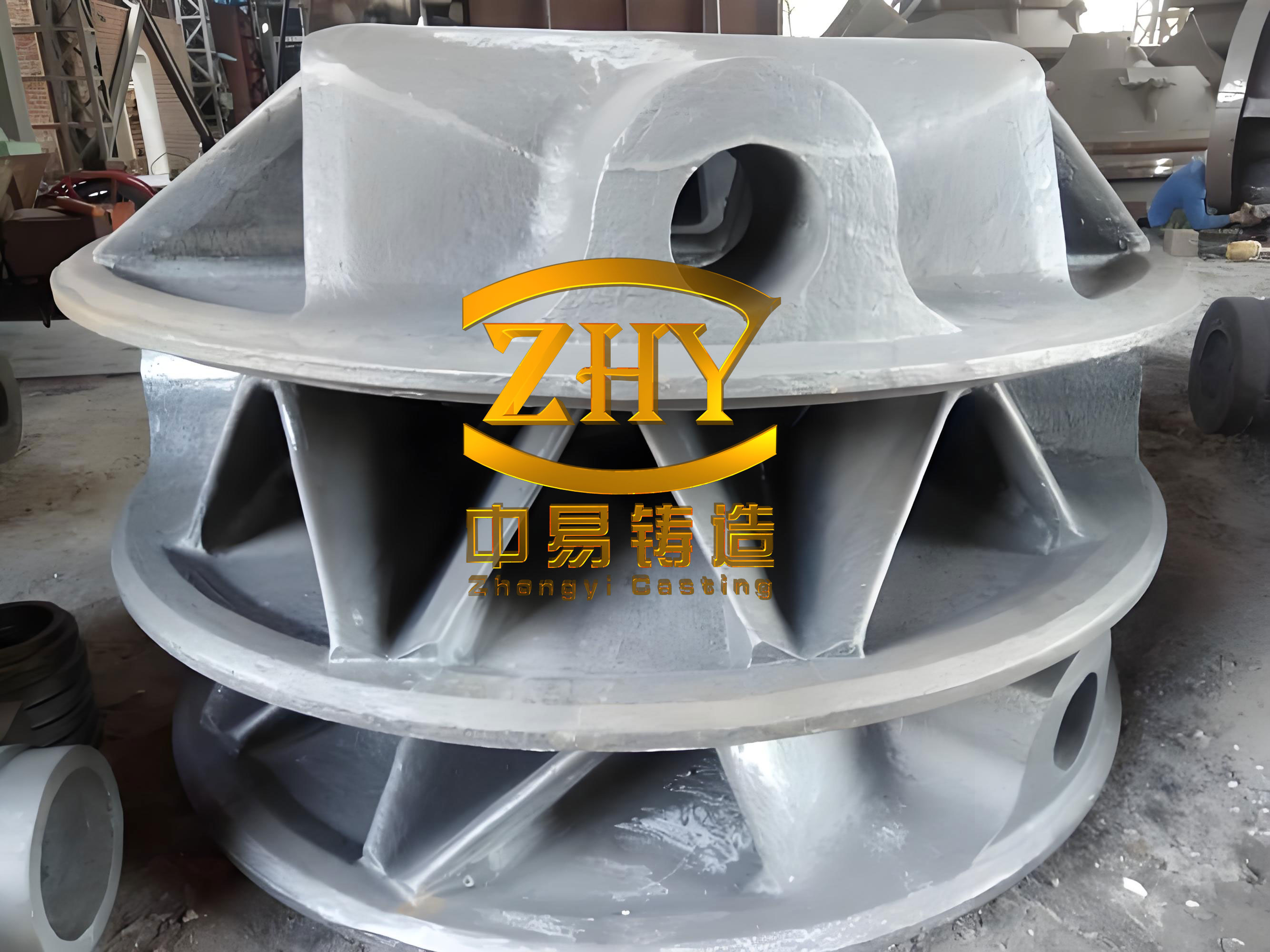
For high-performance as-cast ductile cast iron, achieving the required matrix structure (high pearlite content) often necessitates alloying. The hardenability effect of alloys like Cu and Mn can be estimated using multiplicative factors. The continuous cooling transformation (CCT) behavior dictates the final microstructure. For a pearlitic grade like QT800-5, the cooling rate must be controlled to avoid excessive ferrite formation. The JMAK (Johnson-Mehl-Avrami-Kolmogorov) equation can model transformation kinetics:
$$ f = 1 – \exp(-k t^n) $$
where $f$ is the transformed fraction, $k$ is a rate constant, $t$ is time, and $n$ is the Avrami exponent. In sand casting, this translates to designing casting geometry and risers to ensure appropriate cooling rates in critical sections. Process simulation software solves the heat transfer equation during solidification:
$$ \rho c_p \frac{\partial T}{\partial t} = \nabla \cdot (k \nabla T) + \dot{Q}_{latent} $$
where $\rho$ is density, $c_p$ is specific heat, $k$ is thermal conductivity, $T$ is temperature, and $\dot{Q}_{latent}$ is the latent heat release rate. This is essential for predicting shrinkage porosity, a common defect in ductile cast iron due to its unique expansion behavior during solidification.
The second major category is Austempered Ductile Iron (ADI). This is a heat-treated form of ductile cast iron that achieves a unique ausferritic microstructure, offering an outstanding combination of high strength, wear resistance, and good toughness. The standard austempering process involves austenitizing in the range of 850-950°C, followed by rapid quenching to an isothermal holding temperature (typically 250-400°C) in a salt bath or oil, and holding for 1-4 hours before air cooling. The transformation during isothermal holding involves the reaction of austenite ($\gamma$) to ferrite ($\alpha$) and high-carbon austenite ($\gamma_{HC}$):
$$ \gamma \rightarrow \alpha + \gamma_{HC} $$
The stability of the retained, high-carbon austenite is crucial for toughness. The mechanical properties of ADI are superior to most as-cast ductile cast iron grades. Table 2 compares standard ADI grades per international specifications, which are also referenced in Chinese standards like GB/T 24733.
| Grade Designation | Tensile Strength, Rm (MPa), min | Yield Strength, Rp0.2 (MPa), min | Elongation, A (%), min | Typical Hardness (HBW) |
|---|---|---|---|---|
| QTD 800-10 (EN 1564: JS/800-10) | 800 | 500 | 10 | 250-310 |
| QTD 900-8 (EN 1564: JS/900-8) | 900 | 600 | 8 | 280-340 |
| QTD 1050-6 (EN 1564: JS/1050-6) | 1050 | 700 | 6 | 320-380 |
| QTD 1200-3 (EN 1564: JS/1200-3) | 1200 | 850 | 3 | 360-440 |
The isothermal transformation kinetics follow the principles of bainitic transformation. The time-temperature-transformation (TTT) diagram for a given ductile cast iron chemistry is essential for process design. The time $t$ to achieve a certain transformation fraction at temperature $T$ can be described by an Arrhenius-type relationship:
$$ t = A \exp\left(\frac{Q}{RT}\right) $$
where $A$ is a pre-exponential factor, $Q$ is the activation energy for the transformation, and $R$ is the gas constant. The high strength of ADI stems from the fine, acicular ferrite structure and the dispersed stable austenite. The relationship between yield strength and microstructure can be approximated by the Hall-Petch type relationship for the ferrite lath size, and the rule of mixtures for the two-phase structure. The fatigue strength $\sigma_f$ of ADI is notably high, often related to its tensile strength:
$$ \sigma_f \approx 0.4 \times R_m \quad \text{(for smooth specimens, at 10⁷ cycles)} $$
This makes ADI highly suitable for dynamic load-bearing components.
In the domestic Chinese heavy-duty truck industry, the application of these high-performance ductile cast iron materials has been growing. Based on my analysis of industry reports and technical exchanges, the adoption varies among major OEMs and component suppliers. Table 3 provides a non-exhaustive overview of some applications, illustrating the component diversity.
| OEM / Major Supplier | Component Examples | Material Grade (Typical) | Production Process | Vehicle Type / Status |
|---|---|---|---|---|
| Sinotruk, FAW, Dongfeng | Balance Shaft Brackets, Front Extension Beam Brackets, Leaf Spring Brackets, Tow Hooks | QT800-5 (as-cast), QTD800-10 (ADI) | Sand casting, Disamatic, Lost Foam | Heavy-duty trucks, Mass production |
| Specialized Off-road Vehicle Manufacturers | Steering Knuckles, Control Arms, Axle Housings | QTD900-8, QTD1050-6 | Investment Casting, Sand Casting + Austempering | High-mobility off-road vehicles, Limited series |
| Construction & Mining Equipment Makers | Quick-change Mounts, Lock Hooks, Guide Seats for Spring Leaves | QTD800-10, QT800-5 | Sand Casting | Mining dumper trucks, Engineering machinery |
| Component Specialists (e.g., Henan Oudi Ai, Hebei Hengji) | Various Brackets, Housings, Supports | Full range of ADI grades | Austempering lines on contract basis | Supplied to multiple OEMs |
The driving force for adopting high-performance ductile cast iron is primarily lightweighting. Replacing forged or cast steel components with ductile cast iron of higher specific strength allows for wall thickness reduction. The mass savings $\Delta m$ for a component under constant stiffness design can be estimated. For a beam in bending, stiffness $S$ is proportional to $E I$, where $I$ is the area moment of inertia. If we switch from a steel ($E_s$, $\rho_s$) to a high-performance ductile cast iron ($E_{dci}$, $\rho_{dci}$) and redesign for equal stiffness, the new cross-sectional dimensions change. For a simple rectangular section, the mass ratio becomes:
$$ \frac{m_{dci}}{m_{steel}} = \frac{\rho_{dci}}{\rho_{steel}} \left( \frac{E_{steel}}{E_{dci}} \right)^{1/3} $$
Given $\rho_{dci} \approx 7.3$, $\rho_{steel} \approx 7.85$, $E_{steel} \approx 210$ GPa, $E_{dci} \approx 172$ GPa, the ratio is approximately 0.95, indicating a potential 5% mass saving for equal stiffness. However, when leveraging the higher yield strength of ductile cast iron to design for equal strength under static loads, the savings are more substantial because wall thickness can be reduced further. The new thickness $t_{new}$ relative to the original steel thickness $t_{steel}$ for a stress-limited design is:
$$ t_{new} = t_{steel} \times \frac{\sigma_{y, steel}}{\sigma_{y, dci}} $$
If $\sigma_{y, steel}$ is 355 MPa (e.g., S355 structural steel) and $\sigma_{y, dci}$ is 500 MPa (for QT800-5), then $t_{new} \approx 0.71 \times t_{steel}$. The mass saving would then be roughly 29%, ignoring other design constraints. This theoretical potential is what drives many application projects.
I will now detail a specific application case I was involved with, concerning a balance shaft bracket for a heavy-duty truck. The original component was made from QT500-7, with a mass of 51 kg. The goal was to redesign it using QT800-5 ductile cast iron to achieve significant mass reduction while meeting all structural requirements. The design process began with Finite Element Analysis (FEA) under critical load cases: vertical loading (220 kN) and braking (combined 90 kN vertical and 120 kN longitudinal). The von Mises stress criterion was used for assessment:
$$ \sigma_{vM} = \sqrt{\frac{(\sigma_1 – \sigma_2)^2 + (\sigma_2 – \sigma_3)^2 + (\sigma_3 – \sigma_1)^2}{2}} $$
where $\sigma_1, \sigma_2, \sigma_3$ are principal stresses. The original design had main wall thicknesses of 14-16 mm. After iterative topology and shape optimization, the new design featured more uniform wall thickness of 12 mm, with ribs strategically placed to maintain stiffness. The FEA results confirmed that the maximum stress in the new design under both load cases remained below the allowable stress for QT800-5, with a safety factor $n$ defined as:
$$ n = \frac{\sigma_{y}}{\sigma_{max}} > 1.5 \quad \text{(as per company design guidelines)} $$
The final mass of the optimized bracket was 36 kg, a reduction of 15 kg or 29.4%. This direct mass saving contributes to the vehicle’s payload capacity.
The manufacturing feasibility was then verified through casting process simulation. The solidification analysis aimed to ensure soundness and avoid shrinkage defects. The Niyama criterion, a widely used indicator for shrinkage porosity in castings, was evaluated. It is given by:
$$ N_y = \frac{G}{\sqrt{\dot{T}}} $$
where $G$ is the temperature gradient and $\dot{T}$ is the cooling rate at the solidification front. Regions with $N_y$ below a critical threshold (e.g., 1 °C1/2·min1/2/cm for ductile cast iron) are prone to microporosity. The simulation predicted a small area of potential shrinkage, which was deemed acceptable per internal quality standards. Prototype castings were produced using sand molds. The chemical composition was tightly controlled as per Table 1. The melt treatment used a sandwich method with a FeSiMg6RE2 nodularizer and Ba-containing inoculant. The mold filling was simulated using the Navier-Stokes equations for fluid flow:
$$ \frac{\partial \mathbf{v}}{\partial t} + (\mathbf{v} \cdot \nabla) \mathbf{v} = -\frac{1}{\rho} \nabla p + \nu \nabla^2 \mathbf{v} + \mathbf{g} $$
where $\mathbf{v}$ is velocity, $p$ is pressure, $\nu$ is kinematic viscosity, and $\mathbf{g}$ is gravity. This ensured no turbulence-related defects.
Test bars were cut from the prototype castings’ critical sections (following ASTM A536 sampling guidelines) for mechanical testing. The results met the QT800-5 specification: tensile strength >800 MPa, yield strength >480 MPa, elongation >5%, and hardness 245-335 HBW. Microstructural analysis showed a nodularity >90% (Graphite Form VI, Type I per ISO 945), graphite size class 6 (ASTM A247), and a pearlite content of approximately 85%. The components passed rigorous bench testing and were subsequently installed on test vehicles for road endurance trials, successfully completing the validation cycle.
Despite the clear technical advantages, the widespread adoption of high-performance ductile cast iron in heavy-duty truck chassis faces several challenges from my point of view. First is the cost challenge. While as-cast high-performance ductile cast iron avoids the added cost of heat treatment (as in ADI), the raw material costs are significant. High-purity pig iron, specific alloying elements (Cu, Ni, Mo), and high-quality inoculants are expensive. The cost per kilogram of liquid metal $C_{melt}$ can be modeled as:
$$ C_{melt} = \sum (c_i \cdot w_i) + C_{processing} $$
where $c_i$ is the unit cost of material $i$ (pig iron, scrap, alloys), $w_i$ is its mass fraction in the charge, and $C_{processing}$ includes energy and labor for melting and treatment. The volatility of raw material markets makes cost prediction difficult. The lightweighting benefit must offset this higher unit cost through increased payload or fuel savings over the vehicle’s lifetime, a calculation that is not always straightforward for purchasers.
The second challenge is technological consistency. Producing high-performance ductile cast iron with stable mechanical properties batch-to-batch is demanding. Variability in raw materials, melting conditions, inoculation effectiveness, and cooling rates can lead to scatter in properties. The statistical distribution of tensile strength, for instance, should be narrow. If we assume a normal distribution, the process capability index $C_{pk}$ should be high:
$$ C_{pk} = \min\left( \frac{USL – \mu}{3\sigma}, \frac{\mu – LSL}{3\sigma} \right) $$
where $USL/LSL$ are the specification limits, $\mu$ is the mean, and $\sigma$ is the standard deviation. Achieving a high $C_{pk}$ for both strength and ductility simultaneously requires exceptional process control. Many foundries, especially smaller ones, struggle with this, leading to reliability concerns among OEMs.
The third challenge lies in supply chain collaboration and design integration. Optimal utilization of high-performance ductile cast iron requires concurrent engineering between the OEM design team and the foundry. The designer must understand the material’s characteristics—its lower elongation compared to steel at similar strength, its sensitivity to section thickness (due to cooling rate effects on microstructure), and its fatigue behavior. The foundry engineer must provide feedback on manufacturability, suggesting design modifications to avoid hot spots, ensure proper feeding, and minimize residual stresses. This dialogue is often hampered by traditional sequential development processes and a lack of shared simulation tools. A more integrated approach using digital twins, where the structural FEA and casting simulation models are exchanged and iterated, is needed but not yet commonplace.
Furthermore, there is a knowledge gap regarding the long-term performance of these high-strength ductile cast iron components under real-world, multi-axial fatigue loading conditions. While standard fatigue data exists, the influence of casting defects (even within acceptable limits) on the fatigue life of complex, optimized geometries needs more research. Models like the Murakami model for defect-sensitive fatigue strength could be applied:
$$ \sigma_w = \frac{C (HV + 120)}{(\sqrt{area})^{1/6}} $$
where $\sigma_w$ is the fatigue limit, $HV$ is Vickers hardness, $\sqrt{area}$ is the square root of the projected area of the defect perpendicular to the stress axis, and $C$ is a constant. Integrating such micromechanical models into component design would enhance reliability.
In conclusion, high-performance ductile cast iron, encompassing both advanced as-cast grades and ADI, presents a compelling solution for lightweighting heavy-duty truck chassis. Its superior specific strength and good toughness enable significant mass reduction in components like brackets, supports, and even more critical parts like steering knuckles. The successful application of QT800-5 in a balance shaft bracket, achieving a 29% mass reduction, exemplifies this potential. However, for broader adoption, the industry must address the triad of challenges: cost competitiveness through efficient processing and perhaps alternative alloying strategies, technological mastery to ensure property consistency, and deepened collaboration between designers and manufacturers to fully exploit the material’s capabilities. Continued research into the fatigue and fracture mechanics of high-performance ductile cast iron, along with the development of more robust process control systems using Industry 4.0 technologies, will be key. As these challenges are met, I am confident that high-performance ductile cast iron will play an increasingly vital role in enabling the next generation of efficient, high-payload commercial vehicles, solidifying its position as a cornerstone material in automotive lightweighting strategies.