
As an engineer and researcher in the field of metallurgy, I have witnessed the evolution of ductile iron casting over the decades. The advent of high silicon ductile iron casting represents a significant advancement, offering superior properties that cater to demanding industrial applications. In this article, I will delve into the intricacies of high silicon ductile iron, exploring its chemical composition, microstructure, performance characteristics, production nuances, and future prospects. The focus will be on providing a detailed, first-person perspective, enriched with tables and formulas to elucidate key concepts. Throughout, the term ‘ductile iron casting’ will be emphasized to highlight its relevance in modern manufacturing.
Ductile iron casting, also known as nodular iron, has been a cornerstone material since the mid-20 century due to its excellent strength and versatility. However, with escalating demands for higher performance in extreme environments, conventional ductile iron casting often falls short. This led to the development of high silicon ductile iron casting, where silicon content is elevated to achieve solid solution strengthening. The essence of this material lies in its ability to combine high tensile strength, yield strength, and elongation, along with enhanced resistance to heat and corrosion. In my experience, optimizing silicon levels is critical; typically, silicon content (w(Si)) ranges from 3.0% to 4.3%, beyond which brittleness may increase. This careful balancing act defines the success of high silicon ductile iron casting in practical applications.
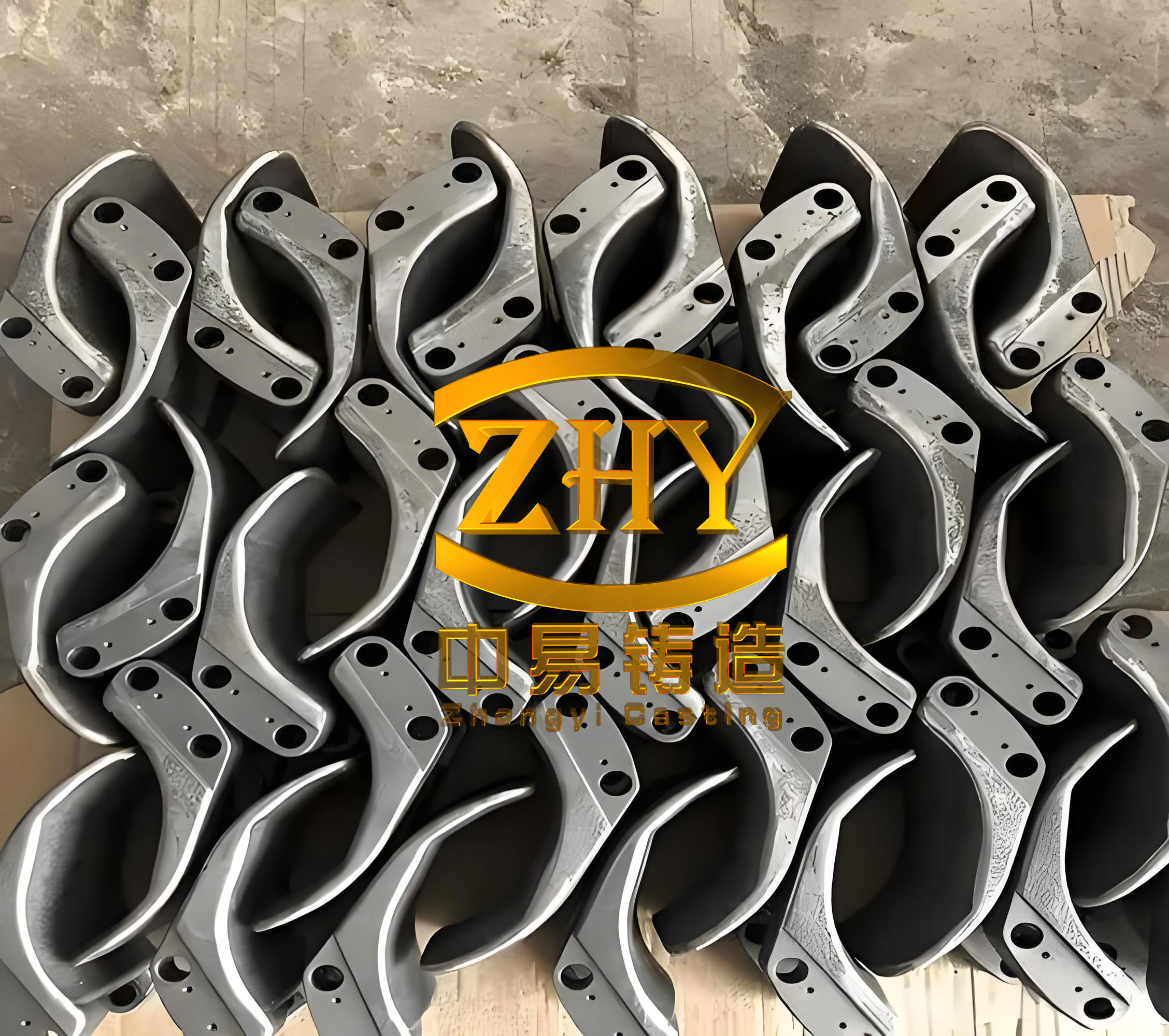
To understand high silicon ductile iron casting, we must first examine its chemical composition. Silicon is the primary alloying element, but other components play crucial roles. The table below summarizes the typical composition ranges for high silicon ductile iron casting compared to standard ductile iron casting:
| Element | High Silicon Ductile Iron Casting (w%) | Standard Ductile Iron Casting (w%) |
|---|---|---|
| Carbon (C) | 3.2–3.8 | 3.4–4.0 |
| Silicon (Si) | 3.0–4.3 | 2.0–3.0 |
| Manganese (Mn) | <0.2 | 0.1–0.5 |
| Phosphorus (P) | <0.03 | <0.05 |
| Sulfur (S) | <0.025 | <0.02 |
| Copper (Cu) | <0.1 | 0–0.5 |
In high silicon ductile iron casting, silicon acts as a graphite-promoter and solid-solution strengthener. The microstructure is predominantly ferritic, with ferrite volume fraction exceeding 95%, while pearlite and free carbides are minimized to below 5% and 1%, respectively. This ferritic matrix is key to the material’s ductility and toughness. The solid solution strengthening effect can be modeled using a simplified formula: $$ \sigma_y = \sigma_0 + k \cdot w(Si)^n $$ where $\sigma_y$ is the yield strength, $\sigma_0$ is the base strength of iron, $k$ is a strengthening coefficient, $w(Si)$ is the silicon content, and $n$ is an exponent typically around 1 for low alloys. For high silicon ductile iron casting, this relationship underscores how silicon enhances mechanical properties without compromising ductility significantly.
The performance of high silicon ductile iron casting is multifaceted, encompassing mechanical, chemical, and machinability aspects. Let’s start with mechanical properties. Silicon content directly influences tensile strength and elongation, as shown in the following empirical relationships derived from experimental data. The tensile strength ($\sigma_t$) can be expressed as: $$ \sigma_t = 250 + 100 \cdot (w(Si) – 2.5) \text{ MPa for } w(Si) \in [3.0, 4.3] $$ This linear approximation highlights the strength gain with increasing silicon. Conversely, elongation ($\epsilon$) follows a parabolic trend: $$ \epsilon = 25 – 5 \cdot (w(Si) – 3.5)^2 \text{ %} $$ indicating optimal ductility around 3.5% silicon. Below is a comparative table of mechanical properties between high silicon ductile iron casting and conventional grades, illustrating its superiority:
| Property | High Silicon Ductile Iron Casting (QT600-10) | Standard Ductile Iron Casting (QT500-7) |
|---|---|---|
| Tensile Strength (min, MPa) | 600 | 500 |
| Yield Strength (min, MPa) | 470 | 320 |
| Elongation (min, %) | 10 | 7 |
| Hardness (HBW) | 200–230 | 170–230 |
| Fatigue Limit (MPa) | 275 | 224 |
In high-temperature environments, high silicon ductile iron casting excels due to silicon’s role in forming protective oxide layers. The elevated temperature yield strength ($\sigma_{y,T}$) can be estimated using: $$ \sigma_{y,T} = \sigma_y \cdot \exp\left(-\frac{Q}{RT}\right) $$ where $Q$ is the activation energy, $R$ is the gas constant, and $T$ is the absolute temperature. For high silicon ductile iron casting, $Q$ is higher than in standard grades, conferring better retention of strength at temperatures up to 600°C. This makes it ideal for applications like exhaust manifolds and industrial furnace parts, where ductile iron casting must withstand thermal cycling.
Chemical performance, particularly corrosion resistance, is another forte of high silicon ductile iron casting. Silicon increases the electrode potential of ferrite, reducing the galvanic couple with graphite. The corrosion rate ($r_c$) in aggressive media can be modeled as: $$ r_c = r_0 – \alpha \cdot w(Si) $$ where $r_0$ is the base corrosion rate and $\alpha$ is a positive constant. Experiments show that doubling silicon content from 2% to 4% can halve corrosion rates in acidic or saline environments. This chemical resilience expands the use of ductile iron casting in marine and chemical processing equipment.
Machinability is often a concern in ductile iron casting, but high silicon variants offer advantages due to their narrow hardness range. The hardness uniformity, measured as the spread in HBW values, is typically within 30 HBW for high silicon ductile iron casting, compared to 50–80 HBW for standard grades. This consistency reduces tool wear and improves surface finish during machining. The relationship between machinability index ($M_i$) and hardness spread ($\Delta H$) can be expressed as: $$ M_i = \frac{1}{\Delta H} \cdot \beta $$ where $\beta$ is a material constant. Thus, lower $\Delta H$ enhances $M_i$, lowering production costs in ductile iron casting operations.
However, high silicon ductile iron casting has its challenges. Excessive silicon can embrittle the material, especially at low temperatures. The impact toughness ($K$) decreases with silicon content and temperature, approximated by: $$ K = K_0 – \gamma \cdot w(Si) – \delta \cdot T $$ where $K_0$ is the base toughness, $\gamma$ and $\delta$ are coefficients, and $T$ is temperature in °C. Below 0°C, impact resistance may drop sharply if silicon exceeds 4.3%, necessitating precise control. Additionally, heat treatment like quenching is difficult due to silicon’s inhibition of martensite formation, limiting surface hardening options in ductile iron casting.
Production of high silicon ductile iron casting requires meticulous工艺. Starting with pure scrap steel, high-quality pig iron, and minimal returns, melting must be controlled with precise charge sequences and temperatures. Overheating above 1500°C is avoided to prevent silicon loss. Key steps include:
- Melting: Maintain a superheat of 50–100°C to ensure fluidity.
- Inoculation: Use barium-containing ferrosilicon inoculants at 0.3–0.6% addition to promote graphite nucleation. The inoculant effect on nodule count ($N$) can be modeled as: $$ N = N_0 + \lambda \cdot I $$ where $N_0$ is the base nodule count, $\lambda$ is a factor, and $I$ is inoculant addition.
- Spheroidization: Employ REMg alloys at 0.9–1.2% addition, ensuring reaction begins when 70% of iron is tapped to minimize oxidation.
- Cooling: Controlled cooling rates below 10°C/s to foster ferrite formation.
These steps ensure a fully ferritic matrix with high nodularity, critical for optimal properties in ductile iron casting.
The application landscape for high silicon ductile iron casting is broadening. In automotive sectors, it is used for brake calipers, suspension components, and turbocharger housings due to its high fatigue strength. For instance, the fatigue limit ($\sigma_f$) under cyclic loading can be calculated using: $$ \sigma_f = 0.4 \cdot \sigma_t + 50 \text{ MPa} $$ which for high silicon ductile iron casting yields values above 250 MPa, outperforming many steels. In energy industries, it serves in pump casings and valve bodies for geothermal plants, leveraging its corrosion resistance. The trend towards lightweighting also benefits from high silicon ductile iron casting, as its high strength-to-weight ratio allows thinner sections without compromising integrity.
Future prospects for ductile iron casting are tied to innovation in high silicon grades. Research is exploring silicon levels up to 5% with micro-alloying additions like molybdenum or nickel to mitigate brittleness. The integration of computational modeling, such as finite element analysis (FEA), optimizes component design. For example, stress distribution ($\sigma(x)$) in a casting under load can be simulated using: $$ \nabla \cdot \sigma(x) + f = 0 $$ where $f$ is body force, aiding in predicting performance. Additionally, additive manufacturing techniques are being adapted for ductile iron casting, enabling complex geometries with tailored silicon gradients.
To industrialize high silicon ductile iron casting, I recommend a collaborative approach. Foundries should invest in real-time monitoring systems to control silicon content within ±0.1%, using spectroscopy and thermal analysis. Quality assurance protocols must include non-destructive testing like ultrasonic inspection for internal defects. Furthermore, educating designers about the material’s capabilities will spur adoption. For instance, highlighting its elastic modulus ($E$) of 170–180 GPa, similar to steel, can convince engineers to switch to ductile iron casting for cost savings.
In conclusion, high silicon ductile iron casting represents a paradigm shift in metallurgy, offering a blend of strength, ductility, and environmental resistance. Through careful composition control and advanced processing, it meets the demands of modern engineering. As we push the boundaries of materials science, ductile iron casting will continue to evolve, with high silicon variants leading the charge. The journey from laboratory to mass production requires perseverance, but the rewards—a sustainable, high-performance material—are well worth the effort. By embracing innovation, the ductile iron casting industry can unlock new horizons, ensuring its relevance for decades to come.
Throughout this discussion, I have emphasized the term ‘ductile iron casting’ to reinforce its centrality. Whether in automotive, energy, or heavy machinery, the versatility of ductile iron casting is undeniable. As a practitioner, I am excited by the potential of high silicon grades to solve complex engineering challenges. Let us continue to explore, experiment, and elevate ductile iron casting to new heights, driven by data and dedication.