
The crankshaft stands as a critical component within internal combustion engines, subjected to complex loading scenarios involving alternating bending and torsional stresses. For high-power, multi-cylinder diesel engines, particularly those employing turbocharging technology, the demands on crankshaft material are severe. It must possess exceptionally high fatigue strength, stiffness, and wear resistance. While forged alloy steels like 42CrMo have traditionally met these demands, their high manufacturing cost presents a significant economic challenge. The development of a cost-effective, high-performance alternative is therefore a pivotal research focus. Ductile iron casting offers a compelling solution due to its excellent castability, good damping capacity, machinability, and relative insensitivity to surface notches. This article details the comprehensive development process, from material design to pilot-scale validation, of a high-strength ductile iron casting intended to replace forged steel crankshafts in a six-cylinder diesel engine.
The target application was the L6R040301Q crankshaft for a heavy-duty tractor engine. The core strategy involved a synergistic combination of alloy composition optimization, advanced sand coated iron mould (iron mould with resin sand lining) casting, and a tailored isothermal normalizing heat treatment. The primary objective was to achieve a microstructure that guarantees a tensile strength exceeding 860 MPa, an elongation over 5%, and a hardness between 250-300 HB, all while ensuring impeccable internal soundness free from shrinkage porosity and slag inclusions.
Material Design and Composition Optimization
The foundation of a high-performance ductile iron casting lies in its chemical composition. The base composition was designed around a hypereutectic range to promote graphite nucleation and ensure good fluidity. Key elements were strategically adjusted and added to enhance strength and microstructural stability.
| Element | Target Range | Primary Function |
|---|---|---|
| C | 3.4 – 3.8 | Promotes graphite formation, ensures fluidity. |
| Si | 1.7 – 2.2 | Strong graphitiser, strengthens ferrite. |
| Mn | 0.4 – 0.5 | Stabilizes pearlite, solid solution strengthener. |
| P | ≤ 0.03 | Minimized to avoid brittle phosphide eutectic. |
| S | ≤ 0.015 | Minimized to prevent interference with nodularization. |
| Cu | 0.4 – 0.5 | Promotes pearlite, refines microstructure, improves homogeneity in heavy sections. |
| Sb | 0.006 – 0.010 | Powerful pearlite promoter, refines graphite nodules, increases nodule count. |
| Mo* | 0.15 – 0.30 | Enhances hardenability, solid solution strengthening, improves high-temperature stability (added during pilot production). |
* Molybdenum was introduced during the pilot-scale production to further boost performance and consistency.
The role of Sb is particularly crucial. In trace amounts, it profoundly refines the pearlitic matrix, improves the roundness of graphite nodules, and increases their population density, directly contributing to higher strength. However, its concentration must be carefully controlled, as excess Sb can lead to carbide formation and embrittlement. Cu acts in synergy, enhancing hardenability and stabilizing the pearlitic matrix while also improving the uniformity of microstructure across the varying section thicknesses of a crankshaft. The final composition represents a balanced, multi-alloyed system designed for high strength through a refined, fully pearlitic/sorbitic matrix.
Casting Process: From Simulation to Iron Mould Practice
To achieve the desired internal integrity, the casting process was meticulously planned and simulated. Initial solidification simulations using casting CAE software for a traditional resin sand mould process predicted a sound casting with only a minor risk of micro-shrinkage at one crankpin journal top. The simulation confirmed the effectiveness of the feeding system design with risers placed over thermal hotspots.
Based on this analysis, the process was optimized and implemented using two distinct moulding techniques for comparison: conventional resin sand moulding and the advanced sand coated iron mould process. The latter involves creating a precise, thin shell of resin-coated sand lining within a permanent iron mould. This hybrid approach combines the dimensional accuracy and rapid heat dissipation of a metal mould with the flexibility and surface finish of a sand mould.
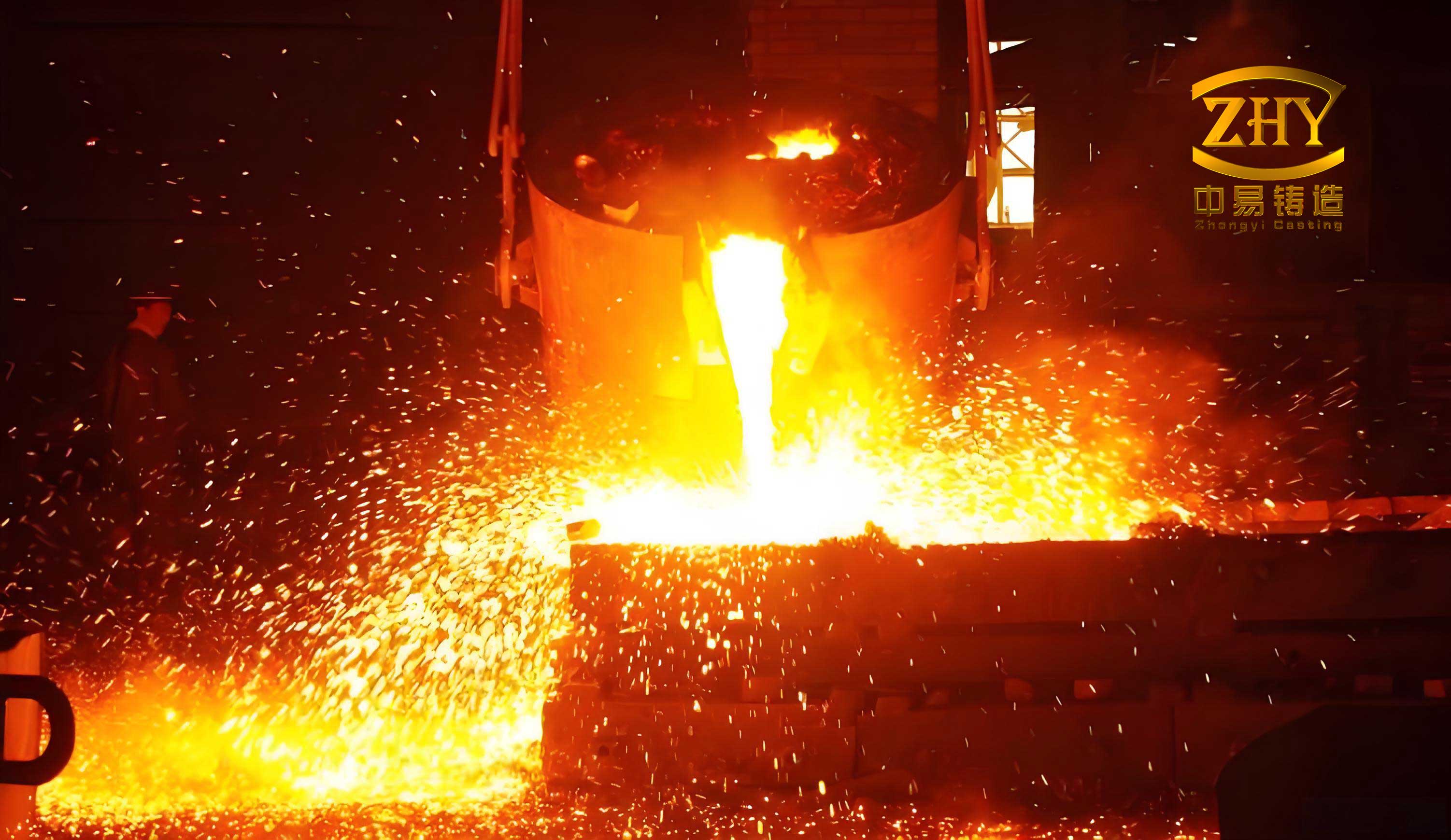
The critical advantage of the sand coated iron mould lies in its significantly higher cooling rate compared to a massive resin sand mould. The chilling effect of the iron mould increases the undercooling ($\Delta T$) during solidification. According to nucleation theory, the increased undercooling leads to a higher nucleation rate ($I$), which can be conceptually related by equations of the form:
$$ I \propto \exp\left(-\frac{\Delta G^*}{k_B T}\right) $$
where $\Delta G^*$ is the activation energy for nucleation, which decreases with increasing $\Delta T$. This results in a finer grain structure, a larger number of smaller eutectic cells, and a more dense distribution of graphite nodules. The melt treatment involved a base furnace treatment with FeSiRE3Mg8 nodularizer (1.0-1.3%) and a primary 75% ferrosilicon inoculant (0.8-1.0%), followed by a secondary stream inoculation with a Ba-containing inoculant during pouring at 1380-1400°C.
The castings produced via the sand coated iron mould process exhibited superior surface quality and, upon sectioning and non-destructive testing, were found to be completely free from internal defects like shrinkage cavities and inclusions, validating the simulation and process design.
Heat Treatment: Engineering the Sorbitic Matrix
The as-cast microstructure, while sound, required transformation to achieve the optimal balance of strength and ductility. An isothermal normalizing treatment was developed specifically for this high-strength ductile iron casting. The thermal profile is critical:
- Two-Stage Austenitization: Heating to 920°C ensures complete dissolution of any free carbides (particularly important with Sb and Mo additions). Holding at 900°C allows for homogenization of the austenite ($\gamma$) without excessive grain growth, following diffusion kinetics where the homogenization time is proportional to the square of the diffusion distance.
- Isothermal Transformation: Rapid cooling to and holding at 600°C places the austenite in the lower temperature region of the Time-Temperature-Transformation (TTT) diagram. At this temperature, the transformation product is fine pearlite, known as sorbitte. The transformation follows Avrami kinetics:
$$ f = 1 – \exp(-k t^n) $$
where $f$ is the transformed fraction, $k$ is a rate constant dependent on temperature and composition, $t$ is time, and $n$ is an exponent related to the transformation mechanism. The isothermal hold allows for a complete and uniform transformation to this tough, fine lamellar structure, minimizing residual stresses that arise from continuous cooling.
Microstructural Analysis: A Tale of Two Processes
Metallographic examination of samples taken from various locations (counterweights) along the crankshaft axis revealed clear differences between the two casting processes post heat-treatment.
| Parameter | Resin Sand Casting | Sand Coated Iron Mould Casting |
|---|---|---|
| Nodularity Grade | 2 | 2 |
| Graphite Size Grade | 5 | 6 (Finer) |
| Nodule Count (nodules/mm²) | ~153 | >165 |
| Matrix Constituent | >90% Sorbitte | >90% Sorbitte (Finer Lamellar Spacing) |
| Free Cementite | < 1% | < 1% |
| Phosphide Eutectic | None | None |
The data unequivocally shows the refining effect of the sand coated iron mould process. The faster solidification rate yielded a finer graphite size grade and a significantly higher nodule count. The subsequent isothermal treatment transformed the fine-grained austenite into a very fine, uniform sorbitic matrix. This refined microstructure is the key precursor to superior mechanical properties.
Mechanical Property Evaluation
Tensile and hardness tests were conducted on specimens machined from the crankshaft body at multiple axial positions. The results highlight the impact of the integrated manufacturing route.
| Sampling Location (Counterweight) | Yield Strength, $R_{p0.2}$ (MPa) | Tensile Strength, $R_m$ (MPa) | Elongation, $A$ (%) | Hardness (HB) |
|---|---|---|---|---|
| 1 | 602 | 925 | 5.4 | 280 |
| 3 | 596 | 940 | 6.3 | 285 |
| 5 | 620 | 964 | 5.8 | 285 |
| 7 | 620 | 961 | 5.2 | 294 |
| 9 | 608 | 955 | 5.4 | 278 |
| 12 | 595 | 932 | 5.6 | 289 |
| Average | 607 | 946 | 5.6 | 285 |
| Axial Variation (Max-Min) | 25 | 39 | 1.1 | 16 |
The pilot-scale ductile iron casting consistently exceeded the minimum requirement of 860 MPa tensile strength, with an impressive average of 946 MPa and a peak value of 964 MPa. The elongation comfortably surpassed the 5% threshold with an average of 5.6%. The hardness was uniform along the shaft, averaging 285 HB. After standard machining, induction hardening of the pin and journal surfaces achieved a consistent hardness of 60-61 HRC. Most critically, under a bending fatigue load of 2900 N·m, the crankshafts withstood over 10 million cycles without failure, definitively meeting the service life criterion for this engine platform.
Conclusion and Economic Impact
The successful development and pilot-scale production of this six-cylinder crankshaft demonstrates the formidable potential of advanced ductile iron casting technologies. By synergistically combining:
- A multi-alloyed composition (C, Si, Cu, Sb, Mo),
- The rapid, controlled solidification of the sand coated iron mould process, and
- A precise isothermal normalizing heat treatment,
a component was produced that meets or exceeds the performance specifications of the incumbent forged steel crankshaft. The resultant microstructure—characterized by a high nodule count, fine graphite, and a uniform, fine sorbitic matrix—delivers an optimal combination of high strength ($R_m > 940$ MPa), adequate ductility ($A > 5.5$%), and excellent fatigue resistance.
The economic implication is substantial. A cost-benefit analysis revealed that replacing the forged 45 steel crankshaft with this high-strength ductile iron casting reduces cost by approximately 44.0%. Even more dramatically, replacing the higher-grade 42CrMo forged steel crankshaft yields a cost reduction of about 66.2%. This project validates that through meticulous material and process engineering, ductile iron casting is not merely a cost-effective alternative but a high-performance solution capable of serving in the most demanding heavy-duty engine applications.