
In the realm of industrial applications requiring sustained performance under extreme thermal conditions, the development of advanced heat-resistant alloys through innovative steel casting processes is paramount. As a researcher deeply invested in materials science, I have focused on exploring high-temperature oxidation mechanisms in steel castings, particularly those designed for critical components like grate plates in pelletizing plants. These components endure cyclic thermal stresses between 800–1,000 °C and 200–300 °C, demanding exceptional oxidation resistance to prevent premature failure. Traditional austenitic heat-resistant steels, while effective, often rely on high nickel content, escalating costs and prompting a shift toward low-nickel alternatives. This study delves into the high-temperature oxidation behavior of a novel low-nickel duplex heat-resistant steel casting, aiming to elucidate its kinetics and oxide film structure at 900 °C, thereby contributing to the optimization of steel casting compositions for enhanced durability.
The steel casting industry continually seeks to balance performance with economic viability, and this research underscores the potential of duplex microstructures achieved through precise steel casting techniques. By replacing nickel with manganese and nitrogen, we can reduce reliance on expensive elements while maintaining or even surpassing the oxidation resistance of conventional austenitic grades. In this article, I will detail our experimental approach, present findings through kinetic models and microstructural analyses, and discuss the implications for steel casting design. Emphasis will be placed on the role of steel casting in fabricating such alloys, and keywords like “steel casting” will be frequently highlighted to underscore its centrality in this work. The integration of tables and mathematical formulas will facilitate a comprehensive summary of data, adhering to scientific rigor.
Our investigation began with the preparation of the low-nickel duplex heat-resistant steel casting. The alloy was melted in an induction furnace and produced via the lost foam casting method, a versatile steel casting process that allows for complex shapes and minimal post-processing. The chemical composition, determined using optical emission spectroscopy, is summarized in Table 1. This composition is critical in steel casting as it dictates the phase balance and subsequent high-temperature properties.
| Element | Content | Element | Content |
|---|---|---|---|
| C | 0.33 | Si | 0.85 |
| Mn | 3.14 | Cr | 25.53 |
| Ni | 5.15 | Mo | 0.17 |
| N | 0.23 | Nb | 0.11 |
| S | 0.007 | P | 0.008 |
The steel casting process ensured a homogeneous microstructure, which was essential for consistent oxidation behavior. Specimens for oxidation tests were sectioned into 30 mm × 10 mm × 5 mm blocks, ground to a surface roughness of Ra 0.8 μm, and cleaned ultrasonically in alcohol before drying. Oxidation experiments followed the continuous weight gain method per standard GB/T 13303-1991, with samples heated at 900 °C in air for durations ranging from 5 to 100 hours. Weight changes were recorded to construct oxidation kinetics curves. For microstructural characterization, cross-sections were prepared by mounting, polishing, and etching with aqua regia (75% HCl + 25% HNO3). Scanning electron microscopy (SEM) coupled with energy-dispersive X-ray spectroscopy (EDS) was employed to examine oxide morphology and elemental distribution, while X-ray diffraction (XRD) identified phase compositions. Image analysis software quantified the ferrite phase fraction, providing insights into microstructural evolution during oxidation.
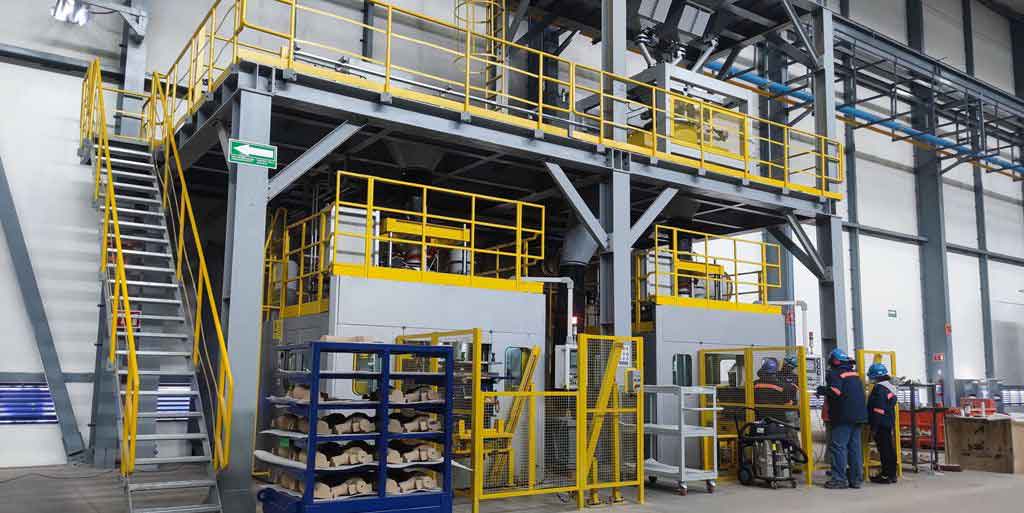
In steel casting, the equipment used plays a pivotal role in determining the final alloy quality. The lost foam casting method, as applied here, involves pattern molding and vaporization to create precise components. To illustrate this, a representative image of steel casting equipment is included below, highlighting the industrial context of our work.
The as-cast microstructure of the duplex heat-resistant steel casting, revealed by SEM, consisted of austenite and ferrite phases, typical of steel casting designed for high-temperature service. After oxidation at 900 °C for 100 hours, sigma phase precipitation was observed, appearing blue under optical microscopy due to etching effects. Quantitative analysis of ferrite content, presented in Table 2, showed an average of 9.2% in the as-cast state. Notably, the surface region after oxidation exhibited a higher ferrite fraction (17.1%) compared to the interior (8.5%), indicating microstructural changes driven by elemental migration during high-temperature exposure. This phenomenon is crucial in steel casting applications where surface degradation dictates component lifespan.
| Sample Condition | Measurement 1 | Measurement 2 | Measurement 3 | Average |
|---|---|---|---|---|
| As-cast | 8.8 | 8.9 | 9.9 | 9.2 |
| Surface after 100 h oxidation | 16.4 | 17.6 | 17.3 | 17.1 |
| Interior after 100 h oxidation | 8.2 | 8.9 | 8.4 | 8.5 |
Oxidation kinetics at 900 °C were evaluated through weight gain measurements. The data, summarized in Table 3, demonstrate an initial rapid oxidation rate that gradually decelerates, stabilizing after approximately 80 hours. This trend is characteristic of protective oxide film formation, a key consideration in steel casting for high-temperature environments. The average oxidation rate was calculated as 0.055 g·m−2·h−1, classifying the steel casting as fully oxidation-resistant according to standard thresholds (K+ < 0.1 g·m−2·h−1). Impressively, this performance matches or exceeds that of typical austenitic heat-resistant steels, such as 310S, which has an average rate of 0.056 g·m−2·h−1 at 900 °C, underscoring the efficacy of our low-nickel steel casting approach.
| Oxidation Time (h) | Weight Gain (mg·cm−2) |
|---|---|
| 5 | 0.08 |
| 10 | 0.12 |
| 20 | 0.20 |
| 30 | 0.23 |
| 40 | 0.29 |
| 60 | 0.38 |
| 80 | 0.53 |
| 100 | 0.55 |
To model the oxidation process, we applied Wagner’s theory, which describes diffusion-controlled kinetics via a parabolic law. The relationship between weight gain per unit area (W) and time (t) is given by:
$$W^2 = K_p t + C$$
where Kp is the parabolic rate constant and C is an integration constant. Plotting W2 versus t yielded a linear fit with high correlation, confirming parabolic behavior. This aligns with expectations for steel casting alloys forming continuous oxide scales, where diffusion of ions through the film limits further oxidation. The rate constant Kp was derived from the slope, providing a quantitative measure of oxidation resistance applicable to steel casting design.
Turning to oxide film structure, SEM-EDS analysis revealed a multi-layered architecture after prolonged oxidation. Initially, at 5 hours, a thin bilayer existed: an inner silica (SiO2) layer adjacent to the steel casting matrix and an outer layer rich in manganese and chromium. By 80–100 hours, the oxide scale evolved into four distinct layers, as illustrated by cross-sectional elemental maps. From the matrix outward, these layers were identified as SiO2, manganese chromite (MnCr2O4), chromia (Cr2O3), and another MnCr2O4 layer. XRD patterns after 100 hours oxidation corroborated the presence of MnCr2O4 and Cr2O3, while SiO2 was detected via EDS despite its low abundance in XRD due to positioning at the innermost region. The overall oxide thickness averaged 6.8 μm after 100 hours, demonstrating the protective nature of this layered structure in steel casting applications.
The formation mechanism of this oxide scale can be explained through selective oxidation principles. In steel casting, elemental affinities for oxygen dictate initial reactions. Silicon, with the highest oxygen affinity, oxidizes first to form a continuous SiO2 layer at the steel casting surface, acting as a diffusion barrier. This is critical in steel casting as it inhibits rapid oxidation onset. Subsequently, chromium and manganese diffuse outward through the silica, reacting to form MnCr2O4 via the reaction:
$$\text{MnO (g)} + \text{Cr}_2\text{O}_3 (\text{s}) \rightarrow \text{MnCr}_2\text{O}_4 (\text{s})$$
As oxidation progresses, chromium enrichment leads to Cr2O3 formation. However, at 900 °C, chromia can volatilize as CrO3 according to:
$$\text{Cr}_2\text{O}_3 (\text{s}) + \frac{3}{2} \text{O}_2 (\text{g}) \rightarrow 2 \text{CrO}_3 (\text{g})$$
To mitigate this, manganese migration from the steel casting matrix to the surface promotes secondary MnCr2O4 formation, enhancing scale stability. This migration also depletes manganese near the surface, altering the local phase equilibrium. In duplex steel casting, manganese is a ferrite stabilizer; its outward diffusion increases the ferrite fraction in subsurface regions, as quantified in Table 2. This microstructural shift impacts mechanical properties and must be considered in steel casting design for thermal cycling applications.
Further insights can be gained by examining the diffusion kinetics of key elements. Fick’s laws describe the flux of manganese and chromium during oxidation. For a semi-infinite steel casting matrix, the concentration profile of an element i can be expressed as:
$$C_i(x,t) = C_{i,0} \left[1 – \text{erf}\left(\frac{x}{2\sqrt{D_i t}}\right)\right]$$
where Ci,0 is the initial concentration, x is distance from the surface, t is time, and Di is the diffusion coefficient. This model helps rationalize the layered oxide growth, with silicon’s high diffusivity enabling rapid SiO2 formation, followed by slower chromium and manganese diffusion. The parabolic rate constant Kp is related to these diffusivities, emphasizing the role of alloy composition in steel casting.
To contextualize our findings, Table 4 compares the oxidation performance of our low-nickel duplex steel casting with other heat-resistant steels. The data highlight the advantages of steel casting innovations in achieving cost-effective oxidation resistance.
| Steel Type | Average Oxidation Rate (g·m−2·h−1) | Key Features |
|---|---|---|
| Low-Ni Duplex Steel Casting (this study) | 0.055 | Fully oxidation-resistant, layered oxide scale |
| 310S Austenitic Steel | 0.056 | High nickel content, good oxidation resistance |
| Standard Ferritic Steel | 0.15–0.30 | Lower cost, but poorer high-temperature performance |
The implications for steel casting are profound. By optimizing compositions through manganese and nitrogen additions, we can reduce nickel usage without compromising oxidation resistance. This aligns with sustainable steel casting practices, lowering material costs and environmental impact. Moreover, the duplex microstructure inherent in this steel casting offers a balance of strength and toughness, beneficial for grate plates subjected to thermal fatigue. Future steel casting research could explore minor alloying elements like boron or cerium to further enhance scale adhesion, as suggested by prior studies on austenitic steels.
In conclusion, our investigation into the high-temperature oxidation behavior of a novel low-nickel duplex heat-resistant steel casting reveals promising results for industrial applications. The steel casting exhibits parabolic oxidation kinetics at 900 °C, with an average rate of 0.055 g·m−2·h−1, achieving full oxidation resistance comparable to austenitic grades. The oxide scale comprises four layers: SiO2, MnCr2O4, Cr2O3, and MnCr2O4, formed through selective oxidation and element diffusion. Manganese migration during oxidation increases the ferrite proportion near the surface, a microstructural effect directly linked to steel casting composition. These findings underscore the potential of advanced steel casting techniques in developing cost-effective, high-performance alloys for extreme environments. As steel casting continues to evolve, such insights will drive innovations in material design, ensuring reliability and efficiency in high-temperature components like grate plates. The integration of kinetic models and microstructural analysis provides a framework for future steel casting optimization, emphasizing the enduring relevance of steel casting in materials engineering.