
In the demanding environment of underground coal mining, the scraper conveyor is a pivotal component of the longwall face. The center channel, representing over 70% of the conveyor’s total mass, is its most critical and consumable part. Traditional manufacturing relies on a welded assembly of cast side rails, a center plate, and a bottom plate. This method, however, is plagued by a lengthy production cycle, suboptimal wear resistance, and the persistent risk of weld seam failure. To overcome these limitations, my research focuses on transitioning to a monolithic, single-piece design through sand casting. This approach eliminates the machining and welding stages inherent to the assembled structure, thereby reducing manufacturing complexity and cost while enhancing integrity. This article details the analysis of challenges specific to the holistic casting of the center channel and presents a comprehensive foundry process design to address them, utilizing ester-cured sodium silicate sand as the core molding medium.
The primary challenge stems from the component’s geometry. The original design, intended for assembly, features a complex structure with significant variations in wall thickness and numerous thermal junctions. These characteristics, when translated directly to a casting, create a high propensity for defects such as local burn-on/bonding, hot tearing at transitions, and distortion of the large, flat center and bottom plates. Therefore, the initial and crucial step was a redesign for castability. The modifications were guided by principles that enhance the manufacturability of sand castings without compromising functional performance.
| Location (Ref. Fig. 2) | Original Feature Issue | Modification | Castability Benefit |
|---|---|---|---|
| 1 (Dumbbell Socket Area) | Complex geometry creating stress concentration and restricting feeding. | Geometry simplification and increased fillet radii. | Reduced hot tearing risk and improved feeding path for shrinkage compensation. |
| 2 (Side Rail Thick Sections) | Excessive thermal mass leading to shrinkage porosity. | Strategic reduction of wall thickness where strength allows. | Reduced thermal mass (hot spots), minimizing shrinkage tendency. |
| 3 (Plate-to-Rail Transitions) | Sharp changes in section leading to stress concentration. | Increased thickness and smooth blending in transition zones. | Enhanced resistance to casting cracks by reducing stress concentration factors. |
The modified geometry provides a more favorable basis for sand castings, but material selection remains paramount. The traditional assembly uses ZG30MnSi for side rails (prioritizing strength and toughness) and hardened steel plate (e.g., Hardox 400) for the wear surfaces. A monolithic casting necessitates a single alloy with a balanced property profile: sufficient yield strength for structural integrity, high hardness and wear resistance for the chain-run surfaces, and adequate toughness to withstand impact. Furthermore, weldability for potential in-field repair is essential.
Based on ZG30MnSi, the chemical composition was optimized. Carbon content was controlled to maintain weldability, while silicon and manganese were balanced for hardenability and strength. The key innovation was the strategic addition of micro-alloying elements. The target composition and the role of each element are summarized below:
| Element | Target wt.% | Primary Function |
|---|---|---|
| C | ≤ 0.35 | Base strength and hardenability; kept low for weldability. |
| Si | 0.50 – 0.90 | Deoxidizer, solid solution strengthener. |
| Mn | 1.20 – 1.60 | Solid solution strengthening, improves hardenability. |
| Re (Rare Earth) | 0.01 – 0.03 | Modifies inclusions, refines grain boundaries. |
| B | 0.001 – 0.005 | Significantly enhances hardenability, allows lower alloying. |
| Ti, Zr, V | Trace additions | Form carbonitrides for grain refinement and precipitation hardening. |
Weldability is assessed via the Carbon Equivalent (CE) formula, kept below 0.68%:
$$ CE = C + \frac{Mn}{6} + \frac{(Cr+Mo+V)}{5} + \frac{(Ni+Cu)}{15} $$
For our composition, the primary contributors are C and Mn, ensuring the value remains within the acceptable limit for good weldability. The mechanical properties are predicted using empirical relationships for low-alloy cast steels, where yield strength (σ_y) is a function of composition and microstructure:
$$ \sigma_y = \sigma_0 + k_y (d)^{-1/2} + \sum (k_i \cdot C_i) $$
where $\sigma_0$ is the lattice friction stress, $k_y$ is the Hall-Petch constant, $d$ is the prior austenite grain size, $k_i$ are strengthening coefficients, and $C_i$ are solute concentrations.
The choice of molding process is critical for large, complex sand castings. Ester-cured sodium silicate sand was selected over alternatives like alkaline phenolic resin sand. This binder system offers excellent dimensional accuracy and surface finish comparable to resin sands. Crucially, it presents significant advantages: lower tendency for casting cracks and gas holes due to the absence of nitrogenous breakdown products, minimal volatile organic compound (VOC) emission, and superior environmental friendliness. The used sand can be mechanically regenerated and, after washing, reused as a high-percentage replacement for new sand.
The process parameters for the ester-hardened silicate sand are finely tuned. Sand temperature is controlled between 10-35°C to ensure consistent workability and reaction speed. The modified sodium silicate binder addition is 2.0-3.0% by weight of sand. The liquid organic ester hardener is added at 13-15% of the binder weight. The 24-hour tensile strength of the sand mixture is a key quality indicator, controlled within 0.2-0.5 MPa for molds and a higher 0.4-0.6 MPa for cores to ensure adequate handling strength and resistance to metal static pressure.
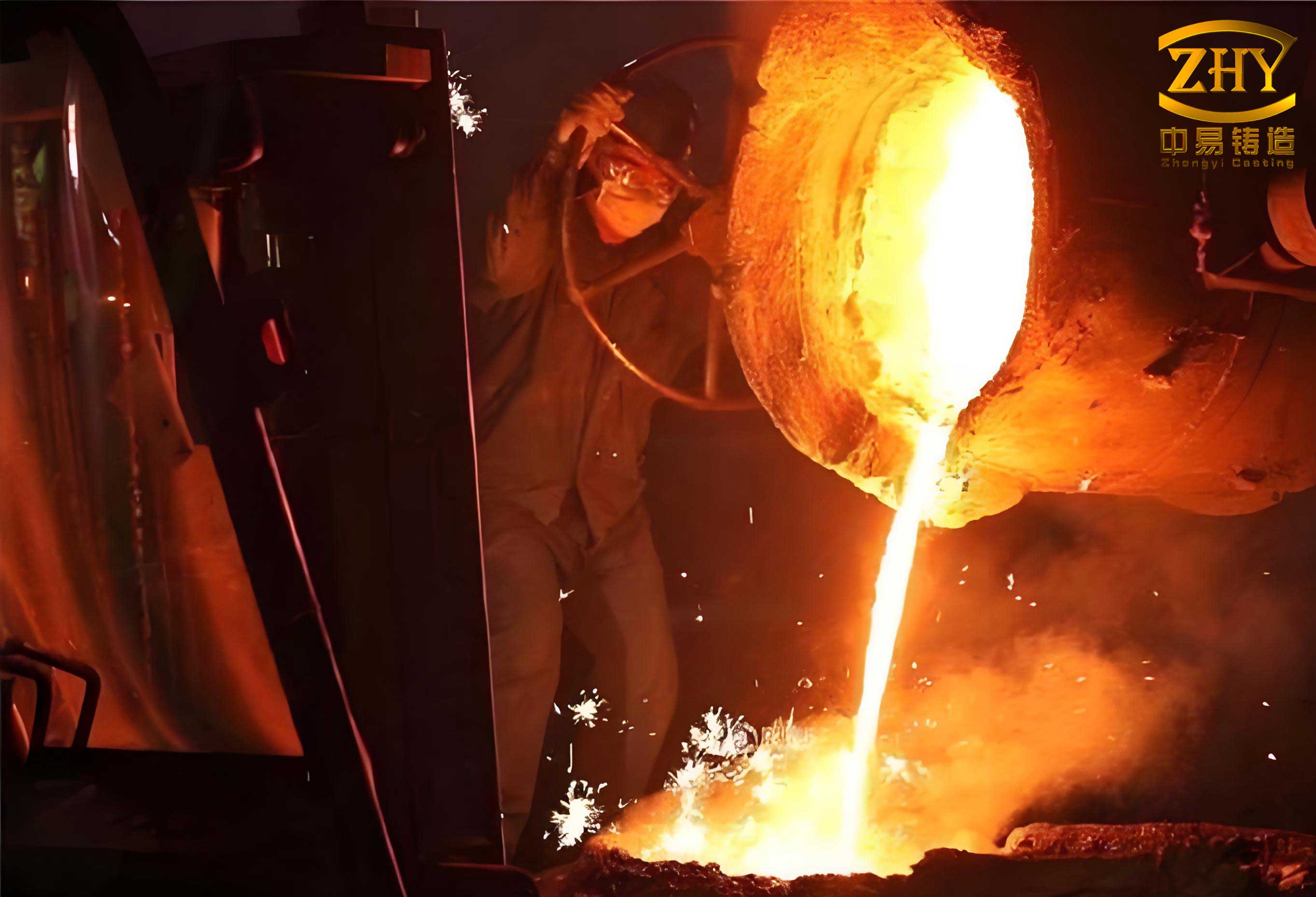
To combat burn-on in problematic areas like the dumbbell sockets and thick sections, a facing sand technique is employed. A 30-40 mm layer of chromite sand, with its higher thermal conductivity and refractoriness, is placed in these areas before backing up with the standard silicate sand. This creates a localized chilling effect, promoting faster solidification and preventing metal penetration. Furthermore, all mold and core surfaces are coated with three layers of alcohol-based zirconium silicate refractory paint to form a robust barrier against metal-mold interaction.
Feeding system design is the cornerstone of sound sand castings. Thermal analysis identified the four dumbbell connection points on the side rails as the primary hot spots requiring feed metal. The casting was oriented with its large, flat bottom face upward to serve as the feeding plane, facilitating effective feeding of both the center and bottom plates. Open-top cylindrical feeders (risers) were placed directly over these hot spots. Riser sizing was performed using the modulus method, ensuring the riser solidifies after the casting section it feeds. The modulus (M) is the ratio of volume (V) to cooling surface area (A):
$$ M = \frac{V}{A} $$
The design criterion is $M_{riser} \ge 1.2 \times M_{casting}$. For the calculated modulus of the hot spot, this yielded a required riser diameter. Factoring in flask size and浇注 considerations, risers of Ø240 mm × 400 mm height were specified.
| Parameter | Specification | Purpose/Rationale |
|---|---|---|
| Base Sand | Silica Sand | Standard foundry sand, cost-effective. |
| Sand Temperature | 10 – 35 °C | Controls ester hydrolysis rate and strip time. |
| Binder (Modified Na-silicate) | 2.0 – 3.0 wt.% | Provides bonding strength. |
| Hardener (Organic Ester) | 13 – 15% of binder | Controls setting and hardening speed. |
| 24-hr Tensile Strength (Mold) | 0.2 – 0.5 MPa | Ensures mold integrity during handling and pouring. |
| 24-hr Tensile Strength (Core) | 0.4 – 0.6 MPa | Higher strength to withstand metallostatic pressure. |
| Facing Sand for Hot Spots | Chromite Sand, 30-40 mm | Prevents burn-on and promotes chilling. |
| Refractory Coating | Alcohol-based Zirconite, 3 layers | Creates high-temperature barrier against metal penetration. |
Computer simulation of solidification was instrumental in validating the feeding design. Using casting simulation software (e.g., InteCast), the progressive solidification was analyzed. The simulation confirmed that the four risers provided adequate feed metal to the main hot spots, with soundness predicted in most areas. However, it indicated a slight shrinkage tendency in the deepest part of the concave-end dumbbell socket, a area difficult to feed directly. This insight prompted a process adjustment: intensifying the chilling effect in that specific socket by increasing the amount of chromite facing sand placed there during molding.
The gating system is designed for a quiet, controlled fill to minimize mold erosion and turbulence. Refractory ceramic tubes were used to form the runners, providing a smooth, erosion-resistant flow path. The system consists of a vertical downgate (Ø80 mm) branching into two horizontal runners (Ø60 mm) that introduce metal into the mold cavity from the bottom of the convex end. To address the issue of sand expansion and potential veining or buckling on the large horizontal surfaces (center and bottom plates) due to radiant heat, an inclined pouring technique was adopted. The entire mold assembly is tilted by approximately 8°, raising the concave end. This creates a progressively advancing solidification front from the low (convex) end to the high (concave) end, reducing the thermal shock on any single area of the mold wall. Pouring temperature is tightly controlled between 1560-1590°C to ensure fluidity for complete filling while avoiding excessive superheat that exacerbates shrinkage and grain growth.
The solidification time ($t_f$) for a sand casting can be estimated using Chvorinov’s rule:
$$ t_f = B \left( \frac{V}{A} \right)^n = B \cdot M^n $$
where $B$ is the mold constant (dependent on mold material, metal properties, and superheat) and $n$ is an exponent typically close to 2. For our heavy-section sand castings, the modulus $M$ is relatively high, leading to long solidification times necessitating robust risers. The Niyama criterion ($G/\sqrt{R}$), where $G$ is the temperature gradient and $R$ is the cooling rate, is a useful metric derived from simulation to predict shrinkage porosity; areas with values below a critical threshold (e.g., ~1 °C1/2·min1/2/mm) are flagged as at-risk.
Heat treatment is essential to achieve the target balance of strength, hardness, and toughness in these alloy steel sand castings. A three-stage process is employed in a car-bottom furnace:
- Normalizing: Heating to 920°C, holding for 240 minutes to achieve complete austenitization and chemical homogenization, followed by air cooling. This refines the as-cast microstructure and reduces segregation.
- Quenching: Re-austenitizing at 920°C for 240 minutes, then rapid cooling in a water tank maintained at 15-30°C. This transforms the microstructure to martensite, providing high strength and hardness.
- Tempering: Heating to 560-600°C, holding for 360 minutes, then air cooling. This relieves quenching stresses, improves toughness and ductility, and precipitates fine carbides for secondary hardening.
The final microstructure is tempered martensite with a hardness profile that can be approximated by the Hollomon-Jaffe tempering parameter for low-alloy steels:
$$ P = T (C + \log t) $$
where $T$ is absolute temperature, $t$ is time, and $C$ is a constant (~20 for many steels). This parameter helps correlate different time-temperature combinations to achieve desired hardness levels.
Initial trial castings revealed three main issues: distortion of the large plates, cracking at specific transitions, and localized wear resistance below the target for the chain-run path on the center plate. A systematic problem-solving approach was implemented, leading to the following corrective actions:
| Defect Observed | Root Cause Analysis | Corrective Action | Mechanism/Outcome |
|---|---|---|---|
| Distortion (Bowing) of Center/Bottom Plates | Differential cooling stresses and lack of rigidity during early solidification. | Addition of three internal bridging ribs (16×50 mm) between center and bottom plates at mid-span. | Ribs act as structural ties, resisting relative warpage and maintaining plate flatness. |
| Cracking at Bottom Plate-to-Side Rail Junction | High thermal stress concentration due to restrained contraction in a T-section. | Addition of triangular gussets (10 mm thick) on each side at three locations along the junction. | Gussets increase the section modulus at the critical junction, reducing stress and providing a more favorable feeding geometry. |
| Potential Shrinkage in Dumbbell Socket | Isolated hot spot difficult to feed effectively. | Increased volume of chromite chilling sand placed specifically in the socket cavity during coremaking. | Enhances directional solidification towards the riser, eliminating the isolated liquid pool. |
| Insufficient Wear Resistance on Center Plate Runway | Base material properties optimized for compromise, not peak wear performance. | Post-casting deposition of a hardfacing weld overlay (e.g., using high-carbon, high-chromium filler metal) onto the chain-run path. | Provides a localized, extremely wear-resistant surface (HRC 55+) while the bulk casting retains its toughness and strength. This hybrid approach offers optimal performance. |
The implementation of these optimized process parameters and corrective measures resulted in the successful production of monolithic center channel sand castings. The castings met all dimensional tolerances, non-destructive testing requirements, and mechanical property specifications. The yield strength, impact toughness, and bulk hardness achieved the designed balance. The localized hardfacing provided the necessary extreme wear resistance for the high-abrasion zones.
In conclusion, the holistic production of scraper conveyor center channels via ester-hardened sodium silicate sand casting presents a technically viable and economically advantageous alternative to traditional cast-weld assembly. The key to success lies in an integrated approach: (1) redesigning the component for castability, (2) engineering a lean alloy steel chemistry with micro-additions for performance, (3) meticulous design of the feeding and gating system validated by simulation, (4) employing advanced green sand molding techniques with strategic chilling, and (5) implementing a tailored heat treatment cycle. This methodology not only circumvents the inherent weaknesses of welded joints but also streamlines production, reduces part count, and leverages the design freedom and integrity of monolithic sand castings. It represents a significant technological upgrade for heavy-duty mining components, offering improved reliability, longevity, and total cost-effectiveness.