
The phenomenon of hot tearing, a critical defect occurring during the final stages of solidification, presents a significant challenge in the production of steel castings. This defect not only compromises the integrity and mechanical performance of the cast component but can also lead to outright rejection, resulting in substantial economic loss and production inefficiencies. As such, a comprehensive understanding of its formation mechanisms, root causes, and effective countermeasures is paramount for advancing foundry practices. From my perspective, the key to mitigating this issue lies in a holistic approach that integrates insights from solidification theory, material science, and process engineering.
The formation of hot tears in steel castings is fundamentally a result of tensile stresses exceeding the cohesive strength of the partially solidified material within a specific temperature range. Two primary morphological types are commonly observed: shrinkage tears and pull tears. Shrinkage tears typically manifest at thermal junctions, such as fillet radii or regions with abrupt section changes. These areas, being the last to solidify, are prone to micro-shrinkage porosity and isolated liquid pools. As the surrounding matrix solidifies and contracts, it pulls on these weak, mushy zones. If insufficient liquid metal is available to feed the contraction, a tear initiates from these porous sites. Conversely, pull tears often appear in regions with significant variation in wall thickness. The thinner sections solidify and gain strength rapidly, while thicker sections remain in a weaker, partially solid state for a longer duration. The differential contraction between these regions, often exacerbated by constraints from the mold or core, generates high tensile strains. When these strains are concentrated in the coherent but weak dendritic network of the mushy zone, they can pull the grains apart, forming a crack.
The critical zone for hot tear initiation is the coherent mushy zone, where the solid fraction ($f_S$) is high but a continuous liquid film still exists at grain boundaries. The susceptibility can be conceptualized by the balance between strain accumulation and strain accommodation. The strain rate imposed on the mushy zone ($\dot{\epsilon}$) must be compared to its ability to accommodate strain through liquid feeding and solid creep. A simplified condition for hot tearing can be expressed as:
$$\int_{t_{coh}}^{t_{solid}} \dot{\epsilon} \, dt > \epsilon_{crit}(f_L)$$
where $t_{coh}$ is the time of coherence formation, $t_{solid}$ is the time of complete solidification, $\dot{\epsilon}$ is the local strain rate, and $\epsilon_{crit}$ is the critical strain to fracture, which is a strong function of the remaining liquid fraction ($f_L$). As $f_L$ decreases below a critical value (typically 0.1 to 0.01), the tensile strength of the mush increases rapidly, but its ductility remains extremely low, creating a “vulnerable period.”
The primary causes of hot tearing are multifaceted, intertwining metallurgical, design, and processing factors.
| Category | Factor | Effect on Hot Tearing Susceptibility |
|---|---|---|
| Metallurgical | Wide Freezing Range | Increases the duration of the vulnerable mushy zone, allowing more time for strain accumulation. |
| Low-Hot Strength/Ductility | Reduces the critical strain ($\epsilon_{crit}$) the mush can withstand before fracture. | |
| Harmful Elements/Inclusions | Form low-melting point phases (e.g., FeS, FeO·SiO₂) at grain boundaries, severely weakening the cohesion. | |
| Design | Abrupt Section Changes | Creates thermal hotspots and stress concentrators. |
| Restrained Geometry | Hinders free contraction, leading to higher internal stresses. | |
| Process | Poor Mold/Core Yield | Mechanically resists contraction, increasing strain rate ($\dot{\epsilon}$). |
| Inadequate Feeding | Fails to compensate for solidification shrinkage, promoting pore/tear initiation. | |
| High Pouring Temperature | Increases total contraction and thermal gradients, though effect is complex. |
A particularly critical initiating factor is the presence of double oxide films or “bifilms.” During turbulent filling of the mold, the surface oxide on the molten steel can be folded and entrained into the bulk liquid. These bifilms, often containing entrapped gas, act as perfect pre-existing cracks within the liquid. Upon solidification, they become integrated into the grain boundary structure, drastically reducing the effective fracture strength of the material. The presence of such defects means that the actual stress required to initiate a hot tear can be far lower than predicted for ideal, clean material.
Modern process control and simulation technology are indispensable for diagnosing and preventing these issues. Advanced casting simulation software can predict temperature fields, solidification sequences, and stress development, allowing engineers to identify potential hot spots and modify the process virtually before any metal is poured.
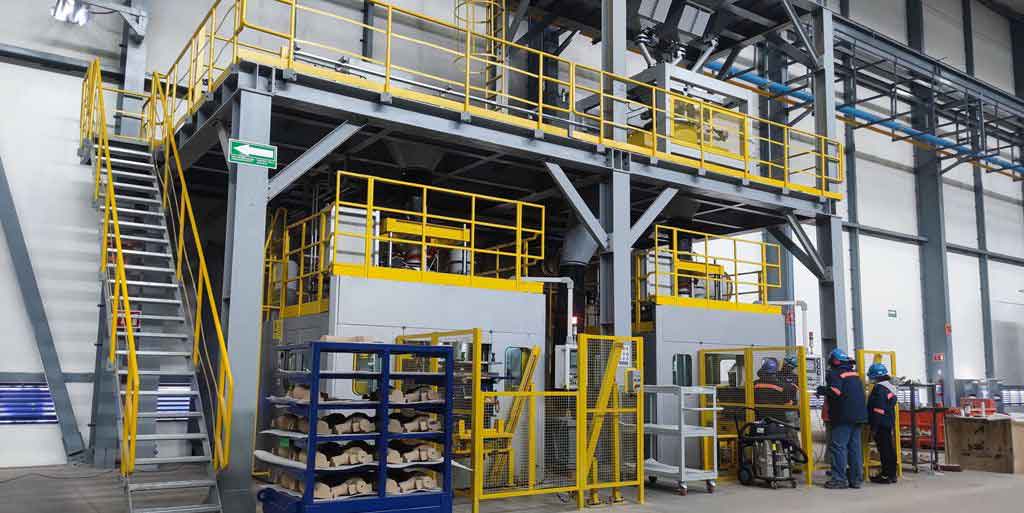
The choice of mold material profoundly influences the thermal and mechanical environment experienced by the solidifying steel casting. Self-setting sands, such as resin-bonded and sodium silicate-bonded sands, exhibit distinct properties.
| Property | Furan Resin Sand | Sodium Silicate Sand | Implication for Hot Tearing |
|---|---|---|---|
| Thermal Conductivity | Lower | Higher | Resin sand leads to slower cooling, potentially widening the mushy zone. Silicate sand extracts heat faster, promoting directional solidification. |
| Collapsibility/Yield | Poorer | Better | Poor collapsibility of resin sand imposes greater mechanical restraint, increasing stress. Better yield of silicate sand allows more contraction. |
| Interfacial Reaction | Potential for sulfur pickup | Generally inert | Decomposition of furan resins can release SO₂, leading to surface sulfur enrichment and formation of brittle Fe-FeS eutectic, weakening grain boundaries. |
The cooling curves for a steel casting in these two mold types differ significantly, as described by the heat transfer equation at the interface. The temperature gradient at the casting-mold interface is key:
$$q = h (T_{cast} – T_{mold}) = k_{mold} \frac{\partial T}{\partial x}\Big|_{mold}$$
where $q$ is the heat flux, $h$ is the interfacial heat transfer coefficient, $T_{cast}$ and $T_{mold}$ are the temperatures at the interface, and $k_{mold}$ is the thermal conductivity of the mold. A lower $k_{mold}$ for resin sand results in a smaller initial $\frac{\partial T}{\partial x}$, slowing heat extraction and affecting the solidification profile.
Based on the underlying mechanisms, a systematic, multi-pronged strategy is required to prevent hot tearing in steel castings.
1. Alloy Design and Melt Quality: The composition of the steel casting should be optimized to minimize the freezing range and avoid elements that form low-melting compounds. For example, controlling the ratio of Mn to S is critical to ensure manganese sulfide forms instead of iron sulfide. More fundamentally, rigorous melt treatment through ladle refining, effective deoxidation (e.g., using Al to form Al₂O₃ which can float out), and filtration is essential to reduce bifilm populations. Cleaner metal has inherently higher tear resistance.
2. Casting and Gating System Design: The design should promote directional and progressive solidification towards feeders (risers). This involves proper placement of chills to control the solidification sequence, ensuring thermal gradients guide liquid feeding to the hot spots. The use of padding on thin sections connected to thick sections can reduce the severity of the section change. Non-structural “cooling fins” or “anti-cracking ribs” can be added to act as sacrificial thermal centers, altering the stress distribution. The gating system must be designed for quiet, non-turbulent filling to minimize oxide film entrainment.
3. Mold and Core Optimization: Selecting a mold material with appropriate properties for the specific steel casting geometry is crucial. For highly restrained castings, a mold material with excellent collapsibility (like certain silicate sands) or even ceramic foam molds can be beneficial. The binder content in resin sands should be minimized to improve collapsibility and reduce gas generation. Cores can be hollowed out or made from crushable materials to reduce mechanical resistance during contraction.
4. Process Parameter Control: While a very high pouring temperature extends the feeding range, it also increases total contraction and may widen the mushy zone. An optimal temperature must be found. The mold pre-heat temperature can also be adjusted to control the initial cooling rate. Post-casting practices, such as controlled cooling in the mold or early knockout before complete cooling, can help relieve stresses.
A quantitative approach to hot tearing susceptibility (HTS) can be developed by integrating thermal and mechanical models. One model relates HTS to the integral of the inverse of the dendrite coherency strength over the vulnerable temperature range:
$$HTS \propto \int_{T_{solidus}}^{T_{coh}} \frac{1}{\sigma_{coh}(T)} \, dT$$
where $\sigma_{coh}(T)$ is the coherent strength of the dendritic network as a function of temperature. Process optimization aims to minimize this integral for critical sections of the steel casting by altering the temperature-time path via chills, padding, or mold materials.
In conclusion, the battle against hot tearing in steel castings is fought on multiple fronts. It requires a deep dive into the metallurgical principles governing solidification, a critical eye on casting design to manage thermal and stress fields, and meticulous control over the entire foundry process—from melt treatment and mold making to pouring and cooling. The integration of computational simulation tools provides a powerful means to predict and preemptively correct issues. While challenges remain, particularly for complex and highly constrained geometries, the continuous refinement of these strategies based on a mechanistic understanding is steadily improving the quality and reliability of industrial steel castings. The pursuit of defect-free production remains a core driver for innovation in casting science and technology.