
In the manufacturing industry, machine tool casting parts, such as beds, columns, saddles, and worktables, serve as the foundational components of machine tools, accounting for over 80% of the machine’s total weight. Their stability, wear resistance, damping capacity, and rigidity directly influence the overall performance of the machine tool. Among these casting parts, gray iron castings are predominantly used, with ductile iron castings applied in only a few specific models. High-end machine tool casting parts demand high compressive and tensile strength, high elastic modulus (indicating high stiffness), low stress, minimal deformation, excellent wear resistance and damping, along with high dimensional accuracy and surface finish. However, achieving high strength, high stiffness, and low stress simultaneously is challenging, as high strength typically requires a low carbon equivalent (CE), while low stress favors a high CE. Thus, the key production challenge lies in obtaining high strength and high stiffness under a high carbon equivalent, which necessitates precise process control and optimization.
From my experience in foundry operations, I have encountered numerous issues with HT300 grade casting parts, including cracks, shrinkage porosity, and uneven hardness, which adversely affect machining performance and product reliability. This article details the original production process, identifies the problems, and presents an optimized approach through microalloying and adjusted melting parameters. The goal is to share insights on improving the quality and consistency of HT300 machine tool casting parts.
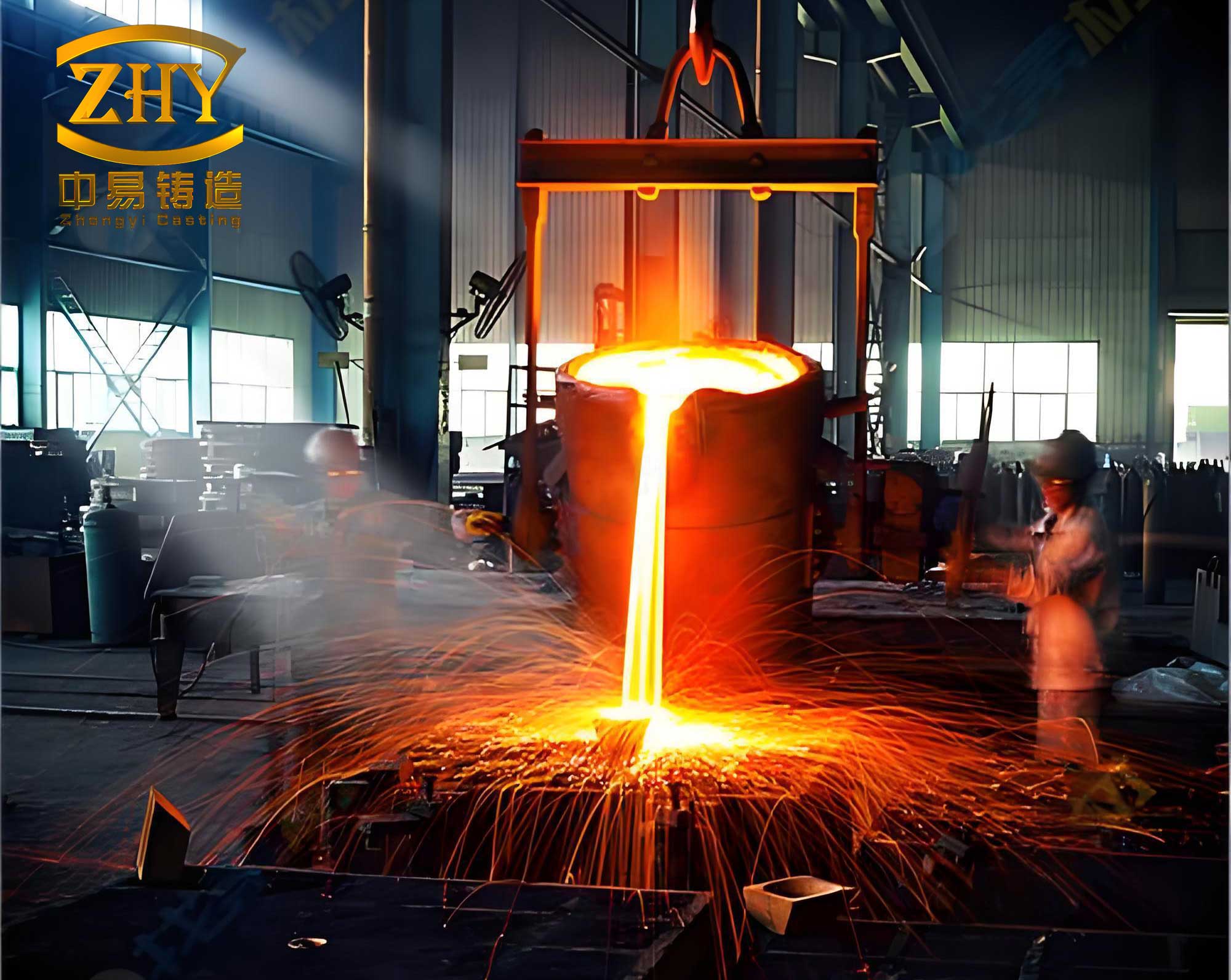
The original casting process for HT300 casting parts involved strict control of chemical composition to meet strength requirements. The carbon equivalent was maintained between 3.60% and 3.70%, with carbon content at 3.0–3.1%, silicon at 1.6–1.7%, and manganese at 0.8–1.0%. Minor additions of tin (Sn) and antimony (Sb) were used for alloying to enhance and refine pearlite. The melting process utilized a 2-ton medium-frequency induction furnace, employing a synthetic cast iron approach to reduce the hereditary effects of pig iron. The charge consisted of 60–70% high-quality carbon steel scrap, 20–30% returns of the same material, and 10% Q10 pig iron. Silicon carbide (90% purity, 2–9 mm grain size) was added at 1.0–1.5% for silicon and carbon enrichment, while medium-temperature graphitizing carburizer (sulfur ≤ 0.25%, nitrogen ≤ 1000 ppm) was added at 1.5–2.0%. After reaching 1450°C, the melt was sampled for composition adjustment, then heated to 1480–1500°C and held for 3–5 minutes before tapping. Inoculation was performed twice: first during tapping with 0.4% Si-Ca-Ba长效 inoculant (3–8 mm), and second during pouring with 0.05–0.1% fine inoculant (0.2–0.7 mm). This process aimed to ensure high graphite nucleation and minimal chilling tendency.
| CE | C | Si | Mn | P | S | Sb | Sn |
|---|---|---|---|---|---|---|---|
| 3.6–3.7 | 3.0–3.1 | 1.6–1.7 | 0.8–1.0 | <0.05 | 0.06–0.1 | 0.02–0.03 | 0.02–0.03 |
The performance of casting parts under this process was evaluated through statistical analysis of 100 sets of data from bed castings. The average CE was 3.635%, carbon 3.077%, and silicon 1.652%. Tensile strength of separately cast test bars exceeded 300 MPa, averaging 364 MPa, with a maximum of 400 MPa. Metallographic examination revealed over 90% Type A graphite, pearlite content above 98%, and graphite length of grade 3–4. However, several critical issues emerged in actual casting parts, compromising their quality and usability.
One major problem was cracking in the internal ribs of bed casting parts, particularly near the guideways. The crack defect rate reached about 10%, attributed to uneven solidification due to varying section thicknesses. Thin ribs solidified rapidly, while thicker guideway sections solidified slowly, generating high internal stresses. The linear shrinkage rate measured 1.4%, significantly higher than the typical 1.0–1.2%, exacerbating stress concentration. Another issue was shrinkage porosity in the T-slots of worktable casting parts, leading to rejection during machining. Scanning electron microscopy (SEM) and energy-dispersive X-ray spectroscopy (EDS) analysis confirmed the defects as shrinkage porosity, with no evidence of gas entrapment or slag inclusions. Additionally, uneven hardness in bed casting parts caused machining difficulties, such as edge chipping and drill breakage during tapping, indicating localized chill zones due to low CE and insufficient alloying.
To address these problems, we optimized the process by increasing the carbon equivalent and employing microalloying. The new target CE range was set at 3.75–3.85%, with carbon at 3.15–3.25%, silicon at 1.65–1.75%, and manganese at 0.8–0.9%. Alloying elements copper (Cu) and tin (Sn) were added to enhance pearlite formation and refine the matrix. Copper reduces section sensitivity, improves graphite morphology, and promotes pearlite refinement, while tin synergistically strengthens the matrix. The combined addition of Cu and Sn was limited to below 0.8% to avoid brittleness. The melting temperature was raised to 1500–1520°C, with a 5-minute holding time to improve melt purity and reduce hereditary effects. Inoculation practices remained unchanged to maintain graphite nucleation efficiency.
| CE | C | Si | Mn | P | S | Cu | Sn |
|---|---|---|---|---|---|---|---|
| 3.75–3.85 | 3.15–3.25 | 1.65–1.75 | 0.8–0.9 | <0.05 | 0.06–0.1 | 0.4–0.5 | 0.02–0.03 |
The carbon equivalent is calculated using the standard formula for gray cast iron, which incorporates silicon and phosphorus influences: $$CE = C + \frac{1}{3}(Si + P)$$ where C, Si, and P are the mass fractions of carbon, silicon, and phosphorus, respectively. For our optimized composition, with average C = 3.189% and Si = 1.711%, and assuming P < 0.05%, the CE approximates to: $$CE \approx 3.189 + \frac{1}{3}(1.711 + 0.05) = 3.189 + 0.587 = 3.776\%$$ This aligns well with our target range, ensuring a balance between strength and stress reduction.
Production verification involved analyzing 100 sets of data from bed casting parts. The average CE was 3.768%, carbon 3.189%, and silicon 1.711%. Tensile strength of test bars averaged 341 MPa, within the optimal range of 300–350 MPa, which minimizes residual stress. Elastic modulus, measured from 70 sets, averaged 126.64 GPa, with values ranging from 110 to 150 GPa, indicating improved stiffness. The relationship between elastic modulus (E), stress (σ), and strain (ε) is given by: $$E = \frac{\sigma}{\epsilon}$$ Higher E values confirm enhanced rigidity of the casting parts. Metallography showed nearly 100% Type A graphite, pearlite content over 99%, and graphite length of grade 4, demonstrating refined microstructure. Hardness tests on 20 consecutive bed casting parts revealed an average Brinell hardness of 188.85 HBW, with uniformity across sections, meeting customer specifications.
| Parameter | Original Process | Optimized Process |
|---|---|---|
| Average CE (%) | 3.635 | 3.768 |
| Average Tensile Strength (MPa) | 364 | 341 |
| Average Elastic Modulus (GPa) | Not specified | 126.64 |
| Average Hardness (HBW) | Uneven | 188.85 |
| Linear Shrinkage Rate (%) | 1.4 | 1.2–1.3 |
| Crack Defect Rate (%) | ~10 | 0 |
| Shrinkage Porosity in T-slots | Present | Absent |
The improvement in casting parts quality can be attributed to the higher carbon equivalent, which reduces solidification shrinkage and stress, as described by the shrinkage coefficient (α) related to CE: $$\alpha \propto \frac{1}{CE}$$ where a higher CE decreases α, minimizing cracking tendency. Microalloying with Cu and Sn enhances pearlite formation through solid solution strengthening and grain refinement. The combined effect on yield strength (σ_y) can be expressed using the Hall-Petch relationship and alloying contribution: $$\sigma_y = \sigma_0 + k_y d^{-1/2} + \sum_i k_i C_i$$ where σ_0 is the lattice friction stress, k_y is the strengthening coefficient, d is the grain diameter, k_i is the strengthening factor for alloy element i, and C_i is its concentration. For Cu and Sn, k_i values are positive, increasing strength without compromising ductility.
Furthermore, the increased melting temperature improves melt fluidity and reduces inclusions, critical for complex casting parts like machine tool beds. The high-temperature holding allows for better dissolution of carbides and homogenization, as per the Arrhenius equation for diffusion: $$D = D_0 \exp\left(-\frac{Q}{RT}\right)$$ where D is the diffusion coefficient, D_0 is a pre-exponential factor, Q is the activation energy, R is the gas constant, and T is the temperature in Kelvin. Higher T significantly enhances diffusion, promoting uniform distribution of alloying elements and reducing segregation in casting parts.
In terms of performance, the optimized casting parts exhibited no cracks, with linear shrinkage reduced to 1.2–1.3%. Shrinkage porosity in T-slots was eliminated, and machining feedback indicated better tool life and surface finish. The hardness uniformity across casting parts sections ensured consistent machinability, reducing downtime and scrap rates. These outcomes underscore the importance of balancing CE and alloying for high-quality machine tool casting parts.
Looking ahead, further refinements are possible. For instance, the silicon-to-carbon ratio (Si/C) could be optimized to enhance graphitization. In our optimized process, the average Si/C is approximately: $$\frac{Si}{C} \approx \frac{1.711}{3.189} = 0.537$$ which is relatively low; increasing this ratio slightly might improve damping capacity without sacrificing strength. Additionally, residual stress measurements using techniques like hole-drilling or X-ray diffraction could provide quantitative data to correlate with process parameters. The target CE range of 3.75–3.85% may be extended to 3.8–3.9% with adjusted alloying to explore higher stiffness for specialized casting parts.
In conclusion, the production process for HT300 machine tool casting parts was successfully improved by increasing the carbon equivalent and incorporating microalloying with copper and tin. This approach enhanced matrix structure, refined grains, and improved strength, hardness uniformity, and dimensional stability. The optimized casting parts met all technical requirements, with defects eliminated and machining performance enhanced. This experience highlights the value of synthetic cast iron melting and controlled alloying in manufacturing high-performance casting parts. Future work will focus on precise composition control and advanced characterization to further push the boundaries of casting parts quality in the machine tool industry.