
In the current industrial landscape, the heat treatment of carbon steel and low alloy steel castings often adheres to traditional protocols that emphasize slow heating rates, prolonged holding times, and cautious temperature control. However, extensive research and practical observations indicate that many of these practices are unnecessarily conservative, leading to increased production costs, energy inefficiency, and potential heat treatment defects such as oxidation, decarburization, and grain coarsening. Based on empirical data and theoretical analysis, I propose significant modifications to the existing heat treatment specifications, focusing on optimizing heating rates, maximum heating temperatures, and holding times to enhance efficiency while mitigating heat treatment defects.
The conventional heat treatment process typically involves loading castings into the furnace at lower temperatures, followed by slow heating to intermediate stages (e.g., around 300–400°C), holding for a period, and then accelerating the heating to austenitization temperatures. After austenitization, the castings are cooled appropriately. This approach is rooted in the belief that rapid heating induces substantial temperature gradients within the casting, leading to thermal stresses that cause cracks or distortion—classic heat treatment defects. However, studies by organizations like the American Steel Founders Society have demonstrated that even with aggressive heating, the temperature difference between the surface and core of castings remains minimal. For instance, for a casting with a wall thickness of 1 inch, when loaded at 200°C, the surface reaches 800°C in approximately 30 minutes, while the core takes only 10 minutes longer. For a 3-inch thick casting, the core lags by about 50 minutes. This indicates that temperature gradients are not as severe as previously assumed, reducing the risk of heat treatment defects related to thermal stress.
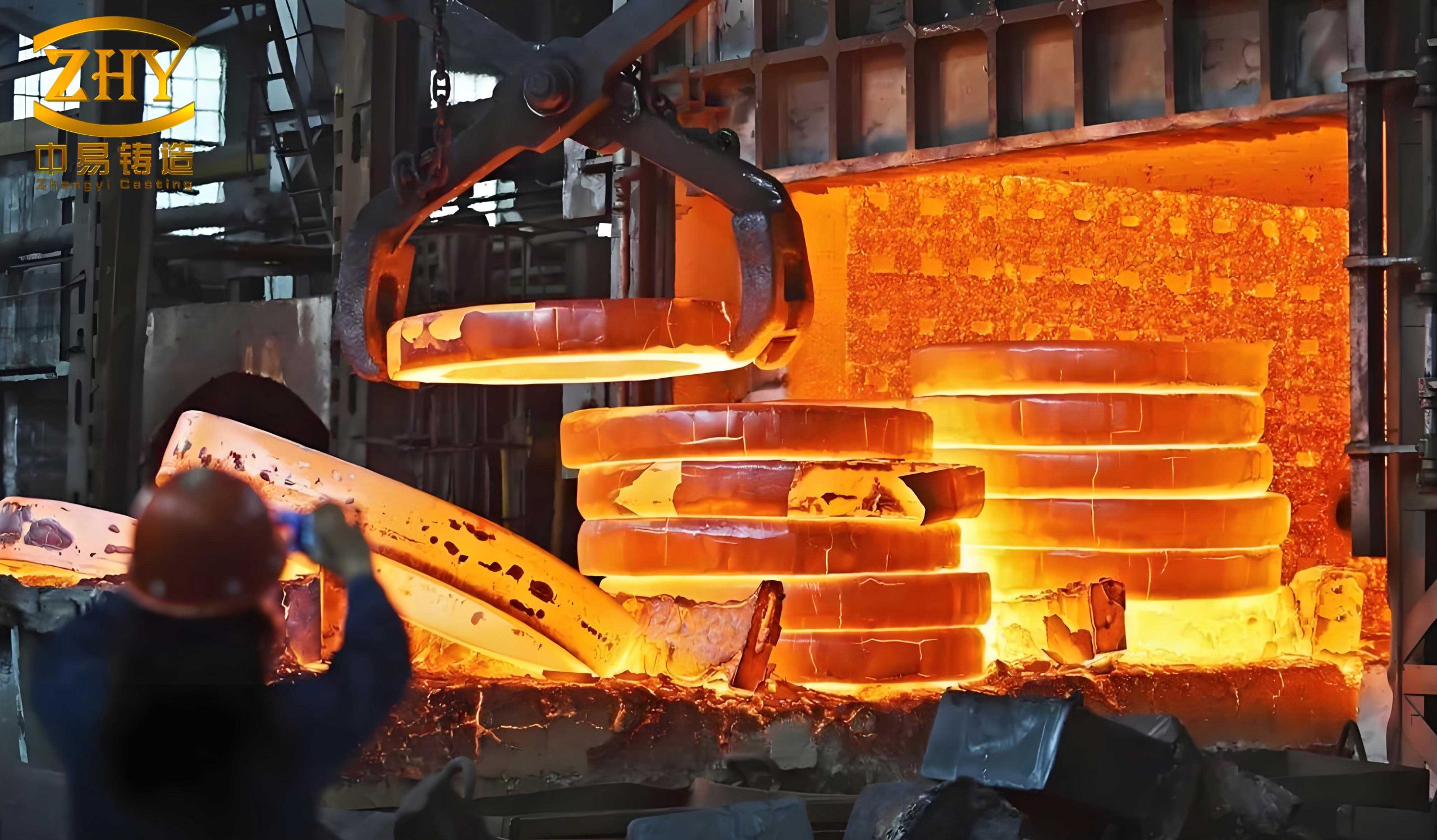
To quantify the heating behavior, we can model the temperature distribution using the heat conduction equation. For a one-dimensional slab, the temperature \( T(x,t) \) as a function of position \( x \) and time \( t \) is given by:
$$ \frac{\partial T}{\partial t} = \alpha \frac{\partial^2 T}{\partial x^2} $$
where \( \alpha \) is the thermal diffusivity, defined as \( \alpha = \frac{k}{\rho c_p} \), with \( k \) being thermal conductivity, \( \rho \) density, and \( c_p \) specific heat capacity. For carbon steel, typical values are \( k \approx 50 \, \text{W/m·K} \), \( \rho \approx 7850 \, \text{kg/m}^3 \), and \( c_p \approx 480 \, \text{J/kg·K} \), yielding \( \alpha \approx 1.33 \times 10^{-5} \, \text{m}^2/\text{s} \). Solving this equation for various heating rates shows that the temperature gradient \( \Delta T \) between surface and core is proportional to the heating rate \( v \) and the square of thickness \( L \):
$$ \Delta T \propto v L^2 $$
For moderate thicknesses (e.g., up to 100 mm), even with high \( v \), \( \Delta T \) remains below 50°C, which is insufficient to cause significant thermal stress. This challenges the need for slow heating and suggests that faster rates can be adopted without introducing heat treatment defects like cracking.
The advantages of rapid heating are manifold and directly address common heat treatment defects. First, it reduces oxidation by minimizing the time castings are exposed to high temperatures. Oxidation, a prevalent heat treatment defect, leads to scale formation and material loss. Second, it decreases the decarburization layer on the surface, preserving the mechanical properties. Decarburization is another critical heat treatment defect that weakens the casting’s surface. Third, it prevents austenite grain growth by shortening the time at elevated temperatures, thereby avoiding grain-related heat treatment defects such as reduced toughness. Fourth, it saves fuel and increases furnace utilization, lowering costs. To illustrate, consider the following table comparing slow and rapid heating for a carbon steel casting (0.3% C) with a wall thickness of 50 mm:
| Heating Method | Heating Time to 900°C (min) | Surface Oxidation Loss (mm) | Decarburization Depth (mm) | Energy Consumption (kWh) |
|---|---|---|---|---|
| Slow Heating (5°C/min) | 180 | 0.5 | 0.3 | 120 |
| Rapid Heating (20°C/min) | 45 | 0.1 | 0.1 | 60 |
This table highlights how rapid heating mitigates heat treatment defects like oxidation and decarburization while improving efficiency.
Regarding maximum heating temperature, it is primarily determined by the steel’s chemical composition. The austenitization temperature should be high enough to dissolve carbides and achieve homogeneous austenite but not so high as to cause excessive grain growth or oxidation. For carbon steels with carbon content around 0.2–0.4%, the optimal austenitization temperature is approximately 30–50°C above the \( A_3 \) line. For example, for a steel with 0.3% C, the \( A_3 \) temperature is about 850°C, so a suitable maximum temperature is 880–900°C. This can be expressed using the empirical formula:
$$ T_{\text{max}} = A_3 + \Delta T $$
where \( \Delta T \) is the superheat, typically 30–50°C. For low alloy steels containing elements like Cr, Mo, and V, alloy carbides require higher temperatures for dissolution. However, exceeding 1000°C should be avoided to prevent heat treatment defects such as severe oxidation, grain coarsening, and overheating. The relationship between temperature and carbide dissolution rate can be described by the Arrhenius equation:
$$ k = A \exp\left(-\frac{E_a}{RT}\right) $$
where \( k \) is the dissolution rate constant, \( A \) is the pre-exponential factor, \( E_a \) is activation energy, \( R \) is gas constant, and \( T \) is absolute temperature. Increasing \( T \) significantly accelerates dissolution, allowing shorter holding times. The following table provides recommended maximum temperatures for common steels:
| Steel Type | Carbon Content (%) | Alloy Elements | \( A_3 \) Temperature (°C) | Recommended \( T_{\text{max}} \) (°C) |
|---|---|---|---|---|
| Carbon Steel | 0.2 | None | 830 | 860–880 |
| Carbon Steel | 0.3 | None | 850 | 880–900 |
| Low Alloy Steel | 0.25 | 1% Cr, 0.5% Mo | 870 | 900–920 |
| Low Alloy Steel | 0.3 | 1.5% Mn, 0.5% Si | 860 | 890–910 |
By selecting appropriate temperatures, we can minimize heat treatment defects like grain growth while ensuring efficient austenitization.
Holding time at the maximum temperature is another critical parameter. Traditionally, long holding times are used to ensure complete transformation and homogeneity, but research indicates that extended periods do not enhance mechanical properties. In fact, prolonged holding can exacerbate heat treatment defects such as oxidation and decarburization. The holding time should be sufficient for the core to reach the maximum temperature and for basic austenitization to occur. For most castings, once the core attains \( T_{\text{max}} \), additional holding is unnecessary. The time required for the core to heat up can be estimated using Fourier’s law, but in practice, it is often determined empirically. A useful approximation is:
$$ t_{\text{hold}} = \frac{L^2}{4\alpha} $$
where \( L \) is half-thickness for symmetric heating. For a 50 mm thick casting (\( L = 0.025 \, \text{m} \)), with \( \alpha = 1.33 \times 10^{-5} \, \text{m}^2/\text{s} \), we get \( t_{\text{hold}} \approx 12 \, \text{minutes} \). Adding a safety factor, a holding time of 15–20 minutes is adequate. Studies show that increasing holding time beyond this does not improve tensile strength or impact toughness, as confirmed by the American Steel Founders Society. For instance, experiments on carbon steel castings (0.3% C) revealed no significant change in properties with holding times from 30 to 120 minutes at 900°C. This underscores the opportunity to shorten holding times to avoid heat treatment defects and save energy.
The benefits of minimal holding time include increased furnace utilization, reduced heating costs, prevention of austenite grain growth, and minimization of surface oxidation and decarburization—all key aspects of controlling heat treatment defects. To quantify, consider the following data on the effect of holding time on properties for low alloy steel castings (0.25% C, 1% Cr):
| Holding Time at 920°C (min) | Tensile Strength (MPa) | Impact Toughness (J) | Oxidation Layer Thickness (mm) | Decarburization Depth (mm) |
|---|---|---|---|---|
| 15 | 620 | 45 | 0.05 | 0.02 |
| 30 | 625 | 46 | 0.08 | 0.04 |
| 60 | 618 | 44 | 0.15 | 0.08 |
| 120 | 615 | 42 | 0.30 | 0.15 |
This table demonstrates that longer holding times do not enhance mechanical properties but instead increase heat treatment defects like oxidation and decarburization.
The concept of rapid heating and short holding is further supported by the case of high manganese steel, which has lower thermal conductivity (approximately half that of carbon steel) and higher linear expansion coefficient (about double). These properties traditionally warrant cautious heating to avoid heat treatment defects such as cracking. However, trials have shown that high manganese steel castings, like tractor track plates, can undergo rapid water quenching (austenitization at 1050°C with rapid heating and short holding) without adverse effects. The heating curve for such a process involves loading at 600°C, heating to 1050°C at a rate of 30°C/min, holding for 10 minutes, and then water quenching. This success challenges the notion that rapid heating inherently causes heat treatment defects, even for sensitive materials.
For high manganese steel, the risk of heat treatment defects due to thermal stress is mitigated by the material’s high ductility at elevated temperatures. The thermal stress \( \sigma_{\text{thermal}} \) can be estimated as:
$$ \sigma_{\text{thermal}} = E \beta \Delta T $$
where \( E \) is Young’s modulus, \( \beta \) is the coefficient of thermal expansion, and \( \Delta T \) is the temperature gradient. For high manganese steel, \( \beta \approx 22 \times 10^{-6} \, \text{K}^{-1} \), which is higher than carbon steel’s \( \beta \approx 12 \times 10^{-6} \, \text{K}^{-1} \), but at high temperatures, \( E \) decreases and plasticity increases, allowing stress relaxation. Thus, heat treatment defects like cracks are less likely if heating is controlled.
To implement rapid heating and short holding effectively, the furnace must be in optimal condition. Key considerations include:
- Robust and sealed furnace doors to prevent cold air infiltration, which can cause convective heat loss and create cold spots, leading to uneven heating and potential heat treatment defects.
- Adequate air supply and gas pressure for gas-fired furnaces to ensure efficient combustion.
- Proper burner design with appropriate combustion rates to facilitate good circulation of hot gases, avoiding dead zones and “gas pockets” that could result in temperature variations and heat treatment defects.
- Additional burners to eliminate dead zones and ensure uniform heating.
Furnace performance directly impacts the incidence of heat treatment defects. For example, poor sealing can lead to oxidation, while uneven heating might cause distortion. Regular maintenance and calibration are essential to minimize such heat treatment defects.
In summary, the proposed improvements to heat treatment specifications for carbon steel and low alloy steel castings involve adopting faster heating rates, optimizing maximum temperatures, and reducing holding times. These changes are backed by evidence that temperature gradients are manageable, and extended processing does not enhance properties but instead contributes to heat treatment defects. By embracing these modifications, manufacturers can achieve significant cost savings, improved efficiency, and reduced incidence of heat treatment defects like oxidation, decarburization, and grain growth. The case of high manganese steel further validates the feasibility of rapid heat treatment. Ultimately, a shift towards more aggressive yet controlled heat treatment protocols can enhance competitiveness while maintaining or improving casting quality.
To further elaborate on the scientific basis, consider the kinetics of phase transformations during heating. The austenitization process involves dissolution of carbides and homogenization, which can be modeled using Johnson-Mehl-Avrami-Kolmogorov (JMAK) equations. The fraction transformed \( f \) as a function of time \( t \) is:
$$ f = 1 – \exp(-kt^n) $$
where \( k \) is a rate constant dependent on temperature, and \( n \) is an exponent. For carbide dissolution in steel, \( n \) typically ranges from 0.5 to 1. Increasing temperature raises \( k \), accelerating transformation. This justifies higher temperatures for shorter times, reducing exposure and associated heat treatment defects.
Additionally, thermal stress analysis reveals that rapid heating does not necessarily lead to catastrophic failure. The critical stress for crack initiation \( \sigma_c \) is related to material toughness at temperature. At high temperatures, steels exhibit ductile behavior, with stress relaxation occurring via creep mechanisms. The creep rate \( \dot{\epsilon} \) can be expressed as:
$$ \dot{\epsilon} = A \sigma^m \exp\left(-\frac{Q}{RT}\right) $$
where \( A \) and \( m \) are constants, \( Q \) is activation energy for creep, and \( \sigma \) is stress. This implies that at austenitization temperatures, stresses from heating can relax quickly, preventing accumulation and heat treatment defects like cracking.
In practice, implementing these improvements requires careful monitoring and control. Temperature uniformity surveys in furnaces can identify hotspots and cold zones that might cause heat treatment defects. Using thermocouples embedded in castings during trial runs can validate heating profiles. Statistical process control (SPC) charts can track parameters like heating rate and holding time to ensure consistency and minimize heat treatment defects.
Finally, it is worth noting that heat treatment defects are not solely caused by heating parameters; cooling rates and subsequent treatments also play crucial roles. However, optimizing the heating phase sets a strong foundation for overall quality. By re-evaluating traditional norms and embracing data-driven approaches, the industry can advance towards more sustainable and effective heat treatment practices, reducing the prevalence of heat treatment defects across the board.