
As a professional engaged in sand casting foundry operations for many years, I have encountered the persistent challenge of surface defects, particularly veining and burn-on, which severely degrade the surface quality of steel and iron castings. These defects not only complicate subsequent cleaning and machining processes but also impose harmful and labor-intensive tasks on foundry workers. In this article, I share my comprehensive understanding and practical strategies derived from extensive research and hands-on experience in sand casting foundry environments, focusing on the mechanisms of veining formation and effective mitigation methods.
Mechanisms of Veining in Sand Casting Foundry
In the early days of sand casting foundry practice, it was widely believed that the easy separation of veining layers from the casting surface was due to the formation of a glassy phase. However, recent years have established the so-called “oxidation theory” as the dominant explanation for veining. I have observed that the interaction among iron oxide, sand grains, and the atmosphere during heating leads to the formation of low-melting-point compounds. These compounds melt at temperatures lower than the molten metal, and when the sand contains a higher proportion of low-melting constituents, more of this fusible phase is generated. The deeper the penetration of this molten phase into the mold, the thicker the veining layer becomes, and the stronger its adhesion to the casting surface after solidification.
The adhesion strength between the veining layer and the casting surface after cooling is largely determined by the extent of surface roughness and the thickness of the iron oxide layer. Veining occurs only through the mediation of iron oxide. However, when the iron oxide layer reaches a sufficient thickness (approximately 100 μm), the veining layer tends to slide along the oxide layer, forming what is known as a “self-peeling” veining structure. This happens because the internal stresses within the oxide layer exceed its tensile strength, facilitated by the contraction of the casting during solidification.
If the iron oxide layer is too thin, as is often the case with uncoated sodium silicate-bonded molds used for cast iron, the veining layer does not slip but adheres firmly to the metal surface, making removal difficult. For steel castings, a sufficiently thick iron oxide layer plays a decisive role in enabling easy separation of the veining layer—a fact confirmed by many later studies.
Key Measures to Prevent Veining in Sand Casting Foundry
To produce castings with smooth, defect-free surfaces, I have established that the following four conditions must be met:
- Prevent penetration of molten metal by sealing the pores on the mold (or core) surface.
- Ensure that the mold surface material does not chemically react with the metal or its oxides.
- Maintain thermal stability of the mold surface so that no softening or spalling occurs when in contact with the molten metal.
- Allow gases generated at the metal-mold interface to escape rapidly and directionally.
In practice, no molding material is completely neutral toward metal or its oxides. The goal is to confine the interaction to the mold surface, preventing deeper penetration. This creates a chain of “metal → oxide → silicate → mold material” at the interface. If the iron oxide layer reaches a critical thickness, it will cause the veining layer to slide off during cooling, resulting in a clean surface.
Role of Carbonaceous Additives and Coatings in Sand Casting Foundry
For iron castings, I have found that adding carbonaceous materials such as coal dust, pitch, or aqueous emulsions into the molding sand, or applying anti-veining coatings based on used coal dust and talc, effectively prevents veining. Earlier theories attributed this to the generation of a reducing atmosphere at the metal-mold interface, which prevented oxidation. However, recent studies suggest that these carbon additives decompose under intense heat from the molten metal, releasing “lustrous carbon” that possesses high oxidation stability. This carbon layer prevents the interaction between iron and sand, thereby eliminating veining defects.
Applying coatings containing carbon and graphite is a reliable method for preventing veining. For medium and large castings, to achieve superior surface quality, the mold and core surfaces must be coated with a high-performance anti-veining coating. Such coatings must exhibit excellent suspension stability, good application properties, strong adhesion to the sand surface, low moisture absorption, and minimal gas evolution.
Development and Properties of High-Performance Coatings for Sand Casting Foundry
I have investigated various thickening agents for water-based coatings. Polymers such as methyl hydroxypropyl cellulose (MHPC), methyl cellulose (MC), and hydroxypropyl cellulose (HPC) have low surface tension and lack high stabilizing capacity, making them unsuitable for anti-veining coating formulations. In contrast, PVA, CMC, and sodium alginate contain hydroxyl and carboxyl functional groups that provide better thickening stability. High molecular weight sodium alginate solutions form thixotropic gels in the presence of sodium ions.
The application properties of coatings are characterized by viscosity and static shear. Viscosity determines permeability, while static shear governs leveling behavior and coating thickness. Permeability is a critical property that, together with the binder, determines the adhesion strength of the coating layer to the mold surface.
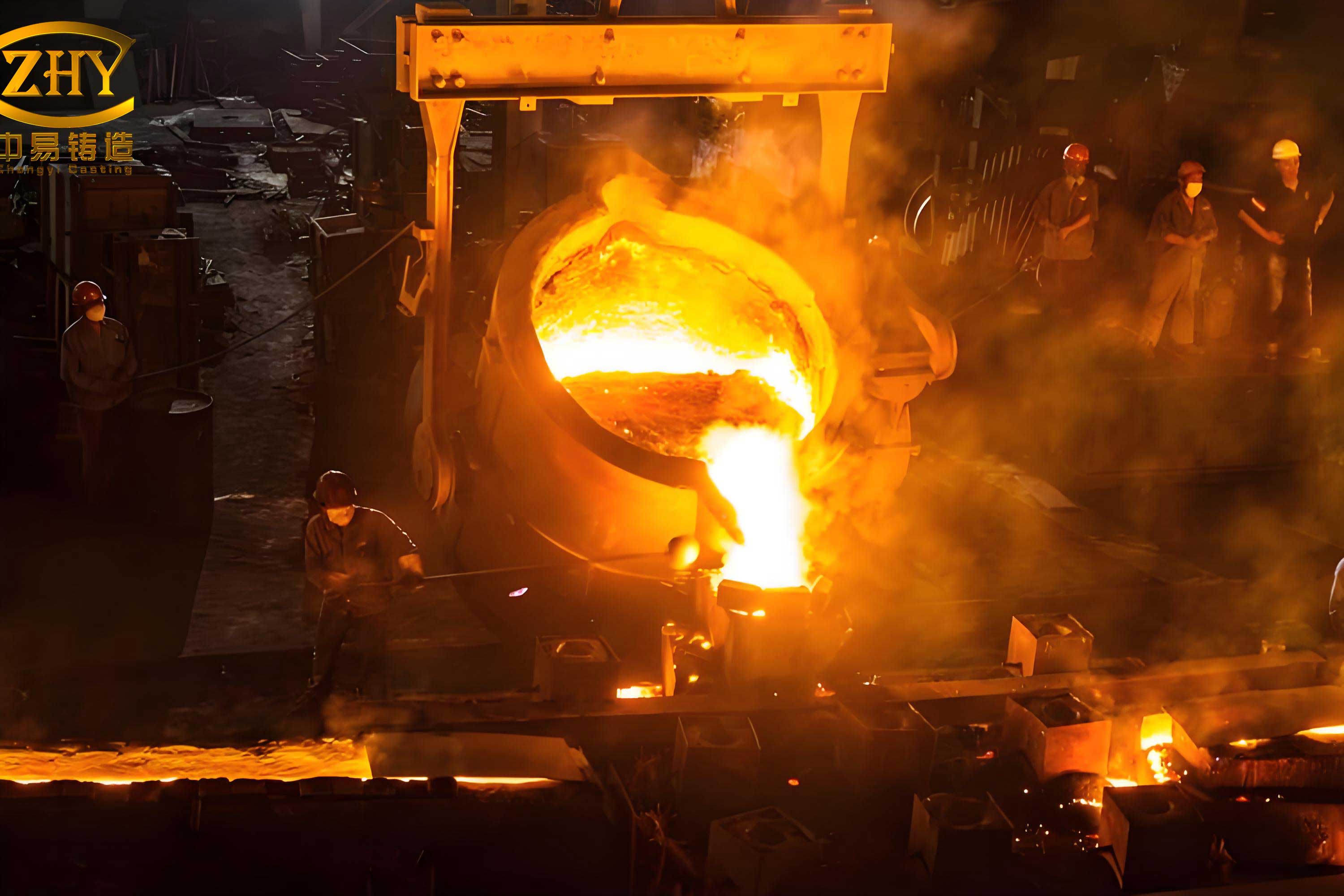
Through systematic experiments, I have determined that the optimal penetration depth of the coating into the sand mold is approximately 1.3 to 1.6 times the average sand grain size. The relationship between optimal viscosity and sand grain size is summarized in the following table:
| Sand Grain Size (mm) | Optimal Viscosity (mPa·s) |
|---|---|
| 0.1 | 20–30 |
| 0.2 | 35–50 |
| 0.3 | 50–70 |
| 0.4 | 70–90 |
| 0.5 | 90–120 |
| 0.6 | 120–150 |
The static shear stress of a coating is mainly determined by its filler content. As filler content increases, the deposited coating thickness and static shear stress also increase. For a casting with wall thickness of 40–50 mm, a coating layer of 0.4–0.5 mm is sufficient to prevent veining. Typical static shear stress values for different coating types are given in the following table:
| Coating Type | Static Shear Stress (mgf/cm²) |
|---|---|
| Zircon (ZrSiO₄) | 7–10 |
| Sillimanite (Al₂SiO₅) | 5–7 |
| Graphite | 4–5 |
The adhesion strength of a coating to the mold surface under thermal exposure is largely governed by the binder. For water-based coatings containing 5% organic binder (e.g., sulfite liquor SYF or urea-formaldehyde resin M-70), the adhesion strength at 600–650°C is approximately 0.15 kg/cm². For higher temperatures, binders with better thermal stability, such as furan resins with high furfuryl alcohol content, must be used. Such organic binders are generally suitable for castings with wall thickness up to 50 mm.
High-Temperature Binders for Large Castings in Sand Casting Foundry
When producing large, thick-walled castings, the mold surface can be heated to over 1000°C. In such cases, I recommend using inorganic binders for anti-veining coatings, as they offer higher thermal stability and lower gas evolution compared to organic binders. Examples include aluminum sulfate (which produces sintered alumina), magnesium sulfate (which forms polymerized magnesia), and inorganic polymers such as sodium tripolyphosphate. The thermal stability ranges of these binders are shown below:
| Binder | Maximum Temperature (°C) |
|---|---|
| Aluminum Sulfate (Al₂(SO₄)₃) | 1100–1200 |
| Magnesium Sulfate (MgSO₄) | 1000–1050 |
| Sodium Tripolyphosphate (Na₅P₃O₁₀) | 950–1000 |
To improve the suspension and application properties of coatings based on magnesium sulfate, sodium tripolyphosphate, or sodium silicate, I have successfully used high-molecular-weight thickeners such as PVA, CMC, or cellulose derivatives (e.g., OEC). For aluminum sulfate coatings, however, the presence of Al³⁺ and SO₄²⁻ ions can cause PVA, CMC, or OEC solutions to coagulate if used in amounts exceeding 2% bentonite. Therefore, careful formulation is required.
For rapid-drying coatings, polyvinyl butyral (PVB) alcohol-based coatings are commonly used. PVB acts both as a binder and a thickener, and it is a thermoplastic polymer. However, its adhesion strength drops sharply above 200°C. To maintain high-temperature adhesion, a secondary binder such as OF-1 resin must be added.
Quantitative Relationships in Coating Penetration and Adhesion
The penetration behavior of coatings into sand molds can be mathematically described. Let \( d \) be the average sand grain diameter (mm). The optimal penetration depth \( h \) is given by:
$$ h = (1.3 \text{ to } 1.6) \times d $$
This empirical relationship ensures that the coating forms a mechanical key with the mold surface without penetrating too deeply, which would waste material and potentially cause defects. The adhesion strength \( \sigma \) between the coating and the mold was found to follow a characteristic curve, with maximum adhesion occurring when penetration is within the optimal range, as shown in the following equation derived from our experiments:
$$ \sigma = \sigma_{\text{max}} \cdot \exp\left[-k \left( \frac{h}{d} – 1.45 \right)^2 \right] $$
where \( \sigma_{\text{max}} \) is the maximum achievable adhesion and \( k \) is a constant depending on binder type and sand composition.
The viscosity \( \eta \) (in mPa·s) of the coating must be adjusted according to the sand grain size to achieve the correct penetration depth. Based on my data, the relationship can be approximated by:
$$ \eta_{\text{opt}} = 150 \cdot d^{0.5} + 10 $$
where \( d \) is in mm. This formula is valid for the typical range of sand sizes used in sand casting foundry (0.1–0.7 mm).
The static shear stress \( \tau \) (mgf/cm²) of the coating is directly related to the volume fraction of solid filler \( \phi \). For zircon-based coatings, the relationship is:
$$ \tau = 4.5 + 8.2 \cdot (\phi – 0.3) \quad \text{for } 0.3 \leq \phi \leq 0.6 $$
This linear dependence allows foundry engineers to tailor the coating’s flow behavior by adjusting the filler content.
Gas Evolution and Directional Venting
Another critical factor in preventing surface defects is the rapid removal of gases from the metal-mold interface. The gas pressure \( P \) generated at the interface can be estimated using the ideal gas law:
$$ P = \frac{nRT}{V} $$
where \( n \) is the number of moles of gas evolved per unit time, \( R \) the gas constant, \( T \) the absolute temperature, and \( V \) the volume available for gas accumulation. To avoid blowholes and veining, the venting system must be designed such that the pressure drop across the mold is sufficient to allow gases to escape before the metal solidifies. The permeability \( K \) of the sand mold is defined by Darcy’s law:
$$ Q = \frac{K \cdot A \cdot \Delta P}{\mu \cdot L} $$
where \( Q \) is the gas flow rate, \( A \) the cross-sectional area, \( \Delta P \) the pressure difference, \( \mu \) the gas viscosity, and \( L \) the length of the flow path. Higher permeability sands or the use of vent wires can significantly reduce the risk of gas-related defects.
Practical Recommendations for Sand Casting Foundry Operations
Based on my extensive experience in sand casting foundry, I summarize the following practical guidelines for achieving excellent surface quality:
- Always choose a molding sand with consistent grain size distribution to ensure uniform thermal and mechanical properties.
- Apply a coating that matches the casting weight and wall thickness; for thin-walled castings (less than 20 mm), a light spray coating may suffice, while heavy castings require thick layers with inorganic binders.
- Monitor coating viscosity and static shear regularly using a rotational viscometer and a shear vane instrument.
- Use carbonaceous additives (e.g., coal dust 5–8% by weight of sand) for gray iron castings to promote lustrous carbon formation.
- For steel castings, ensure the iron oxide layer reaches a thickness of at least 0.1 mm by controlling mold temperature and oxidation conditions.
- In high-production sand casting foundry settings, implement automated coating application systems to maintain consistency.
Conclusion
The surface quality of castings produced in a sand casting foundry is influenced by a multitude of interacting variables. While our understanding is not yet complete, the principles outlined here—chemical inertness, thermal stability, proper gas venting, and the controlled formation of an iron oxide layer—provide a robust framework for minimizing veining and other surface defects. The development of advanced coatings with optimized viscosity, penetration, and high-temperature adhesion remains a key area of innovation. By applying these techniques, I have consistently achieved castings with smooth, clean surfaces, reducing post-processing costs and improving overall productivity in sand casting foundry operations.