
Centrifugal fans are pivotal in numerous ventilation and air-moving applications, and the impeller is the very heart that dictates their performance, efficiency, and acoustic signature. For decades, the manufacture of forward-curved, multi-blade impellers, especially those with narrow flow channels, has been dominated by fabrication methods involving the separate production of shrouds, blades, and hub discs, followed by mechanical assembly, typically riveting. While functional, these assemblies are prone to long-term reliability issues such as blade fatigue cracks, loose rivets, and structural deformation under cyclic loading, ultimately compromising the fan’s operational integrity and safety.
In contrast, monolithic, or in-block, sand castings offer a superior alternative. A single-piece impeller possesses inherent structural homogeneity, eliminating stress concentration points at joints and providing greater resistance to vibration and dynamic loads. When crafted from aluminum alloys, particularly those with good damping characteristics, these impellers leverage the material’s internal friction and vibration hysteresis to convert mechanical vibrational energy into heat, thereby intrinsically reducing aerodynamic and structure-borne noise. Furthermore, the smooth, continuous flow path achievable with a well-cast impeller minimizes flow separation and turbulence, reducing another significant source of noise. Despite these clear advantages, the widespread adoption of in-block casting for narrow-channel designs (e.g., flow passages smaller than 30mm x 20mm) has been severely hampered by a fundamental manufacturing constraint: the impossibility of core or pattern removal from the intricate, enclosed blade passages.
This article details a novel and practical sand casting process developed to overcome this critical barrier. The core innovation lies in a unique, demountable pattern system for creating the impeller’s internal cavity. We will explore the structural challenges of narrow-channel impellers, deconstruct the ingenious “movable-blade” core-making technique, and comprehensively outline the entire foundry workflow—from mold and core production to pouring, solidification control, and finishing. Data on production outcomes and performance benefits will be presented, demonstrating that this process enables the reliable, cost-effective production of high-integrity, low-noise aluminum alloy impellers through conventional sand castings.
The Technical Challenge of Narrow-Channel Impellers
A typical forward-curved, multi-blade impeller for low-noise applications features a high blade count (often 20-30 or more), short blades with significant curvature, and a very restricted passage between the front and back shrouds. The geometry presents a near-insurmountable challenge for traditional pattern-making.
- Undercuts and Zero Draft: The blades, often only 2-3 mm thick, act as severe undercuts. Providing adequate draft angle for pattern withdrawal is physically impossible without drastically altering the blade’s aerodynamic profile, which is unacceptable for performance.
- Enclosed Cavity: The flow channel is fully enclosed by the front and back shrouds. In a traditional sand mold, once the sand is packed around a solid pattern representing this cavity, there is no way to extract the pattern without destroying the mold.
- Alternative Methods: Processes like investment casting, which uses a sacrificial wax pattern, seem promising at first. However, for these narrow, deep cavities, even the molten wax often cannot reliably drain out during the dewaxing stage, leading to mold defects or failure. Similarly, complex multi-part cores are exceedingly difficult to assemble with the required precision and are prone to shifting during mold assembly.
The fundamental problem can be summarized by the relationship between the minimum draft angle ($\theta_{min}$), the blade depth ($L$), and the allowable blade profile deviation ($\Delta t$):
$$\Delta t = L \cdot \tan(\theta_{min})$$
For a blade depth $L = 28\ mm$ and a maximum allowable profile change $\Delta t \leq 0.2\ mm$, the required draft angle is:
$$\theta_{min} = \arctan\left(\frac{\Delta t}{L}\right) \approx \arctan\left(\frac{0.2}{28}\right) \approx 0.41^\circ$$
Achieving and controlling such a minuscule, consistent draft angle on a thin, curved blade across a multi-cavity pattern is impractical in a permanent metal pattern, making conventional pattern withdrawal unfeasible.
Core Innovation: The Movable-Blade Core Box System
The solution pivots from trying to remove a monolithic pattern to constructing the core from within a dedicated core box using removable elements. The system is comprised of several key components designed for precision and repeatability.
| Component | Material & Manufacture | Function & Key Features |
|---|---|---|
| Movable Blade Inserts | Tool steel, wire-cut via CNC EDM. | Form the precise blade cavities. Each is an individual, precision-ground insert. Height extends 40+ mm beyond the core print for handling. |
| Reversible Base Plate (Back Shroud Pattern) | Machined steel plate. | Holds all blade inserts in correct position. Contains precisely located holes with a tight clearance fit (~0.05 mm) for each blade insert. Has indexed inner recesses for the hub section. |
| Hub / Flow Diveter Plug | Machined steel, two variants (Left/Right hand). | Forms the central hub and flow diverter cone. Plugs into the base plate, defining the impeller’s rotation direction. |
| Core Box Casing | Machined steel frame. | |
| A containment frame that registers the base plate and defines the outer radial boundary of the core during sand ramming. | ||
The core-making sequence is as follows:
- Assembly: The appropriate hub plug (for left or right-hand rotation) is seated in the base plate. All individual blade inserts are meticulously inserted into their corresponding holes in the base plate. This assembly is then placed into the core box casing. The extended length of the blades above the plate is crucial.
- Core Sand Ramming: The box is filled with a self-setting resin sand mixture (e.g., furan or phenolic urethane cold-box sand). The sand is compacted around and between the blade inserts to form a green core.
- Disassembly & Pattern Removal: After the sand has cured, the core box is inverted. The base plate is unbolted and removed first. With the plate gone, each individual blade insert is now accessible and can be pulled straight out vertically from the cured sand core, one by one, thanks to their extended handles. This leaves behind a perfect, monolithic sand core containing all the intricate, enclosed blade cavities. The hub plug is also removed at this stage.
- Core Finishing: The extracted sand core may require minor dressing to remove fins, but it is now a single, handleable piece ready for mold assembly.
Complete Sand Casting Process Workflow
With the core-making challenge solved, the process integrates into a standard, yet carefully controlled, sand casting practice. The overall methodology is a two-part green sand mold with a resin sand core.
1. Mold and Core Production
Core Fabrication: As described above, using the movable-blade system. The core sand is typically a cold-curing resin sand for high dimensional stability and good collapsibility after casting. A core reinforcement (core bar or “skeleton”) is often embedded within the core sand to enhance its handling strength, especially for larger impellers. The core must be thoroughly dried or cured before use.
Drag (Lower Mold) and Cope (Upper Mold) Production: These are produced using simple, reusable metal patterns that form the external contours of the impeller’s front and back shrouds. They are made in standard green sand molding machines. The drag mold incorporates the sprue and runner system, while the cope mold includes the risers. Crucially, both mold halves have core prints—recesses that accurately locate and support the fragile internal core when it is placed in the drag.
2. Mold Assembly and Pouring
- Core Placement: The cured core is carefully lowered into the core print in the drag (lower mold). Its position is critical for achieving uniform wall thickness.
- Coping Up: The cope (upper mold) is aligned and placed over the drag, enclosing the core.
- Steel Hub Sleeve Insertion: A pre-fabricated steel sleeve, which will form the final bore for the drive shaft, is incorporated. To ensure a metallurgical bond with the aluminum, its outer surface is often grooved or knurled. It is pre-heated to approximately 300-400°C to drive off moisture and reduce the chilling effect, then precisely positioned in the mold cavity around the core’s hub region.
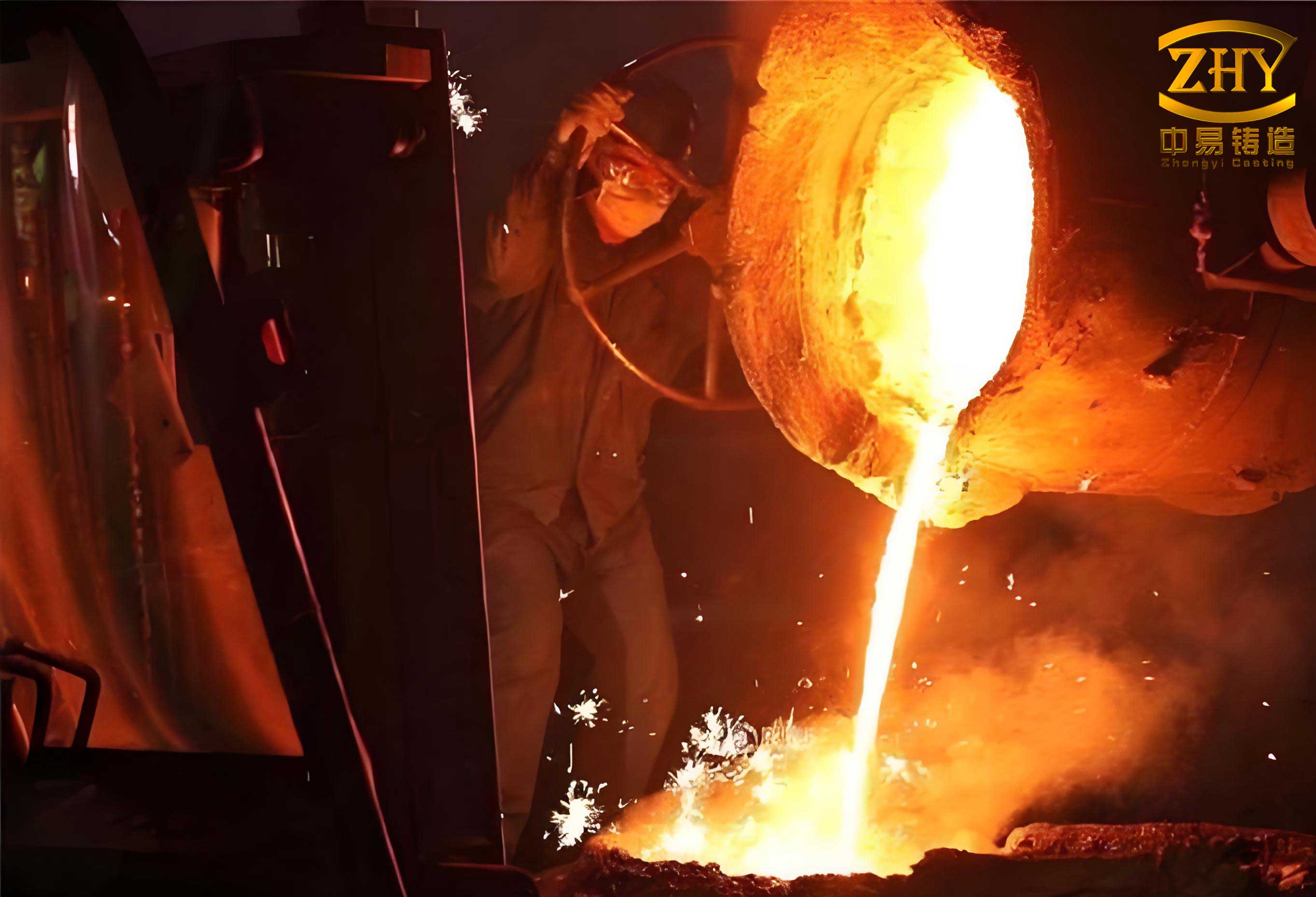
- Pouring: The mold is now ready. The alloy of choice, typically a castable aluminum-silicon alloy like ZL104 (A413.0 equivalent), is melted and brought to a temperature between 720°C and 760°C. The pouring is done quickly at first to ensure complete filling of the thin blade sections, then slowed to allow proper feeding from the risers. The pouring head ($h$) is maintained to provide adequate metallostatic pressure:
$$P_{metal} = \rho \cdot g \cdot h$$
where $\rho$ is the molten aluminum density (~2400 kg/m³), $g$ is gravity, and $h$ is typically 0.5-0.7 m.
3. Solidification Control and Gating Design
Directional solidification is paramount to sound sand castings. The design is oriented so that the thickest sections (the hub and shroud junctions) solidify last, being fed by the risers located in the cope. The thin blades solidify almost instantaneously. The gating system is designed to minimize turbulence and promote a thermal gradient. A bottom gating system is often preferred to allow calm filling from below. The chills may be strategically placed in the drag near heavy sections to promote directional solidification towards the risers in the cope.
| Parameter | Value / Specification | Rationale |
|---|---|---|
| Alloy | ZL104 (Al-Si10Mg) | Excellent castability, good strength, and damping properties. |
| Pouring Temperature | 740°C ± 20°C | Balances fluidity for thin blades with reduced gas absorption and shrinkage. |
| Mold Sand (Green) | Clay-bonded silica sand, 5-6% moisture | Provides sufficient strength and permeability for the mold walls. |
| Core Sand | Phenolic urethane cold-box sand | High precision, good breakdown after casting. |
| Steel Sleeve Pre-heat | 350°C – 400°C | Prevents gas entrapment, promotes bonding, reduces thermal shock. |
| Solidification Time | ~10-15 minutes (varies with size) | Monitored to determine shakeout time. |
Material Selection: Why Aluminum Alloy?
The choice of material is integral to the success of these sand castings. Aluminum alloys, specifically Al-Si based alloys like ZL104 (A413.0) or A356 (Al-Si7Mg), are predominant for several reasons:
- Castability: They exhibit superb fluidity, low hot tearing tendency, and good feeding characteristics—essential for replicating thin, complex blade geometries in sand castings.
- Light Weight: Density (~2.68 g/cm³) is about one-third that of steel, reducing rotational inertia and bearing loads.
- Damping Capacity: Certain aluminum alloys, particularly those with silicon and magnesium, have a higher internal damping coefficient than steel, aiding in noise and vibration reduction.
- Machinability: They are easily machined in the final finishing steps to achieve precise balance and surface finish.
- Corrosion Resistance: They form a protective oxide layer, offering good resistance to atmospheric corrosion in typical ventilation environments.
The composition and typical “as-cast” mechanical properties of ZL104 are summarized below:
| Element | Si | Mg | Mn | Al |
|---|---|---|---|---|
| Wt. % | 8.0 – 10.5 | 0.17 – 0.35 | 0.2 – 0.5 | Bal. |
| Property | Typical Value (As-Cast, Sand Mold) | |||
| Tensile Strength | 150 – 200 MPa | |||
| Yield Strength (0.2% Offset) | 70 – 100 MPa | |||
| Elongation | 2 – 4% | |||
| Brinell Hardness (HB) | 50 – 70 | |||
Post-Casting Processing and Quality Control
Upon shakeout, the raw casting undergoes a series of critical steps to become a functional impeller.
- Heat Treatment (Optional but Recommended): A T5 (artificial aging after casting) or T6 (solution heat treatment and artificial aging) treatment can be applied to enhance mechanical properties. For ZL104, a typical T6 cycle involves solutionizing at 525°C for 8-12 hours, quenching in hot water, and aging at 160°C for 4-8 hours.
- De-gating and Cleaning: The sprue, runners, and risers are removed by sawing or grinding. The casting is shot blasted to remove residual sand and scale.
- Machining: Critical surfaces are machined to final dimensions. This includes:
- Facing the front and back shroud mounting surfaces to ensure parallelism.
- Turning the outer diameter to achieve precise aerodynamic contour and balance.
- Boring or honing the steel sleeve’s inner diameter to the final shaft fit tolerance.
- Polishing the blade inlet and outlet edges and flow passages to reduce surface roughness and improve airflow.
- Non-Destructive Testing (NDT): Every casting should be inspected. Common methods include visual inspection, penetrant testing (PT) to reveal surface defects on blades and shrouds, and radiographic testing (X-ray) to check for internal shrinkage or gas porosity in critical areas.
- Dynamic Balancing: This is a crucial final step. The impeller is mounted on a balancing machine. Material is carefully removed from designated heavy spots on the shrouds (not the blades) until the residual unbalance is within strict limits. The balance quality grade “G” is specified, related to the permissible residual specific unbalance ($e_{per}$) and operating angular velocity ($\omega$):
$$e_{per} = \frac{G \cdot 1000}{\omega}$$
Where $e_{per}$ is in µm, $G$ in mm/s, and $\omega$ in rad/s. For a typical small fan impeller aiming for G2.5 grade at 3000 RPM ($\omega \approx 314\ rad/s$), the allowable $e_{per} \approx 8\ \mu m$.
Results, Performance, and Advantages
The implementation of this movable-blade core process for sand castings has yielded significant improvements over traditional fabricated impellers.
| Aspect | In-Block Sand Cast Impeller | Riveted Sheet Metal Impeller |
|---|---|---|
| Structural Integrity | Monolithic, no joints. High fatigue resistance. | Stress concentrators at rivets. Prone to fretting and crack initiation. |
| Dimensional Accuracy & Consistency | High. Blade profiles and positions are determined by precision-machined core box inserts. | Variable. Depends on stamping die wear and assembly jig accuracy. |
| Airflow & Noise | Smoother flow paths, reduced turbulence. Material damping reduces vibration noise. | Steps and gaps at joints disrupt flow, increasing turbulence noise. |
| Weight | Comparable or slightly higher than aluminum sheet. | Lightweight, but strength-to-weight ratio may be lower. |
| Production Scalability | Well-suited for medium to high-volume batches. Core boxes are durable. | Efficient for very high volumes with dedicated stamping lines. |
| Prototype & Small Batch Cost | Relatively low tooling cost for sand casting patterns. | Very high cost for precision stamping dies. |
In production trials, this process has consistently achieved a casting yield (sound castings per pour) exceeding 70%. The mechanical performance is robust, with the cast impellers successfully passing stringent environmental tests including prolonged vibration, shock, and operational endurance runs. Most notably, acoustic measurements on fans equipped with these cast impellers show a reduction in overall sound pressure level (SPL) of 2-4 dB(A) compared to equivalent performance fans using fabricated impellers, a significant improvement in noise-critical applications.
Application Prospects and Conclusion
The movable-blade core system for in-block sand castings represents a versatile and economically viable breakthrough. Its applicability extends beyond the specific narrow-channel impeller described here.
- Scalability: The principle can be scaled to manufacture larger impellers with wider channels, where it may simplify core-making compared to extremely complex, segmented core assemblies.
- Material Flexibility: While demonstrated with aluminum, the process is equally valid for other castable alloys, such as ductile iron or specialized bronzes, where monolithic construction is desired for strength or corrosion resistance.
- Design Freedom: It enables designers to specify optimized, aerodynamically efficient blade shapes (e.g., non-radial, compound curves) that would be impossible or prohibitively expensive to produce via sheet metal forming and assembly.
In conclusion, the inability to demold complex, narrow internal passages has long been a stumbling block for the monolithic casting of efficient fan impellers. This innovative sand casting process, centered on a demountable, movable-blade core box, effectively solves this decades-old foundry dilemma. It marries the design freedom and structural benefits of casting with the practical realities of production foundry engineering. The result is a reliable method to produce high-performance, low-noise, and durable aluminum alloy centrifugal fan impellers. By leveraging conventional sand castings infrastructure augmented with smart tooling design, this process opens the door to wider adoption of superior monolithic impellers across the HVAC, appliance, and specialized ventilation industries.