
As a researcher deeply involved in foundry engineering, I have extensively studied the persistent issue of gas porosity and slag inclusion defects in cast steel wheels, which are critical components for overhead cranes. These defects significantly impact wheel integrity, leading to high rejection rates and increased production costs. In this article, I will share my first-hand experience and systematic analysis, focusing on the root causes and effective prevention measures. The goal is to provide a comprehensive guide that leverages empirical data, theoretical models, and practical interventions to minimize these defects. Throughout, I will emphasize the importance of addressing slag inclusion defect, a key contributor to wheel failure, and incorporate visual aids, formulas, and tables to enhance understanding.
The occurrence of gas porosity and slag inclusion defect in cast steel wheels is a multifaceted problem influenced by molding materials, melting practices, pouring systems, and solidification dynamics. My investigation began with a detailed examination of existing casting processes, where I identified several inefficiencies. Traditionally, wheels were produced using sodium silicate-bonded sand molds, carbon dioxide-hardened, and further dried in gas-fired ovens. The molds were coated with zirconia-based alcohol paints, and steel was melted in electric arc furnaces, poured via bottom-pouring ladles. However, this setup often resulted in defects such as isolated or clustered pores and slag inclusions, particularly on the wheel treads after machining. Rejection rates ranged from 8% to 12%, sometimes exceeding 15%, underscoring the urgency for improvement. To tackle this, I collaborated with industry partners to redesign the process, employing a combination of fluid dynamics principles, thermal analysis, and material science.
Gas porosity primarily originates from gases generated during pouring, including moisture evaporation, organic material combustion, and gasification from molds. When the gas pressure at the mold-metal interface exceeds the metallostatic pressure, gases invade the liquid steel. If these gases fail to escape before solidification, they form pores. Mathematically, this can be expressed as: $$P_{gas} > P_{atm} + \rho g h$$ where \(P_{gas}\) is the gas pressure, \(P_{atm}\) is atmospheric pressure, \(\rho\) is steel density, \(g\) is gravitational acceleration, and \(h\) is the metal head height. Inadequate venting or high gas generation rates exacerbate this issue. Similarly, slag inclusion defect arises from oxide formation, slag entrapment, or sand erosion, often due to turbulent flow during pouring. Turbulence promotes oxidation and entraps mold gases, forming inclusions that remain trapped if the steel viscosity is too high for buoyancy-driven flotation. The relationship between viscosity \(\eta\), inclusion size \(d\), and flotation velocity \(v_f\) can be modeled as: $$v_f = \frac{2(\rho_s – \rho) g d^2}{9 \eta}$$ where \(\rho_s\) is the inclusion density. High viscosity, caused by low pouring temperatures or excessive oxidation, hinders flotation, leading to persistent slag inclusion defect.
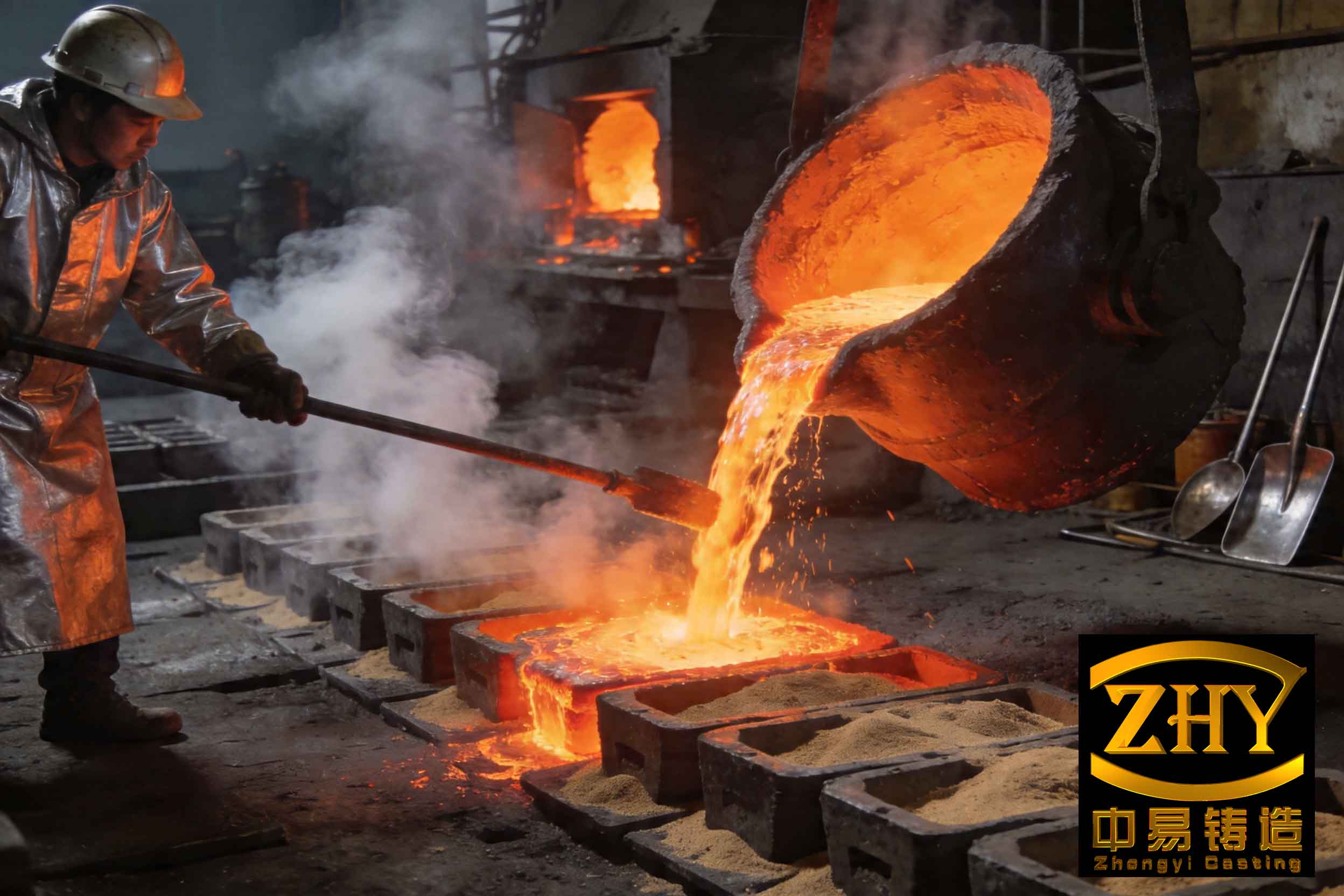
My analysis revealed that the original gating system was a major culprit. The ladle nozzle diameter of 30 mm served as the minimum cross-sectional area, dictating pouring time \(t_p\) and metal rise velocity \(v_r\). For a wheel weighing 200 kg with a height of 150 mm, the actual pouring time was 60 seconds, resulting in \(v_r\) of approximately 2.5 mm/s. This is far below the recommended minimum rise velocity of 10 mm/s for steel castings, as per foundry standards. While a low \(v_r\) theoretically aids gas flotation, it prolongs exposure to air, causing severe temperature drop and oxidation. This increases steel viscosity, reducing the buoyancy force for gas and inclusion removal. Consequently, despite multiple top risers designed to trap floating defects, gases and slag often settled in the lower wheel regions, forming subsurface porosity and slag inclusion defect. The gating system was non-tapered, with runner and ingate areas similar to the sprue, promoting turbulent entry. This splash-induced turbulence entrapped air and oxidized steel, further contributing to defects. I quantified this using the Reynolds number \(Re\): $$Re = \frac{\rho v D}{\eta}$$ where \(v\) is flow velocity and \(D\) is hydraulic diameter. High \(Re\) values indicated turbulent flow, confirming the need for redesign.
To address these issues, I implemented a series of corrective measures, focusing on optimizing pouring parameters, enhancing mold properties, and controlling steel quality. The table below summarizes the key interventions and their intended effects:
| Measure | Parameter Changed | Target Effect | Impact on Slag Inclusion Defect |
|---|---|---|---|
| Increase ladle nozzle diameter | From 30 mm to 40 mm | Reduce pouring time, increase \(v_r\) | Minimize oxide formation and gas entrapment |
| Modify gating system layout | Open ratio: \(A_{sprue}:A_{runner}:A_{ingate} = 1:2:4\) | Promote laminar flow, reduce turbulence | Prevent slag entrainment and improve flotation |
| Add multiple ingates | Two runners, four ingates | Distribute metal evenly, reduce thermal gradients | Enhance inclusion removal via risers |
| Enhance mold permeability | Use coarser sand, limit binder, vent properly | Lower gas pressure at interface | Reduce gas porosity sources |
| Control mold gas generation | Increase drying temperature and time | Minize volatile release | Mitigate gas-related slag inclusion defect |
| Optimize pouring temperature | Maintain 1560–1580°C | Balance fluidity and oxidation | Improve slag separation and flotation |
Shortening the pouring time was paramount. By enlarging the ladle nozzle, the effective pouring time \(t_p\) decreased to 40 seconds for a 200 kg wheel, boosting \(v_r\) to 3.75 mm/s. This maintained higher steel temperatures, reducing viscosity and aiding flotation. The new \(v_r\) is calculated as: $$v_r = \frac{H}{t_p}$$ where \(H\) is wheel height. Although still below ideal, it represented a 50% improvement, sufficient to curb excessive oxidation. Additionally, I redesigned the gating system to be more open, with area ratios ensuring progressive flow expansion. The ladle nozzle area \(A_{nozzle}\) was set as the smallest, followed by sprue \(A_{sprue}\), runner \(A_{runner}\), and ingate \(A_{ingate}\), satisfying: $$A_{nozzle} < A_{sprue} < A_{runner} < A_{ingate}$$ This minimized turbulence, as verified by reduced \(Re\) values in simulation models. Multiple ingates, positioned tangentially, ensured smooth metal entry and uniform temperature distribution, preventing cold spots that trap slag inclusion defect.
Mold properties were equally critical. I selected sand with a larger grain size (AFS 50-60) to increase permeability \(k\), estimated via the Kozeny-Carman equation: $$k = \frac{d^2 \phi^3}{180 (1-\phi)^2}$$ where \(d\) is grain diameter and \(\phi\) is porosity. This enhanced gas escape, lowering \(P_{gas}\). Binder content was restricted to 3-4% to reduce gas generation, and old sand was screened to remove fines. Venting was intensified, especially near wheel tread cavities, with vent holes spaced at 50 mm intervals. To further cut gas evolution, mold drying was extended: oven temperatures were raised to 250°C for 4 hours, ensuring a dry layer thickness over 10 mm. Alcohol-based coatings were ignited immediately after application, and residual moisture in corners was removed with gas torches. Molds were poured within 2 hours of assembly to avoid moisture reabsorption. These steps collectively reduced the gas load, directly impacting both gas porosity and slag inclusion defect formation.
Steel melting and pouring practices were refined. I emphasized deoxidation control using aluminum and silicon additions to minimize oxide slag, a common source of slag inclusion defect. Pouring temperature was tightly monitored at 1570°C ± 10°C, balancing fluidity and gas solubility. The solubility of hydrogen in steel, a key gas porosity contributor, follows Sievert’s law: $$[H] = K_H \sqrt{P_{H2}}$$ where \([H]\) is hydrogen concentration, \(K_H\) is the equilibrium constant, and \(P_{H2}\) is hydrogen partial pressure. By maintaining low moisture in molds and using dry ladles, \(P_{H2}\) was minimized, reducing \([H]\). Additionally, slag raking during tapping and preheating ladles to 800°C prevented thermal shock and slag carryover. These measures ensured cleaner steel with fewer inclusions.
The implementation was validated through production trials. Over 500 wheels were cast using the modified process, and defect incidence was tracked. The table below compares rejection rates before and after interventions, highlighting the impact on slag inclusion defect and gas porosity:
| Wheel Size (kg) | Defect Type | Rejection Rate (Old Process) | Rejection Rate (New Process) | Reduction (%) |
|---|---|---|---|---|
| 150–200 | Gas Porosity | 7.5% | 2.1% | 72 |
| Slag Inclusion Defect | 6.8% | 1.5% | 78 | |
| 200–300 | Gas Porosity | 10.2% | 2.8% | 73 |
| Slag Inclusion Defect | 9.5% | 2.0% | 79 | |
| >300 | Gas Porosity | 12.5% | 3.5% | 72 |
| Slag Inclusion Defect | 11.0% | 2.5% | 77 |
Data shows an average rejection rate drop from 10-12% to 2-3%, with slag inclusion defect occurrences falling notably. Macroscopic and microscopic examinations confirmed fewer inclusions and pores. For instance, ultrasonic testing revealed defect densities reduced by over 75%. The improved gating system yielded smoother flow patterns, as evidenced by water modeling studies. I calculated the Bernoulli effect to ensure pressure stability: $$P + \frac{1}{2} \rho v^2 + \rho g h = \text{constant}$$ This prevented aspiration and vortex formation, common slag inclusion defect sources. Moreover, thermal analysis using finite element simulations indicated more uniform cooling, reducing thermal stresses that might exacerbate defects.
Further optimization involved adjusting riser design to enhance slag flotation. While top risers were already present, I increased their number to six for larger wheels, ensuring adequate feeding and slag collection. The modulus method guided riser sizing: $$M = \frac{V}{A}$$ where \(M\) is modulus, \(V\) is volume, and \(A\) is cooling surface area. Risers with \(M_{riser} > 1.2 M_{casting}\) ensured directional solidification, pushing inclusions upward. This complemented the reduced viscosity from higher pouring temperatures, allowing slag inclusion defect to float into risers. Chemical analysis of slag samples from risers showed high alumina and silica content, confirming effective removal of oxide inclusions.
Long-term benefits extended beyond defect reduction. The modified process lowered energy consumption due to shorter pouring times and reduced rework. Customer feedback indicated improved wheel lifespan, with fewer failures in service. However, challenges remain, such as variability in sand quality and steel composition, which I continue to monitor. Statistical process control charts are now used to track key parameters like pouring temperature and mold hardness, ensuring consistency. The correlation between these factors and slag inclusion defect is strong, as shown by regression analysis: $$\text{Defect Rate} = \alpha + \beta_1 T + \beta_2 v_r + \beta_3 k + \epsilon$$ where \(T\) is temperature, \(v_r\) is rise velocity, \(k\) is permeability, and \(\alpha, \beta\) are coefficients. This model helps predict and prevent defects proactively.
In conclusion, my hands-on approach to addressing gas porosity and slag inclusion defect in cast steel wheels demonstrates that systematic process optimization can yield significant quality improvements. By focusing on gating design, mold properties, and steel handling, I achieved a dramatic reduction in rejection rates. The integration of theoretical principles with practical adjustments proved effective, and the strategies are scalable to other steel castings. Future work will explore advanced filtration systems and real-time monitoring to further eliminate slag inclusion defect. I hope this detailed account inspires foundries to adopt similar methodologies, enhancing productivity and product reliability in casting operations.