
In the context of declining subsidies and the transition to grid parity in the wind power industry, there is an urgent need for technological advancements to achieve cost reduction. Ductile iron castings, which constitute approximately 20% to 30% of the total weight of the rotor-nacelle assembly in wind turbines, play a critical role in this endeavor. The development of higher-performance ductile iron castings is essential for lightweight design and overall cost efficiency. This study focuses on enhancing the strength of ferritic ductile iron castings beyond the conventional QT400-18AL grade, while maintaining low-temperature impact toughness, through optimized chemical composition, process control, and trace element management. The findings are pivotal for advancing wind turbine technology and meeting the demands of large-scale, high-power wind energy systems.
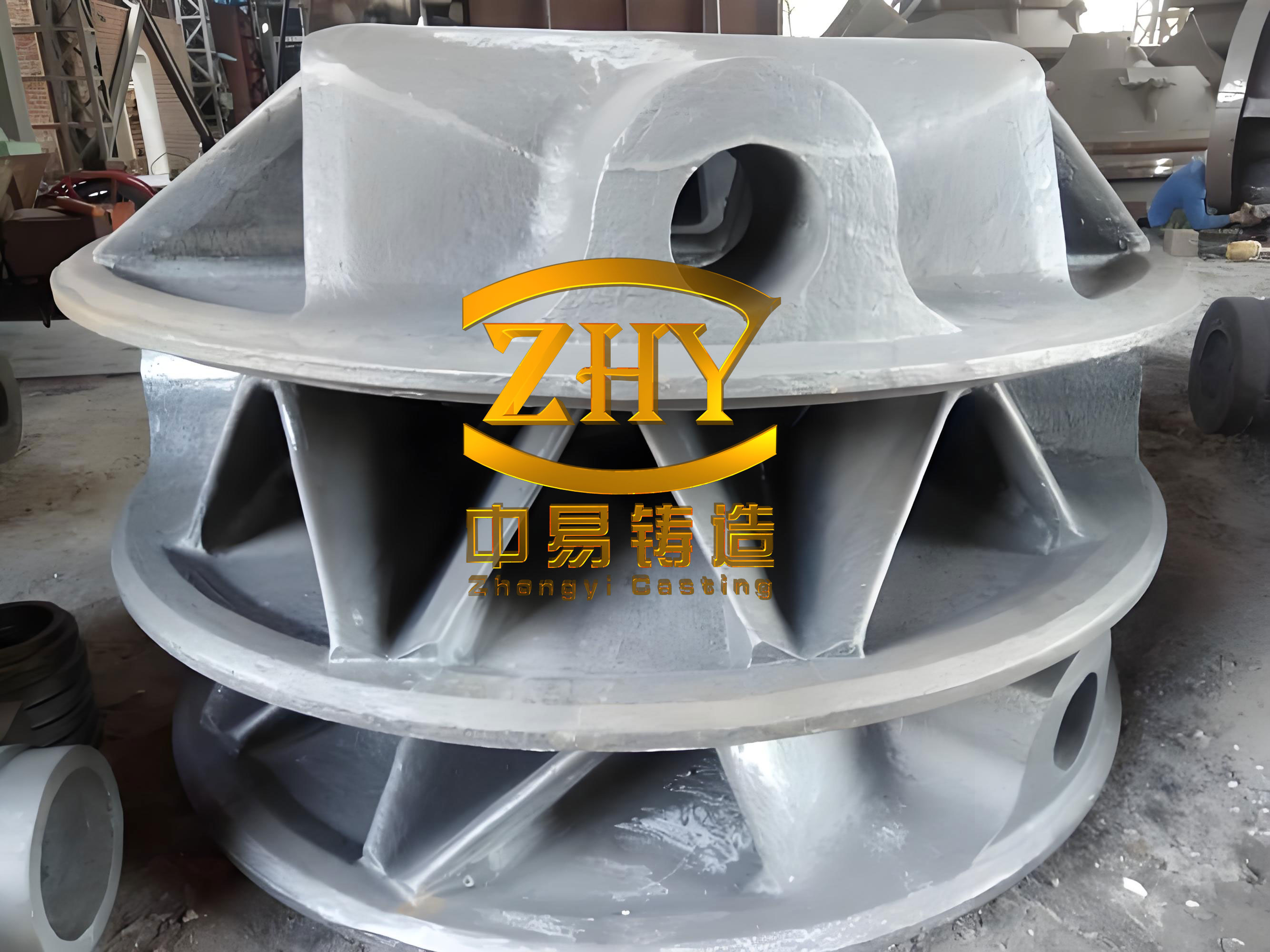
The performance requirements for ductile iron castings in wind turbines are stringent, especially for large-section components such as frames, hubs, and bearing housings. These castings often have wall thicknesses exceeding 100 mm, which classifies them as large-section castings. In such cases, challenges like spheroidal graphite degeneration, graphite flotation, and graphite distortion arise due to slow cooling and prolonged solidification times, leading to degraded mechanical properties. To address this, the target performance criteria include: (1) mechanical properties, particularly low-temperature impact toughness, that meet or exceed the GB/T 1348-2009 standard; and (2) metallographic structure with a graphite spheroidization rate ≥90%, ferrite content ≥90%, pearlite content <10%, cementite ≤1%, and phosphide eutectic ≤1%, with graphite size above grade 5. These requirements ensure reliability under operational loads and environmental conditions.
Chemical composition design is a cornerstone for achieving enhanced strength in ductile iron castings. The base material, QT400-18AL, serves as a reference, but modifications are necessary to improve strength without compromising toughness. Key elements under investigation include silicon (Si) and nickel (Ni). Silicon promotes graphitization, facilitates the decomposition of cementite, and reduces pearlite content. It dissolves in the ferritic matrix, thereby increasing tensile and yield strength. However, excessive Si elevates the ductile-to-brittle transition temperature, adversely affecting low-temperature impact toughness. Empirical data indicates that for every 0.1% increase in Si content, the transition temperature rises by approximately 5.5 to 6°C. This relationship can be expressed as:
$$ \Delta T_{brittle} = k_{Si} \cdot \Delta [Si] $$
where \( \Delta T_{brittle} \) is the change in brittle transition temperature, \( \Delta [Si] \) is the change in silicon content, and \( k_{Si} \) is a coefficient ranging from 55 to 60°C per 1% Si. To balance strength and toughness, the Si content is controlled within 2.1% to 2.5%.
Nickel, with a graphitization ability about one-fifth to one-third that of silicon, infinitely dissolves in iron and promotes graphitization while stabilizing and refining pearlite. Through solid solution strengthening, Ni enhances dislocation motion and multiplication resistance, improving toughness. However, excessive Ni content causes lattice distortion, reducing dislocation mobility and compromising toughness. The Ni content is thus maintained between 0.2% and 0.7%. The synergistic effect of Si and Ni can be modeled to predict strength improvements. For instance, the increase in yield strength (\( \Delta \sigma_y \)) due to these elements can be approximated by:
$$ \Delta \sigma_y = A_{Si} \cdot [Si] + A_{Ni} \cdot [Ni] $$
where \( A_{Si} \) and \( A_{Ni} \) are strengthening coefficients. This approach allows for tailored compositions to achieve target properties in ductile iron castings.
Raw material selection is critical for consistency in ductile iron castings. The charge composition includes: (1) pig iron, comprising 20% to 40% of the charge, selected for low manganese, phosphorus, and sulfur content to ensure high purity; (2) scrap steel, making up 30% to 40% of the charge, chosen from carbon steel with stable chemistry and minimal carbide-forming elements like chromium, copper, tungsten, and vanadium; and (3) returns, accounting for 30% to 40% of the charge, to promote recycling and cost efficiency. Strict control over impurities ensures reproducible chemical analysis and mechanical properties.
Process control in spheroidization and inoculation is vital for achieving the desired microstructure in ductile iron castings. A rare-earth magnesium spheroidizer is used, added via the pouring-in method. The spheroidizer composition typically includes 40% to 45% Si, 6% to 7% Mg, 1% to 2% rare earths (RE), 1% to 2% barium (Ba), 0.8% to 2% calcium (Ca), with the remainder as iron. For inoculation, a silicon-barium inoculant is added during tapping, with a composition of 70% to 75% Si, 4% to 6% Ba, 0.8% to 1.5% Ca, and aluminum (Al) ≤1.5%. Additionally, a silicon-bismuth inoculant is introduced during molding, containing 70% to 75% Si, 1% to 2% bismuth (Bi), 0.8% to 1.5% Ca, and Al ≤1.5%. These treatments enhance graphite nucleation and spheroidization, crucial for large-section ductile iron castings.
Melting and annealing processes further refine the properties of ductile iron castings. Melting is conducted in a medium-frequency induction furnace at approximately 1,430°C. After spheroidization, inoculation, and micro-alloying, the molten metal is cooled to 1,330–1,360°C and poured into furan resin sand molds at controlled rates. Post-pouring, the castings are slowly cooled in the mold to below 400°C to minimize residual stresses. A high-temperature annealing treatment follows: the castings are heated to 900–950°C at a rate below 60°C/h, held for 2 to 5 hours, then furnace-cooled to 600°C before air cooling. This annealing reduces pearlite content and enhances ferritic formation, optimizing toughness in ductile iron castings.
Experimental analysis was conducted on trial castings with attached test blocks to evaluate chemical composition and mechanical properties. The results are summarized in the following tables. Table 1 presents the chemical composition analysis of three samples, highlighting the controlled levels of Si and Ni.
| Sample ID | C | Si | Mn | P | S | Ni | Residual Mg | Residual RE |
|---|---|---|---|---|---|---|---|---|
| Sample A | 3.66 | 2.17 | 0.21 | 0.028 | 0.005 | 0.35 | 0.043 | 0.023 |
| Sample B | 3.63 | 2.21 | 0.18 | 0.026 | 0.005 | 0.41 | 0.041 | 0.025 |
| Sample C | 3.61 | 2.15 | 0.17 | 0.03 | 0.005 | 0.38 | 0.035 | 0.028 |
Table 2 shows the mechanical properties of these samples, including tensile strength, yield strength, elongation, hardness, and low-temperature impact energy at -20°C.
| Sample ID | Tensile Strength (MPa) | Yield Strength (MPa) | Elongation (%) | Hardness (HBW) | Impact Energy at -20°C (J) |
|---|---|---|---|---|---|
| Sample A | 398 | 282 | 25.3 | 141 | 15.2 |
| Sample B | 405 | 284 | 23.9 | 143 | 14.1 |
| Sample C | 392 | 275 | 25.1 | 138 | 15.7 |
For comparison, Table 3 outlines the standard requirements for QT400-18AL ductile iron castings according to national and industry standards.
| Standard | Tensile Strength (MPa) | Yield Strength (MPa) | Elongation (%) | Hardness (HBW) | Impact Energy at -20°C (J) |
|---|---|---|---|---|---|
| GB/T 1348 | 360 | 220 | 12 | 120–175 | 10 |
| GB/T 25390 | 370 | 220 | 12 | 120–175 | 10 |
The data indicates that the developed ductile iron castings exhibit an average tensile strength increase of approximately 11% and an average yield strength increase of about 27% compared to standard QT400-18AL, while maintaining elongation above 23% and low-temperature impact energy averaging 15 J, which exceeds standard requirements. This demonstrates the effectiveness of the compositional and process optimizations for high-strength ductile iron castings.
Metallographic examination revealed that the as-cast microstructure of the trial ductile iron castings had a spheroidization rate >90%, graphite size grades 6–7, phosphide eutectic <1%, and pearlite content between 10% and 15%. After annealing, the pearlite content reduced to below 5%, promoting a predominantly ferritic matrix. The relationship between microstructure and mechanical properties can be described using models such as the Hall-Petch equation for grain size strengthening, although for ductile iron castings, the graphite morphology and matrix composition play dominant roles. The impact of graphite spheroidization on toughness can be quantified as:
$$ K_{IC} \propto \sqrt{\frac{E \cdot \sigma_y}{\rho}} $$
where \( K_{IC} \) is fracture toughness, \( E \) is Young’s modulus, \( \sigma_y \) is yield strength, and \( \rho \) is the graphite nodule density. Higher spheroidization rates improve \( \rho \), enhancing toughness in ductile iron castings.
The discussion extends to the economic and engineering implications of using enhanced ductile iron castings in wind turbines. By increasing strength, wall thicknesses can be reduced, leading to weight savings and material efficiency. For a typical large-section casting, the weight reduction (\(\Delta W\)) can be estimated using the formula:
$$ \Delta W = W_0 \cdot \left(1 – \frac{\sigma_{y0}}{\sigma_{y1}}\right) $$
where \( W_0 \) is the original weight, \( \sigma_{y0} \) is the original yield strength, and \( \sigma_{y1} \) is the enhanced yield strength. With a 27% increase in yield strength, significant weight reductions are achievable, contributing directly to cost savings in raw materials, logistics, and installation for wind power systems.
Furthermore, the low-temperature impact toughness ensures reliability in harsh environments, such as offshore wind farms where temperatures can plummet. The ductile-to-brittle transition temperature (\( T_{DBT} \)) is a critical parameter, and its dependence on composition can be modeled as:
$$ T_{DBT} = T_0 + \alpha [Si] – \beta [Ni] $$
where \( T_0 \) is a base temperature, and \( \alpha \) and \( \beta \) are positive coefficients. By optimizing Si and Ni levels, \( T_{DBT} \) is suppressed below operational temperatures, ensuring ductile behavior in ductile iron castings under service conditions.
In conclusion, this study successfully demonstrates the development of high-strength ductile iron castings for wind power applications through meticulous chemical composition design, raw material control, and advanced processing techniques. The key findings are: (1) Enhanced ductile iron castings can be achieved by balancing silicon and nickel contents, with Si maintained at 2.1–2.5% and Ni at 0.2–0.7%; (2) The resulting material exhibits an average tensile strength improvement of 11% and yield strength improvement of 27% over standard QT400-18AL, while low-temperature impact energy meets and exceeds requirements; (3) These advancements enable wall thickness reduction in large-section castings, promoting lightweight design and cost reduction in wind turbine manufacturing. Future work may explore additional alloying elements or heat treatment variations to further push the boundaries of ductile iron castings for renewable energy systems.
The integration of these high-performance ductile iron castings into wind turbine components like hubs, frames, and bearing housings will drive technological progress in the industry. As wind power continues to expand globally, especially in offshore and high-capacity installations, the demand for robust and efficient materials will only grow. This research provides a foundational framework for ongoing innovation in ductile iron castings, ensuring they remain a cornerstone of sustainable energy infrastructure.