
In my extensive experience within the field of wear-resistant materials, the production of high-quality grinding media for ball mills remains a significant engineering challenge with substantial economic implications. Grinding balls are the single largest consumable item in the comminution processes used across cement, mining, power generation, and chemical industries. Their performance directly dictates operational costs through wear rates and, critically, through their impact on mill downtime and output related to premature failure. Among the various materials employed, low-chromium white cast iron has emerged as a prominent candidate due to its favorable balance of high wear resistance, relatively low production cost, and straightforward manufacturing process. This alloy derives its name and primary characteristic from its microstructure, which is dominated by hard iron carbides in a metallic matrix, resulting in a white, crystalline fracture surface. However, the journey from a standard low-chromium white cast iron formulation to a reliable, high-performance grinding ball is non-trivial. Instability in product quality, often manifested as high breakage rates and inconsistent wear, plagues many production lines. Through this analysis, I aim to systematically deconstruct the principal factors governing the final quality of low-chromium white cast iron grinding balls, moving beyond generic guidelines to a more mechanistic understanding.
The foundation for specifying any material begins with a thorough understanding of its service environment. Inside a rotating ball mill, grinding balls are subjected to a complex and severe regime of mechanical stresses. Their motion involves being lifted by the mill liner to a certain height before cascading or cataracting down onto the charge. During this cycle, they endure repeated low-energy, high-frequency impacts from collisions with other balls and the mill shell. Simultaneously, they are in constant sliding and rolling contact with the mineral feed, which acts as an abrasive medium. Therefore, the ideal material must satisfy a demanding set of concurrent requirements. First, it must possess sufficient toughness or, more precisely, high resistance to impact fatigue, to withstand the myriad of minor collisions without initiating subsurface cracks or suffering from spalling and fragmentation. Second, it requires high bulk and surface hardness to resist the micro-cutting and deformation caused by the abrasive particles. This creates the classic wear-versus-toughness trade-off common in material selection. Third, microstructural homogeneity is paramount; variations in hardness or the presence of soft zones lead to uneven wear and loss of spherical geometry (ball “dishing”), which drastically reduces grinding efficiency. Finally, in wet grinding applications or with corrosive feeds, the material must also exhibit adequate corrosion resistance to prevent accelerated wear from synergistic corrosion-abrasion mechanisms. The challenge with low-chromium white cast iron is to engineer its inherently brittle carbide network to meet these toughness demands without sacrificing its cardinal advantage: exceptional abrasion resistance provided by the hard carbides.
The core issues leading to the failure of low-chromium white cast iron balls—specifically, high breakage rates—can typically be traced to two interrelated root causes: deleterious carbide morphology and intrinsic casting defects. In its conventional, unmodified state, the microstructure of this white cast iron features a continuous or semi-continuous network of eutectic carbides (primarily M3C type, where M is predominantly Fe with some Cr). This network acts as a brittle skeletal framework that severely embrittles the material by providing easy paths for crack propagation. A crack initiating at a stress concentrator, such as a pore or inclusion, can rapidly travel along this carbide network, leading to catastrophic fracture. Furthermore, traditional sand-casting methods, while simple, result in slow cooling rates. This promotes coarse grain structures, macro-segregation, and the formation of shrinkage porosity, gas holes, and sand inclusions. These defects act as internal stress raisers, drastically reducing the effective load-bearing cross-section and initiating fatigue cracks under cyclical loading. Therefore, the overarching goal of quality control in producing these white cast iron balls is to disrupt the continuous carbide network and eliminate, or at least minimize, all casting imperfections.
To achieve this goal, every step of the manufacturing process must be meticulously controlled. The following sections detail the critical factors, presenting data and relationships in a structured format.
I. System Design: Chemical Composition
The chemical composition is the blueprint for the final microstructure and properties of the white cast iron. It is not a fixed formula but a system that must be tuned for the specific grinding ball diameter and service conditions. The primary influencing elements are Carbon, Chromium, and auxiliary alloys like Copper and Molybdenum.
| Element | Role & Influence | Typical Optimal Range for Grinding Balls | Effect of Deviation |
|---|---|---|---|
| Carbon (C) | Primary carbide former. Directly controls the volume fraction of hard carbides, which dictates hardness and abrasion resistance. | 2.2% – 3.0% | High C: Increased carbide volume, higher hardness/wear resistance, but severely reduced toughness and increased brittleness. Low C: Improved toughness but lower hardness, poorer castability, and reduced wear resistance. |
| Chromium (Cr) | Modifies carbide type from M3C to harder (Fe,Cr)7C3 carbides. Improves hardness, corrosion/oxidation resistance, and hardenability. | 0.5% – 3.5% (Diameter-dependent) | High Cr: Promotes (Fe,Cr)7C3 carbides, improves performance but increases cost. Very high levels lead to ledeburite structures. Low Cr: Predominantly soft M3C network, lower performance. |
| Silicon (Si) | Graphitizer, but controlled amounts are used for deoxidation and fluidity improvement. | 0.8% – 1.5% | Excessive Si promotes graphitization, destroying the white cast iron structure and softening the matrix. |
| Manganese (Mn) | Suppresses pearlite formation, increases hardenability, and neutralizes sulfur by forming MnS inclusions. | 0.5% – 1.5% | Balances sulfur. High Mn can stabilize austenite. |
| Copper (Cu) | Moderate hardenability enhancer, refines carbides. Often used with Mo. | 0 – 0.5% | Improves through-hardening capability, especially in larger sections. Excess can segregate at grain boundaries. |
| Molybdenum (Mo) | Powerful hardenability agent, refines carbides and matrix, improves toughness. | 0 – 0.4% | Very effective in preventing pearlite in heavy sections, but expensive. |
| Phosphorus (P) | Impurity. Forms brittle phosphide eutectic (steadite). | < 0.08% | Severely embrittles the white cast iron. Must be minimized. |
| Sulfur (S) | Impurity. Forms FeS, which promotes hot tearing and creates weak interfaces. | < 0.08% | Detrimental to mechanical properties. Controlled by Mn addition. |
The interplay between carbon and chromium is fundamental. The hardness of the white cast iron can be empirically related to carbon content by an equation of the form:
$$HRC = a \cdot C\% + b$$
where \(a\) and \(b\) are constants dependent on the other alloying elements and cooling rate. A generalized trend is illustrated conceptually: hardness increases monotonically with carbon content, but the relationship is not purely linear due to changes in carbide morphology and matrix constitution.
Furthermore, the effect of section size (ball diameter) cannot be ignored when designing chemistry. Larger balls cool more slowly, which can lead to lower as-cast hardness and coarser microstructures for the same nominal composition. Therefore, a size-dependent correction is often necessary. For a given target hardness, the required chromium equivalent might follow a rule such as:
$$[Cr]_{effective} = [Cr]_{nominal} + \Delta_{Cr}(D)$$
where \(\Delta_{Cr}(D)\) is a positive increment for larger diameters \(D\) to compensate for slower cooling and ensure sufficient hardenability. This principle is crucial for maintaining consistent performance across a product range of white cast iron balls.
II. Forming the Body: Molding & Casting Process
The choice of molding technology is arguably the most significant process decision affecting internal soundness. While sand casting is the simplest method, its volume solidification characteristic almost guarantees the presence of shrinkage porosity and coarse microstructure in the thermal center of the ball. Metal mold (permanent mold) casting is the superior technique for producing high-integrity white cast iron grinding balls.
The high thermal conductivity of the metal mold induces rapid solidification, shifting the solidification mode towards skin-forming or mushy zone with a much steeper temperature gradient. This results in:
- Fine, Dense Microstructure: Significant grain refinement of both carbides and the metallic matrix.
- Reduced Shrinkage Defects: The directional solidification can be better managed to feed shrinkage, minimizing internal porosity.
- Excellent Surface Finish: Eliminates sand inclusions and surface roughness, removing potential crack initiation sites.
Key parameters in metal mold design include the size and geometry of the feeding riser (to ensure adequate metal feed for solidification shrinkage) and the gating system (to ensure smooth, turbulent-free filling). Mold material selection is critical for longevity; grades of heat-resistant alloy cast iron or steel are typically used to withstand thermal fatigue cycling. A standardized pre-heating protocol (200–250°C) and the application of a refractory ceramic coating (a “mold wash”) are essential to prevent thermal shock to the mold, improve metal flow, and facilitate ball ejection.
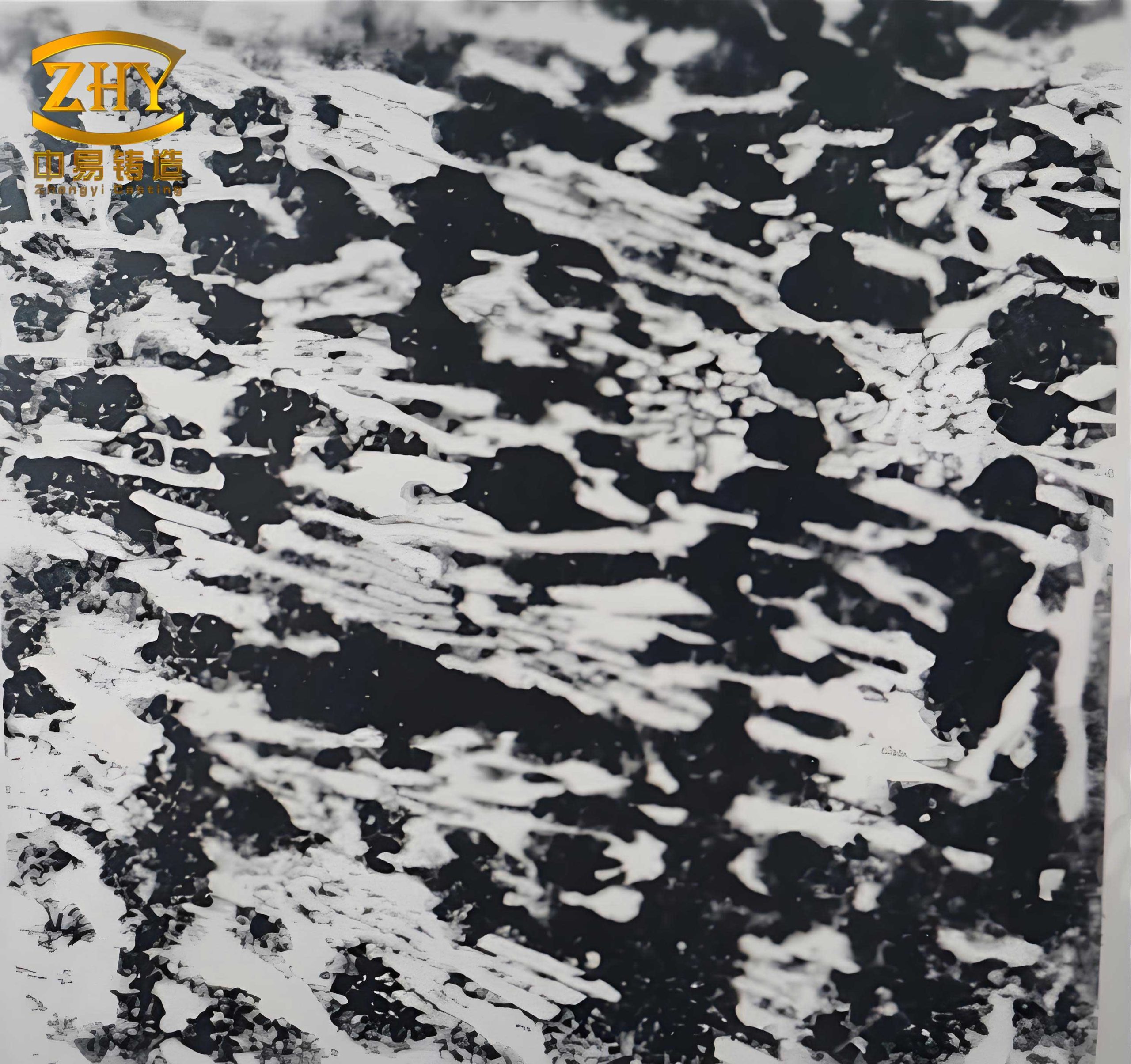
The image above provides a visual reference for the characteristic microstructure one aims to optimize in a high-quality white cast iron, highlighting the carbide phases embedded within the matrix.
| Process Feature | Sand Casting | Metal Mold Casting |
|---|---|---|
| Cooling Rate | Slow | Fast |
| Solidification Mode | Volume / Pasty | Directional / Skin-forming |
| Microstructure | Coarse grains, Continuous carbides | Fine grains, Refined/disrupted carbides |
| Casting Defects | Significant shrinkage porosity, sand inclusions likely | Minimal shrinkage, no sand inclusions |
| Surface Quality | Rough | Smooth, clean |
| Dimensional Accuracy | Lower | Higher |
| Breakage Rate Tendency | High | Low (when process is controlled) |
III. The Liquid State: Melting, Inoculation & Pouring
High-quality molten metal is the prerequisite for a high-quality casting. For low-chromium white cast iron, this involves precise temperature control and effective melt treatment.
Melting: The charge should be melted to a superheat temperature of approximately 1450–1500°C to ensure complete dissolution of alloying elements and adequate fluidity. A key practice is effective deoxidation. Using a compound deoxidizer like Fe-Si-Al (containing 41-45% Al, 36-40% Si) is highly recommended over pure aluminum. This alloy has a higher density than aluminum, allowing it to remain submerged in the iron melt longer for a more stable and thorough reaction. The deoxidation products are low-melting-point complex aluminosilicates that readily coalesce and float to the slag, resulting in a cleaner melt with fewer non-metallic inclusions that could act as fracture origins in the final white cast iron ball.
Inoculation (Modification): This is the transformative step that directly addresses the problem of the continuous carbide network. The addition of small amounts of rare earth (RE) elements (e.g., Cerium, Lanthanum) or other modifiers like Ferro-Titanium, just prior to pouring, has a profound impact on the solidification process. The mechanisms are multi-fold:
- Carbide Modification: RE elements are surface-active at the solid-liquid interface. They adsorb onto the growing carbide faces, poisoning their growth and promoting a more divorced, isolated, or rod-like morphology instead of a continuous network. This dramatically improves toughness.
- Grain Refinement: RE compounds can act as heterogeneous nucleation sites for both carbides and the austenite matrix, leading to overall grain refinement.
- Melt Purification: RE elements have a strong affinity for sulfur and oxygen. They form stable, high-melting-point compounds like RExSy and RExOy (e.g., CeS, melting point ~2990°C). These compounds are solid at pouring temperatures, have densities different from the melt, and are effectively removed with the slag, thereby desulfurizing and deoxidizing the iron. The reaction can be summarized as:
$$[RE] + [S] \rightarrow (RE)S_{(s)}$$
$$[RE] + [O] \rightarrow (RE)O_{(s)}$$
The inoculation is typically performed using the “pour-over” or “ladle-inoculation” method, where the precisely weighed inoculant is placed in the bottom of the pouring ladle, and the molten white cast iron is tapped onto it. After a brief stirring and slag removal, the metal is ready for pouring.
Pouring: The inoculated metal must be poured promptly to avoid fading of the inoculation effect. A pouring temperature in the range of 1350–1420°C is optimal—high enough to ensure complete filling but low enough to minimize shrinkage and gas absorption. The pouring stream should be steady and rapid to prevent mist runs, following a “slow-fast-slow” sequence to minimize turbulence.
IV. Solid-State Processing: Shakeout & Heat Treatment
Shakeout & Controlled Cooling: In metal mold casting, the mold is not simply left to cool. After a dwell time (3-10 minutes depending on ball size), the mold is opened, and the still-red-hot casting is ejected. This “shakeout” step is critical. The ball is then placed in an insulated container or a controlled environment to undergo a slow, stress-relieving cool to room temperature. This practice, essentially an in-process annealing, helps prevent the formation of casting stresses and cracks that could occur during unrestricted air cooling of the complex carbide structure in white cast iron.
Heat Treatment: While the as-cast microstructure can be serviceable, heat treatment is employed to optimize the matrix properties for the required combination of hardness and toughness. The matrix in low-chromium white cast iron can be austenitic, pearlitic, martensitic, or a tempered martensite/bainite, depending on composition and cooling history. Common heat treatment cycles include:
| Process | Typical Cycle | Objective & Resulting Microstructure | Resulting Properties |
|---|---|---|---|
| Air Quenching + Tempering | Austenitize (850-950°C) → Air Cool → Temper (200-450°C) | Transform matrix to martensite/bainite. Tempering relieves stresses and improves toughness. Matrix: Tempered martensite/bainite + Carbides. | High hardness (HRC 50-60), Good toughness. |
| High-Temperature Tempering (Annealing) | Heat to 500-600°C, hold, slow cool. | Decompose any as-cast martensite/austenite to softer, more stable phases like sorbitle (fine pearlite). Matrix: Sorbitle or fine pearlite + Carbides. | Lower hardness (HRC 45-52), Higher impact toughness, Good stress relief. |
| Sub-Critical Stress Relief | Heat to 250-350°C, hold, slow cool. | Relieve internal casting and transformation stresses without major microstructural change. | Minimal hardness change, Reduced risk of in-service cracking. |
The choice of treatment is a cost-performance decision based on the specific application’s demands on the white cast iron grinding ball.
V. Quantitative Quality Targets
When all factors are correctly controlled, a premium low-chromium white cast iron grinding ball should consistently meet the following benchmarks:
- Metallographic Structure: Fine, isolated or aggregated carbides ((Fe,Cr)7C3 and/or M3C) uniformly distributed in a matrix of tempered martensite, bainite, or fine pearlite (sorbitic structure).
- Macro-Hardness: HRC 45 – 58 (specific range depends on chosen heat treatment and application).
- Impact Toughness: Unnotched Charpy impact energy (ak) ≥ 5 J/cm². Higher values indicate better fracture resistance.
- Hardness Profile: Minimal gradient from surface to core. For a well-made Ø80mm ball, the core hardness should not be more than 3-5 HRC points lower than the surface hardness. The profile can be modeled as a function of radial position \(r\) (from center, \(r=0\), to surface, \(r=R\)):
$$HRC(r) = HRC_{surface} – k \cdot (R – r)^n$$
where \(k\) and \(n\) are material/process constants. A small \(k\) indicates uniform hardenability. - Wear Rate: In cement grinding, a specific wear rate of 70–150 grams per ton of ground cement is achievable, representing a significant improvement over forged steel balls.
In conclusion, the production of high-performance, reliable low-chromium white cast iron grinding balls is a symphony of interdependent processes. It begins with a chemistry tailored to the ball size and duty, proceeds through high-quality melting and transformative inoculation, is shaped by rapid solidification in a properly designed and managed metal mold, and is finally optimized through controlled cooling and appropriate heat treatment. Neglecting any one of these factors—be it an imbalanced composition, poor melt treatment, inadequate mold design, or incorrect thermal processing—will inevitably compromise the final product. The result of such compromise is most visibly and costly manifested in the mill: high breakage rates, irregular wear, and lost production. Therefore, a scientific, controlled, and holistic approach to manufacturing is not merely beneficial but essential to fully unlock the economic and performance potential inherent in low-chromium white cast iron as a premier material for grinding media. Future developments may focus on further refining inoculation techniques, modeling solidification and cooling stresses more precisely, and developing integrated process control systems to push the consistency and performance boundaries of this versatile white cast iron even further.