
In the manufacturing of automotive body panel stamping dies, surface hardening is a pivotal strengthening method. Among the techniques prevalent in die shops, such as flame hardening, laser hardening, and induction hardening, induction hardening stands out for its efficiency and controllability. This article delves into a comprehensive study of the induction hardening process applied to pearlitic spheroidal graphite iron, specifically the grade GGG70L. Through systematic experimentation and analysis of hardened case depth, a set of robust and optimized process parameters is summarized to meet the stringent technical demands of modern die manufacturing.
Material Fundamentals: Spheroidal Graphite Iron GGG70L
The spheroidal graphite iron designated GGG70L (according to DIN standards) is extensively employed in critical forming die components like draw dies, punches, and blank holders for automotive skin panels. Its popularity stems from an excellent combination of mechanical properties, surface hardenability, and weldability. The performance after induction hardening is intrinsically linked to its chemical composition and initial microstructure.
Chemical Composition Specifications
The chemical composition of spheroidal graphite iron GGG70L is carefully balanced to ensure the desired matrix structure and hardenability. Key alloying elements such as Copper (Cu) and Molybdenum (Mo) promote pearlite formation and increase hardenability, while Nickel (Ni) enhances both strength and toughness. The following table compares the compositional requirements across various international and corporate standards.
| Standard | Grade | C | Si | Mn | P (max) | S (max) | Cu | Ni | Mo | Mg |
|---|---|---|---|---|---|---|---|---|---|---|
| Germany (DIN) | GGG70L | 3.3-3.8 | 2.1-2.4 | 0.4-0.7 | 0.05 | 0.01 | 0.7-1.1 | 0.8-1.1 | 0.4-0.6 | ≥0.04 |
| Europe (EN) | EN-JS2070 | 3.2-3.6 | 1.8-2.4 | ≤0.8 | 0.05 | 0.01 | ≤1.0 | ≤1.0 | ≤0.5 | 0.04-0.06 |
| General Motors | GM338M | 3.0-3.8 | 1.6-2.6 | 0.3-0.8 | 0.08 | 0.015 | 0.6-1.2 | 0.7-1.2 | 0.3-0.8 | ≥0.03 |
| USA (ASTM) | A897 D7003 | 3.0-3.7 | 2.0-2.4 | 0.3-0.6 | 0.08 | 0.015 | 0.4-0.7 | 0.5-1.0 | 0.3-0.5 | 0.04-0.05 |
| China (GB) | QT700M | 3.4-3.8 | 2.0-2.8 | 0.3-0.8 | 0.06 | 0.02 | 0.3-0.7 | 0.9-1.0 | 0.4-1.0 | ≥0.03 |
Microstructure and Mechanical Prerequisites
The as-cast microstructure is paramount for successful surface hardening. For spheroidal graphite iron GGG70L, the ideal matrix consists predominantly of fine, uniformly distributed pearlite with a minimum of free ferrite. A high nodularity (graphite spheroidization) grade is also essential. A coarse initial structure or large, uneven blocks of ferrite can lead to austenite grain growth during rapid heating and impede the complete dissolution of carbides, thereby reducing hardenability and final hardness. The most favorable pearlitic morphology for induction hardening is a fine, fingerprint-like (“ridge”) structure, which allows for rapid and homogeneous austenitization.
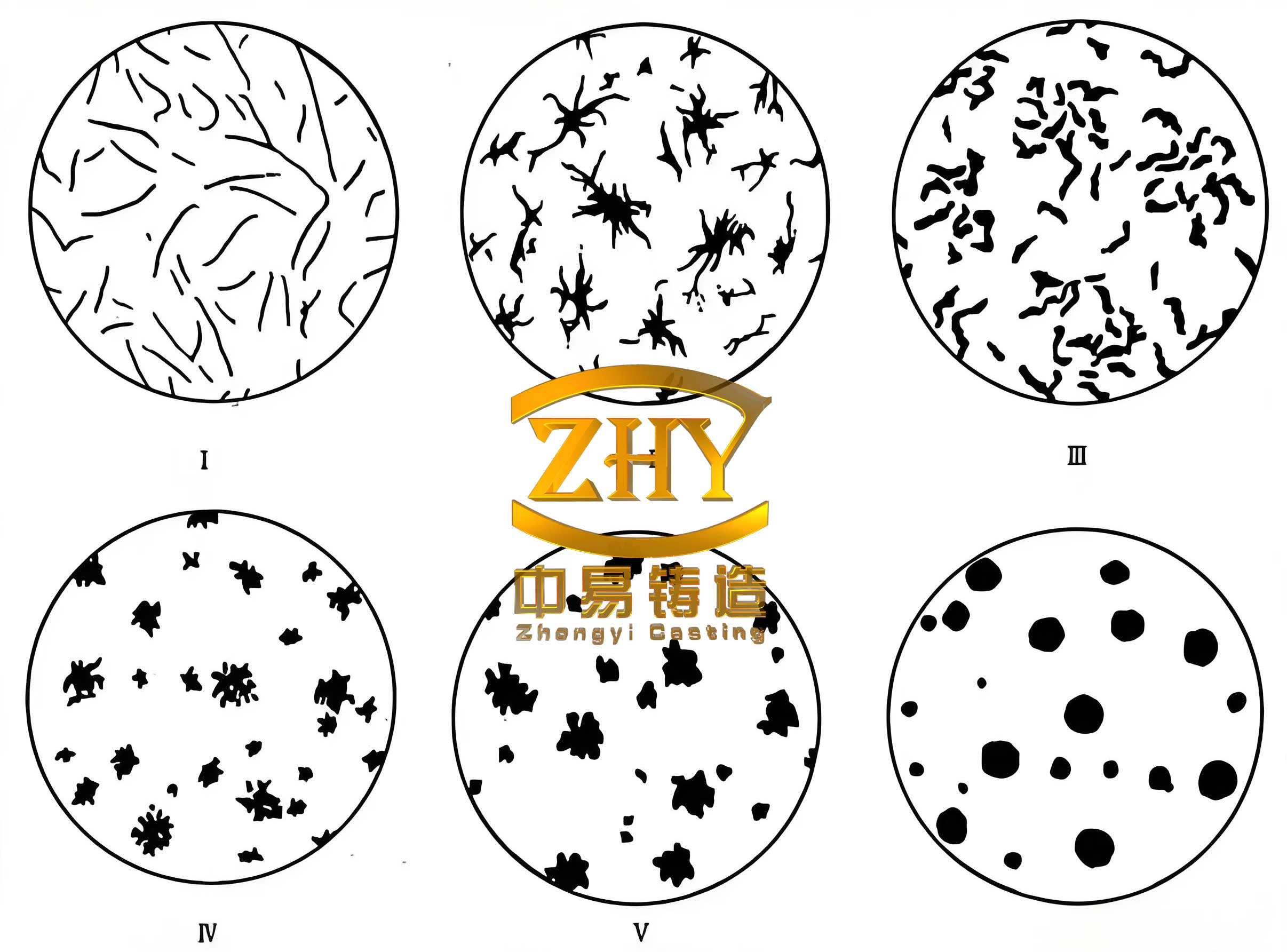
The table below outlines the typical microstructural and mechanical property requirements for this spheroidal graphite iron as specified by major automotive manufacturers.
| Specifying Entity / Standard | Grade | Nodularity / Graphite | Pearlite (%) | Tensile Strength (MPa) | Yield Strength (MPa) | Base Hardness (HBW) |
|---|---|---|---|---|---|---|
| Ford (WDX) | GGG70L | >90% (Grade 2) | >90 | ≥700 | ≥400 | 240-280 |
| BMW | GGG70L / EN-JS2070 | – | Sufficient Pearlite | ≥700 | ≥400 | 240-280 |
| Mercedes-Benz | GGG70L / EN-JS2070 | Uniformly distributed graphite nodules | >90 | 650-700 | 380-440 | 220-270 |
| Volkswagen | GGG70L / EN-JS2070 | – | – | 650-700 | 380-440 | 220-270 |
Principles and Equipment for Induction Hardening
Induction hardening is a surface heat treatment process that utilizes electromagnetic induction to generate eddy currents within the workpiece, resulting in rapid, localized heating. Subsequent self-quenching (or spray quenching) leads to the formation of a hard martensitic case. This method offers significant advantages: the heat source is confined to the surface layer, enabling fast heating rates and high thermal efficiency; the short processing time minimizes oxidation and decarburization; and the selective heating reduces overall part distortion.
The depth of the hardened case (δ) is a critical parameter and is primarily governed by the frequency (f) of the alternating current, the material’s electrical resistivity (ρ), and relative magnetic permeability (μr). An approximate relationship for the current penetration depth, which influences the heating depth, is given by:
$$
\delta \approx 503 \sqrt{\frac{\rho}{\mu_r f}}
$$
where δ is in meters, ρ in ohm-meters, and f in hertz. For spheroidal graphite iron, a medium frequency range is typically used to achieve case depths suitable for die applications (1-3 mm).
For this investigation on spheroidal graphite iron, the following materials and equipment were employed:
- Test Material: A cast block of spheroidal graphite iron GGG70L was used, with a verified chemical composition within the specified limits (e.g., C: 3.64%, Si: 2.03%, Cu: 0.92%, Ni: 0.91%, Mo: 0.52%) and a microstructure featuring >90% nodularity and 85-90% pearlite content.
- Induction Hardening Equipment: A MICO mobile induction hardening unit (Model M18MF) with a frequency range of 16-40 kHz and an inverter efficiency factor (ηinv) adjustable up to >0.95.
- Hardness Measurement: A TMVS-1S Vickers microhardness tester was used to measure the hardness profile and determine the effective case depth, defined as the depth where hardness exceeds 50 HRC (approx. 513 HV).
Experimental Study and Process Optimization
The objective was to establish a process window that consistently produces a surface hardness ≥ 50 HRC with a controlled and uniform case depth on the spheroidal graphite iron component. The theoretical austenitization temperature range for GGG70L is 840-870°C. However, practical induction heating requires a slightly higher surface temperature to ensure complete transformation, typically in the range of 900-950°C. The key controlled variables were the inverter power factor (as a proxy for power input) and the traverse speed of the inductor. The frequency was held relatively constant within the machine’s medium-frequency band.
Process Trials and Results
Four distinct process parameter sets were trialed on the spheroidal graphite iron test block. Hardness traverses were performed perpendicular to the quenching direction, measuring from the surface to the core. Case depth values were recorded at the edge and in the central “red-hard” zone.
| Trial | Inverter Efficiency (ηinv) | Frequency (kHz) | Traverse Speed (mm/min) | Avg. Case Depth (mm) | Case Depth at Edge (mm) | Case Depth at Center (mm) | Surface Hardness (HRC) |
|---|---|---|---|---|---|---|---|
| Process 1 | 0.800 | 29.8 | 280 | 1.55 | 0.83 | 2.05 | 50-60 |
| Process 2 | 0.855 | 29.9 | 260 | 1.65 | 1.60 | 1.67 | 54-61 |
| Process 3 | 0.886 | 30.1 | 280 | 1.52 | 1.51 | 1.53 | 52-60 |
| Process 4 | 0.921 | 30.1 | 280 | 2.04 | 1.74 | 2.34 | 52-64 |
Analysis and Discussion
The results clearly demonstrate the sensitivity of the spheroidal graphite iron’s hardening response to input power (represented by ηinv) and heat input time (inversely related to traverse speed).
- Process 1 (Low Power): The lowest power setting resulted in a shallow and non-uniform case, particularly at the edges (0.83 mm). This indicates insufficient energy density to fully austenitize the surface layer uniformly, especially where heat losses are higher.
- Process 2 & 3 (Moderate Power): Increasing the inverter efficiency to 0.855-0.886 significantly improved uniformity between edge and center (1.60-1.67 mm). The case depth stabilized around 1.5-1.6 mm with excellent hardness values. This range appears optimal for achieving a consistent, functional case.
- Process 4 (Higher Power): The highest power setting (ηinv = 0.921) produced the deepest average case (2.04 mm) and highest surface hardness. However, the disparity between edge (1.74 mm) and center (2.34 mm) depths increased, suggesting a risk of overheating in the central zone if not carefully controlled.
The relationship between surface temperature (Ts), power (P), and speed (v) can be conceptually described for a moving inductor:
$$
T_s \propto \frac{P}{v \cdot k}
$$
where k is a factor encompassing material thermal properties, geometry, and inductor coupling. For the spheroidal graphite iron GGG70L, maintaining Ts between 900-950°C requires balancing P and v. Based on the trials, an inverter efficiency setting of 0.90-0.92 with a uniform traverse speed of 260-280 mm/min yields the most favorable combination of adequate hardness (≥54 HRC) and uniform case depth (~1.6-2.0 mm).
It is critical for the operator to visually monitor the heated zone. The aim is to achieve a consistent “red-hard” color, corresponding to the austenitization temperature. A “bright-red” or “orange” glow (exceeding ~1100°C) must be avoided, as the melting point of spheroidal graphite iron (1148-1400°C) is lower than that of steel. Localized dwelling causing such overheating can lead to surface melting, burning, or the formation of undesirable brittle microstructures and quenching cracks.
Key Considerations for Industrial Application on Dies
When applying induction hardening to actual spheroidal graphite iron die components, several practical factors must be considered beyond the basic power-speed parameters.
- Variability in Pearlite Content: The hardenability of spheroidal graphite iron is directly linked to its pearlite fraction. Castings with lower initial pearlite content (e.g., high ferrite) present a challenge. To achieve the required surface hardness, the operator may need to employ a higher heating temperature (within the safe limit) and a slower traverse speed. In some cases, multiple successive heating passes might be necessary to create a “normalizing” effect, dissolving more carbon into the matrix to facilitate martensite formation upon quenching.
- Manual Process Control: With mobile induction equipment, the operator’s skill in maintaining a steady, consistent traverse speed is paramount for achieving a uniform hardened case on spheroidal graphite iron components. Any hesitation or variation directly translates into fluctuations in case depth and hardness.
- Die Geometry and Functional Areas: Stamping dies have distinct functional zones such as draw beads (on blank holders), convex radii on the die, character lines, and restrike surfaces. The geometry (edges, corners, ribs) significantly affects the electromagnetic coupling and heat dissipation during induction heating of spheroidal graphite iron. Inductor design and path planning must account for these variations to ensure the working hardness is achieved in all critical areas without overheating geometric features.
In conclusion, induction hardening is a highly effective method for strengthening the surface of pearlitic spheroidal graphite iron GGG70L die components. Success hinges on a triad of factors: a controlled and fine pearlitic base microstructure, optimized process parameters (specifically a power setting corresponding to ηinv ~0.90-0.92 and a controlled traverse speed of ~260-280 mm/min to achieve a surface temperature of 900-950°C), and skilled manual execution that accounts for component geometry. This systematic approach ensures the production of durable dies capable of withstanding the high loads and abrasive wear encountered in automotive sheet metal stamping operations.