
The production of high-integrity cylinder heads remains a significant challenge in foundry engineering due to the component’s complex geometry, stringent service requirements, and susceptibility to various casting defects. As a core component subjected to extreme thermal and mechanical stresses, the presence of defects such as porosity, sand burn-in, and chill-related issues can severely compromise the structural integrity and longevity of the entire engine assembly. Therefore, the systematic identification, root-cause analysis, and mitigation of these casting defects are paramount for ensuring product reliability and manufacturing efficiency. This article details a comprehensive investigation into the prevalent casting defects encountered during the production of a specific monoblock cylinder head, presenting a multi-faceted approach to process improvement that significantly enhanced casting quality.
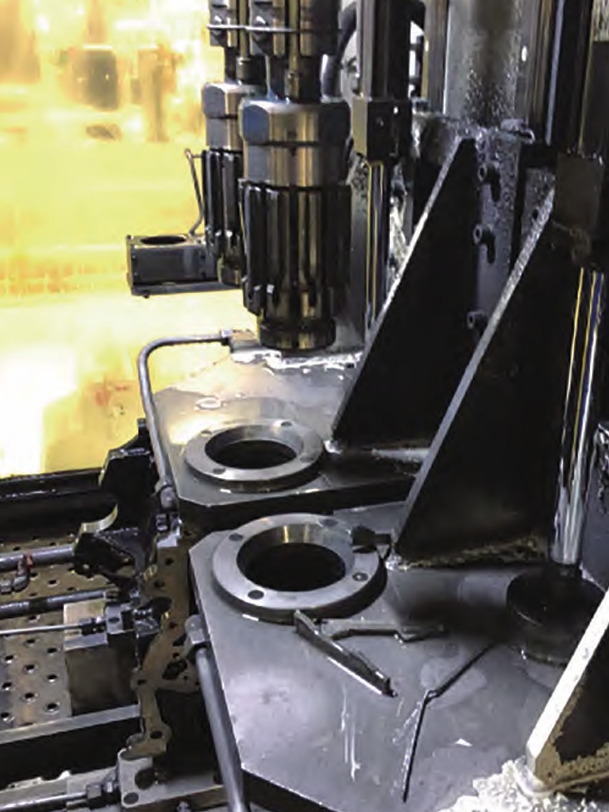
The subject cylinder head, cast in grade HT300 grey iron with a net weight of approximately 250 kg, features intricate internal passages for coolant, intake, and exhaust. The significant variation in wall thickness, with sections as thin as 8 mm, alongside the extensive use of resin-bonded sand cores, creates an environment prone to specific failure modes. Initial production data revealed a dominant Pareto distribution of scrap causes, with upper surface porosity, internal cavity sintering, and chill-related defects collectively accounting for over 85% of rejections. This analysis will focus on these critical casting defect categories.
1. Analysis and Mitigation of Upper Surface Porosity Defects
The most frequent and critical casting defect observed was localized porosity on the upper deck surface of the cylinder head. These defects typically manifested as spherical or elliptical cavities located in sections corresponding to the last areas to solidify. Metallographic examination confirmed these as blowholes or subsurface pinholes, classic forms of gas-related casting defects.
1.1 Root Cause Analysis
The formation of such porosity is fundamentally linked to the entrapment of gas within the solidifying metal. The primary gas sources in this process were identified as:
- Gases generated from the thermal decomposition of organic binders (resins) in the sand cores.
- Air and moisture displaced from the sand mold and core assembly during pouring.
The core assembly for this cylinder head was particularly complex, incorporating several shell cores made with hot-box coated sand for sections like the water jacket. While offering good dimensional accuracy, these cores can exhibit high gas evolution rates if not properly vented. The fundamental problem was identified as inadequate venting pathways for the gases generated from the thick, massive sections of the water jacket core and the upper core assembly. During pouring, the rapid heating of these cores produced a large volume of gas that could not escape efficiently into the mold atmosphere or through the sand mold itself. The gas pressure buildup at the metal-core interface eventually exceeded the local metallostatic pressure, allowing gas to invade the still-liquid or semi-solid metal, resulting in the observed casting defect.
The gas pressure required to form a pore can be described by a simplified force balance at the interface:
$$ P_g > P_m + \frac{2\sigma}{r} $$
Where \( P_g \) is the gas pressure at the interface, \( P_m \) is the metallostatic pressure at that point, \( \sigma \) is the surface tension of the liquid iron, and \( r \) is the effective radius of a nucleation site. Inadequate venting leads to an increase in \( P_g \), directly promoting pore formation.
1.2 Process Optimization Strategy
The corrective strategy focused on creating dedicated, low-resistance escape routes for core and mold gases, effectively reducing \( P_g \). This was implemented through a multi-point modification of the tooling and process.
| Component Modified | Specific Change | Functional Purpose |
|---|---|---|
| Water Jacket Core | Drilling of Ø12 mm vent holes in large planar sections, Ø10 mm holes at front/rear ends, and Ø6 mm holes in side core prints. All holes were plugged with ceramic rope and backing sand. | To provide direct venting paths from the thickest, most gassy sections of the core to the external mold cavity or core prints. |
| Upper Core (Cope Core) | Modification of the cold-box core tooling to incorporate 14 vent pins (Ø12 mm). Manual enlargement of 4 central vent holes to Ø25 mm after core making. | To significantly increase the cross-sectional area for gas escape from the upper core assembly directly into the upper mold. |
| Upper Mold Pattern Plate | Addition of movable blocks to connect and ensure the openness of the vent channels leading from the core to the mold’s atmospheric vents. | To guarantee that the vent paths from the core are not blocked by molding sand and are effectively connected to the outside atmosphere. |
The synergistic effect of these modifications created a comprehensive low-pressure venting network. This network allowed gases generated during pouring to be efficiently channeled away from the metal-core interface before they could reach critical pressure levels to cause a casting defect. Post-implementation statistical process control data showed a dramatic reduction in the porosity defect rate on the upper surface from an initial 47.6% to a stabilized 2.52%, validating the effectiveness of the venting solution.
2. Analysis and Resolution of Internal Sand Burn-in Defects
Another persistent quality issue was sand sintering or burn-in on the internal surfaces of the water jacket passages. This casting defect presents as a rough, fused layer of sand and metal, increasing cleaning costs and potentially causing downstream issues if loose particles break off during engine operation.
2.1 Root Cause Analysis
Burn-in occurs when the thermal load on a section of the sand core exceeds the refractory capacity of the sand/binder system or the protective coating. The water jacket core, due to its substantial mass and proximity to hot metal, is especially vulnerable. Analysis pointed to two contributing factors:
- Insufficient Cured Shell Thickness: The hot-box core-making process parameters for the massive water jacket core were suboptimal. The original cycle time and temperature profile resulted in a cured phenolic resin shell that was locally less than 3 mm thick, whereas a minimum of 5-6 mm is required for such an application. This thin shell had reduced hot strength and allowed excessive heat transfer to the uncured sand behind it, leading to its disintegration and fusion with the metal.
- Inadequate Thermal Protection: The standard robotic dipping coating process, while efficient, sometimes resulted in inconsistent coating thickness on complex geometries and deep pockets of the core assembly, leaving some areas under-protected.
2.2 Integrated Process Improvements
To combat this casting defect, a dual-pronged approach was adopted, targeting both the core integrity and its surface protection.
2.2.1 Optimization of Core-Making Parameters
The hot-box process for the water jacket core was rigorously reviewed and adjusted. The key change was increasing the sand shooting time from 8-12 seconds to 10-15 seconds. This ensured better compaction and uniformity of the sand in the tooling cavity, leading to a more consistent and adequately thick cured shell. The improved shell thickness provided better mechanical resistance against metal penetration and increased the thermal mass of the refractory barrier.
2.2.2 Enhanced Coating Strategy
A hybrid coating technique was implemented:
- Localized Pre-coating: Before the core assembly stage, the identified critical areas on the water jacket core prone to burn-in were manually pre-coated with a high-refractoriness alcohol-based zirconia paint. This established a robust, first-line thermal barrier exactly where it was needed most.
- Robotic Overall Dipping: Following assembly, the complete core package (lower and upper assemblies) underwent the standard robotic dipping process using a high-quality water-based coating. This ensured overall coverage and good surface finish for all internal passages.
This two-step coating process guaranteed that the most thermally stressed areas received maximum protection, while maintaining the efficiency and consistency of automated coating for the entire core. The result was the virtual elimination of sand burn-in defects, proving the efficacy of targeted thermal management in preventing this type of casting defect.
3. Management of Chill-Induced Casting Defects
External chills, used extensively on the lower deck (fire deck) to promote directional solidification and achieve desired microstructure, were the source of two distinct defects: surface porosity and chill “stickers” or fusion.
3.1 Defect Characterization and Causes
Chill-Related Porosity: This appeared as small, shiny pinholes or blowholes typically within 15 mm of the casting surface in contact with the chill. The root cause is chemical. Moisture, rust (Fe₂O₃), or other contaminants on the chill surface react violently with the molten iron. The classic reaction is:
$$ \text{Fe}_2\text{O}_3 + 3\text{C} \rightarrow 2\text{Fe} + 3\text{CO} \uparrow $$
The rapid generation of carbon monoxide (CO) gas, combined with the poor venting conditions at the tight metal-chill interface, leads to gas entrapment and pore formation. This highlights how an auxiliary tool meant to improve quality can itself become a source of a significant casting defect if not properly controlled.
Chill Fusion (Stickers): This defect occurred when the chill surface became partially fused to the casting, requiring extensive grinding for removal. The primary cause was the degradation of the chill’s chilling power over repeated use. Grey iron chills undergo graphitization and oxidation during thermal cycling. The surface oxide layer cracks, allowing oxygen to penetrate and oxidize the underlying graphite flakes. As the high-thermal-conductivity graphite is replaced by lower-conductivity oxides, the chill’s ability to extract heat diminishes. Consequently, the interface temperature rises, increasing the risk of metallurgical bonding between the chill and the casting, leading to this troublesome casting defect. The heat extraction capacity can be conceptualized by Fourier’s law:
$$ q = -k \cdot A \cdot \frac{dT}{dx} $$
Where \( q \) is the heat flux, \( k \) is the thermal conductivity of the chill material, \( A \) is the contact area, and \( dT/dx \) is the temperature gradient. A decrease in the effective \( k \) due to surface oxidation reduces \( q \), leading to a higher interface temperature.
3.2 Systematic Chill Management Protocol
To eliminate these defects, a strict, process-controlled chill management system was instituted, treating chills as critical consumable tooling rather than permanent fixtures.
| Improvement Measure | Implementation | Targeted Defect |
|---|---|---|
| Surface Condition Control | Mandatory use of new or fully reconditioned chills with clean, rust-free surfaces. Strict pre-use inspection for contamination, oxidation, or damage. | Chill-related Porosity |
| Lifecycle Management | Establishment of a maximum reuse limit of 10 cycles for grey iron chills. Implementation of a tracking system (e.g., batch marking) to monitor usage count. | Chill Fusion & General Performance Decay |
| Operator Training & Procedure | Standardized work instructions for chill inspection, placement, and removal. Emphasis on chill cleanliness as a critical quality parameter. | Both Porosity and Fusion |
The implementation of this controlled protocol had an immediate and pronounced effect. The defect rate attributed to external chills plummeted from 22.3% to 2.4%. This case underscores that controlling a casting defect often requires managing the entire ecosystem of the process, including auxiliary tooling.
4. Summary of Improvements and Generalized Learnings
The comprehensive approach to tackling the dominant casting defects in this cylinder head program yielded transformative results. The table below summarizes the key interventions and their quantitative impact.
| Casting Defect Category | Root Cause Identified | Key Process Improvements | Result (Defect Rate Reduction) |
|---|---|---|---|
| Upper Surface Porosity | Insufficient venting for gases from thick shell cores. | Design of integrated venting network in water jacket core, upper core, and mold. | 47.6% → 2.52% |
| Internal Sand Burn-in | Thin cured shell on core and inadequate thermal protection. | Optimized hot-box parameters; Hybrid (pre-coat + dip) coating strategy. | Virtually Eliminated |
| Chill-Related Defects | Contaminated/degraded chill surfaces and overused chills. | Strict surface quality control, reuse limit (10 cycles), and standardized handling. | 22.3% → 2.4% |
The successful resolution of these issues reinforces several fundamental principles in preventing casting defects:
- Gas Management is Critical: For complex cores, proactive venting design is non-negotiable. It must be treated as importantly as the feeding system design.
- Core Integrity and Protection are a System: Core-making parameters and coating application must be jointly optimized based on the specific thermal load of each core section.
- Auxiliary Tooling Requires Active Management: Items like chills must have defined quality standards and lifecycle limits to prevent them from introducing variability and defects.
- Data-Driven Diagnosis is Key: Effective defect reduction starts with precise categorization (e.g., differentiating between gas porosity and shrinkage) and Pareto analysis to focus efforts on the most impactful issues.
Looking forward, further advancements can be pursued. The development of next-generation core sands with lower gas evolution and higher hot strength would provide a more robust baseline. Similarly, exploring advanced coating technologies with enhanced insulating properties could offer greater margins against sintering defects. Ultimately, the control of casting defects is an iterative process of analysis, targeted intervention, and standardization, demanding a deep understanding of the intricate interplay between geometry, materials, process physics, and tooling management.