
In the field of internal combustion engine manufacturing, gray iron casting plays a pivotal role due to its excellent castability, machinability, and damping capacity. Cylinder heads, as critical components, are subjected to severe thermal and mechanical stresses, necessitating precise control over their material properties. The performance and longevity of these castings are heavily influenced by the microstructure, which in turn depends on the charge materials used during melting. This study investigates the effects of varying charge ratios—specifically the proportions of returns, pig iron, and start-up blocks—on the microstructure and mechanical properties of gray iron casting for cylinder head applications. Understanding these relationships is essential for optimizing production processes and ensuring consistent quality, especially in the face of fluctuating raw material supply.
The hereditary effects of charge materials in gray iron casting are well-documented; the initial graphite morphology and matrix structure from the charge can propagate through the melting process, affecting the final casting. This research delves into how different charge compositions alter graphite length, pearlite content, and ultimately tensile strength and hardness. By employing systematic trials, we aim to provide actionable insights for foundries to adjust their charge mixes while maintaining desired specifications. The focus is on X-type cylinder heads, which require high tensile strength (≥240 MPa) and controlled hardness (190–240 HB) for meeting stringent emission standards. Throughout this article, the term gray iron casting will be emphasized to underscore its relevance in industrial applications.
Our experimental approach involved melting in a 10-ton medium-frequency induction furnace, with charge ratios designed to isolate the impact of returns, pig iron, and start-up blocks. The chemical composition was kept within a narrow range to minimize confounding variables, as shown in Table 1. The charge materials were added sequentially, with alloying elements introduced early in the melt. Key process parameters included a high-temperature holding phase at 1520–1530°C for 10 minutes, followed by tapping at 1460–1530°C. Inoculation was performed both at the furnace (0.3–0.5%) and during pouring (0.06–0.12%). For one trial, an extended high-temperature stirring process was implemented to assess its effect on mitigating graphite heredity from pig iron.
| Element | C | Si | Mn | S | P | Cu | Cr | Ni |
|---|---|---|---|---|---|---|---|---|
| Range | 3.20–3.35 | 1.70–2.10 | 0.60–1.00 | 0.06–0.12 | ≤0.06 | 0.60–0.80 | 0.20–0.35 | 0.30–0.50 |
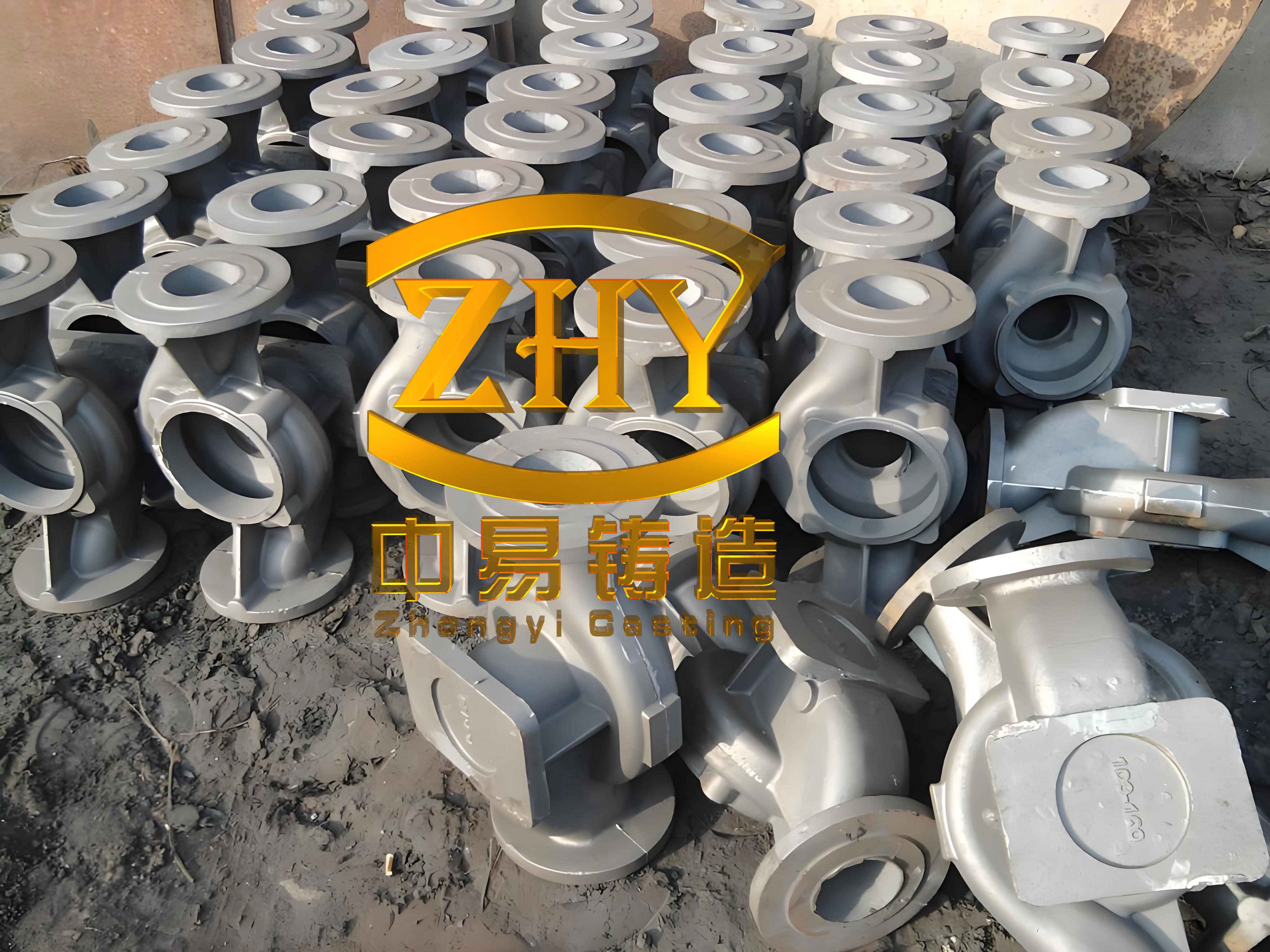
The charge ratio trials are summarized in Table 2, which outlines seven distinct mixtures. Schemes 1–4 varied the returns proportion from 15% to 40%, with the balance made up of scrap steel. Scheme 5 introduced a start-up block (15%) alongside returns and scrap steel. Schemes 6 and 7 incorporated pig iron at 5% and 57%, respectively, with Scheme 7 including a 1.5-hour high-temperature stirring above 1500°C. Each batch produced cylinder head castings, from which samples were extracted from designated locations (similar to the reference figure) for mechanical testing and microstructural analysis. Tensile strength was measured using a universal testing machine, hardness via Brinell testing, and microstructure examined through optical microscopy.
| Scheme | Pig Iron | Scrap Steel | Returns | Start-up Block |
|---|---|---|---|---|
| 1 | 0 | 85 | 15 | 0 |
| 2 | 0 | 80 | 20 | 0 |
| 3 | 0 | 75 | 25 | 0 |
| 4 | 0 | 60 | 40 | 0 |
| 5 | 0 | 70 | 15 | 15 |
| 6 | 5 | 55 | 40 | 0 |
| 7 | 57 | 13 | 30 | 0 |
The chemical analysis of the produced gray iron casting is presented in Table 3. All schemes maintained compositions within the target ranges, with slight variations in alloying elements like Cu, Cr, and Ni due to differences in charge heritage. These variations are critical, as they influence the microstructure and mechanical properties. For instance, higher alloy content can enhance pearlite stability and refine the matrix, counteracting some hereditary effects. The carbon equivalent (CE) can be approximated using the formula: $$ CE = C + \frac{Si + P}{3} $$ which for these gray iron castings ranged from approximately 3.8 to 4.0, indicating good castability but also sensitivity to graphite formation.
| Scheme | C | Si | Mn | S | P | Cu | Cr | Ni |
|---|---|---|---|---|---|---|---|---|
| 1 | 3.35 | 1.95 | 0.70 | 0.079 | 0.021 | 0.66 | 0.24 | 0.30 |
| 2 | 3.34 | 1.95 | 0.80 | 0.075 | 0.020 | 0.66 | 0.23 | 0.31 |
| 3 | 3.35 | 1.98 | 0.73 | 0.075 | 0.020 | 0.69 | 0.24 | 0.32 |
| 4 | 3.34 | 1.90 | 0.72 | 0.075 | 0.022 | 0.72 | 0.28 | 0.34 |
| 5 | 3.33 | 1.95 | 0.74 | 0.073 | 0.023 | 0.65 | 0.25 | 0.30 |
| 6 | 3.32 | 1.90 | 0.73 | 0.076 | 0.021 | 0.74 | 0.21 | 0.31 |
| 7 | 3.27 | 1.91 | 0.69 | 0.081 | 0.027 | 0.80 | 0.23 | 0.30 |
Microstructural observations revealed significant trends. As the returns proportion increased from 15% to 25% (Schemes 1–3), graphite length and quantity gradually rose, with more coarse flakes evident. This is attributed to the hereditary propagation of graphite nuclei from the returns, which act as substrates for growth during solidification. The pearlite content remained above 98% in all these cases, indicating minimal impact on the matrix. However, at 40% returns (Scheme 4), the graphite was still prevalent, but the higher alloy content (notably Cu, Cr, Ni) contributed to a refined pearlite structure, offsetting some softening effects. The relationship between graphite length (L_g) and returns ratio (R_r) can be modeled linearly for this gray iron casting: $$ L_g = \alpha + \beta R_r $$ where $\alpha$ and $\beta$ are constants derived from experimental data, with $\beta > 0$ indicating increased graphite length with higher returns.
The addition of start-up blocks (Scheme 5) resulted in even coarser and longer graphite compared to Scheme 3, due to the inherent slow cooling history of these blocks that promotes large graphite formation. This highlights the strong hereditary influence in gray iron casting, where prior graphite morphology can persist through remelting. In contrast, pig iron additions introduced distinct changes. With 5% pig iron (Scheme 6), graphite became coarser, and ferrite content increased slightly, reducing tensile strength. At 57% pig iron (Scheme 7), the hereditary effect was more pronounced, but the high-temperature stirring process effectively dissolved primary graphite, leading to shorter and finer graphite compared to Scheme 6. This suggests that kinetic factors during melting can modulate heredity. The stirring process enhances diffusion, as described by Fick’s law: $$ J = -D \frac{\partial C}{\partial x} $$ where $J$ is the flux, $D$ is the diffusion coefficient, and $\frac{\partial C}{\partial x}$ is the concentration gradient, facilitating graphite dissolution in the melt.
Mechanical property data are consolidated in Table 4. Tensile strength decreased from 286 MPa to 280 MPa as returns increased from 15% to 25%, consistent with graphite coarsening. However, at 40% returns, strength rebounded to 285 MPa due to alloy strengthening. Hardness followed a similar pattern, staying within 202–204 HB for Schemes 1–4. The start-up block scheme (5) showed a notable drop to 250 MPa tensile strength and 185 HB, underscoring the detrimental impact of coarse graphite. For pig iron schemes, Scheme 6 maintained 282 MPa and 202 HB, while Scheme 7 fell to 253 MPa and 191 HB, reflecting the interplay between heredity and process intervention. These results emphasize that in gray iron casting, mechanical properties are sensitive to charge-induced microstructural changes.
| Scheme | Tensile Strength (MPa) | Hardness (HB) | Graphite Type | Graphite Length (Grade) | Pearlite Content (%) |
|---|---|---|---|---|---|
| 1 | 286 | 202 | A | 4 | ≥98 |
| 2 | 282 | 204 | A | 4 | ≥98 |
| 3 | 280 | 202 | A | 4 | ≥98 |
| 4 | 285 | 204 | A | 4 | ≥98 |
| 5 | 250 | 185 | A | 4 | ≥98 |
| 6 | 282 | 202 | A | 4 | ≥98 |
| 7 | 253 | 191 | A | 4 | 95–98 |
To quantify the effect of charge ratio on tensile strength ($\sigma_t$), a multiple regression model can be developed incorporating key variables such as returns ratio ($R_r$), pig iron ratio ($R_p$), and alloy factor ($A_f$), where $A_f$ is a weighted sum of Cu, Cr, and Ni content. For this gray iron casting dataset, an empirical relationship might be: $$ \sigma_t = \gamma_0 + \gamma_1 R_r + \gamma_2 R_p + \gamma_3 A_f + \epsilon $$ where $\gamma_i$ are coefficients and $\epsilon$ is error. Based on our observations, $\gamma_1$ is negative for low alloy levels but positive when alloy content is high, $\gamma_2$ is negative due to ferrite promotion, and $\gamma_3$ is positive. This model aids in predicting property shifts when adjusting charge mixes for gray iron casting production.
The role of inoculation in gray iron casting cannot be overlooked; it modifies graphite nucleation and growth, partially counteracting hereditary effects. The efficiency of inoculation ($I_e$) can be expressed as a function of base sulfur content and inoculant addition: $$ I_e = k_s S + k_i I_a $$ where $S$ is sulfur percentage, $I_a$ is inoculant addition rate, and $k_s$, $k_i$ are constants. In our trials, consistent inoculation helped maintain Type A graphite, but it could not fully overcome the coarse graphite from high-returns or start-up blocks. This interplay between charge heredity and inoculation is crucial for controlling gray iron casting quality.
Extended discussion on the high-temperature stirring process reveals its potential for improving gray iron casting consistency. By maintaining the melt above 1500°C for 1.5 hours with agitation, we observed reduced graphite size in Scheme 7 compared to Scheme 6, despite higher pig iron content. This aligns with kinetic theory, where temperature ($T$) and time ($t$) enhance dissolution according to an Arrhenius-type equation: $$ r_d = A e^{-E_a / (RT)} t $$ where $r_d$ is dissolution rate, $A$ is a pre-exponential factor, $E_a$ is activation energy, and $R$ is the gas constant. Implementing such practices can mitigate the negative heredity of pig iron in gray iron casting, offering a pathway to use higher proportions of cost-effective charge materials without sacrificing properties.
In industrial contexts, the findings underscore the need for dynamic charge management. For gray iron casting like cylinder heads, where properties are critical, returns should be limited to 25% or less unless compensated by alloy additions. Start-up blocks, while useful for furnace initiation, should be avoided in the final charge due to their strong coarse graphite heredity. Pig iron can be incorporated up to 5% with minimal impact, but higher amounts require process adjustments like high-temperature stirring to dissolve primary graphite. These strategies ensure that gray iron casting meets the rigorous demands of modern engine designs.
Future work could explore the integration of computational thermodynamics to predict phase equilibria in gray iron casting melts with varied charges. Software such as Thermo-Calc could simulate the effects of charge composition on graphite saturation and pearlite formation, providing a virtual testing ground. Additionally, advanced characterization techniques like scanning electron microscopy (SEM) could quantify graphite morphology parameters (e.g., aspect ratio, branching) to refine the relationships with mechanical properties. The ongoing evolution of gray iron casting technology will benefit from such multidisciplinary approaches.
In conclusion, the charge ratio significantly influences the microstructure and mechanical properties of gray iron casting through hereditary mechanisms. Increasing returns proportion elongates graphite and reduces tensile strength, unless offset by alloying elements. Start-up blocks introduce coarse graphite, degrading properties. Pig iron increases ferrite content and coarsens graphite, but high-temperature stirring can alleviate these effects. For foundries producing high-performance gray iron casting components, careful selection and control of charge materials, combined with process optimizations, are essential to achieve consistent quality and performance. This study reinforces the importance of understanding material heredity in gray iron casting and provides practical guidelines for charge formulation in industrial applications.