
In the field of industrial materials, wear resistance is a critical property that determines the longevity and efficiency of components subjected to abrasive environments. Among various wear-resistant materials, white cast iron has emerged as a prominent candidate due to its high hardness and excellent abrasion resistance. However, the inherent brittleness of white cast iron, primarily caused by the continuous network of eutectic carbides, limits its widespread application. This brittleness results in catastrophic failure under impact or tensile stresses, leading to frequent replacements and economic losses. Therefore, enhancing the toughness of white cast iron without compromising its wear resistance is a significant challenge. In this study, we investigate the effects of modification and heat treatment on the microstructure and impact toughness of low alloy white cast iron. By employing various modifiers and normalizing processes, we aim to disrupt the carbide network, refine the microstructure, and improve the mechanical properties. The findings from this research provide insights into developing cost-effective and high-performance white cast iron for applications in mining, construction, and machinery industries.
White cast iron is characterized by its high carbon content, which forms hard carbides during solidification. These carbides, typically in the form of cementite (Fe3C), create a brittle network that embrittles the material. To address this, several approaches have been explored, including alloying, modification, and heat treatment. Alloying with elements like chromium, molybdenum, and vanadium can alter carbide morphology, but it often increases cost. Heat treatment, such as normalizing or annealing, can partially break the carbide network through diffusion processes. Modification, involving the addition of inoculants or modifiers during melting, offers a simpler and more economical route to refine microstructure and improve toughness. In this work, we focus on modification techniques using combinations of rare earth (Re), zinc (Zn), niobium (Nb), and calcium-silicon (Ca-Si) alloys, followed by normalizing heat treatment. We analyze the microstructural changes, hardness, and impact toughness to evaluate the effectiveness of these treatments.
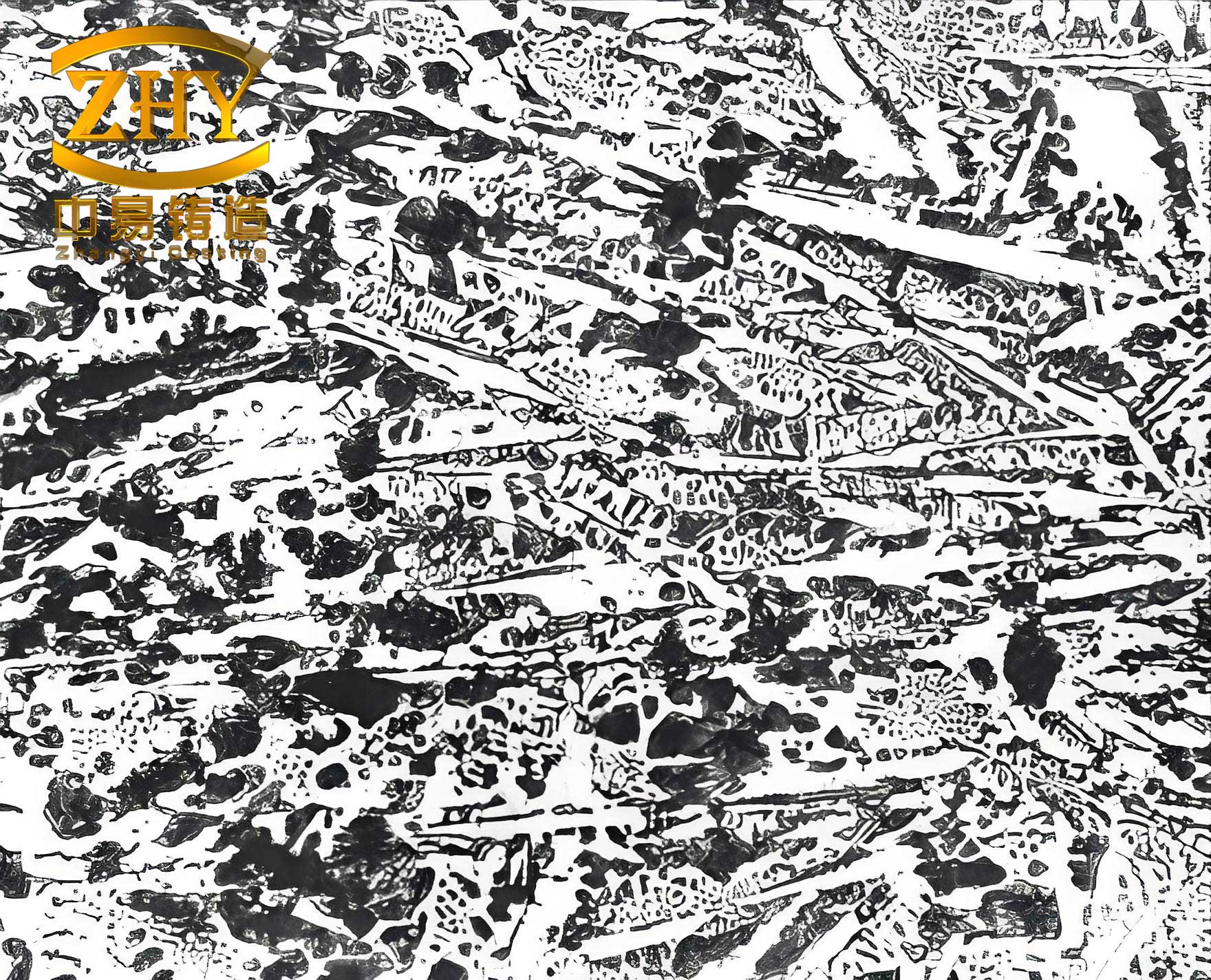
The production of white cast iron components often involves casting processes, where control over microstructure is crucial. The image above illustrates a typical white iron casting, highlighting its applications in wear-resistant parts. Our study delves into the microstructural engineering of such castings through modification and heat treatment. We begin by detailing the experimental procedures, including alloy melting, sample preparation, and characterization techniques. Then, we present the results through metallographic analysis, hardness measurements, and impact tests, supported by tables and theoretical formulas. Finally, we discuss the mechanisms behind the improvements and conclude with recommendations for industrial applications.
Experimental Methodology
To investigate the effects of modification and heat treatment on low alloy white cast iron, we designed a series of experiments involving melting, modification, casting, and heat treatment. The base composition of the white cast iron was selected to represent a typical low-alloy grade, with carbon content around 3% and additions of manganese and chromium for hardenability and carbide formation. The chemical composition of the raw materials used for melting is summarized in Table 1.
| Material | C | Si | Mn | Cr | S | P | Fe |
|---|---|---|---|---|---|---|---|
| Pig Iron | 4.3 | 1.2 | 0.4 | 0.05 | 0.06 | Balance | – |
| Steel (45) | 0.45 | 0.2 | 0.6 | 0.04 | 0.04 | Balance | – |
| Ferromanganese | 1.5 | – | 75 | – | – | Balance | – |
| Ferrochrome | 1.1 | – | – | 60 | – | Balance | – |
| Ferrosilicon | – | 75 | – | – | – | Balance | – |
The melting process was carried out in a basic medium-frequency induction furnace to prevent carburization and sulfur pickup. The charge composition was calculated to achieve the target chemical composition, as shown in Table 2. Each heat of 2.5 kg was prepared to ensure consistency across samples.
| Material | Pig Iron | Steel | Ferromanganese | Ferrochrome | Ferrosilicon |
|---|---|---|---|---|---|
| Proportion | 3.5 | 1.15 | 0.13 | 0.17 | 0.05 |
Modification was performed by adding modifiers to the molten metal before pouring. Three different modifier combinations were used, along with an unmodified reference sample. The modifiers were crushed to particles smaller than 5 mm and placed at the bottom of the ladle. The molten metal was then poured onto the modifiers, stirred, and cast into sand molds. The modifier compositions and addition amounts are listed in Table 3.
| Sample No. | Modifiers | Addition Amount (g) | Chemical Composition of Modifiers (mass%) |
|---|---|---|---|
| 1 | None (Unmodified) | 0 | – |
| 2 | Re + Zn | 9.5 (Re) + 0.6 (Zn) | Re: 29% rare earth, 60% Fe; Zn: 100% |
| 3 | Re + Zn + Nb | 9.5 (Re) + 0.5 (Zn) + 1.6 (Nb-Fe) | Nb-Fe: 60% Nb, balance Fe |
| 4 | Zn + Ca-Si + Nb | 0.5 (Zn) + 1.5 (Ca-Si) + 7 (Nb-Fe) | Ca-Si: 40% Ca, 60% Si |
The casting temperature was carefully controlled at 1390°C ± 10°C to ensure proper fluidity and microstructure. After casting, the samples were machined into standard impact test specimens with dimensions of 10 mm × 10 mm × 55 mm. The chemical composition of the final samples was verified using spectroscopy, as presented in Table 4.
| Sample No. | C | Si | Mn | Cr | S | P | Re | Zn | Nb | Ca |
|---|---|---|---|---|---|---|---|---|---|---|
| 1 | 3 | 1 | 2 | 2 | 0.03 | 0.04 | – | – | – | – |
| 2 | 3 | 1 | 2 | 2 | 0.03 | 0.04 | 0.1 | 0.01 | – | – |
| 3 | 3 | 1 | 2 | 2 | 0.03 | 0.04 | 0.1 | 0.01 | 0.1 | – |
| 4 | 3 | 1 | 2 | 2 | 0.03 | 0.04 | – | 0.01 | 0.1 | 0.1 |
Heat treatment involved normalizing at 930°C for 3 hours, followed by air cooling. This was applied to both modified and unmodified samples to study the combined effects. Microstructural analysis was conducted using optical microscopy on samples etched with 4% nital. Hardness was measured using a Rockwell hardness tester (scale C, 150 kg load), and impact toughness was evaluated using a Charpy impact tester, with results expressed as impact energy per unit area (αk in J/cm²).
Microstructural Evolution
The microstructure of white cast iron plays a pivotal role in determining its mechanical properties. In the as-cast state, unmodified white cast iron typically exhibits a ledeburitic structure consisting of a continuous network of eutectic carbides embedded in a pearlitic matrix. This network acts as a brittle phase, leading to low toughness. Modification aims to disrupt this network by refining the carbide morphology and distribution. In our study, we observed significant microstructural changes due to modification and heat treatment.
For the unmodified sample (Sample 1) in the as-cast condition, the microstructure comprised a continuous ledeburite network with coarse carbides and pearlite colonies. The carbides showed a typical eutectic morphology, forming a skeletal structure that partitioned the matrix. This resulted in poor impact toughness, as expected. After modification with Re + Zn (Sample 2), the carbide network was partially disrupted, with carbides appearing as broken blocks and rods rather than a continuous mesh. The ledeburitic特征 was still present but less pronounced. With Re + Zn + Nb modification (Sample 3), the carbide network was further fragmented, and the ledeburite特征 was significantly reduced, revealing larger areas of pearlitic matrix. The most notable improvement was seen with Zn + Ca-Si + Nb modification (Sample 4), where the carbides were refined into slender rods and isolated blocks, and the matrix continuity was greatly enhanced.
Normalizing heat treatment at 930°C for 3 hours induced additional microstructural changes. In the unmodified sample, normalizing caused partial breaking of the carbide network and spheroidization of carbides, leading to a more discrete distribution. For modified samples, normalizing further refined the microstructure. For instance, in Sample 4 (Zn + Ca-Si + Nb modified), normalizing resulted in a homogeneous microstructure with finely dispersed carbides in a continuous pearlitic matrix. The carbides lost their eutectic特征 and appeared as small particles or short rods, significantly improving the toughness.
To quantify these observations, we can consider the carbide network continuity index (CNCI), which can be defined as the ratio of the total length of carbide boundaries to the area of the microstructure. A lower CNCI indicates a less continuous network. Assuming the carbides are approximated as cylindrical rods, the CNCI can be expressed as:
$$ \text{CNCI} = \frac{\sum L_i}{A} $$
where \( L_i \) is the perimeter of each carbide particle and \( A \) is the total area analyzed. For modified white cast iron, the CNCI decreases due to carbide fragmentation. Additionally, the mean free path (λ) in the matrix, which affects toughness, can be estimated using:
$$ \lambda = \frac{1 – V_f}{N_L} $$
where \( V_f \) is the volume fraction of carbides and \( N_L \) is the number of carbide intersections per unit length. Modification increases λ by reducing \( N_L \), thereby enhancing toughness.
Mechanical Properties
The mechanical properties of white cast iron, particularly impact toughness and hardness, are critical for wear-resistant applications. Our results show that both modification and heat treatment significantly influence these properties. Table 5 summarizes the impact toughness (αk) and hardness (HRC) values for all samples in the as-cast and normalized conditions.
| Sample No. | Condition | αk (J/cm²) | HRC | Modifier Used |
|---|---|---|---|---|
| 1 | As-cast | 1.5 | 51 | None |
| Normalized | 3.8 | 50 | None | |
| 2 | As-cast | 2.5 | 50 | Re + Zn |
| Normalized | 4.0 | 49 | Re + Zn | |
| 3 | As-cast | 2.1 | 50 | Re + Zn + Nb |
| Normalized | 4.1 | 47 | Re + Zn + Nb | |
| 4 | As-cast | 2.7 | 52 | Zn + Ca-Si + Nb |
| Normalized | 6.5 | 51 | Zn + Ca-Si + Nb |
From Table 5, it is evident that modification improves impact toughness in the as-cast state. For instance, Sample 4 (Zn + Ca-Si + Nb modified) shows an 80% increase in αk compared to the unmodified sample. Normalizing further enhances toughness, with Sample 4 achieving a 89% improvement over the unmodified as-cast sample. Hardness values remain relatively stable, indicating that the wear resistance of white cast iron is preserved while toughness is enhanced. This balance is crucial for applications where both abrasion resistance and impact load-bearing capacity are required.
The relationship between microstructure and toughness can be described using models from fracture mechanics. For brittle materials like white cast iron, impact toughness is influenced by the energy required to propagate cracks through the carbide network. The Griffith criterion for brittle fracture provides a basis:
$$ \sigma_f = \sqrt{\frac{2E\gamma}{\pi a}} $$
where \( \sigma_f \) is the fracture stress, \( E \) is Young’s modulus, \( \gamma \) is the surface energy, and \( a \) is the crack length. In white cast iron, the carbides act as crack initiators; by refining and dispersing carbides, the effective crack length \( a \) is reduced, increasing \( \sigma_f \) and thus toughness. Additionally, the presence of modifiers can increase \( \gamma \) by forming stronger interfaces.
To further analyze the hardness, we can consider the contribution of carbides to overall hardness using a rule of mixtures:
$$ H = V_f H_c + (1 – V_f) H_m $$
where \( H \) is the composite hardness, \( H_c \) is the carbide hardness, and \( H_m \) is the matrix hardness. Modification does not significantly alter \( V_f \), but it changes carbide morphology, which may affect \( H_c \) locally. However, the overall hardness remains similar due to the high volume fraction of carbides in white cast iron.
Mechanisms of Improvement
The enhancement of toughness in modified and heat-treated white cast iron can be attributed to several mechanisms. Firstly, modification introduces heterogeneous nucleation sites during solidification, refining the grain structure. Elements like rare earth, zinc, niobium, and calcium-silicon form compounds or act as inoculants, promoting the formation of finer carbides and reducing the continuity of the carbide network. This refinement increases the matrix continuity, allowing for better stress distribution and crack blunting.
Secondly, modification elements can dissolve in the matrix, providing solid solution strengthening and increasing hardenability. For example, rare earth elements are known to purify the melt by removing impurities and gases, leading to a cleaner microstructure with fewer stress concentrators. Niobium forms stable carbides (NbC) that can pin grain boundaries and dislocations, further refining the structure. Calcium and silicon improve fluidity and reduce oxidation, contributing to a more homogeneous casting.
Thirdly, heat treatment, specifically normalizing, facilitates diffusion-driven processes that break the carbide network. During holding at 930°C, carbon diffuses from high-curvature regions of carbides to low-curvature regions, leading to dissolution and reprecipitation. This Ostwald ripening effect results in spheroidization and fragmentation of carbides. The kinetics of this process can be described by the Lifshitz-Slyozov-Wagner theory:
$$ \bar{r}^3 – \bar{r}_0^3 = \frac{8\gamma D C_\infty V_m}{9RT} t $$
where \( \bar{r} \) is the mean carbide radius, \( \bar{r}_0 \) is the initial radius, \( \gamma \) is the interfacial energy, \( D \) is the diffusion coefficient, \( C_\infty \) is the equilibrium solubility, \( V_m \) is the molar volume, \( R \) is the gas constant, \( T \) is the temperature, and \( t \) is time. Normalizing increases \( t \) and \( T \), accelerating carbide coarsening and network breaking.
Moreover, normalizing homogenizes the matrix composition and relieves casting stresses, which improves toughness. The combined effect of modification and normalizing is synergistic, as modification creates a refined starting microstructure that responds better to heat treatment.
To illustrate the impact of these mechanisms, we can develop a quantitative model for toughness enhancement. Let \( \alpha_{k0} \) be the toughness of unmodified white cast iron, and \( \Delta \alpha_k \) be the improvement due to modification and heat treatment. We can express this as:
$$ \Delta \alpha_k = \Delta \alpha_{\text{mod}} + \Delta \alpha_{\text{ht}} + \Delta \alpha_{\text{syn}} $$
where \( \Delta \alpha_{\text{mod}} \) is the contribution from modification, \( \Delta \alpha_{\text{ht}} \) is from heat treatment, and \( \Delta \alpha_{\text{syn}} \) is the synergistic effect. Based on our data, for Sample 4, \( \Delta \alpha_k = 6.5 – 1.5 = 5.0 \, \text{J/cm}^2 \). Assuming linear additivity, modification contributes about 1.2 J/cm² (from as-cast values), heat treatment contributes 2.3 J/cm² (from unmodified sample), and synergy accounts for the remaining 1.5 J/cm².
Industrial Applications and Implications
The findings from this study have significant implications for the industrial production of white cast iron components. By employing cost-effective modification techniques followed by normalizing, manufacturers can produce white cast iron with enhanced toughness suitable for demanding applications. For instance, in mining equipment such as ball mill liners and grinding balls, improved impact toughness can reduce breakage and downtime, leading to cost savings. Similarly, in construction machinery like crusher parts and wear plates, the combination of high hardness and toughness extends service life.
We recommend the use of Zn + Ca-Si + Nb modification for low alloy white cast iron, as it yields the best balance of properties. The addition levels should be optimized based on casting size and cooling rates. Normalizing at 930°C for 3 hours is effective, but the time can be adjusted for thicker sections. Future work could explore other modifier combinations, such as with titanium or boron, and advanced heat treatment cycles like austempering to further improve toughness.
Furthermore, the principles developed here can be applied to other types of white cast iron, such as high-chromium or nickel-chromium grades. By understanding the microstructural mechanisms, engineers can tailor compositions and processes to achieve desired properties. For example, in high-chromium white cast iron, modification may reduce the need for expensive alloying elements while maintaining wear resistance.
Conclusion
In this comprehensive study, we have investigated the influence of modification and heat treatment on the microstructure and impact toughness of low alloy white cast iron. Through experimental analysis and theoretical modeling, we demonstrate that modification with Zn + Ca-Si + Nb effectively disrupts the continuous carbide network, refines the microstructure, and enhances toughness without compromising hardness. Normalizing further improves these properties by promoting carbide spheroidization and matrix homogenization. The synergistic effects of modification and heat treatment lead to a significant increase in impact toughness, making white cast iron more viable for impact-abrasion applications. Our results provide a framework for optimizing the production of wear-resistant white cast iron components, contributing to advancements in material science and industrial engineering.
The success of this approach underscores the importance of microstructural control in achieving desired mechanical properties. By leveraging modification and heat treatment, we can overcome the brittleness limitations of white cast iron, unlocking its full potential as a cost-effective and durable material. Future research should focus on scaling up these techniques for industrial production and exploring digital simulations to predict microstructure-property relationships. Ultimately, the continued innovation in white cast iron technology will drive efficiency and sustainability in various sectors reliant on wear-resistant materials.